Bicalutamide CINFA 50 mg film-coated tablets EFG
Spain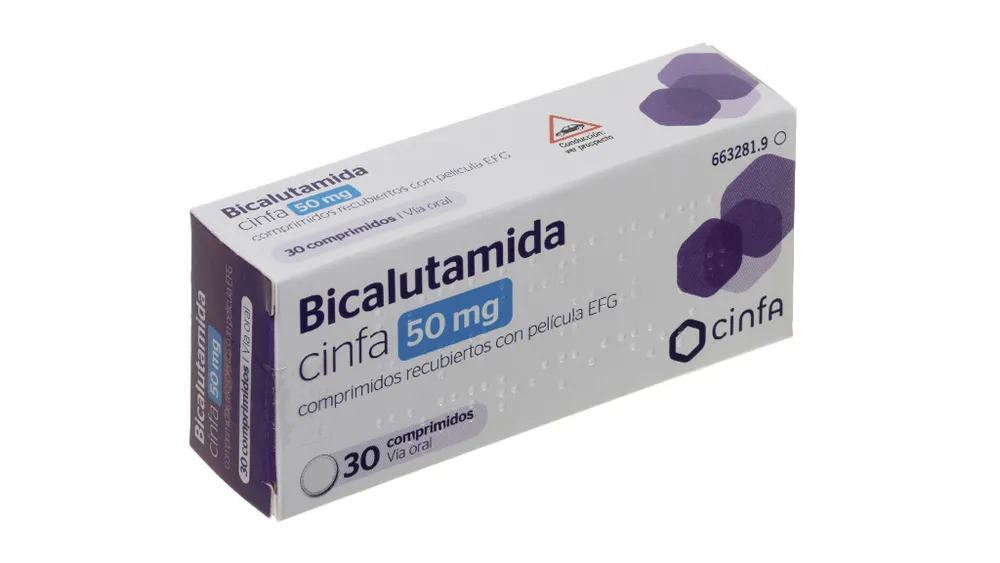
Table of Contents
- Package leaflet: Information for the user
- Introduction
- 1. What bicalutamide cinfa is and what it is used for
- 2. What you need to know before taking bicalutamida cinfa
- 3. How to take bicalutamide cinfa
- 4. Possible adverse effects
- 5. Storage of bicalutamide cinfa
- 6. Contents of the container and other information
Package leaflet: Information for the user
Introduction
Package leaflet: information for the user
bicalutamida cinfa 50 mg film-coated tablets EFG
Read the entire leaflet carefully before you start taking this medicine, because it contains important information for you.
- Keep this leaflet as you may need to read it again.
- If you have any questions, ask your doctor or pharmacist.
- This medicine has been prescribed for you only, and you should not give it to others, even if they have the same symptoms as you, because it could harm them.
- If you experience any adverse reactions, consult your doctor or pharmacist, even if they are adverse reactions not listed in this leaflet. See section 4.
Leaflet contents
- What bicalutamida cinfa is and what it is used for
- What you need to know before taking bicalutamida cinfa
- How to take bicalutamida cinfa
- Possible side effects
- How to store bicalutamida cinfa
- Contents of the pack and other information
1. What bicalutamide cinfa is and what it is used for
Bicalutamide cinfa belongs to a group of medicines called anti-androgens, which means that it interferes with some of the actions of androgens (male sex hormones) in the body.
This medicine is used in the treatment of advanced prostate cancer (50 mg daily dose) in combination with a medicine called luteinizing hormone-releasing hormone (LHRH) analogue—a supplementary hormonal treatment—or together with surgical removal of the testicles.
It is also used in the treatment of non-metastatic prostate cancer in cases where there is a high risk of disease progression (150 mg daily dose). It may be used alone or in combination with other therapeutic methods such as surgical removal of the prostate gland or radiotherapy.
2. What you need to know before taking bicalutamida cinfa
Do not take bicalutamida cinfa
- If you are allergic to bicalutamide or any of the other ingredients of this medicine (listed in section 6).
- If you are a woman.
- If you are taking terfenadine or astemizole, used to treat allergies, or cisapride, used to treat heartburn and acid reflux.
Bicalutamide must not be administered to children and adolescents under 18 years of age.
Warnings and precautions
Talk to your doctor or pharmacist before taking bicalutamida cinfa:
- If you have any liver disorder or disease. This medicine should only be taken after your doctor has carefully considered the potential benefits and risks. In such cases, your doctor should regularly perform liver function tests. Deaths (severe liver changes and liver failure) have been reported.
- If you have a lung inflammation called interstitial lung disease. Symptoms may include severe shortness of breath with cough or fever. Deaths have been reported.
- If you are taking any medicines, including those obtained without a prescription. Especially if you are taking medicines that thin the blood or medicines to prevent blood clots.
- If you have diabetes. Combined treatment with bicalutamide and LHRH analogues may alter your blood sugar levels. Your doctor must adjust your insulin and/or antidiabetic medication dose.
- If you have severe kidney problems. Caution is necessary, as there is no experience with the use of bicalutamide in such cases.
- If you are taking a daily dose of 150 mg of bicalutamide and have heart disease. Your doctor may choose to periodically check your heart function.
Inform your doctor if you have any heart or blood vessel condition or are being treated for such conditions, including medications to control heart rhythm (arrhythmias). The risk of heart rhythm problems may increase when bicalutamide is used.
If any of the above situations apply to you, inform your doctor, who will take them into account during your treatment with bicalutamide.
If you are admitted to hospital, inform healthcare staff that you are taking bicalutamide.
If you are taking bicalutamide, you and/or your partner must use a contraceptive method while you are on treatment with bicalutamide and for 130 days after stopping treatment. Consult your doctor if you have any questions about contraceptive methods.
Children and adolescents
Bicalutamide must not be administered to children and adolescents under 18 years of age.
Other medicines and bicalutamida cinfa
Tell your doctor or pharmacist if you are taking, have recently taken or might need to take any other medicines, including those obtained without a prescription and herbal medicines.
Do not take bicalutamide together with the following medicines:
- Terfenadine or astemizole (for hay fever or allergies).
- Cisapride (for stomach disorders).
If you take bicalutamide together with any of the following medicines, the effect of these medicines and/or bicalutamide may be affected. Consult your doctor before taking any of the following medicines together with bicalutamide:
- In particular, inform your doctor if you are taking blood-thinning medicines such as warfarin.
- Cyclosporine (used to suppress the immune system to prevent and treat rejection of organ or bone marrow transplants).
- Midazolam (a medicine used to relieve anxiety before surgery or certain procedures, or as an anaesthetic before and during surgery).
- Calcium channel blockers (e.g., diltiazem or verapamil). These medicines are used to treat high blood pressure or certain heart conditions.
- Cimetidine (to treat stomach ulcers).
- Ketoconazole (used to treat fungal infections of the skin and nails).
Bicalutamide may interfere with some medicines used to treat heart rhythm problems (e.g., quinidine, procainamide, amiodarone, and sotalol) or may increase the risk of heart rhythm problems when used with other medicines (e.g., methadone (used for pain relief and detoxification from other drugs), moxifloxacin (an antibiotic), antipsychotics used to treat serious mental illnesses).
Please note that these warnings may also apply to medicines you have taken some time ago.
Pregnancy, breast-feeding and fertility
If you are pregnant or breast-feeding, think you may be pregnant or plan to become pregnant, consult your doctor or pharmacist before using this medicine.
Bicalutamide must not be taken by women, including pregnant women or breastfeeding mothers.
Bicalutamide may have an effect on male fertility which may be reversible.
Driving and using machines
Bicalutamide may make you feel drowsy, so you should be cautious when driving or operating machinery.
bicalutamida cinfa contains lactose
This medicine contains lactose. If your doctor has told you that you have an intolerance to certain sugars, consult with him before taking this medicine.
bicalutamida cinfa contains sodium
This medicine contains less than 23 mg of sodium (1 mmol) per tablet; this is essentially “sodium-free”.
3. How to take bicalutamide cinfa
Follow exactly the instructions given by your doctor or pharmacist for taking this medicine. If in doubt, consult your doctor or pharmacist again.
- The recommended dose for adults is 1 tablet daily (equivalent to 50 mg of bicalutamide) or 3 tablets daily (equivalent to 150 mg of bicalutamide).
- Swallow the tablet(s) whole with water.
- Try to take the tablet(s) at the same time each day.
For patients with non-metastatic prostate cancer who are at high risk of disease progression, the recommended dose is 3 tablets daily (equivalent to 150 mg of bicalutamide).
If you take more bicalutamide cinfa than you should
If you ingest more than the prescribed dose, contact your doctor or nearest hospital.
In case of overdose or accidental ingestion, contact your doctor or pharmacist immediately, or call the Toxicology Information Service at telephone number 91 562 04 20, indicating the medicine and the amount ingested.
If you forget to take bicalutamide cinfa
Do not take a double dose to make up for missed doses. Simply continue with your regular treatment schedule.
If you stop taking bicalutamide cinfa
Do not stop taking this medicine even if you feel well, unless your doctor advises otherwise.
If you have any further questions about the use of this medicine, ask your doctor or pharmacist.
4. Possible adverse effects
Like all medicines, this medicine can cause adverse effects, although not everyone experiences them.
If you notice any of the following symptoms, contact your doctor immediately or go to the nearest hospital emergency department. These adverse effects are very serious.
- Skin rash, severe skin itching (with lumps), hives, skin peeling, or formation of blisters or crusts.
- Swelling of the face or neck, lips, tongue and/or throat, which may cause difficulty breathing or swallowing.
- Difficulty breathing or sudden worsening of breathing problems, possibly with cough or fever. These may be signs of interstitial lung disease.
- Blood in the urine.
- Abdominal pain.
- Yellowing of the skin and eyes (jaundice). These may be symptoms of liver damage.
Other possible adverse effects of this medicine are:
Very common (may affect more than 1 in 10 patients):
- Anaemia.
- Dizziness.
- Abdominal pain, constipation, nausea (feeling sick).
- Hot flush.
- Blood in the urine.
- Skin rash.
- Weakness, swelling.
- Breast enlargement and breast tenderness. Breast enlargement may not resolve spontaneously after stopping treatment, particularly after prolonged therapy.
Common (may affect up to 1 in 10 patients):
- Weight gain.
- Drowsiness.
- Heart attack (fatal cases have been reported), heart failure.
- Indigestion, flatulence (gas).
- Hair loss (alopecia), excessive hair growth/regrowth of hair, dry skin, itching.
- Loss of appetite.
- Chest pain.
- Liver toxicity, elevated transaminase levels (liver enzymes), jaundice (yellowing of skin and eyes).
- Erectile dysfunction.
- Decreased libido.
- Depression.
Uncommon (may affect up to 1 in 100 patients):
- Interstitial lung disease (a lung inflammation). Fatal cases have been reported.
- Allergic reactions (hypersensitivity), skin swelling, urticaria.
Rare (may affect up to 1 in 1,000 patients):
- Liver failure. Fatal cases have been reported.
- Increased sensitivity to sunlight.
Frequency not known (cannot be estimated from available data):
- Changes in electrocardiogram (ECG) (prolongation of QT interval).
Reporting of adverse effects
If you experience any type of adverse effect, talk to your doctor or pharmacist, even if it is a possible adverse effect not listed in this leaflet. You can also report them directly via the Spanish Pharmacovigilance System for Human Medicinal Products: https://www.notificaram.es. By reporting adverse effects, you can help provide more information on the safety of this medicine.
5. Storage of bicalutamide cinfa
Keep this medicine out of the sight and reach of children.
Do not use this medicine after the expiry date stated on the packaging after EXP. The expiry date refers to the last day of the month indicated.
This medicine does not require any special storage conditions.
Medicines must not be disposed of via wastewater or household waste. Dispose of empty containers and unused medicines at the SIGRE Point in your pharmacy. If in doubt, ask your pharmacist how to dispose of containers and medicines you no longer need. This will help protect the environment.
6. Contents of the container and other information
Composition of bicalutamide cinfa
- The active substance is bicalutamide. Each tablet contains 50 mg of bicalutamide.
- The other components are:
Tablet core: lactose monohydrate, povidone, crospovidone, sodium lauryl sulfate, magnesium stearate, and purified water.
Tablet coating: lactose monohydrate, hypromellose, titanium dioxide, macrogol 4000, and purified water.
Appearance of the product and contents of the container
bicalutamide cinfa is presented as film-coated white, cylindrical, biconvex tablets. One side is marked with "BCM 50".
Each pack contains 30 or 100 tablets (clinical pack) in PVC/PE/PVDC/Aluminum blisters.
Only certain pack sizes may be commercially available.
Marketing Authorization Holder and Manufacturer
Marketing Authorization Holder
Laboratorios Cinfa, S.A.
Carretera Olaz-Chipi, 10. Polígono Industrial Areta
31620 Huarte (Navarra) - Spain
Manufacturer
SYNTHON BV Microweg,
22, P.O.Box 7071 (Nijmegen) - NL-6545 - The Netherlands
Synthon Hispania S.L.
Castelló, 1 Polígono Las Salinas 08830 Sant Boi de Llobregat Spain
Laboratorios Cinfa, S.A.
Carretera Olaz-Chipi, 10. Polígono Industrial Areta
31620 Huarte (Navarra) - Spain
Date of the most recent revision of this leaflet: May 2021
Detailed information on this medicinal product is available on the website of the Spanish Agency of Medicines and Health Products (AEMPS) http://www.aemps.gob.es
You can access detailed and up-to-date information about this medicine by scanning with your mobile phone (smartphone) the QR code included in the package leaflet and packaging. You can also access this information at the following internet address: https://cima.aemps.es/cima/dochtml/p/68818/P_68818.html
QR code to: https://cima.aemps.es/cima/dochtml/p/68818/P_68818.html