Betmiga 50 mg prolonged-release tablets
Spain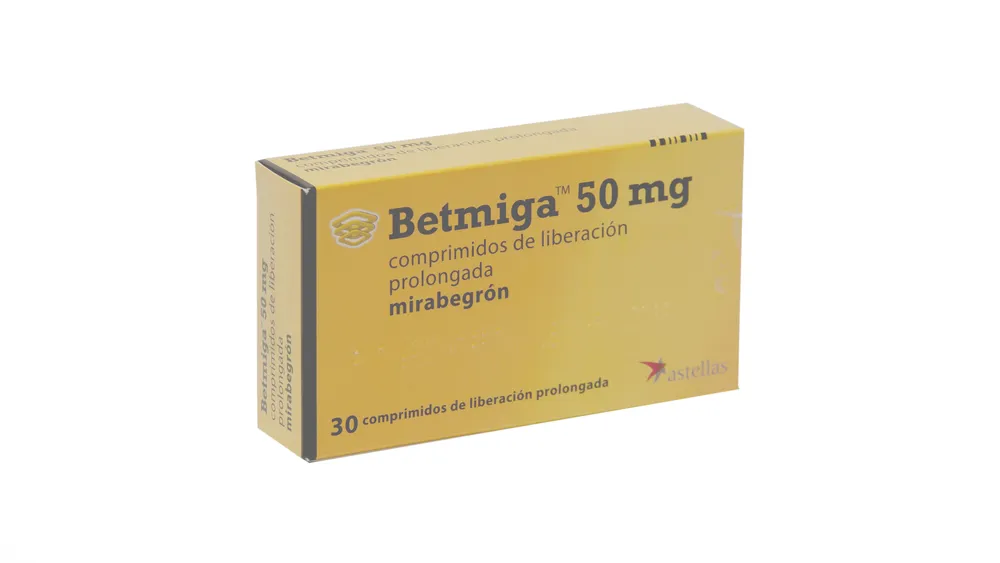
Table of Contents
Package leaflet: Information for the user
Introduction
Package leaflet: information for the user
Betmiga 25mg prolonged-release tablets
Betmiga 50mg prolonged-release tablets
mirabegron
Read the entire leaflet carefully before you start using this medicine, because it contains important information for you.
- Keep this leaflet. You may need to read it again.
- If you have any questions, ask your doctor or pharmacist.
- This medicine has been prescribed for you only. Do not give it to other people, even if they have the same symptoms as you, because it may harm them.
- If you experience any adverse reactions, consult your doctor or pharmacist, even if they are adverse reactions not listed in this leaflet. See section 4.
Leaflet contents
- What Betmiga is and what it is used for
- What you need to know before taking Betmiga
- How to take Betmiga
- Possible side effects
- How to store Betmiga
- Contents of the pack and other information
1. What Betmiga is and what it is used for
Betmiga contains the active substance mirabegron. It is a medicine that relaxes the smooth muscle of the bladder (known as a beta3 adrenergic receptor agonist), which reduces symptoms associated with overactive bladder and reduces neurogenic detrusor overactivity.
Betmiga is used to:
- treat the symptoms of a condition called overactive bladder in adults.
These symptoms include: a sudden need to empty your bladder (called urgency), needing to empty your bladder more often than normal (called increased urinary frequency), and being unable to control when you empty your bladder (called urgency incontinence).
- treat a condition called neurogenic detrusor overactivity in children aged 3 to less than 18 years. Neurogenic detrusor overactivity is a condition in which involuntary bladder contractions occur due to a birth disorder or injury affecting the nerves that control the bladder. If left untreated, neurogenic detrusor overactivity can cause damage to the bladder and/or kidneys. Betmiga is used to increase the amount of urine the bladder can hold and to reduce urine leakage.
2. What you need to know before taking Betmiga
Do not take Betmiga:
- if you are allergic to mirabegron or to any of the other ingredients of this medicine (listed in section 6);
- if you have uncontrolled high blood pressure.
Warnings and precautions
Talk to your doctor or pharmacist before taking Betmiga
-
if you have difficulty emptying your bladder or have a weak urine stream, or if you are taking other medicines for overactive bladder or neurogenic detrusor overactivity, such as anticholinergic medicines;
-
if you have kidney or liver problems. Your doctor may need to reduce your dose or may advise you not to take Betmiga, especially if you are taking other medicines such as itraconazole, ketoconazole (for fungal infections), ritonavir (for HIV/AIDS), or clarithromycin (for bacterial infections). Inform your doctor about all the medicines you are taking;
-
if you have a known abnormality in your ECG (heart test), such as QT interval prolongation, or if you are taking any medicines known to cause such abnormalities, such as:
-
medicines used for heart rhythm disorders, for example quinidine, sotalol, procainamide, ibutilide, flecainide, dofetilide, and amiodarone;
-
medicines used for allergic rhinitis;
-
antipsychotic medicines (medicines for mental illnesses), such as thioridazine, mesoridazine, haloperidol, and chlorpromazine;
-
anti-infective agents, such as pentamidine, moxifloxacin, erythromycin, and clarithromycin.
Betmiga may cause your blood pressure to increase or worsen if you have a history of high blood pressure. Your doctor should monitor your blood pressure while you are taking this medicine.
Children and adolescents
Do not give this medicine to children and adolescents under 18 years of age for the treatment of overactive bladder, as the safety and efficacy of Betmiga in this population have not been established.
Betmiga must not be used in children under 3 years of age for the treatment of neurogenic detrusor overactivity.
Other medicines and Betmiga
Tell your doctor or pharmacist if you are taking, have recently taken, or might need to take any other medicines.
Betmiga may affect how other medicines work, and other medicines may affect how Betmiga works.
- Inform your doctor if you are taking thioridazine (a medicine for mental illnesses), propafenone, or flecainide (medicines for heart rhythm disorders), or imipramine or desipramine (medicines used for depression). Your doctor may need to adjust the dose of these specific medicines.
- Inform your doctor if you are taking digoxin (a medicine for heart failure or heart rhythm disorders). Your doctor will monitor blood levels of this medicine. If the blood level is outside the recommended range, your doctor will adjust the dose of digoxin.
- Inform your doctor if you are taking dabigatran etexilate (a medicine used to reduce the risk of stroke or systemic embolism due to blood clots in patients with irregular heartbeat (atrial fibrillation) and additional risk factors). Your doctor may need to adjust the dose of this medicine.
Pregnancy and breastfeeding
If you are pregnant, think you may be pregnant, or are planning to become pregnant, you must not take Betmiga.
If you are breastfeeding, consult your doctor or pharmacist before using this medicine. This medicine may pass into breast milk. You and your doctor will need to decide whether to take Betmiga or breastfeed. Do not do both.
Driving and using machines
There is no information suggesting that this medicine affects your ability to drive or use machines.
3. How to take Betmiga
Follow exactly the instructions for using this medicine as given by your doctor. If in doubt, consult your doctor or pharmacist again.
Use in adults with overactive bladder
The recommended dose is one 50 mg tablet taken orally once daily. If you have kidney or liver problems, your doctor may need to reduce your dose to one 25 mg tablet taken orally once daily. Take this medicine with liquid and swallow the tablet whole. Do not crush or chew the tablet. Betmiga may be taken with or without food.
Use in children and adolescents (aged between 3 and under 18 years) with neurogenic detrusor overactivity
Take this medicine orally once daily. Take the medicine with liquid and swallow the tablet whole. Do not crush or chew the tablet. Betmiga should be taken with food. Your doctor will tell you what dose your child should take. The doctor will calculate the correct dose for the patient based on body weight. You must follow these instructions carefully.
If you take more Betmiga than you should
If you have taken more tablets than prescribed, or if someone has accidentally taken your tablets, contact your doctor, pharmacist, or hospital immediately.
Symptoms of overdose may include strong heartbeat, increased pulse rate, and elevated blood pressure.
If you forget to take Betmiga
If you forget to take your medicine, take the missed dose as soon as you remember. If less than 12 hours remain before your next scheduled dose, skip the missed dose and continue taking the medicine at your usual time.
Do not take a double dose to make up for a missed dose. If you miss several doses, consult your doctor and follow their advice.
If you stop taking Betmiga
Do not stop treatment with Betmiga prematurely if you do not see an immediate effect. Your bladder may need time to adjust. You should continue taking your tablets. Do not stop taking them when your bladder condition improves. Stopping treatment may lead to a recurrence of symptoms of overactive bladder or neurogenic detrusor overactivity.
Do not stop taking Betmiga without first consulting your doctor, as symptoms of overactive bladder or neurogenic detrusor overactivity may return.
If you have any further questions about the use of this medicine, ask your doctor or pharmacist.
4. Possible adverse effects
Like all medicines, this medicine can cause adverse effects, although not everyone experiences them.
The most serious adverse effects may include irregular heartbeat (atrial fibrillation). This is an uncommon adverse effect (may affect up to 1 in 100 people), but if this adverse effect occurs, stop taking the medicine immediately and seek urgent medical advice.
Consult your doctor if you experience headache, especially if sudden in onset, or migraine-type headache (palpitations). These may be signs of very high blood pressure.
Other adverse effects include:
Common (may affect up to 1 in 10 people)
- Infection of the structures carrying urine (urinary tract infections)
- Headache
- Dizziness
- Increased heart rate (tachycardia)
- Feeling of nausea (nausea)
- Constipation
- Diarrhea
Uncommon (may affect up to 1 in 100 people)
- Vaginal infection
- Bladder infection (cystitis)
- Awareness of heartbeats (palpitations)
- Problems with heart rhythm (atrial fibrillation)
- Indigestion (dyspepsia)
- Stomach infection (gastritis)
- Itching, rash, or hives (urticaria, rash, macular rash, papular rash, pruritus)
- Swelling of the joints
- Itching of the vulva or vagina (vulvovaginal pruritus)
- Increased blood pressure
- Increased liver enzymes (GGT, AST and ALT)
Rare (may affect up to 1 in 1,000 people)
- Swelling of the eyelids (eyelid edema)
- Swelling of the lips (lip edema)
- Inflammation of small blood vessels mainly affecting the skin (leukocytoclastic vasculitis)
- Small purple-colored spots on the skin (purpura)
- Swelling of the deeper layers of the skin caused by fluid accumulation, which may affect any part of the body including the face, tongue or throat, and which may cause difficulty breathing (angioedema)
- Inability to completely empty the bladder (urinary retention)
Very rare (may affect up to 1 in 10,000 people)
- Very high blood pressure (hypertensive crisis)
Frequency not known (frequency cannot be estimated from the available data)
- Insomnia
- Confusion
Betmiga may increase the possibility of being unable to empty your bladder if you have an obstruction of the bladder outlet or if you are taking other medicines for overactive bladder. Inform your doctor immediately if you are unable to empty your bladder.
Reporting of adverse effects
If you experience any adverse effect, talk to your doctor or pharmacist, even if it is a possible adverse effect not listed in this leaflet. You can also report them directly through the national reporting system included in Appendix V. By reporting adverse effects, you can help provide more information on the safety of this medicine.
5. Storage of Betmiga
Keep this medicine out of the sight and reach of children.
Do not use this medicine after the expiry date which is stated on the carton or blister after EXP. The expiry date refers to the last day of the month indicated.
This medicine does not require any special storage conditions.
Medicines should not be disposed of via wastewater or household waste. Ask your pharmacist how to dispose of medicines and packaging you no longer need. This will help protect the environment.
6. Contents of the pack and other information
Composition of Betmiga
- The active substance is mirabegron.
Betmiga 25 mg prolonged-release tablets
Each tablet contains 25 mg of mirabegron.
Betmiga 50 mg prolonged-release tablets
Each tablet contains 50 mg of mirabegron.
- The other components are:
Tablet core: macrogols, hypromellose, butylhydroxytoluene, magnesium stearate
Coating: hypromellose, macrogol, yellow iron oxide (E172), red iron oxide (E172) (only in 25 mg tablets).
Nature of the product and contents of the container
Betmiga 25 mg prolonged-release film-coated tablets are brown, oval-shaped, film-coated tablets, marked with the company logo and "325" on one side.
Betmiga 50 mg prolonged-release film-coated tablets are yellow, oval-shaped, film-coated tablets, marked with the company logo and "355" on one side.
Betmiga is available in aluminium-aluminium blister packs containing 10, 20, 30, 50, 60, 90, 100 or 200 tablets.
Only certain pack sizes may be marketed in your country.
Marketing Authorisation Holder
Astellas Pharma Europe B.V.
Sylviusweg 62
2333 BE Leiden
The Netherlands
Manufacturer
Delpharm Meppel B.V.
Hogemaat 2
7942 JG Meppel
The Netherlands
For further information about this medicinal product, please contact the local representative of the Marketing Authorisation Holder:
Belgium/Belgium/Belgium Astellas Pharma B.V. Branch Tel/Tel: + 32 (0)2 5580710 | Lithuania Astellas Pharma d.o.o. Tel: + 370 37 408 681 |
| Luxembourg/Luxembourg Astellas Pharma B.V. Branch Belgium/Belgium Tel/Tel: + 32 (0)2 5580710 |
| Hungary Astellas Pharma Kft. Tel.: + 36 1 577 8200 |
Denmark Astellas Pharma a/s Tlf.: + 45 43 430355 | Malta Astellas Pharmaceuticals AEBE Tel: + 30 210 8189900 |
Germany Astellas Pharma GmbH Tel: + 49 (0)89 454401 | Netherlands Astellas Pharma B.V. Tel: + 31 (0)71 5455745 |
Estonia Astellas Pharma d.o.o. Tel: + 372 6 056 014 | Norway Astellas Pharma Tlf: + 47 66 76 46 00 |
| Austria Astellas Pharma Ges.m.b.H. Tel: + 43 (0)1 8772668 |
Spain Astellas Pharma S.A. Tel: + 34 91 4952700 | Poland Astellas Pharma Sp.z.o.o. Tel.: + 48 225451 111 |
France Astellas Pharma S.A.S. Tél: + 33 (0)1 55917500 | Portugal Astellas Farma, Lda. Tel: + 351 21 4401300 |
Croatia Astellas d.o.o. Tel: + 385 1670 0102 | Romania S.C. Astellas Pharma SRL Tel: + 40 (0)21 361 04 95 |
Ireland Astellas Pharma Co. Ltd. Tel: + 353 (0)1 4671555 | Slovenia Astellas Pharma d.o.o. Tel: + 386 14011400 |
Iceland Vistor Sími: + 354 535 7000 | Slovakia Astellas Pharma s.r.o. Tel: + 421 2 4444 2157 |
| Sweden Astellas Pharma AB Tel: + 46 (0)40-650 15 00 |
Latvia Astellas Pharma d.o.o. Tel: + 371 67 619365 | |
Date of the most recent review of this summary: .
Detailed information on this medicine is available on the European Medicines Agency website: https://www.ema.europa.eu.