Besponsa 1 mg powder for concentrate for solution for infusion
Spain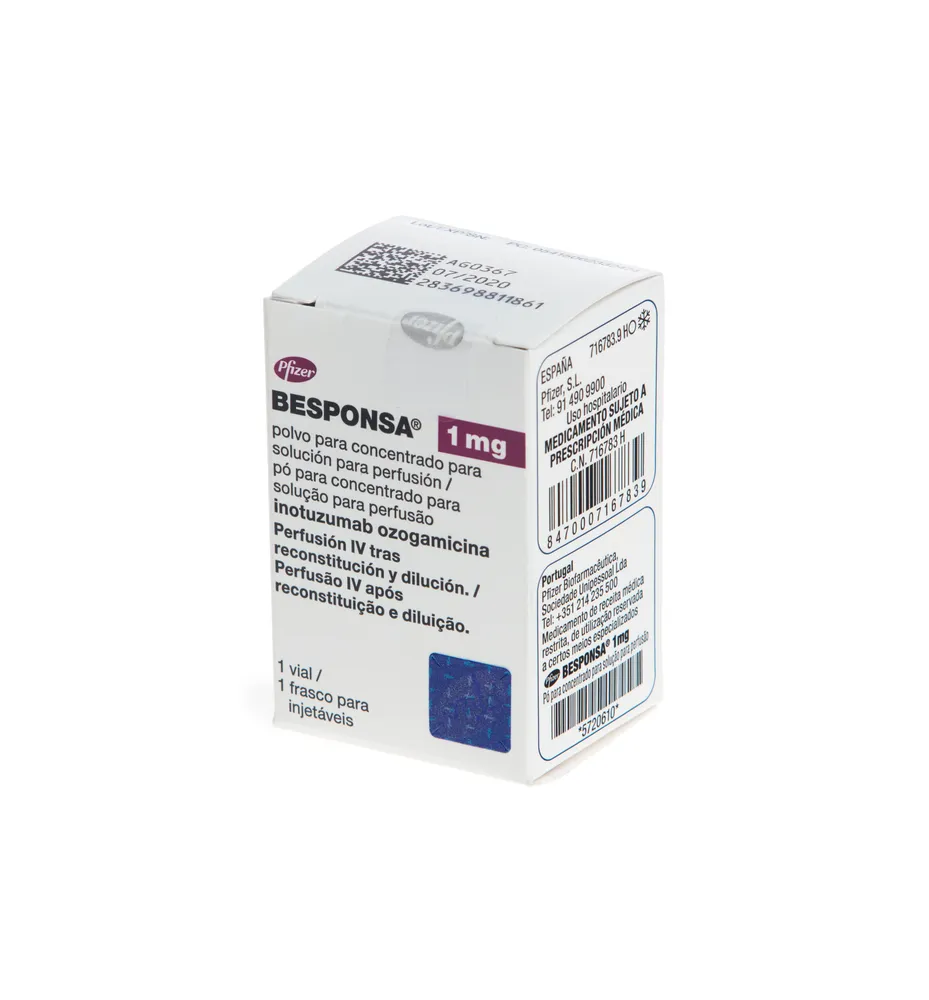
Table of Contents
Package leaflet: Information for the user
Introduction
Package leaflet: information for the user
BESPONSA 1 mg powder for concentrate for solution for infusion
inotuzumab ozogamicin
Read all of this leaflet carefully before you start using this medicine, because it contains important information for you.
- Keep this leaflet; you may need to read it again.
- If you have any questions, ask your doctor, pharmacist or nurse.
- If you get any side effects, talk to your doctor, pharmacist or nurse. This includes any possible side effects not listed in this leaflet. See section 4.
Contents of this leaflet
- What BESPONSA is and what it is used for
- What you need to know before you are given BESPONSA
- How BESPONSA is given
- Possible side effects
- How to store BESPONSA
- Contents of the pack and other information
1. What BESPONSA is and what it is used for
The active substance in BESPONSA is inotuzumab ozogamicin. It belongs to a group of medicines that target cancer cells. These medicines are called antineoplastic agents.
BESPONSA is used for the treatment of adults with acute lymphoblastic leukaemia. Acute lymphoblastic leukaemia is a blood cancer in which there is an excessive number of white blood cells. BESPONSA is intended for the treatment of acute lymphoblastic leukaemia in adult patients whose previous treatments have failed.
BESPONSA works by binding to cells that have a protein called CD22. Acute lymphoblastic leukaemia cells have this protein. Once attached to the leukaemia cells, the medicine releases a substance inside the cells that interferes with the cells' DNA and destroys them.
2. What you need to know before you are given BESPONSA
Do not use BESPONSA
- if you are allergic to inotuzumab ozogamicin or to any of the other ingredients of this medicine (listed in section 6).
- if you have previously had confirmed severe veno-occlusive disease (a condition in which the blood vessels of the liver become damaged and blocked by blood clots) or currently have veno-occlusive disease.
- if you have severe liver disease, for example, cirrhosis (a condition in which the liver does not function properly due to long-term injury), nodular regenerative hyperplasia (a condition with signs and symptoms of portal hypertension that may be caused by chronic use of medications), or active hepatitis (a disease characterized by inflammation of the liver).
Warnings and precautions
Talk to your doctor, pharmacist, or nurse before starting BESPONSA if:
- you have a history of liver problems or liver disease, or if you have signs and symptoms of a serious condition called hepatic veno-occlusive disease, a condition in which the blood vessels of the liver become damaged and blocked by blood clots. Veno-occlusive disease can be fatal and is associated with rapid weight gain, pain in the upper right side of the abdomen (stomach), enlarged liver, fluid accumulation causing abdominal swelling, and blood tests showing elevated bilirubin and/or liver enzymes (which may cause yellowing of the skin and eyes). This condition may occur during treatment with BESPONSA or after subsequent stem cell transplant treatment. Stem cell transplant is a procedure to transplant stem cells (cells that develop into new blood cells) from another person into your bloodstream. This procedure may be performed if your disease completely responds to treatment.
- you have signs or symptoms of low blood cell counts known as neutrophils (sometimes accompanied by fever), red blood cells, white blood cells, lymphocytes, or low levels of blood components known as platelets; these signs and symptoms include developing an infection or fever, easy bruising, or frequent nosebleeds.
- you experience signs and symptoms of an infusion-related reaction, such as fever and chills or difficulty breathing during or shortly after the infusion of BESPONSA.
- you experience signs and symptoms of tumor lysis syndrome, which may include gastrointestinal symptoms (e.g., nausea, vomiting, diarrhea), heart symptoms (e.g., changes in heart rhythm), kidney symptoms (e.g., decreased urine output, blood in urine), and nerve and muscle symptoms (e.g., muscle spasms, weakness, cramps) during or shortly after the infusion of BESPONSA.
- you have a history or predisposition to QT interval prolongation (a change in the heart's electrical activity that may cause serious irregular heart rhythms), are taking medications known to prolong the QT interval, and/or have abnormal electrolyte levels (e.g., calcium, magnesium, potassium).
- you have elevated amylase or lipase enzyme levels, which may indicate problems with your pancreas or liver, gallbladder, or bile ducts.
Immediately inform your doctor, pharmacist, or nurse if you become pregnant during treatment with BESPONSA and for up to 8 months after completing treatment.
Your doctor will perform periodic blood tests to monitor your blood counts during treatment with BESPONSA. See also section 4.
During treatment, especially in the first few days after starting treatment, your white blood cell count (neutrophils) may drop severely (neutropenia), which may be accompanied by fever (febrile neutropenia).
During treatment, especially in the first few days after starting treatment, your liver enzymes may become elevated. Your doctor will perform periodic blood tests to monitor your liver enzymes during treatment with BESPONSA.
Treatment with BESPONSA may prolong the QT interval (a change in the heart's electrical activity that may lead to serious irregular heart rhythms). Your doctor will perform an electrocardiogram (ECG) and blood tests to measure electrolytes (e.g., calcium, magnesium, potassium) before your first dose of BESPONSA and repeat them during treatment. See also section 4.
Your doctor will also monitor you for signs and symptoms of tumor lysis syndrome after administration of BESPONSA. See also section 4.
Children and adolescents
BESPONSA should not be used in children and adolescents under 18 years of age, as there is no available data in this population.
Other medicines and BESPONSA
Tell your doctor or pharmacist if you are taking, have recently taken, or might need to take any other medicines. This includes medicines obtained without a prescription and herbal (medicinal plant) remedies.
Pregnancy, breastfeeding, and fertility
If you are pregnant or breastfeeding, think you may be pregnant, or plan to become pregnant, consult your doctor or nurse before using this medicine.
Contraception
Avoid becoming pregnant or fathering a child. Women must use effective contraception during treatment and for at least 8 months after the last dose. Men must use effective contraception during treatment and for at least 5 months after the last dose of treatment.
Pregnancy
The effects of BESPONSA in pregnant women are unknown, but based on its mechanism of action, BESPONSA may harm the unborn baby. Do not use BESPONSA during pregnancy unless your doctor considers it the most appropriate treatment for you.
Contact your doctor immediately if you or your partner becomes pregnant during treatment with this medicine.
Fertility
Men and women should seek information about fertility preservation before starting treatment.
Breastfeeding
If you require treatment with BESPONSA, you must stop breastfeeding during treatment and for at least 2 months after treatment. Consult your doctor.
Driving and use of machines
If you feel abnormally tired (this is a very common side effect of BESPONSA), you should not drive or operate machinery.
BESPONSA contains sodium
This medicine contains less than 1 mmol of sodium (23 mg) per 1 mg of inotuzumab ozogamicin; hence, it is essentially "sodium-free".
3. How BESPONSA is administered
Follow exactly the instructions for administering this medicine as given by your doctor, pharmacist, or nurse. If in doubt, consult your doctor, pharmacist, or nurse again.
How BESPONSA is administered
-
Your doctor will decide the correct dose.
-
A doctor or nurse will administer BESPONSA to you through an intravenous infusion (a drip into a vein) lasting 1 hour.
-
Each dose is given weekly, and each treatment cycle consists of 3 doses.
-
If the medicine is working well and you are going to receive a stem cell transplant (see section 2), you may receive 2 cycles or up to a maximum of 3 cycles of treatment.
-
If the medicine is working well but you are not going to receive a stem cell transplant (see section 2), you may receive up to a maximum of 6 cycles of treatment.
-
If you do not respond to the medicine after 3 cycles, treatment will be stopped.
-
Your doctor may adjust the dose, interrupt, or completely discontinue treatment with BESPONSA if you experience certain adverse reactions.
-
Your doctor may reduce the dose depending on your response to treatment.
-
Your doctor will perform blood tests during treatment to monitor for adverse effects and to check your response to treatment.
If you have any further questions about the use of this medicine, ask your doctor, pharmacist, or nurse.
Medicines administered before BESPONSA treatment
Before treatment with BESPONSA, you will be given other medicines (premedication) to reduce infusion reactions and other possible adverse effects. These medicines may include corticosteroids (e.g., dexamethasone), antipyretics (medicines to reduce fever), and antihistamines (medicines to reduce allergic reactions).
Before your BESPONSA treatment, you may also be given medicines and fluids to prevent tumor lysis syndrome. Tumor lysis syndrome is associated with a range of symptoms affecting the stomach and intestines (e.g., nausea, vomiting, diarrhea), heart (e.g., changes in heart rhythm), kidneys (e.g., reduced urine output, blood in urine), and nerves and muscles (e.g., muscle spasms, weakness, cramps).
4. Possible adverse effects
Like all medicines, this medicine can cause adverse effects, although not everyone experiences them. Some of these adverse effects may be very serious.
Tell your doctor immediately if you have signs and symptoms of any of the following serious adverse effects:
- reactions related to infusion (see section 2); signs and symptoms include fever and chills during or shortly after BESPONSA infusion.
- hepatic veno-occlusive disease (see section 2); signs and symptoms include rapid weight gain, pain in the upper right side of the abdomen, enlargement of the liver, fluid accumulation causing swelling in the abdomen, and elevated bilirubin and/or liver enzymes (which may result in a yellowish discoloration of the skin and eyes).
- low number of blood cells known as neutrophils (sometimes accompanied by fever), red blood cells, white blood cells, lymphocytes, or a low number of blood components known as platelets (see section 2); signs and symptoms include development of infection or fever, easy bruising, or frequent nosebleeds.
- tumor lysis syndrome (see section 2); which may be associated with gastrointestinal symptoms (e.g., nausea, vomiting, diarrhea), heart (e.g., changes in heart rhythm), kidneys (e.g., decreased urine output, blood in urine), and nerves and muscles (e.g., muscle spasms, weakness, cramps).
- QT interval prolongation (see section 2); signs and symptoms include a change in the heart's electrical activity that may cause serious irregular heartbeats. Inform your doctor if you experience symptoms such as dizziness, lightheadedness, or fainting.
Other adverse effects may include:
Very common: may affect more than 1 in 10 people
- infections
- reduced number of white blood cells, which may lead to general weakness and increase the risk of infections
- reduced number of lymphocytes (a type of white blood cell), which may increase the risk of infections
- reduced number of red blood cells, which may lead to fatigue and shortness of breath
- decreased appetite
- headache
- bleeding
- abdominal pain
- vomiting
- diarrhea
- nausea
- inflammation of the mouth
- constipation
- increased bilirubin levels, which may result in yellowish discoloration of the skin, eyes, and other tissues
- fever
- chills
- tiredness
- elevated blood levels of liver enzymes (which may indicate liver damage)
Common: may affect up to 1 in 10 people
- reduction in the number of several types of blood cells
- excess uric acid in the blood
- excessive accumulation of fluid in the abdomen
- inflammation of the abdomen
- changes in heart rhythm (may appear on electrocardiogram)
- abnormally high blood levels of amylase (an enzyme necessary for digestion and conversion of starch into sugars)
- abnormally high blood levels of lipase (an enzyme necessary for processing dietary fat)
- hypersensitivity
Reporting of adverse effects
If you experience any adverse effect, consult your doctor, pharmacist, or nurse, even if it is a possible adverse effect not listed in this leaflet. You may also report them directly via the Spanish Pharmacovigilance System for Human Medicinal Products: www.notificaRAM.es. By reporting adverse effects, you can help provide more information on the safety of this medicine.
5. Storage of BESPONSA
Keep this medicine out of the sight and reach of children.
Do not use this medicine after the expiry date stated on the vial label and the carton after EXP. The expiry date refers to the last day of the month indicated.
Unopened vial
- Store in a refrigerator (between 2 °C and 8 °C).
- Keep in the original packaging to protect from light.
- Do not freeze.
Reconstituted solution
- Use immediately or store in a refrigerator (between 2 °C and 8 °C) for a maximum of 4 hours.
- Protect from light.
- Do not freeze.
Diluted solution
- Use immediately or store at room temperature (between 20 °C and 25 °C) or in a refrigerator (between 2 °C and 8 °C). The total time from reconstitution to the end of administration must not exceed 8 hours, with no more than 4 hours between reconstitution and dilution.
- Protect from light.
- Do not freeze.
Inspect this medicine for particles or discoloration prior to administration. Do not use this medicine if particles or discoloration are observed.
Medicines must not be disposed of via wastewater or household waste. Ask your pharmacist how to dispose of medicines and packaging you no longer need. This will help protect the environment.
6. Contents of the container and other information
Composition of BESPONSA
- The active substance is inotuzumab ozogamicin. Each vial contains 1 mg of inotuzumab ozogamicin. After reconstitution, 1 ml of solution contains 0.25 mg of inotuzumab ozogamicin.
- The other components are sucrose, polysorbate 80, sodium chloride, and trometamol (see section 2).
Appearance of the product and contents of the pack
BESPONSA is a powder for concentrate for solution for infusion (powder for concentrate).
Each pack of BESPONSA contains:
- One glass vial with a white to off-white lyophilized powder or cake.
Marketing Authorization Holder
Pfizer Europe MA EEIG
Boulevard de la Plaine 17
1050 Bruxelles
Belgium
Manufacturer
Pfizer Service Company BV
Hoge Wei 10
B-1930, Zaventem
Belgium
For further information about this medicinal product, please contact the local representative of the Marketing Authorization Holder:
Spain
Pfizer, S.L.
Tel: +34 91 490 99 00
Date of the most recent review of this leaflet:
Other sources of information
Detailed information about this medicinal product is available on the website of the European Medicines Agency: http://www.ema.europa.eu/. Links to other websites on rare diseases and orphan medicinal products are also available.
This package leaflet is available on the European Medicines Agency website in all languages of the European Union/European Economic Area.
This information is intended for healthcare professionals only. Please consult the complete information on dosage and dose modifications in the Summary of Product Characteristics.
Method of administration
BESPONSA is administered intravenously. The infusion should be given over 1 hour.
Do not administer BESPONSA as a rapid intravenous injection or bolus.
BESPONSA must be reconstituted and diluted prior to administration.
BESPONSA should be administered in cycles of 3 to 4 weeks.
For patients undergoing hematopoietic stem cell transplantation (HSCT), the recommended duration of treatment is 2 cycles. A third cycle may be considered for patients who have not achieved CR/CRi and MRD negativity after 2 cycles. For patients not undergoing HSCT, up to a maximum of 6 cycles may be administered. Patients who do not achieve CR/CRi after 3 cycles should discontinue treatment (see section 4.2 of the Summary of Product Characteristics).
The table below shows the recommended dosing regimens.
For the first cycle, the recommended total dose for all patients is 1.8 mg/m² per cycle, administered in 3 divided doses on days 1 (0.8 mg/m²), 8 (0.5 mg/m²), and 15 (0.5 mg/m²). Cycle 1 is 3 weeks in duration but may be extended up to 4 weeks if the patient achieves CR or CRi, and/or to allow recovery from toxicity.
For subsequent cycles, the recommended total dose is 1.5 mg/m² per cycle administered in 3 divided doses on days 1 (0.5 mg/m²), 8 (0.5 mg/m²), and 15 (0.5 mg/m²) for patients who have achieved CR/CRi, or 1.8 mg/m² per cycle administered in 3 divided doses on days 1 (0.8 mg/m²), 8 (0.5 mg/m²), and 15 (0.5 mg/m²) for patients who have not achieved CR/CRi. Subsequent cycles are 4 weeks in duration.
Dosing schedule for cycle 1 and subsequent cycles depending on treatment response | |||
Day 1 | Day 8 to | Day 15 to | |
Dosing schedule for cycle 1 | |||
All patients: | |||
Dose (mg/m²) | 0.8 | 0.5 | 0.5 |
Cycle duration | 21 daysb | ||
Dosing schedule for subsequent cycles depending on treatment response | |||
Patients who have achieved a CR or CRi: | |||
Dose (mg/m²) | 0.5 | 0.5 | 0.5 |
Cycle duration | 28 dayse | ||
Patients who have not achieved a CR or CRi: | |||
Dose (mg/m²) | 0.8 | 0.5 | 0.5 |
Cycle duration | 28 dayse | ||
Abbreviations: ANC = absolute neutrophil count; CR = complete remission; CRi = complete remission with incomplete hematologic recovery. |
Instructions for reconstitution, dilution and administration
Use appropriate aseptic technique for reconstitution and dilution procedures. Inotuzumab ozogamicin (with a density of 1.02 g/ml at 20 °C) is light-sensitive and must be protected from ultraviolet light during reconstitution, dilution, and administration.
The maximum elapsed time from reconstitution to the end of administration must be ≤ 8 hours, with ≤ 4 hours between reconstitution and dilution.
Reconstitution:
- Calculate the required dose (mg) and the number of BESPONSA vials needed.
- Reconstitute each 1 mg vial with 4 ml of water for injections to obtain a single-use solution of 0.25 mg/ml of BESPONSA.
- Gently swirl the vial to aid dissolution. Do not shake.
- Inspect the reconstituted solution for particles or discoloration. The reconstituted solution should be clear or slightly opalescent, colorless, and practically free from visible foreign matter. Do not use if particles or discoloration are observed.
- BESPONSA contains no bacteriostatic preservatives. The reconstituted solution should be used immediately. If immediate use is not possible, the reconstituted solution may be stored in the refrigerator (between 2 °C and 8 °C) for up to 4 hours. Protect from light and do not freeze.
Dilution:
- Calculate the required volume of reconstituted solution needed to achieve the appropriate dose based on the patient's body surface area. Withdraw this volume from the vial(s) using a syringe. Protect from light. Discard any unused reconstituted solution remaining in the vial.
- Add the reconstituted solution to an infusion container with 9 mg/ml (0.9%) sodium chloride injection solution, to a total nominal volume of 50 ml. The final concentration should be between 0.01 and 0.1 mg/ml. Protect from light. A container made of polyvinyl chloride (PVC) (with or without di(2-ethylhexyl)phthalate [DEHP]), polyolefin (polypropylene and/or polyethylene), or ethylene vinyl acetate (EVA) is recommended.
- Gently invert the infusion container to mix the diluted solution. Do not shake.
- The diluted solution should be used immediately or stored at room temperature (between 20 °C and 25 °C) or in the refrigerator (between 2 °C and 8 °C). The maximum elapsed time from reconstitution to the end of administration must be ≤ 8 hours, with ≤ 4 hours between reconstitution and dilution. Protect from light and do not freeze.
Administration:
- If the diluted solution has been stored in the refrigerator (between 2 °C and 8 °C), allow it to reach room temperature (between 20 °C and 25 °C) for approximately 1 hour before administration.
- Filtration of the diluted solution is not required. However, if filtration is performed, filters made of polyethersulfone (PES), polyvinylidene fluoride (PVDF), or hydrophilic polysulfone (HPS) are recommended. Do not use filters made of nylon or mixed cellulose esters (MCE).
- Protect the intravenous bag from light by covering it with a material that blocks ultraviolet light (e.g., amber, dark brown, or green bags, or aluminum foil) during infusion. The infusion line does not need to be protected from light.
- Infuse the diluted solution over 1 hour at a rate of 50 ml/hour at room temperature (between 2 °C and 25 °C). Protect from light. Infusion sets made of PVC (with or without DEHP), polyolefin (polypropylene and/or polyethylene), or polybutadiene are recommended.
Do not mix BESPONSA or administer it simultaneously by infusion with other medicinal products.
The following are the storage times and conditions for reconstitution, dilution, and administration of BESPONSA.
Storage conditions and times for reconstituted and diluted BESPONSA solution | ||
Maximum time from reconstitution to completion of administration ≤8 hoursa | ||
Reconstituted solution | Diluted solution | |
After start of dilution | Administration | |
Use the reconstituted solution immediately or after storage in a refrigerator (between 2 °C and 8 °C) for up to 4 hours. Protect from light. Do not freeze. | Use the diluted solution immediately or after storage at room temperature (between 20 °C and 25 °C) or in a refrigerator (between 2 °C and 8 °C). The maximum time from reconstitution to completion of administration must be ≤ 8 hours, with ≤ 4 hours between reconstitution and dilution. Protect from light. Do not freeze. | If the diluted solution is stored in a refrigerator (between 2 °C and 8 °C), allow it to reach room temperature (between 20 °C and 25 °C) for approximately 1 hour before administration. Administer the diluted solution as a 1-hour infusion at a rate of 50 ml/h at room temperature (between 20 °C and 25 °C). Protect from light. |
a With ≤ 4 hours between reconstitution and dilution. |
Storage conditions and shelf life
Unopened vials
5 years.
Reconstituted solution
BESPONSA does not contain bacteriostatic preservatives. The reconstituted solution must be used immediately. If the reconstituted solution cannot be used immediately, it may be stored in the refrigerator (between 2 °C and 8 °C) for up to 4 hours. Protect from light and do not freeze.
Diluted solution
The diluted solution must be used immediately or stored at room temperature (between 20 °C and 25 °C) or in the refrigerator (between 2 °C and 8 °C). The total time from reconstitution to the end of administration must not exceed 8 hours, with no more than 4 hours between reconstitution and dilution. Protect from light and do not freeze.