Benlysta 200 mg solution for injection in pre-filled pen
Spain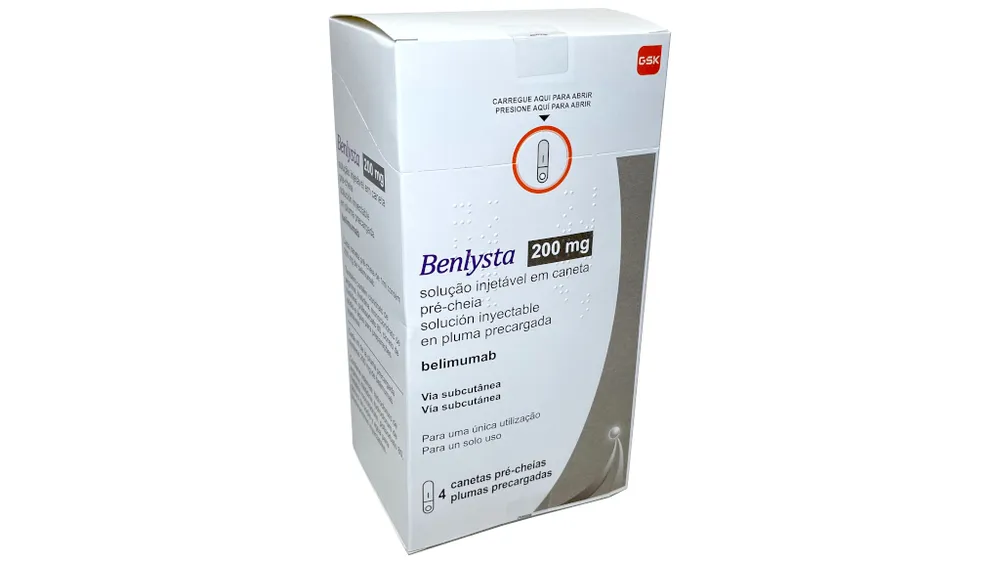
Table of Contents
Package Leaflet: Information for the User
Introduction
Package Leaflet: Information for the User
Benlysta 200 mg solution for injection in a pre-filled pen
belimumab
This medicinal product is subject to additional monitoring, which will allow quicker identification of new safety information. You can help by reporting any side effects you may experience. See the end of section 4 for information on how to report side effects.
Read this entire leaflet carefully before you start using this medicine, as it contains important information for you.
- Keep this leaflet; you may need to read it again.
- If you have any questions, ask your doctor.
- This medicine has been prescribed for you only and must not be given to other people, even if they have the same symptoms as you, because it may harm them.
- If you experience any side effects, consult your doctor, even if they are side effects not listed in this leaflet. See section 4.
Leaflet Contents
- What Benlysta is and what it is used for
- What you need to know before using Benlysta
- How to use Benlysta
- Possible side effects
- How to store Benlysta
- Contents of the pack and other information
Step-by-step instructions for using the pre-filled pen
1. What Benlysta is and what it is used for
Benlysta as a subcutaneous injection is a medicine used to treat lupus (systemic lupus erythematosus, SLE) in adults (aged 18 years and older) and children (aged 5 to 18 years and weighing at least 15 kg) whose disease remains highly active despite standard treatment. Benlysta is also used in combination with other medicines to treat adults (aged 18 years and older) with active lupus nephritis (kidney inflammation associated with lupus).
Lupus is a disease in which the immune system (the system that fights infections) attacks your own cells and tissues, causing inflammation and organ damage. It can affect any organ in the body and is thought to involve a type of white blood cells called B cells.
Benlysta contains belimumab (a monoclonal antibody). It reduces the number of B cells in your blood by blocking the action of BLyS, a protein that helps prolong the survival of B cells and is found at elevated levels in people with lupus.
Benlysta will be given to you in addition to your usual lupus treatment.
2. What you need to know before using Benlysta
Do not use Benlysta
-
if you are allergic to belimumab or to any of the other ingredients of this medicine (listed in section 6).
-
Tell your doctor if you think this may apply to you.
Warnings and precautions
Talk to your doctor before starting Benlysta:
-
if you have a current or chronic infection, or if you frequently get infections. Your doctor will decide whether you can be given Benlysta.
-
if you are planning to be vaccinated or have been vaccinated within the last 30 days. Some vaccines should not be given shortly before or during treatment with Benlysta.
-
if lupus affects your nervous system.
-
if you have HIV or low levels of immunoglobulins.
-
if you have or have had hepatitis B or C.
-
if you have had an organ transplant or a bone marrow or stem cell transplant.
-
if you have had cancer.
-
if you have ever developed a severe skin rash, skin peeling, blistering, and/or mouth ulcers after using Benlysta.
-
Tell your doctor if any of these situations apply to you.
Depression and suicide
There have been reports of depression, suicidal ideation, and suicide attempts, including suicides, during treatment with Benlysta. Inform your doctor if you have a history of these conditions. If you develop new symptoms or worsening of symptoms at any time:
- Contact your doctor immediately or go to the hospital straight away.
If you feel depressed or have thoughts of self-harm or suicide, it may help to talk to a close family member or friend and ask them to read this leaflet. You may wish to ask them to inform you if they notice any changes in your mood or behaviour.
Serious skin reactions
Cases of Stevens-Johnson syndrome and toxic epidermal necrolysis have been reported with Benlysta treatment.
- Stop using Benlysta and seek immediate medical attention if you notice any of the symptoms described in section 4.
Be alert to important symptoms
People taking medicines that affect the immune system may be at increased risk of developing infections, including a rare but serious brain infection called progressive multifocal leukoencephalopathy (PML).
- Read the information “Increased risk of brain infection” in section 4 of this leaflet.
To improve traceability of this medicine, you and your healthcare professional should record the batch number of Benlysta. It is recommended that you keep this information in case it is required in the future.
Children and adolescents
The Benlysta pre-filled pen for subcutaneous injection is not intended for use in the treatment of SLE in children under 5 years of age or weighing less than 15 kg.
The Benlysta pre-filled pen for subcutaneous injection is not intended for use in the treatment of lupus nephritis in children or adolescents under 18 years of age.
Other medicines and Benlysta
Tell your doctor if you are taking, have recently taken, or might need to take any other medicines.
In particular, tell your doctor if you are being treated with medicines that affect your immune system, including any medicine that affects your B-cells (used to treat cancer or inflammatory diseases).
Using these medicines together with Benlysta may make your immune system less effective. This could increase the risk of developing a serious infection.
Pregnancy and breastfeeding
Contraception for women who could become pregnant
- Use a reliable method of contraception while being treated with Benlysta and for at least 4 months after your last dose.
Pregnancy
Benlysta is generally not recommended during pregnancy.
- Tell your doctor if you are pregnant, think you might be pregnant, or plan to become pregnant. Your doctor will decide whether you can use Benlysta.
- If you become pregnant while being treated with Benlysta, inform your doctor.
Breastfeeding
Tell your doctor if you are breastfeeding. Benlysta may pass into breast milk. Your doctor will advise whether you should stop treatment with Benlysta while breastfeeding or whether you should stop breastfeeding.
Driving and using machines
Benlysta may cause side effects that could affect your ability to drive or use machines.
Benlysta contains polysorbate 80
This medicine contains 0.1 mg of polysorbate 80 in each pre-filled pen. Polysorbates may cause allergic reactions. Inform your doctor if you or your child has any known allergies.
Benlysta contains sodium
This medicine contains less than 1 mmol of sodium (23 mg) per dose; essentially, “sodium-free”.
3. How to use Benlysta
Follow exactly the instructions for administering this medicine as given by your doctor or pharmacist. If you are unsure, consult your doctor or pharmacist again.
Benlysta should be injected under the skin according to the schedule prescribed by your doctor.
How much to use
Systemic lupus erythematosus
Adults
The recommended dose is 200 mg (full contents of one pen) once weekly.
Children and adolescents from 5 years of age
The recommended dose for children and adolescents from 5 years of age is based on body weight as shown below:
Body weight | Recommended dose |
50 kg or more | 200 mg (full content of one pen) once weekly |
30 kg to less than 50 kg | 200 mg (full content of one pen) every 10 days |
15 kg to less than 30 kg | 200 mg (full content of one pen) every 2 weeks |
Lupus nephritis
Adults only
The recommended dose may vary. Your doctor will determine the appropriate dose for you, which may be:
- a dose of 200 mg (the entire contents of one pen) once weekly
or
- a dose of 400 mg (the entire contents of two pens on the same day) once weekly for 4 weeks. Afterwards, the recommended dose is 200 mg (the entire contents of one pen) once weekly.
If you wish to change your dosing day
Administer a dose on the new day (even if the time since your last dose is shorter than usual). Continue with the new schedule from that day onward.
Benlysta injection
Your doctor or nurse will show you or your caregiver how to inject Benlysta. The first injection with the Benlysta pre-filled pen will be supervised by your doctor or nurse at the medical facility. After you or your caregiver has been trained on how to use the pen, your doctor or nurse will indicate when you or your caregiver may begin administering the medication without supervision. Your doctor or nurse will also inform you about the signs and symptoms to watch for while using Benlysta, as serious allergic reactions may occur (see "Allergic reactions" in section 4).
For children under 10 years of age, the Benlysta pre-filled pen must be administered by a qualified doctor, nurse, or caregiver.
Benlysta is injected under the skin in the stomach area (abdomen) or upper leg (thigh).
Subcutaneous injection of Benlysta must not be administered into a vein (intravenous route).
Instructions for using the pre-filled pen are provided at the end of this leaflet.
If you use more Benlysta than you should
If this occurs, contact your doctor or nurse immediately. They will monitor you for any signs or symptoms of adverse effects and treat them if necessary. If possible, show them the packaging or this leaflet.
If you forget to use Benlysta
Inject the missed dose as soon as you remember, then continue with your regular weekly schedule as usual, or start a new weekly schedule beginning on the day you administered the missed dose.
If you do not realize you missed a dose until it is time for your next scheduled dose, simply inject your next dose as planned.
Discontinuation of Benlysta treatment
Your doctor will decide whether you need to stop using Benlysta.
4. Possible adverse effects
Like all medicines, this medicine can cause adverse effects, although not everyone gets them.
Stop using Benlysta and seek immediate medical attention if you notice any of the following symptoms of a serious skin reaction:
- Reddish spots on the trunk with a circular or target-like shape, often with blisters in the center, skin peeling, ulcers in the mouth, throat, nose, genitals, and eyes. These severe skin rashes may be preceded by fever and flu-like symptoms (Stevens-Johnson syndrome and toxic epidermal necrolysis). These adverse effects have been reported at an unknown frequency (cannot be estimated from available data).
Allergic reactions – seek immediate medical help
Benlysta may cause an injection-related reaction or an allergic reaction (hypersensitivity). These are common adverse effects (may affect up to 1 in 10 people). They may occasionally be serious (uncommon, affecting up to 1 in 100 people) and may be life-threatening. These serious adverse reactions are more likely to occur during the first or second day of treatment with Benlysta, but may be delayed and occur several days later.
If you experience any of the following symptoms of an allergic reaction or injection-related reaction, contact your doctor or nurse immediately or go to the nearest hospital emergency department:
- Swelling of the face, lips, mouth, or tongue
- Wheezing, difficulty breathing, or shortness of breath
- Skin rash
- Itchy rash or raised bumps (hives).
Rarely, less severe delayed reactions to Benlysta may also occur, usually 5 to 10 days after the injection. These include symptoms such as skin rash, feeling unwell, fatigue, muscle aches, headache, or facial swelling.
If you experience these symptoms, especially if you notice two or more at the same time:
- Inform your doctor or nurse.
Infections
Benlysta may increase your risk of developing infections, including urinary tract and respiratory tract infections. These infections are very common and may affect more than 1 in 10 people. Some infections may be serious and, uncommonly, may result in death.
If you have any of the following symptoms of infection:
-
Fever and/or chills
-
Cough, breathing problems
-
Diarrhea, vomiting
-
Burning sensation when urinating; frequent urination
-
Skin that is warm, red, or painful, or skin lesions on your body.
-
Inform your doctor or nurse immediately.
Depression and suicide
Cases of depression, suicidal ideation, and suicide attempts have been reported during treatment with Benlysta. Depression may affect up to 1 in 10 people; suicidal ideation or suicide attempts may affect up to 1 in 100 people. If you feel depressed, have thoughts of self-harm or other troubling thoughts, or if you are depressed and notice your symptoms worsening or new symptoms developing:
- Contact your doctor or go immediately to the hospital.
Increased risk of brain infection
Medicines that weaken your immune system, such as Benlysta, may increase the risk of a rare but serious and potentially fatal brain infection called progressive multifocal leukoencephalopathy (PML).
Symptoms of PML include:
-
Memory loss
-
Problems with thinking
-
Difficulty speaking or walking
-
Vision loss.
-
Inform your doctor immediately if you have any of these symptoms or similar problems lasting several days.
If you already had these symptoms before starting treatment with Benlysta:
- Inform your doctor immediately if you notice any change in these symptoms.
Other possible adverse effects:
Very common adverse effects
May affect more than 1 in 10 people:
- Bacterial infections (see section “Infections” above).
Common adverse effects
May affect up to 1 in 10 people:
- High temperature or fever
- Reactions at the injection site, for example: rash, redness, itching, or swelling of the skin where Benlysta was injected
- Itchy rash, raised bumps (hives), skin rash
- Low levels of white blood cells (can be seen in blood tests)
- Infection of the nose, throat, or stomach
- Pain in the hands or feet
- Migraine
- Feeling unwell, diarrhea.
Reporting of adverse effects
If you experience any adverse effect, talk to your doctor or nurse, even if it is a possible adverse effect not listed in this leaflet. You can also report them directly through the national reporting system included in Appendix V. By reporting adverse effects, you can help provide more information on the safety of this medicine.
5. Storage of Benlysta
Keep this medicine out of the sight and reach of children.
Do not use this medicine after the expiry date which is stated on the carton and label after EXP. The expiry date refers to the last day of the month indicated.
Store in a refrigerator (between 2°C and 8°C).
Do not freeze.
Keep in the original packaging to protect it from light.
A single pre-filled pen may be stored at room temperature (up to 25°C) for a maximum of 12 hours, provided it is protected from light. Once removed from the refrigerator, the pen must be used within the next 12 hours or discarded.
Medicines should not be disposed of via wastewater or household waste. Ask your pharmacist how to dispose of medicines and packaging that you no longer need. This will help protect the environment.
6. Contents of the pack and other information
Composition of Benlysta
The active substance is belimumab.
Each ml of the pre-filled pen contains 200 mg of belimumab.
The other components are arginine hydrochloride, histidine, histidine hydrochloride monohydrate, polysorbate 80 (E 433), sodium chloride, water for injections. See section 2 for more information on polysorbate 80 and sodium content.
Nature of the product and contents of the pack
Benlysta is supplied as a solution, colourless to slightly yellow, in a single-use 1 ml pre-filled pen.
Available in packs of 1 or 4 pre-filled pens per pack and multiple packs containing 12 pre-filled pens (3 packs of 4 pre-filled pens).
Some pack sizes may not be marketed.
Marketing Authorization Holder
GlaxoSmithKline (Ireland) Limited
12 Riverwalk
Citywest Business Campus
Dublin 24
Ireland
Manufacturer
GlaxoSmithKline Manufacturing S.P.A
Strada Provinciale Asolana, 90
43056 San Polo di Torrile
Parma
Italy
Further information on this medicinal product is available upon request by contacting the local representative of the Marketing Authorization Holder:
Belgium/Belgium/Belgium GlaxoSmithKline Pharmaceuticals s.a./n.v. Tel/Tel: + 32 (0) 10 85 52 00 | Lithuania GlaxoSmithKline Trading Services Limited Tel: + 370 80000334 |
| Luxembourg/Luxembourg GlaxoSmithKline Pharmaceuticals s.a./n.v. Belgium/Belgium Tel/Tel: + 32 (0) 10 85 52 00 |
Czech Republic GlaxoSmithKline s.r.o. Tel: + 420 222 001 111 | Hungary GlaxoSmithKline Trading Services Limited Tel.: + 36 80088309 |
Denmark GlaxoSmithKline Pharma A/S Tlf: + 45 36 35 91 00 | Malta GlaxoSmithKline Trading Services Limited Tel: + 356 80065004 |
Germany GlaxoSmithKline GmbH & Co. KG Tel.: + 49 (0)89 36044 8701 | Netherlands GlaxoSmithKline BV Tel: + 31 (0)33 2081100 |
Estonia GlaxoSmithKline Trading Services Limited Tel: + 372 8002640 | Norway GlaxoSmithKline AS Tlf: + 47 22 70 20 00 |
Greece GlaxoSmithKline Monoypopoiiki A.E.B.E. Tel: + 30 210 68 82 100 | Austria GlaxoSmithKline Pharma GmbH Tel: + 43 (0)1 97075 0 |
Spain GlaxoSmithKline, S.A. Tel: + 34 900 202 700 | Poland GSK Services Sp. z o.o. Tel.: + 48 (0)22 576 9000 |
France Laboratoire GlaxoSmithKline Tel.: + 33 (0)1 39 17 84 44 | Portugal GlaxoSmithKline – Produtos Farmacêuticos, Lda. Tel: + 351 21 412 95 00 |
Croatia GlaxoSmithKline Trading Services Limited Tel:+ 385 800787089 | Romania GlaxoSmithKline Trading Services Limited Tel: + 40 800672524 |
Ireland GlaxoSmithKline (Ireland) Limited Tel: + 353 (0)1 4955000 | Slovenia GlaxoSmithKline Trading Services Limited Tel: + 386 80688869 |
Iceland Vistor ehf. Tel: +354 535 7000 | Slovakia GlaxoSmithKline Trading Services Limited Tel: + 421 800500589 |
Italy GlaxoSmithKline S.p.A. Tel: + 39 (0)45 7741111 | Finland GlaxoSmithKline Oy Tel: + 358 (0)10 30 30 30 |
Cyprus GlaxoSmithKline Trading Services Limited Tel: + 357 80070017 | Sweden GlaxoSmithKline AB Tel: + 46 (0)8 638 93 00 |
Latvia GlaxoSmithKline Trading Services Limited Tel: + 371 80205045 | |
Date of the most recent review of this leaflet:
Other sources of information
Detailed information on this medicine is available on the website of the European Medicines Agency: https://www.ema.europa.eu, and on the website of the Spanish Agency of Medicines and Health Products (AEMPS) (http://www.aemps.gob.es/).
Step-by-step instructions for using the pre-filled pen
Once weekly: for adults and children aged 5 to less than 18 years and weighing 50 kg or more.
Every 10 days: for children aged 5 to less than 18 years and weighing 30 kg to less than 50 kg.
Every two weeks: for children aged 5 to less than 18 years and weighing 15 kg to less than 30 kg.
Read these sections first
Follow these instructions carefully to correctly use the pre-filled pen. Failure to follow these instructions may affect the proper functioning of the pre-filled pen. In addition, you will need training on how to use the pre-filled pen.
Benlysta is only for subcutaneous administration (under the skin).
To improve the traceability of this medicine, you and your healthcare professional should record the batch number of Benlysta. It is recommended that you note this information in case it is required in the future.
Storage
-
Keep refrigerated until 30 minutes before use.
-
Store in the original packaging to protect it from light.
-
Keep out of sight and reach of children.
-
Keep away from heat and direct sunlight.
-
Do not freeze. If the pre-filled pen has been frozen, do not use it even if it has thawed.
-
Do not use and do not return it to the refrigerator if it has been left at room temperature for more than 12 hours.
Precautions
-
The pre-filled pen must be used only once and then discarded.
-
Do not share your Benlysta pre-filled pen with another person.
-
Do not shake.
-
Do not use if it has fallen onto a hard surface.
-
Do not remove the ring cap until just before injection.
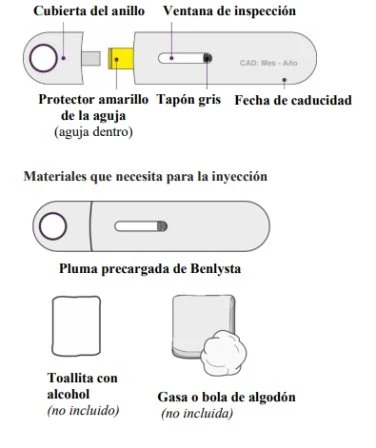
Parts of the Benlysta pre-filled pen
 Gather and check the materials
Gather the materials
-
Remove from the refrigerator a sealed tray containing the pre-filled pen.
-
Return any remaining pre-filled pens to the refrigerator.
-
Find a clean, well-lit, comfortable surface and place the following materials within easy reach:
-
Benlysta pre-filled pen
-
Alcohol swab (not included in the package)
-
Gauze or cotton ball (not included in the package)
-
Container with a tight-fitting lid for disposal of the pen (not included in the package).
-
Do not perform the injection if you do not have all the materials listed.
Remove the pre-filled pen
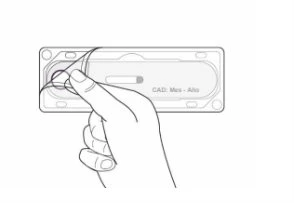
- Peel off the film from the corner of the tray (Figure 1).
Figure 1
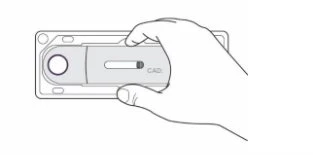
- Holding the center of the pre-filled pen (near the inspection window), carefully remove the pre-filled pen from the tray (Figure 2).
Figure 2
Check the expiration date
- Check the expiration date on the pre-filled pen (Figure 3).
Figure 3
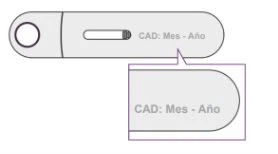
- Do not use the pen if the expiration date has passed.
- Prepare and inspect the pre-filled pen
Allow it to reach room temperature
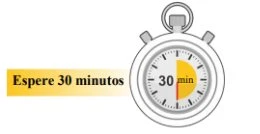
- Let the pen sit at room temperature for 30 minutes (Figure 4). Injecting cold Benlysta may take longer and may be uncomfortable.
Figure 4
-
Do not heat the pen in any other way, for example, in a microwave, with hot water, or under direct sunlight.
-
Do not remove the ring cap during this step.
Inspect the Benlysta solution
-
Look through the inspection window to check that the Benlysta solution is colorless to slightly yellow (Figure 5).
-
It is normal to see one or more air bubbles in the solution.
Figure 5
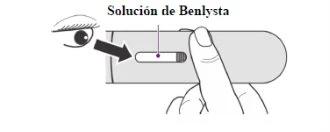
- Do not use the pen if the solution appears cloudy, discolored, or contains particles.
- Choose and clean the injection site
Choose the injection site
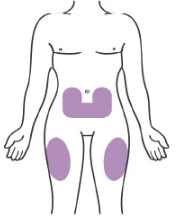
- Select an injection site (abdomen or thigh) as shown in Figure 6.
Figure 6
-
If two injections are needed to complete your dose, leave at least 5 cm (2 inches) between each injection if using the same area.
-
Do not inject in the same spot every time. This is to avoid skin hardening.
-
Do not inject in areas where the skin is tender, bruised, red, or hard.
-
Do not inject within 5 cm of the navel.
Clean the injection site
-
Wash your hands.
-
Clean the area where the injection will be given with an alcohol swab (Figure 7). Allow the skin to air dry.
Figure 7
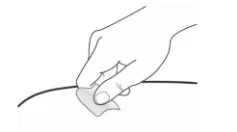
- Do not touch this area again before administering the injection.
- Prepare for injection
Remove the cap
-
Do not remove the cap until immediately before injection.
-
Remove the cap by pulling or twisting it. The cap may be twisted clockwise or counterclockwise (Figure 8).
Figure 8
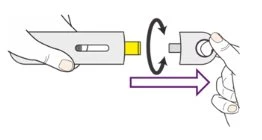
- Do not reattach the cap to the pen.
Position the pen
- Hold the pen comfortably so that you can see the inspection window. This is important so you can confirm that a full dose has been administered (Figure 9).
Figure 9
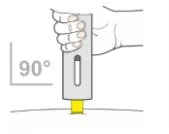
-
If necessary, smooth the injection site by pinching or stretching the skin.
-
Place the pen directly onto the injection site (at a 90° angle). Make sure the yellow needle shield is firmly against the skin.
- Inject Benlysta and check
Start the injection
-
Press the pen firmly downward as far as it will go at the injection site and hold it in place (Figure 10).
-
This will insert the needle and start the injection.
Figure 10
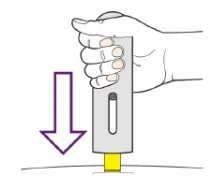
- You may hear a first "click" at the beginning of the injection. You will see the purple indicator begin to move across the inspection window (Figure 11).
Figure 11
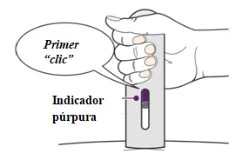
Complete the injection
-
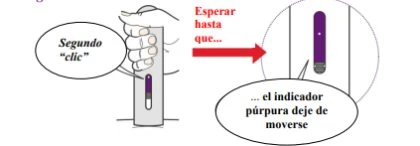
Continue holding the pen downward until the purple indicator stops moving.
-
You may hear a second "click" a few seconds before the purple indicator stops moving (Figure 12).
Figure 12
-
The injection may take up to 15 seconds to complete.
-
When the injection is complete, lift the pen away from the injection site.
Check the injection site
There may be a small amount of blood at the injection site.
-
If needed, press a cotton ball or gauze against the injection site.
-
Do not rub the injection site.
- Dispose of the used pen
-
Do not reattach the cap to the pen.
-
Dispose of the used pen and cap in a container with a tight-fitting lid.
-
Ask your doctor or pharmacist for information on how to properly dispose of a used pen or a used pen container.
-
Do not recycle or throw the used pen or used pen container into household waste.