Benferol Mensual 25,000 IU soft capsules
Spain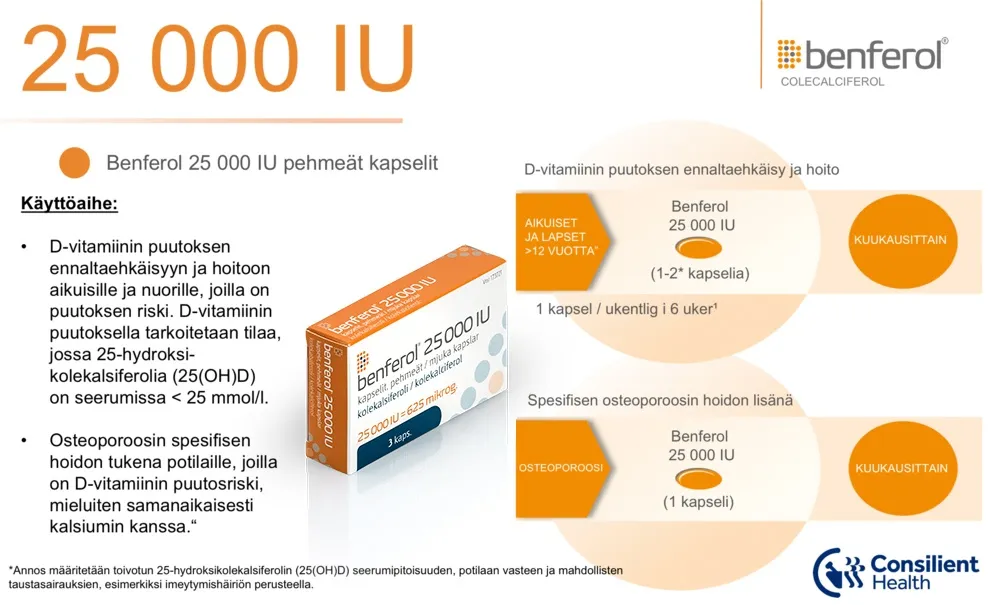
Table of Contents
- Package leaflet: Information for the user
- Introduction
- 1. What Benferol Monthly is and what it is used for
- 2. What you need to know before starting to take Benferol monthly
- 3. How to take Benferol monthly
- 4. Possible adverse effects
- 5. Storage of Benferol monthly
- 6. Contents of the pack and further information
Package leaflet: Information for the user
Introduction
Package leaflet: information for the user
Benferol monthly 25,000 IU soft capsules
colecalciferol (vitamin D3)
Read the entire leaflet carefully before starting to take this medicine, because it contains important information for you.
- Keep this leaflet, as you may need to read it again.
- If you have any questions, ask your doctor or pharmacist.
- This medicine has been prescribed for you only, and you should not give it to other people, even if they have the same symptoms as you, because it could harm them.
- If you experience any adverse effects, consult your doctor or pharmacist, even if they are adverse effects not listed in this leaflet. See section 4.
Leaflet contents
- What Benferol monthly is and what it is used for
- What you need to know before taking Benferol monthly
- How to take Benferol monthly
- Possible side effects
- How to store Benferol monthly
- Contents of the pack and other information
1. What Benferol Monthly is and what it is used for
This medicine contains vitamin D3, which regulates the absorption and metabolism of calcium, as well as the incorporation of calcium into bone tissue.
Benferol Monthly is used to prevent and treat vitamin D3 deficiency in adults and adolescents (children ≥ 12 years of age).
Your doctor may prescribe this medicine as an addition to specific treatment for bone loss. Consult your doctor or pharmacist if you have any further questions, and always follow their instructions.
2. What you need to know before starting to take Benferol monthly
Do not take Benferol monthly:
- if you are allergic to cholecalciferol or to any of the other ingredients of this medicine (listed in section 6).
- if you have hypercalcemia (increased calcium levels in blood) or hypercalciuria (increased calcium levels in urine).
- if you have hypervitaminosis D (increased vitamin D levels in blood).
- if you have kidney stones.
If you have any of the above conditions, consult your doctor or pharmacist before taking Benferol monthly.
Warnings and precautions
Talk to your doctor or pharmacist before taking this medicine:
- if you have sarcoidosis (a specific type of connective tissue disease affecting the lungs, skin, and joints).
- when taking other medicines containing vitamin D at the same time.
- if you have kidney problems or have previously had kidney stones.
Children
This medicine is not suitable for use in children under 12 years of age.
Taking Benferol monthly with other medicines
Tell your doctor or pharmacist if you are taking, have recently taken, or might need to take any other medicines, especially:
- Cholestyramine (used to treat high cholesterol).
- Phenytoin or barbiturates (used to treat epilepsy).
- Laxatives containing paraffin oil.
- Thiazide diuretics (to treat high blood pressure).
- Glucocorticoids (to treat inflammation).
- Cardiac glycosides (to treat heart conditions), e.g., digoxin.
- Actinomycin (chemotherapy).
- Imidazole (antifungal).
- Orlistat (weight loss).
Taking Benferol monthly with food and drinks
See section 3 “How to take Benferol monthly”.
Pregnancy, breastfeeding, and fertility
During pregnancy, daily intake of vitamin D should not exceed 600 IU.
Benferol monthly should only be used during pregnancy if vitamin D deficiency has been clinically diagnosed.
This medicine may be used during breastfeeding. Vitamin D3 passes into breast milk. This should be taken into account when administering additional vitamin D to the infant.
There are no data on the effects of vitamin D3 on fertility. However, normal levels of vitamin D are not expected to have adverse effects on fertility.
If you are pregnant, breastfeeding, think you may be pregnant, or are planning to become pregnant, consult your doctor or pharmacist before using this medicine.
Driving and using machines
This medicine has no known effects on the ability to drive or operate machinery.
Benferol monthly contains Allura Red AC (E129), which may cause allergic-type reactions.
If you are allergic to the above-mentioned dye, consult your doctor or pharmacist.
3. How to take Benferol monthly
Follow exactly the administration instructions given by your doctor. If you have any doubts, consult your doctor or pharmacist again.
The capsules must be swallowed whole with water.
You should take this medicine preferably with a substantial meal to ensure your body absorbs vitamin D3.
Adults and adolescents
The recommended dose is one 25,000 IU capsule per month.
For vitamin D deficiency, the dose may be adjusted according to vitamin D blood levels (25(OH)D levels).
For the treatment of symptomatic vitamin D deficiency, the recommended dose is one capsule of 100,000 IU or two capsules of 50,000 IU within one week. A maintenance dose of 25,000 IU per month may be considered.
Use in children
This medicine is not intended for use in children under 12 years of age. Other formulations of this medicine may be more suitable for children; please consult your doctor or pharmacist.
If you take more Benferol monthly than you should
If you have taken more of this medicine than prescribed, or if a child has accidentally taken this medicine, contact your doctor or emergency services to assess the risk involved, or call the toxicology information service at 91 562 04 20, indicating the medicine and the amount taken. Bring the medicine packaging with you. It is recommended to bring the medicine packaging and leaflet to the healthcare professional.
The most common symptoms of overdose are: nausea, vomiting, excessive thirst, production of large amounts of urine over 24 hours, constipation and dehydration, elevated levels of calcium in the blood (hypercalcemia and hypercalciuria) detected by laboratory tests.
If you forget to take Benferol monthly
Do not take a double dose to make up for missed doses.
If you stop treatment with Benferol monthly
If you have any further questions about the use of this medicine, ask your doctor or pharmacist.
4. Possible adverse effects
Like all medicines, this medicine can cause adverse effects, although not everyone will experience them.
You should immediately stop taking the medicine and consult your doctor if you experience symptoms of severe allergic reactions such as:
- Swelling of the face, lips, tongue, or throat
- Difficulty swallowing
- Hives and difficulty breathing
Uncommon adverse effects (occur in less than 1 in 100 patients): Hypercalcemia (increased calcium levels in blood) and hypercalciuria (increased calcium levels in urine).
Rare (occur in less than 1 in 1,000 patients): Itching, skin rash (pruritus/urticaria).
Reporting of adverse effects
If you experience any type of adverse effect, talk to your doctor or pharmacist, even if it is a possible adverse effect not listed in this leaflet. You may also report them directly via the Spanish Pharmacovigilance System for Human Medicinal Products: www.notificaram.es. By reporting adverse effects, you can help provide more information on the safety of this medicine.
5. Storage of Benferol monthly
Keep this medicine out of the sight and reach of children.
Do not use this medicine after the expiry date stated on the outer packaging or blister pack, following the abbreviation EXP. The expiry date refers to the last day of the month indicated.
Do not store above 30°C. Keep in the original packaging to protect from light.
Medicines should not be disposed of via wastewater or household waste. Dispose of unused medicines and their containers at the SIGRE collection point at your pharmacy. If you are in doubt, please ask your pharmacist how to dispose of medicines and containers you no longer need. This will help protect the environment.
6. Contents of the pack and further information
Composition of Benferol monthly
The active substance is colecalciferol (vitamin D3). Each soft capsule contains 0.625 mg of colecalciferol, equivalent to 25,000 IU of vitamin D3.
The other components are: all-rac-α-tocopherol (E307), medium-chain triglycerides, glycerol, gelatin, white printing ink Opacode (shellac (E904), titanium dioxide (E171) and simethicone) and Allura Red AC (E129).
Appearance of Benferol monthly and contents of the pack
Soft, oval capsule, light red in colour, with "25" printed in white ink. It contains a slightly yellow oily liquid.
Each box contains 1, 2, 3 or 4 capsules in blister strips.
Only certain pack sizes may be marketed.
Marketing Authorization Holder
Consilient Health Limited.
Floor 3, Block 3, Miesian Plaza,
Dublin 2, D02 Y754
Ireland
Manufacturer
Consilient Health Limited,
Block 2A Richview Office Park,
Clonskeagh, Dublin 14,
D14 Y0A5, Ireland
or
Pharma Pack Hungary Ltd.,
Vasút utca 13., Budaörs,
2040, Hungary
For further information on this medicinal product, please contact the local representative of the Marketing Authorization Holder:
ANGELINI PHARMA ESPAÑA, S.L.
c/ Antonio Machado, 78-80
3rd floor, module A-Edificio Australia
08840 Viladecans, Barcelona (Spain)
This medicinal product is authorized in the Member States of the European Economic Area under the following names:
Denmark: Benferol 25.000 IE bløde kapsler
Finland: Benferol 25.000 IU kapselit, pehmeät
Norway: Benferol 25.000 IU myke kapsler
Sweden: Benferol 25.000 IU mjuka kapslar
Spain: Benferol mensual 25.000 UI cápsulas blandas
Date of the most recent review of this leaflet: January 2024