Benestan Retard 5 mg prolonged-release tablets
Spain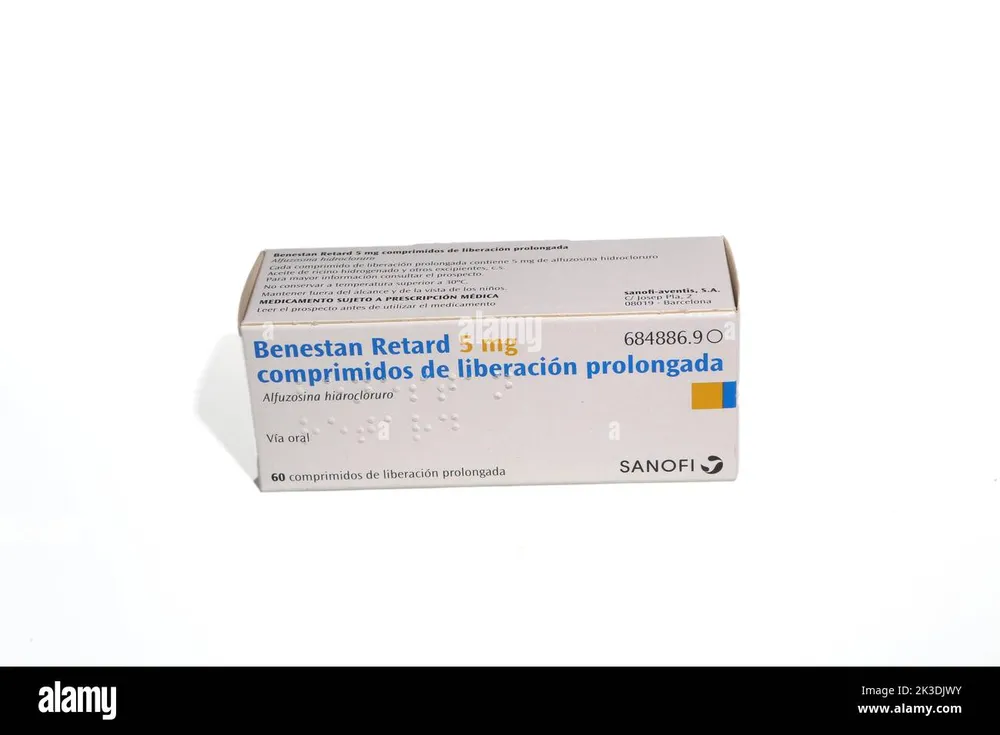
Table of Contents
- Package leaflet: Information for the user
- Introduction
- 1. What Benestan Retard is and what it is used for
- 2. What you need to know before taking Benestan Retard
- 3. How to take Benestan Retard
- 4. Possible adverse effects
- 5. Storage of Benestan Retard
- 6. Contents of the pack and other information
- **This leaflet was approved in 10/2024**
Package leaflet: Information for the user
Introduction
Package leaflet: information for the user
Benestan Retard 5 mg prolonged-release tablets
Alfuzosin hydrochloride
Read all of this leaflet carefully before you start taking this medicine because it contains important information for you.
- Keep this leaflet as you may need to read it again. If you have any further questions, ask your doctor or pharmacist.
- This medicine has been prescribed for you only, and you should not give it to other people even if they have the same symptoms as you, because it may harm them.
- If you experience any adverse effects, consult your doctor or pharmacist, even if they are adverse effects not listed in this leaflet. See section 4.
Contents of this leaflet
- What Benestan Retard is and what it is used for
- What you need to know before taking Benestan Retard
- How to take Benestan Retard
- Possible side effects
- How to store Benestan Retard
- Contents of the pack and other information
1. What Benestan Retard is and what it is used for
Benestan Retard belongs to a group of medicines that act specifically on the urinary tract (bladder, urethra, and prostate).
Benestan Retard is indicated for the treatment of functional symptoms of benign prostatic hyperplasia (enlargement of the prostate gland).
2. What you need to know before taking Benestan Retard
Please read the following sections carefully.
Do not take Benestan Retard
- if you are allergic to the active substance or to any of the other components of this medicine (listed in section 6)
- if you have orthostatic hypotension (a drop in blood pressure upon standing)
- if you are taking other medicines of the same type as this medicine (alpha1-blockers). See section “Use of Benestan Retard with other medicines”.
- if you have severe hepatic impairment (serious liver disease)
- if you have gastrointestinal obstruction
- if you are taking ritonavir alone or in combination with ombitasvir/paritaprevir, lopinavir, or nirmatrelvir. See section “Use of Benestan Retard with other medicines” below.
Warnings and precautions
Talk to your doctor or pharmacist before starting to take Benestan:
-
If you are taking other medicines such as ketoconazole and itraconazole (antifungals).
-
Before starting treatment with Benestan Retard, your doctor may perform tests to rule out other diseases that may cause the same symptoms as benign prostatic hyperplasia. Before treatment and periodically thereafter, you may undergo a digital rectal examination and, if necessary, blood tests.
-
If you are scheduled for surgery, you must inform the anaesthetist prior to the procedure that you are taking Benestan Retard (see section “Use of Benestan Retard with other medicines”).
-
If you have previously been treated with a medicine similar to Benestan Retard.
-
If you are taking medicines for hypertension (high blood pressure) or nitrates (for the treatment of heart conditions), a drop in blood pressure upon standing may occur in the hours following administration of the medicine, which may be accompanied by dizziness, sweating, or fatigue (see section “Possible side effects”). If you experience these symptoms, lie down until you feel better. This is more likely to occur at the beginning of treatment, but generally does not prevent continuation of therapy. Inform your doctor if you have ever experienced a significant drop in blood pressure when treated for hypertension with other medicines.
-
If you have cerebral ischaemic disorders (problems with blood circulation in the brain), as this medicine may cause hypotension (low blood pressure). You may have cerebral ischaemic disorders that have not yet become apparent (see section “Possible side effects”).
-
If you have or have had heart disease, as this medicine may increase the risk of hypotension when taken together with nitrates (a medicine used for heart disease) (see section “Possible side effects”). If angina pectoris reappears or worsens, treatment with alfuzosin should be discontinued. Inform your doctor if you have any heart problems related to QT interval.
-
If you are elderly, as the risk of hypotension and other adverse effects may be higher.
-
If you have renal impairment, your doctor may adjust your dose.
-
If you are scheduled for cataract surgery, please inform your doctor before the procedure if you are currently taking or have previously taken Benestan Retard. This is because Benestan Retard may cause complications during surgery, which can be anticipated and managed by your ophthalmologist if informed in advance.
Alfuzosin, like other medicines in the same class, may cause priapism (a persistent and painful erection). If this occurs, seek immediate medical attention at an emergency department for appropriate treatment.
Consult your doctor or pharmacist even if any of the above situations have occurred in the past.
Use of Benestan Retard with other medicines
Inform your doctor or pharmacist if you are taking, have recently taken, or might need to take any other medicines (especially medicines for high blood pressure), including those obtained without a prescription, homeopathic remedies, herbal medicines, and other health-related products, as it may be necessary to interrupt treatment or adjust the dose of one or more of these medicines.
Certain medicines, such as those listed below, may increase the risk of hypotension (low blood pressure) when taken at the same time as Benestan Retard:
Medicines that must not be used:
- Alpha1-blockers: drugs of the same type as this medicine.
- Ritonavir, either alone or in combination with lopinavir (commonly used for the treatment of HIV), or ritonavir in combination with ombitasvir/paritaprevir (commonly used for the treatment of chronic hepatitis C infection), or ritonavir in combination with nirmatrelvir (commonly used for the treatment of mild to moderate COVID-19).
Medicines that should be used with caution:
- Antihypertensive medicines (drugs that lower blood pressure)
- Nitrates (medicines for the treatment of coronary insufficiency)
- Medicines for fungal infections (such as itraconazole)
- Medicines for bacterial infections (such as clarithromycin, telithromycin)
- Medicines for the treatment of depression (such as nefazodone)
- Ketoconazole tablets (used to treat Cushing's syndrome – when the body produces excess cortisol)
In addition, administration of general anaesthetics to patients treated with Benestan Retard may cause blood pressure instability; therefore, in the event of surgery, you must inform the anaesthetist that you are taking Benestan Retard.
Your doctor will determine whether you should stop taking any of these medicines or whether close monitoring or dose adjustments are necessary.
Pregnancy and breastfeeding
Not applicable, as this medicine is intended for use only in males.
Driving and using machines
You should be aware that your ability to drive or operate machinery may be impaired due to the possible occurrence of adverse effects such as dizziness and fatigue, especially at the beginning of treatment. If this occurs, refrain from driving and operating dangerous machinery.
Benestan Retard contains hydrogenated castor oil
This medicine may cause stomach discomfort and diarrhoea because it contains hydrogenated castor oil.
3. How to take Benestan Retard
Follow exactly the instructions given by your doctor for taking this medicine. If you are unsure, consult your doctor or pharmacist again.
Remember to take your medication.
If you feel that the effect of Benestan Retard is too strong or too weak, inform your doctor or pharmacist.
The recommended dosage is indicative and variable. The establishment of the dosing regimen is left to the discretion of the physician.
The tablet must be swallowed whole. Any other method of administration, such as chewing, crushing, biting, grinding, or pulverizing, should be avoided, as these actions could lead to inappropriate absorption of the medication and thus to the rapid onset of possible adverse reactions.
Adults
1 tablet twice daily (morning and evening), corresponding to 10 mg of alfuzosin per day.
Elderly patients
As a precautionary measure, treatment should be initiated with a dose of 1 tablet at night (5 mg of alfuzosin), which may be increased to 1 tablet twice daily according to clinical response, without exceeding 10 mg of alfuzosin per day.
Renal impairment
In patients with mild or moderate renal impairment, as a precaution, treatment should be initiated with 1 tablet at night (5 mg of alfuzosin), which may be increased to 1 tablet twice daily depending on clinical response, without exceeding 10 mg of alfuzosin per day.
In patients with severe renal impairment, the use of Benestan Retard is not recommended. Therefore, your doctor will prescribe a treatment with a lower dose, which will be increased according to clinical response.
Hepatic impairment
In patients with mild to moderate hepatic impairment (liver), the use of Benestan Retard is not recommended. Therefore, your doctor will prescribe treatment with Benestan 2.5 mg.
In Benestan Retard, the medication is contained within a non-absorbable tablet specially designed to provide controlled release of the active substance. When this process is complete, the empty tablet shell is eliminated from the body in the faeces, so you may notice the tablet coating in your stools.
Use in children
The efficacy of alfuzosin has not been demonstrated in children aged 2 to 16 years. Therefore, alfuzosin is not indicated for use in children.
If you take more Benestan Retard than you should
If you have taken more Benestan Retard than you should, contact your doctor, pharmacist, or call the Toxicology Information Service immediately at telephone number: 915 620 420, stating the medication and the amount taken. It may be necessary to go to a hospital. It is recommended to bring the medicine packaging and leaflet to the healthcare professional.
You should remain lying down.
If you forget to take Benestan Retard
If you accidentally miss a daily dose, take the next dose as usual. Do not take a double dose to make up for forgotten doses.
If you have any further questions about the use of this product, ask your doctor or pharmacist.
4. Possible adverse effects
Like all medicines, this medicine may cause adverse effects, although not everyone will experience them.
The adverse effects observed, according to their frequency of occurrence: very common (may affect more than 1 in 10 patients); common (may affect up to 1 in 10 patients); uncommon (may affect up to 1 in 100 patients); rare (may affect up to 1 in 1,000 patients); very rare (may affect up to 1 in 10,000 patients); frequency not known (cannot be estimated from the available data), have been:
Nervous System
Common: fainting/dizziness, vertigo, headache
Uncommon: syncope (loss of consciousness), somnolence (drowsiness)
Frequency not known: cerebral ischaemic disorders (problems with blood circulation in the brain) in patients who may have previously had this condition but had not yet shown symptoms
Eye disorders
Uncommon: visual disturbance
Frequency not known: Intraoperative Floppy Iris Syndrome (characterized by pupil constriction and iris deformation)
Cardiac disorders
Uncommon: increased heart rate, palpitations
Very rare: angina pectoris in patients with coronary artery disease (severe chest pain radiating to the left arm) (see section “Warnings and precautions”)
Frequency not known: atrial fibrillation (uncontrolled, very rapid irregular heartbeats)
Vascular disorders
Common: orthostatic hypotension (drop in blood pressure when changing position, e.g. from lying down to standing up) (see section “Warnings and precautions”)
Uncommon: hot flushes
Respiratory system
Uncommon: inflammation of the nasal mucosa (rhinitis)
Gastrointestinal disorders
Common: nausea, abdominal pain, diarrhoea, dry mouth
Uncommon: vomiting
Hepatobiliary disorders
Frequency not known: liver injury and hepatic cholestasis (a condition in which bile flow from the liver is obstructed)
Skin and subcutaneous tissue disorders
Uncommon: skin rash, skin itching
Very rare: hives, skin irritation and itching (urticaria), swelling of blood vessels due to fluid accumulation (angioedema)
Reproductive system
Frequency not known: priapism (persistent and painful penile erection)
General and administration site conditions
Common: fatigue, malaise
Uncommon: oedema (swelling), chest pain
Blood and lymphatic system disorders
Frequency not known: neutropenia (reduction in the number of neutrophil white blood cells), thrombocytopenia (reduction in the number of platelets)
Reporting of adverse effects
If you experience any type of adverse effect, consult your doctor or pharmacist, even if it is a possible adverse effect not listed in this leaflet. You may also report them directly via the Spanish Pharmacovigilance System for Human Medicines: https://www.notificaram.es. By reporting adverse effects, you can help provide more information on the safety of this medicine.
5. Storage of Benestan Retard
Keep this medicine out of the sight and reach of children.
Do not remove the tablets from their packaging until it is time to take the medicine.
Do not store above 30°C.
Do not use this medicine after the expiry date stated on the packaging. The expiry date refers to the last day of the month indicated.
Medicines must not be disposed of via wastewater or household waste. Dispose of empty containers and unused medicines at the SIGRE collection point at your pharmacy. If in doubt, ask your pharmacist how to properly dispose of containers and medicines you no longer need. This way, you will help protect the environment.
6. Contents of the pack and other information
Composition of Benestan Retard
- The active substance is alfuzosin hydrochloride. Each tablet contains 5 mg of alfuzosin hydrochloride.
- The other components are: hydrogenated castor oil, microcrystalline cellulose, calcium hydrogen phosphate dihydrate, povidone, magnesium stearate, hypromellose, propylene glycol, titanium dioxide and iron (III) oxide monohydrate.
Appearance of the product and contents of the pack
Benestan Retard is presented as prolonged-release tablets, round, biconvex, pale yellow in colour. Pack containing 60 tablets.
Marketing Authorization Holder and Manufacturer
Holder:
sanofi-aventis, S.A.
C/ Roselló i Porcel, 21
08016 Barcelona
Spain
Manufacturer:
SANOFI WINTHROP INDUSTRIE
Avenue Gustave Eiffel, 30-36
37000 Tours (France)
OTHER PRESENTATIONS:
Unibenestan 10 mg prolonged-release tablets: pack containing 30 tablets.
This leaflet was approved in 10/2024
Detailed and up-to-date information on this medication is available on the website of the Spanish Agency of Medicines and Medical Devices (AEMPS) http://www.aemps.gob.es/