Benerva 100 mg/ml solution for injection
Spain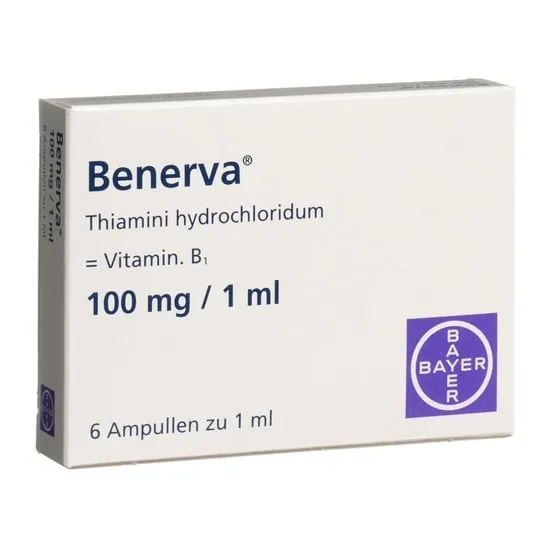
Table of Contents
- Package leaflet: Information for the user
- Introduction
- 1. What Benerva injectable solution is and what it is used for
- 2. What you need to know before using Benerva injectable solution
- 3. How to use Benerva injectable solution
- 4. Possible adverse effects
- 5. Storage of Benerva injectable solution
- 6. Contents of the pack and other information
Package leaflet: Information for the user
Introduction
Package leaflet: information for the patient
BENERVA 100 mg/ml injection solution
thiamine hydrochloride
Read all of this leaflet carefully before you start using this medicine, because it contains important information for you.
- Keep this leaflet, as you may need to read it again.
- If you have any questions, ask your doctor or pharmacist.
- This medicine has been prescribed for you only, and you should not give it to other people, even if they have the same symptoms as you, because it could harm them.
- If you experience any adverse effects, consult your doctor or pharmacist, even if they are adverse effects not listed in this leaflet. See section 4.
Contents of the leaflet
- What Benerva injection solution is and what it is used for
- What you need to know before using Benerva injection solution
- How to use Benerva injection solution
- Possible side effects
- How to store Benerva injection solution
- Contents of the pack and other information
1. What Benerva injectable solution is and what it is used for
Benerva contains thiamine (vitamin B1), a water-soluble vitamin involved in many processes of human metabolism, primarily carbohydrate metabolism.
It is indicated in adults for:
Prevention and treatment of vitamin B1 deficiency due to increased requirements, reduced intake, or impaired absorption.
Situations frequently associated with vitamin B1 deficiency that require supplementation include:
- Regular excessive alcohol consumption.
- Prolonged infection.
- Intestinal diseases, such as celiac disease or persistent diarrhea.
- High carbohydrate intake.
- Poor nutritional status.
Treatment of beriberi (characterized by severe fatigue and slowed movements, primarily affecting the nervous system, heart, and circulation), Wernicke's disease (affecting the nervous system), and Korsakoff syndrome (caused by excessive alcohol consumption, with effects on the brain).
2. What you need to know before using Benerva injectable solution
Do not use Benerva
- if you are allergic to thiamine (vitamina B1) or to any of the other components of this medicine (listed in section 6).
Warnings and precautions
Talk to your doctor or pharmacist before using Benerva injectable solution.
The risk of hypersensitivity reactions increases with repeated intravenous or intramuscular administrations of thiamine. Therefore, when possible, oral administration is recommended. That is, in this case, a medicine in which the active substance is administered orally would be preferable.
Administer intravenously only by a healthcare professional. The administration of the product and handling of needles must be carried out with caution.
If you have previously experienced an allergy to vitamin B1 due to skin contact (contact dermatitis), for example for occupational reasons, you could experience a relapse when treated with this medicine.
Interference with laboratory tests: If you are due to have any diagnostic tests (including blood, urine, etc.), inform your doctor that you are being treated with this medicine, as it may alter the results. False results may occur in certain assays for uric acid, urobilinogen, or theophylline.
Children
Do not use this medicine in children due to lack of data.
Other medicines and Benerva injectable solution
Tell your doctor or pharmacist if you are taking, have recently taken, or might need to take any other medicines.
Benerva injectable solution may interact with the following medicines:
- 5-Fluorouracil and capecitabine (for certain types of cancer)
- Tegafur (for certain types of cancer).
Pregnancy, breastfeeding, and fertility
If you are pregnant or breastfeeding, think you may be pregnant, or plan to become pregnant, consult your doctor before using this medicine.
Use of Benerva injectable solution is not recommended if you are pregnant or breastfeeding.
This medicine is not recommended for women of childbearing age who are not using an effective method of contraception.
Driving and using machines
The effect of this medicine on the ability to drive and use machines is negligible or none.
Benerva injectable solution contains sodium
This medicine contains less than 1 mmol of sodium (23 mg) per ml of injectable solution; i.e., essentially "sodium-free".
3. How to use Benerva injectable solution
Follow exactly the administration instructions for this medicine as indicated by your doctor.
If in doubt, consult your doctor again.
Route of administration: intramuscular, slow intravenous injection, or short-term infusion.
The contents of the ampoule must not be mixed with any other parenteral product or injection fluid. The injection must be administered by a qualified healthcare professional.
Recommended dosage:
- Adults:
50 mg (half an ampoule) of vitamin B1 should be administered daily by intramuscular route for several days when absorption is significantly impaired, and also for the treatment of Wernicke-Korsakoff syndrome and beriberi.
For initial treatment of vitamin B1 deficiency (avitaminosis) or severe B1 hypovitaminosis, the initial daily dose may be 100 mg or up to 200 mg by parenteral route (e.g., intramuscular, slow intravenous injection, or even short-term infusion) to achieve as rapidly as possible an adequate blood concentration of vitamin B1.
For the treatment of Wernicke-Korsakoff syndrome due to alcohol abuse, the usual dose is 100 mg by intravenous route, followed by 50–100 mg daily by intramuscular route until the patient resumes a balanced diet.
For emergency treatment, 100 mg (or 200 mg, if considered necessary, or up to 1000 mg within the first 12 hours if needed) by slow intravenous injection daily for three days.
Intramuscular administration may be used if intravenous administration is not possible. This may be followed by 100 mg of thiamine orally.
If you use more Benerva injectable solution than you should
Rapid intravenous administration and multiple and/or high doses increase the likelihood of adverse reactions, such as anaphylactoid reactions and injection site reactions.
In case of overdose or accidental ingestion, contact your doctor or pharmacist immediately, go to a medical center, or call the Toxicology Information Service at telephone number 91 562 04 20, indicating the medicine and the amount ingested.
If you forget to use Benerva
Do not use a double dose to make up for forgotten doses.
If you have any further questions about the use of this medicine, ask your doctor or pharmacist.
4. Possible adverse effects
Like all medicines, this medicine can cause adverse effects, although not everyone experiences them.
As these reactions are reported voluntarily, it is not possible to estimate their frequency.
The following have been reported:
Reactions at the injection site: frequently (may affect up to 1 in 10 people), pain at the injection site after rapid intravenous injection; this reaction can be avoided by slow administration.
Allergic or anaphylactic reactions have usually been reported after intravenous, intramuscular, or subcutaneous injection, including hypersensitivity reactions with their respective clinical and laboratory manifestations, such as asthmatic syndrome, mild to moderate skin and/or respiratory tract reactions, gastrointestinal tract and/or cardiovascular system reactions. Symptoms reported may include rash, itching, red, itchy skin eruptions (urticaria), rapid swelling of the skin and mucous membranes (angioedema), cardiorespiratory difficulty, and severe reactions including anaphylactic shock.
If an allergic reaction occurs, treatment should be discontinued and a healthcare professional should be consulted.
Contact dermatitis in predisposed patients.
Reporting of adverse effects
If you experience any type of adverse effect, consult your doctor or pharmacist, even if it is a possible adverse effect not listed in this leaflet. You may also report them directly through the Spanish Pharmacovigilance System for Human Medicinal Products at www.notificaRAM.es. By reporting adverse effects, you can help provide more information on the safety of this medicine.
5. Storage of Benerva injectable solution
Keep this medicine out of sight and reach of children.
Do not store above 25°C.
Do not use this medicine after the expiry date stated on the label and carton following EXP. The expiry date refers to the last day of the month indicated.
Do not use this medicine if you notice visible particles, if the solution is not clear, or if the container is damaged.
Medicines must not be disposed of via wastewater or household waste. Unwanted medicines and their containers should be returned to a pharmacy’s SIGRE Point. Ask your pharmacist how to dispose of medicines and containers you no longer need. This will help protect the environment.
6. Contents of the pack and other information
Composition of Benerva injectable solution
- The active substance is thiamine hydrochloride (Vitamin B1).
Each 1 ml vial of solution contains 100 mg of thiamine hydrochloride.
- The other components (excipients) are: glycerol, phenol, sodium phosphate, sodium hydrogen carbonate, and water for injections.
Appearance of the product and contents of the pack
Injectable solution, transparent, colourless or slightly yellowish, contained in 1 ml glass vials.
Packs containing 6 and 10 vials of 1 ml.
- Other presentations
Benerva 300 mg film-coated tablets
Marketing Authorization Holder and Manufacturer
Marketing Authorization Holder
TEOFARMA Srl
Via F.lli Cervi, 8
27010 Valle Salimbene (PV) – Italy
Manufacturer
CENEXI SAS
Rue Marcel ANDJacques Gaucher, 52 - Fontenay Sous Bois
F-94120 – France
Date of the most recent revision of this leaflet: April 2018.
Detailed information on this medicine is available on the website of the Spanish Agency of Medicines and Medical Devices (AEMPS) http://www.aemps.gob.es/