Bekunis 5 mg gastro-resistant tablets
Spain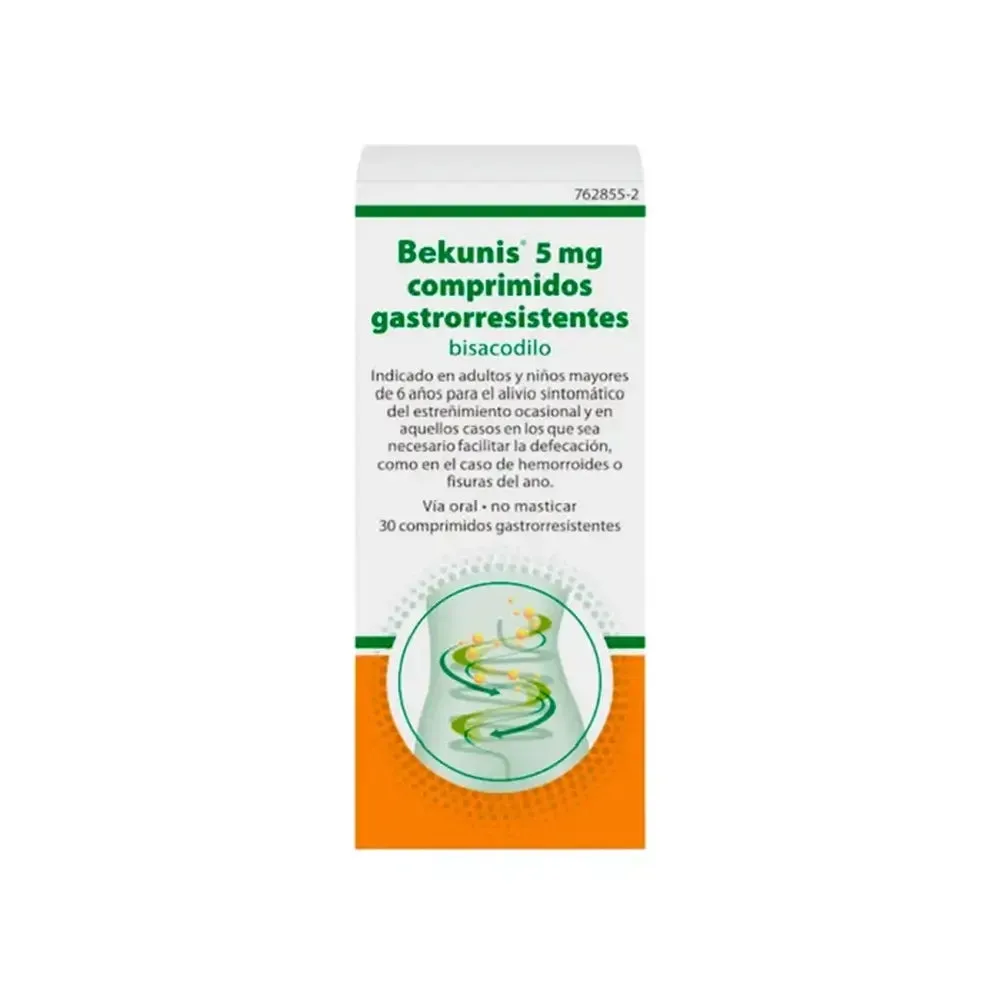
Table of Contents
Patient Information Leaflet
Introduction
PACKAGE LEAFLET: INFORMATION FOR THE USER
Bekunis 5 mg gastro-resistant tablets
Bisacodyl
Read the entire leaflet carefully as it contains important information for you.
This medicine is available without a prescription. However, to achieve the best results, it must be used correctly.
- Keep this leaflet, as you may need to read it again.
- If you need advice or further information, consult your pharmacist.
- If symptoms worsen or persist after 7 days, you should consult your doctor.
- If you consider any of the side effects you experience to be serious, or if you notice any side effects not listed in this leaflet, inform your doctor or pharmacist.
Leaflet contents:
- What Bekunis is and what it is used for
- Before taking Bekunis
- How to take Bekunis
- Possible side effects
- How to store Bekunis
- Further information
1. What Bekunis is and what it is used for
Bisacodyl belongs to the group of so-called stimulant laxatives, which act by direct contact with the intestinal mucosa, stimulating the nerve endings in the intestinal wall and increasing its motility.
This medicine is indicated in adults and children over 6 years of age for the symptomatic relief of occasional constipation, such as that caused by prolonged bed rest or travel. It may also be used in cases where facilitation of defecation is necessary, for example in hemorrhoids or anal fissures.
2. Before taking Bekunis
Do not take Bekunis
- If you are allergic (hypersensitive) to bisacodyl or to any of the other components of Bekunis.
- If you have abdominal pain of unknown origin.
- If you have intestinal obstruction or paralytic ileus (a disorder of the intestine).
- If you have appendicitis or intestinal perforation.
- If you have gastrointestinal bleeding or inflammatory bowel diseases (ulcerative colitis, Crohn's disease).
- If the patient is a child under 2 years of age.
- If you have disturbances in water or electrolyte metabolism.
Take special care with Bekunis
- Prolonged use of bisacodyl may lead to laxative dependence; therefore, it is recommended that this medicine be used only for short periods of time.
- If you experience symptoms of appendicitis such as nausea, vomiting, or abdominal cramps, it is recommended to consult a doctor to rule out the presence of appendicitis.
- If you are over 65 years of age or are a debilitated patient, adequate intake of fluids and mineral salts is recommended, and electrolyte levels should be monitored periodically to prevent dehydration.
- If you have gastrointestinal obstruction or suffer from chronic constipation, you should consult a doctor, as the underlying cause of constipation should be investigated in such cases.
Use of other medicines
Inform your doctor or pharmacist if you are taking, or have recently taken, any other medicines, including those obtained without a prescription.
In particular, if you are taking any of the following medicines, it may be necessary to adjust the dose or discontinue treatment:
- Antiarrhythmics (quinidine).
- Anti-inflammatory drugs (corticosteroids).
- Thiazide diuretics (used to increase urine elimination).
- Cardiac glycosides such as digoxin, used for heart conditions.
- Antacid and anti-ulcer medications (proton pump inhibitors, H2 antihistamines); these should be taken at least 2 hours apart from Bekunis.
- Medications containing liquorice.
Interference with diagnostic tests:
- May increase blood glucose levels; this should be taken into account in diabetic patients.
- May interfere with laboratory test results, as prolonged use of laxatives may lead to hypokalaemia (reduced potassium levels in the blood).
Taking Bekunis with food and drinks
Do not consume liquorice while being treated with this medicine.
Simultaneous ingestion of Bekunis with milk should be avoided, or at least the administration should be spaced by at least 2 hours, as concomitant administration may increase absorption of this medicine.
Pregnancy and breastfeeding
Consult your doctor or pharmacist before using any medicine.
IMPORTANT FOR WOMEN If you are pregnant or think you might be pregnant, consult your doctor before taking this medication. Taking medications during pregnancy can be harmful to the embryo or fetus and should be monitored by your doctor. |
Bisacodyl may pass into breast milk, therefore women who are breastfeeding should not take this medication without first consulting their doctor.
Driving and use of machines
No effects on the ability to drive or operate machinery due to taking this medication have been reported.
Important information about some of the components of Bekunis
This medicine contains lactose, glucose, and sucrose. If your doctor has informed you that you have an intolerance to certain sugars, consult with him before taking this medicine.
3. How to take Bekunis
Follow the administration instructions for Bekunis provided in this leaflet or those given by your doctor. Consult your doctor or pharmacist if you have any doubts.
The usual dose is:
Adults and children over 12 years: 1 to 3 tablets per day. Do not administer more than 3 tablets per day.
Use in children
- Children under 2 years: Do not use this medicine.
- Children aged 2 to 6 years: this medicine should only be used under medical advice.
- Children aged 6 to 12 years: maximum 1 tablet per day. Do not administer more than 1 tablet per day (equivalent to 5 mg of bisacodyl per day).
It is recommended to swallow the tablet whole, without chewing, with plenty of liquid, either at night or in the morning on an empty stomach. If taken at night, defecation will occur approximately 10 hours later. If taken in the morning on an empty stomach, defecation will occur approximately 6 hours later.
If symptoms worsen, if no bowel movement occurs within 12 hours, or if symptoms persist for more than 7 days, you should consult your doctor.
If you take more Bekunis than you should
If you have taken more Bekunis than you should, consult your doctor or pharmacist immediately.
The most common symptoms of overdose are: abdominal cramps, vomiting, mucus and diarrheal stools, and loss of potassium and other electrolytes.
Treatment in these cases consists of discontinuing the laxative and subsequent rehydration with saline solution, fluids, and administration of mineral salts.
If you have taken more Bekunis Instant than you should, consult your doctor or pharmacist, or call the Toxicology Information Service at telephone number: 91 562 04 20, indicating the medicine and the amount taken.
If you forget to take Bekunis
Do not take a double dose to make up for forgotten doses.
If you have any further questions about the use of this product, ask your doctor or pharmacist.
4. Possible adverse effects
Like all medicines, Bekunis may cause adverse effects, although not everyone will experience them.
During the period of use of medicines containing bisacodyl, the following adverse effects have been observed, although their frequency could not be established accurately.
The most frequently reported adverse effects have been gastrointestinal disturbances such as abdominal pain or cramps, flatulence, abdominal distension, and slower intestinal movement.
Rarely, allergic reactions, skin rashes, and angioedema (swelling of the face, lips, mouth, tongue, or throat that may cause difficulty in swallowing or breathing) may also occur.
Prolonged administration of bisacodyl may lead to increased loss of water, potassium salts, and other electrolytes. This may result in cardiac dysfunction, muscle weakness, and fatigue, particularly if administered concomitantly with diuretics and corticosteroids.
If you consider any of the adverse effects you experience to be severe, or if you notice any adverse effect not listed in this leaflet, inform your doctor or pharmacist.
5. Bekunis Storage
Keep out of the reach and sight of children.
Special storage conditions are not required.
Do not use BEKUNIS after the expiry date stated on the packaging after EXP. The expiry date is the last day of the month indicated.
Medicines should not be disposed of via wastewater or household waste. Dispose of unused containers and medicines at the SIGRE collection point at your pharmacy. If in doubt, ask your pharmacist how to dispose of medicines and containers you no longer need. This will help protect the environment.
6. Additional Information
Composition of Bekunis
- The active substance is bisacodyl. Each tablet contains 5 milligrams of bisacodyl.
- The other components (excipients) are: magnesium stearate, talc, microcrystalline cellulose (E-460), Macrogol 6000, monohydrate lactose, methacrylic acid and ethyl acrylate copolymer (1:1), sucrose, arabic gum, calcium carbonate, polysorbate 80, titanium dioxide (E 171), stearic acid, liquid glucose, purified water, white wax, and montan glycol wax.
Appearance of the product and contents of the container
Bekunis are gastro-resistant tablets, supplied in polypropylene bottles with polyethylene caps or in cardboard boxes with blister packs (PVC/PVDC/Al) containing 30 gastro-resistant tablets.
Marketing Authorization Holder
ROHA ARZNEIMITTEL GmbH
Am Tabakquartier 50 (Loft 20)
28197 Bremen
Germany
Manufacturer
Artesan Pharma GmbH & Co. KG
Wendlandstraße 1
29439 Lüchow
Germany
This leaflet was approved in October 2007
Detailed and up-to-date information on this medicinal product is available on the website of the Spanish Agency of Medicines and Health Products (AEMPS) http://www.aemps.gob.es/