Bekemv 300 mg concentrate for solution for infusion
Spain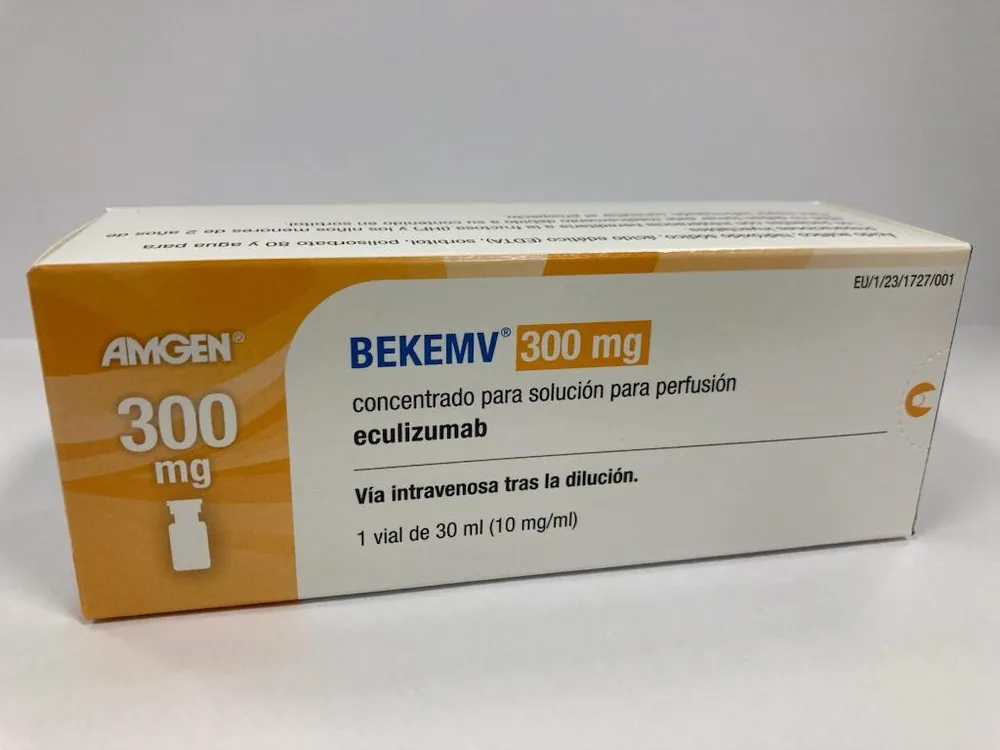
Table of Contents
Package leaflet: Information for the user
Introduction
Package leaflet: Information for the user
BEKEMV 300 mg concentrate for solution for infusion
eculizumab
Read all of this leaflet carefully before you start using this medicine, because it contains important information for you.
- Keep this leaflet, as you may need to read it again.
- If you have any questions, ask your doctor, pharmacist or nurse.
- This medicine has been prescribed for you only, and you should not give it to other people, even if they have the same symptoms as you, because it could harm them.
- If you experience any adverse reactions, talk to your doctor, pharmacist or nurse, even if they are adverse reactions not listed in this leaflet. See section 4.
Contents of this leaflet
- What BEKEMV is and what it is used for
- What you need to know before using BEKEMV
- How to use BEKEMV
- Possible side effects
- How to store BEKEMV
- Contents of the pack and other information
1. What BEKEMV is and what it is used for
What BEKEMV is
The active substance in BEKEMV is eculizumab, which belongs to a group of medicines called monoclonal antibodies. Eculizumab binds to a specific protein in the body that causes inflammation and inhibits it, thereby preventing the body's systems from attacking and destroying vulnerable blood cells or kidneys.
What BEKEMV is used for
Paroxysmal nocturnal hemoglobinuria
BEKEMV is used to treat adults and children with a specific type of blood disorder called paroxysmal nocturnal hemoglobinuria (PNH). In patients with PNH, red blood cells can be destroyed, leading to a reduced number of red blood cells (anemia), fatigue, impaired functioning, pain, darkening of the urine, difficulty breathing, and blood clots. Eculizumab can block the body's inflammatory response and its ability to attack and destroy its own vulnerable blood cells in PNH.
Atypical hemolytic uremic syndrome
BEKEMV is also used to treat adult and pediatric patients with a certain type of blood and kidney disorder called atypical hemolytic uremic syndrome (aHUS). In patients with aHUS, the kidneys and blood cells, including platelets, may be damaged, leading to low blood counts (thrombocytopenia and anemia), reduced or loss of kidney function, blood clots, fatigue, and impaired normal functioning. Eculizumab can block the body's inflammatory response and its ability to attack and destroy its own vulnerable blood and kidney cells.
2. What you need to know before using BEKEMV
Do not use BEKEMV
- If you are allergic to eculizumab or to any of the other ingredients of this medicine (listed in section 6).
- If you have fructose intolerance, a rare inherited condition in which the enzyme that breaks down fructose is missing.
- Children under 2 years of age should not receive this medicine, as it contains sorbitol and may be fatal in hereditary fructose intolerance (HFI). HFI may not yet have been diagnosed in infants and children under 2 years of age. (See special warnings at the end of this section under the subheading “BEKEMV contains sorbitol”).
- If you have not been vaccinated against meningococcal infection, unless you are taking antibiotic treatment to reduce the risk of infection for up to 2 weeks after vaccination.
- If you currently have a meningococcal infection.
Warnings and precautions
Meningococcal infection and other Neisseria infections alert
Treatment with BEKEMV may reduce your natural resistance to infections, particularly to certain organisms causing meningococcal infection (a serious infection of the lining of the brain and sepsis) and other Neisseria infections, including disseminated gonococcal infection.
Talk to your doctor before using BEKEMV to ensure you are vaccinated against Neisseria meningitidis, one of the microorganisms causing meningococcal infection, at least 2 weeks before starting treatment, or that you receive antibiotic treatment to reduce the risk of infection for up to two weeks after vaccination.
Make sure your meningococcal vaccinations are up to date. Also note that vaccination does not always prevent these types of infections. According to national recommendations, your doctor may consider additional preventive measures necessary.
If you are at risk of gonorrhea, consult your doctor or pharmacist before starting this medicine.
Symptoms of meningococcal infection
Because rapid identification and treatment of certain infections are critical in patients receiving BEKEMV, you will be given a card listing specific infection symptoms to carry with you at all times. This is called the “Patient Card”.
If you experience any of the following symptoms, contact your doctor immediately:
- headache accompanied by nausea or vomiting
- headache accompanied by neck or back stiffness
- fever
- rash
- confusion
- severe muscle pain combined with flu-like symptoms
- sensitivity to light
Meningococcal infection treatment while traveling
If you plan to travel to a remote area where you cannot easily contact your doctor or access medical care, your doctor may take appropriate preventive measures, such as providing a prescription for an antibiotic against Neisseria meningitidis to carry with you. If you develop any of the symptoms listed above, take the prescribed antibiotic immediately. Remember that you must seek medical attention as soon as possible, even if you feel better after taking the antibiotic.
Infections
Before using BEKEMV, inform your doctor if you have any active infection.
Allergic reactions
BEKEMV contains a protein, and proteins may cause allergic reactions in some people.
Children and adolescents
Patients under 18 years of age should be vaccinated against Haemophilus influenzae and pneumococcal infections.
Elderly people
No special precautions are required for treatment in patients aged 65 years and older.
Other medicines and BEKEMV
Inform your doctor or pharmacist if you are currently taking, have recently taken, or might need to take any other medicines.
Pregnancy, breast-feeding and fertility
If you are pregnant, breast-feeding, think you may be pregnant, or are planning to become pregnant, consult your doctor or pharmacist before using this medicine.
Women of childbearing age
In women of childbearing age, effective contraceptive methods should be considered during treatment and for up to 5 months after treatment.
Driving and using machines
The effect of BEKEMV on the ability to drive and operate machinery is negligible or none.
BEKEMV contains sorbitol
This medicine contains 50 mg of sorbitol per ml.
Sorbitol is a source of fructose. If you (or your child) have hereditary fructose intolerance (HFI), a rare genetic disorder, this medicine must not be administered. Patients with HFI cannot metabolize fructose, which may lead to serious adverse effects.
Consult your doctor before receiving this medicine if you (or your child) have HFI or cannot consume foods or drinks containing sugar because they cause dizziness, vomiting, or unpleasant effects such as bloating, stomach cramps, or diarrhea.
Sodium
BEKEMV contains sodium when diluted with sodium chloride.
This medicine contains less than 1 mmol of sodium (23 mg) per dose; thus, it is essentially “sodium-free”.
When diluted with sodium chloride 9 mg/ml (0.9%) solution for injection, this medicine contains 0.34 g of sodium (main component of table/cooking salt) per 180 ml at the maximum dose. This corresponds to 17.0% of the maximum recommended daily dietary sodium intake for an adult. This should be taken into account if you are on a sodium-restricted diet.
When diluted with sodium chloride 4.5 mg/ml (0.45%) solution for injection, this medicine contains 0.18 g of sodium (main component of table/cooking salt) per 180 ml at the maximum dose, equivalent to 9.0% of the maximum recommended daily dietary sodium intake for an adult. This should be considered if you are on a sodium-restricted diet.
If your healthcare provider dilutes the BEKEMV vials with 5% glucose solution, the medicine will be essentially “sodium-free”.
Polysorbate 80
This medicine contains 3.0 mg of polysorbate 80 (E 433) in each vial (30 ml vial), equivalent to 0.3 mg/kg or less of the maximum dose for adult patients and pediatric patients weighing more than 10 kg, and equivalent to 0.6 mg/kg or less of the maximum dose for pediatric patients weighing 5 to <10 kg. Polysorbates may cause allergic reactions. Inform your doctor if you or your child have any known allergies.
3. How to use BEKEMV
At least 2 weeks before starting treatment with BEKEMV, your doctor will administer a vaccine against meningococcal infection if you have not been previously vaccinated or if your previous vaccination has expired. If your child is younger than the age required for vaccination or if you have not been vaccinated at least 2 weeks before starting treatment with BEKEMV, your doctor will prescribe antibiotics to reduce the risk of infection for up to 2 weeks after vaccination.
Your doctor will administer a vaccine against Haemophilus influenzae and pneumococcal infections to your child under 18 years of age, according to current local vaccination recommendations for each age group.
Instructions for proper use
Your doctor or another healthcare professional will administer the treatment, which consists of an intravenous infusion of a diluted solution from the BEKEMV vial prepared in an infusion bag, delivered through a small tube directly into a vein. The initial phase of treatment, or initial phase, is recommended to last 4 weeks, after which the maintenance phase will begin.
If you are using this medicine to treat PAH
For adults:
- Initial phase:
During the first four weeks, your doctor will administer a weekly intravenous infusion of diluted BEKEMV. Each infusion will consist of a dose of 600 mg (2 vials of 30 ml) and will last 25–45 minutes (35 minutes ± 10 minutes).
-
Maintenance phase:
-
In week five, your doctor will administer an intravenous infusion of diluted BEKEMV corresponding to a dose of 900 mg (3 vials of 30 ml) over approximately 25–45 minutes (35 minutes ± 10 minutes).
-
After week five, your doctor will administer 900 mg of diluted BEKEMV every two weeks as long-term treatment.
If you are using this medicine to treat aHUS:
For adults:
- Initial phase:
During the first four weeks, your doctor will administer a weekly intravenous infusion of diluted BEKEMV. Each administration will consist of a dose of 900 mg (3 vials of 30 ml) and will last 25–45 minutes (35 minutes ± 10 minutes).
-
Maintenance phase:
-
In week five, your doctor will administer an intravenous infusion of diluted BEKEMV corresponding to a dose of 1200 mg (4 vials of 30 ml) over approximately 25–45 minutes (35 minutes ± 10 minutes).
-
After week five, your doctor will administer 1200 mg of diluted BEKEMV every two weeks as long-term treatment.
For children and adolescents:
- Children and adolescents with PAH or aHUS and weighing equal to or more than 40 kg will be treated with the adult dose.
- Children and adolescents with PAH or aHUS and weighing less than 40 kg require a lower dose based on body weight. Your doctor will calculate it.
For children and adolescents with PAH or aHUS older than 2 years of age and weighing less than 40 kg:
Body weight |
Initial phase |
Maintenance phase |
30 - < 40 kg |
600 mg weekly for the first 2 weeks |
900 mg in week 3; then 900 mg every 2 weeks |
20 - < 30 kg |
600 mg weekly for the first 2 weeks |
600 mg in week 3; then 600 mg every 2 weeks |
10 - < 20 kg |
Single dose of 600 mg in week 1 |
300 mg in week 2; then 300 mg every 2 weeks |
5 - < 10 kg |
Single dose of 300 mg in week 1 |
300 mg in week 2; then 300 mg every 3 weeks |
Patients undergoing plasma exchange may receive additional doses of BEKEMV.
After each infusion, you must remain under observation for one hour and strictly follow your doctor's instructions.
If you have received more BEKEMV than you should
If you suspect that you have accidentally been given a higher dose of BEKEMV than prescribed, consult your doctor.
If you miss an appointment to receive BEKEMV
If you miss an appointment, contact your doctor immediately and read the section “If you interrupt treatment with BEKEMV”.
If you interrupt treatment with BEKEMV in PNH
If you interrupt or discontinue treatment with BEKEMV, symptoms of PNH may reappear more intensely shortly after stopping treatment. Your doctor will discuss the potential adverse effects, explain the risks, and closely monitor you for at least 8 weeks.
The risks of interrupting treatment with BEKEMV include an increased destruction of your red blood cells, which may cause the following:
- a marked decrease in red blood cell count (anemia);
- confusion or lack of attention;
- chest pain or angina;
- increased serum creatinine concentration (kidney problems); or
- thrombosis (blood clots).
If you experience any of these symptoms, contact your doctor.
If you interrupt treatment with BEKEMV in aHUS
If you interrupt or discontinue treatment with BEKEMV, symptoms of aHUS may reappear. Your doctor will discuss the potential adverse effects, explain the risks, and closely monitor you.
The risks of interrupting treatment with BEKEMV include increased inflammatory processes in your platelets, which may cause the following:
- a marked decrease in platelet count (thrombocytopenia);
- a significant increase in destruction of your red blood cells;
- reduced urination (kidney problems);
- increased serum creatinine concentration (kidney problems);
- confusion or lack of attention;
- chest pain or angina;
- shortness of breath; or
- thrombosis (blood clots).
If you experience any of these symptoms, contact your doctor.
4. Possible adverse effects
Like all medicines, this medicine can cause adverse effects, although not everyone will experience them. Your doctor will discuss the possible adverse effects with you and explain the benefits and risks of BEKEMV before starting treatment.
The most serious adverse effect reported was meningococcal sepsis. If you experience any symptoms of meningococcal infection (see section 2 “Meningococcal infection and other Neisseria infections alert”), contact your doctor immediately.
If you are unsure about the nature of the adverse effects listed below, please ask your doctor to explain them to you.
Very common (may affect more than 1 in 10 patients)
- headache
Common (may affect up to 1 in 10 patients)
- lung infection (pneumonia), cold (nasopharyngitis), urinary tract infection (urinary infection)
- low white blood cell count (leukopenia), reduction in red blood cells that may cause paleness and lead to weakness or shortness of breath
- inability to sleep
- dizziness, high blood pressure
- upper respiratory tract infection, cough, sore throat (oropharyngeal pain), bronchitis, cold sores (herpes simplex)
- diarrhea, vomiting, nausea, abdominal pain, rash, hair loss (alopecia), itching (pruritus)
- joint pain (arms and legs), pain in the limbs (arms and legs)
- fever (pyrexia), feeling of tiredness (fatigue), flu-like illness
- infusion-related reaction
Uncommon (may affect up to 1 in 100 patients)
- serious infection (meningococcal infection), sepsis, septic shock, viral infection, lower respiratory tract infection, stomach flu (gastrointestinal infection), cystitis
- infection, fungal infection, pus accumulation (abscesses), skin infection (cellulitis), influenza, sinusitis, dental infection (abscess), gum infection
- relatively low platelet count (thrombocytopenia), low lymphocyte levels (a specific type of white blood cell) (lymphopenia), sensation of palpitations
- severe allergic reactions causing difficulty breathing or dizziness (anaphylactic reaction), hypersensitivity
- loss of appetite
- depression, anxiety, mood changes, sleep disorder
- sensation of tingling in part of the body (paresthesia), tremor, taste disturbance (dysgeusia), fainting
- blurred vision
- ringing in the ears, dizziness
- sudden and rapid development of extremely high blood pressure, low blood pressure, hot flushes, venous disorders
- dyspnea (difficulty breathing), nosebleed, nasal congestion (nasal congestion), throat irritation, nasal discharge (rhinorrhea)
- inflammation of the peritoneum (the tissue lining most of the abdominal organs), constipation, stomach discomfort after meals (dyspepsia), abdominal distension
- increased liver enzymes
- urticaria, skin redness, dry skin, red or purple spots on the skin, increased sweating, skin inflammation
- muscle cramp, muscle pain, back and neck pain, bone pain
- kidney disorders, difficulty or pain when urinating (dysuria), blood in urine
- spontaneous erection
- swelling (edema), chest discomfort, feeling of weakness (asthenia), chest pain, pain at the infusion site, chills
- decrease in the proportion of blood volume occupied by red blood cells, decrease in the protein that carries oxygen in red blood cells
Rare (may affect up to 1 in 1,000 patients)
- fungal infection (infection by Aspergillus), joint infection (bacterial arthritis), infection by Haemophilus, impetigo, sexually transmitted bacterial disease (gonorrhea)
- skin tumor (melanoma), bone marrow disorder
- destruction of red blood cells (hemolysis), cell aggregation, abnormal coagulation factor, abnormal coagulation
- disease with overactive thyroid (Graves' disease)
- abnormal dreams
- eye irritation
- bruising
- unusual gastric reflux of food, gum pain
- yellowing of the skin and/or eyes (jaundice)
- skin color disorders
- spasms of the oral musculature, joint swelling
- menstrual disorder
- abnormal leakage of infused medicine from the vein, abnormal sensation at the infusion site, feeling of warmth
Frequency not known (cannot be estimated from available data)
- liver damage
Reporting of adverse effects
If you experience any adverse effect, consult your doctor, pharmacist, or nurse, even if it is a possible adverse effect not listed in this leaflet. You may also report them directly through the national reporting system detailed in Appendix V. By reporting adverse effects, you can help provide more information on the safety of this medicine.
5. Storage of BEKEMV
Keep this medicine out of the sight and reach of children.
Do not use this medicine after the expiry date stated on the packaging and on the label of the vial following "EXP". The expiry date refers to the last day of the month indicated.
Store in a refrigerator (between 2 °C and 8 °C). Do not freeze.
BEKEMV vials may be kept outside the refrigerator, in the original packaging, for a single period of up to 7 days. At the end of this period, the product may be returned to refrigerated storage.
Keep in the original packaging to protect from light. After dilution, the medicine should be used within 24 hours.
Medicines should not be disposed of via wastewater. Ask your pharmacist how to dispose of medicines and packaging you no longer need. This will help protect the environment.
6. Contents of the container and other information
Composition of BEKEMV
-
The active substance is eculizumab (300 mg/30 ml in a vial corresponding to 10 mg/ml).
-
The other components are:
-
acetic acid
-
sodium hydroxide (E 524)
-
edetic acid (EDTA)
-
sorbitol (E 420), see section 2 “BEKEMV contains sorbitol”
-
polysorbate 80 (E 433) (of vegetable origin)
-
water for injections
BEKEMV contains sorbitol, sodium, and polysorbate 80. See section 2.
Appearance of the product and contents of the container
BEKEMV is available as a concentrate for solution for infusion (30 ml in a vial – container size 1).
BEKEMV is a solution ranging from clear to opalescent and from colorless to slightly yellowish.
Marketing Authorization Holder and Manufacturer
Amgen Technology (Ireland) UC
Pottery Road, Dun Laoghaire
Co. Dublin,
A96 F2A8 Ireland
Marketing Authorization Holder
Amgen Technology (Ireland) UC
Pottery Road, Dun Laoghaire
Co. Dublin,
A96 F2A8 Ireland
Manufacturer
Amgen Europe B.V.
Minervum 7061
4817 ZK Breda
The Netherlands
Manufacturer
Amgen NV
Telecomlaan 5-7
1831 Diegem
Belgium
More information about this medicinal product can be requested by contacting the local representative of the Marketing Authorization Holder:
Belgium/Belgium/Belgium s.a. Amgen n.v. Tel/Tel: +32 (0)2 7752711 | Lithuania Amgen Switzerland AG Vilnius Branch Tel: +370 5 219 7474 |
| Luxembourg/Luxembourg s.a. Amgen Belgium/Belgium Tel/Tel: +32 (0)2 7752711 |
Czech Republic Amgen s.r.o. Tel: +420 221 773 500 | Hungary Amgen Kft. Tel.: +36 1 35 44 700 |
Denmark Amgen, branch of Amgen AB, Sweden Tlf: +45 39617500 | Malta Amgen S.r.l. Italy Tel: +39 02 6241121 |
Germany Amgen GmbH Tel.: +49 89 1490960 | Netherlands Amgen B.V. Tel: +31 (0)76 5732500 |
Estonia Amgen Switzerland AG Vilnius Branch Tel: +372 586 09553 | Norway Amgen AB Tlf: +47 23308000 |
Greece Amgen Hellas Pharmaceuticals E.P.E. Tel: +30 210 3447000 | Austria Amgen GmbH Tel: +43 (0)1 50 217 |
Spain Amgen S.A. Tel: +34 93 600 18 60 | Poland Amgen Biotechnologia Sp. z o.o. Tel.: +48 22 581 3000 |
France Amgen S.A.S. Tél: +33 (0)9 69 363 363 | Portugal Amgen Biofarmacêutica, Lda. Tel: +351 21 4220606 |
Croatia Amgen d.o.o. Tel: +385 (0)1 562 57 20 | Romania Amgen Romania SRL Tel: +4021 527 3000 |
Ireland Amgen Ireland Limited Tel: +353 1 8527400 | Slovenia AMGEN zdravila d.o.o. Tel: +386 (0)1 585 1767 |
Iceland Vistor Sími: +354 535 7000 | Slovakia Amgen Slovakia s.r.o. Tel: +421 2 321 114 49 |
Italy Amgen S.r.l. Tel: +39 02 6241121 | Finland/Suomi Amgen AB, branch in Finland/Amgen AB, filial i Finland Puh/Tel: +358 (0)9 54900500 |
Cyprus C.A. Papaellinas Ltd Tel: +357 22741 741 | Sweden Amgen AB Tel: +46 (0)8 6951100 |
Latvia Amgen Switzerland AG Riga Branch Tel: +371 257 25888 |
Date of the most recent review of this leaflet
Other sources of information
Detailed information on this medicine is available on the European Medicines Agency website: http://www.ema.europa.eu/.
Instructions for healthcare professionals on the handling of BEKEMV
In order to improve the traceability of biological medicines, the name and batch number of the administered medicine should be clearly recorded.
This information is intended for healthcare professionals only.
- How is BEKEMV supplied?
Each vial of BEKEMV contains 300 mg of active substance in 30 ml of product solution.
- Before administering the medicine
Dilution must be carried out in accordance with good practice standards, particularly with regard to asepsis.
BEKEMV must be prepared using an aseptic technique for subsequent administration by a qualified healthcare professional.
- Visually inspect the BEKEMV solution to ensure it contains no particles or discoloration.
- Withdraw the required amount of BEKEMV from the vial(s) using a sterile syringe.
- Transfer the recommended dose to an infusion bag.
- Dilute BEKEMV to a final concentration of 5 mg/ml (initial concentration divided by 2) by adding the appropriate amount of diluent to the infusion bag.
- To prepare a 300 mg dose, use 30 ml of BEKEMV (10 mg/ml) and add 30 ml of diluent.
- For a 600 mg dose, use 60 ml of BEKEMV and add 60 ml of diluent.
- For a 900 mg dose, use 90 ml of BEKEMV and add 90 ml of diluent.
- For a 1200 mg dose, use 120 ml of BEKEMV and add 120 ml of diluent.
The final volume of a diluted BEKEMV solution at 5 mg/ml is 60 ml for 300 mg doses, 120 ml for 600 mg doses, 180 ml for 900 mg doses, or 240 ml for 1200 mg doses.
-
The diluents that may be used are sodium chloride 9 mg/ml (0.9%) solution for injection, sodium chloride 4.5 mg/ml (0.45%) solution for injection, or 5% glucose solution in water.
-
Gently agitate the infusion bag containing the diluted BEKEMV solution to ensure the medicine and diluent are well mixed.
-
Allow the diluted solution to reach room temperature (between 18 °C – 25 °C) before administration by leaving it at room temperature.
-
The diluted solution must not be heated in a microwave or by any other heat source other than room temperature.
-
Discard any medicine remaining in the vial.
-
The diluted BEKEMV solution may be stored at 2 °C to 8 °C for up to 24 hours prior to administration.
- Administration
- Do not administer BEKEMV via direct intravenous injection or by bolus injection.
- BEKEMV must only be administered by intravenous infusion.
- The diluted BEKEMV solution should be administered by intravenous infusion over 25 to 45 minutes (35 minutes ± 10 minutes) in adults and 1 to 4 hours in pediatric patients under 18 years of age, using gravity drip, syringe pump, or infusion pump. The diluted BEKEMV solution does not need to be protected from light during administration to the patient.
The patient should remain under observation for one hour after the infusion. If an adverse reaction occurs during administration of BEKEMV, the infusion may be interrupted or the infusion rate reduced, at the physician's discretion. If the infusion rate is reduced, the total duration of infusion must not exceed two hours in adults and four hours in pediatric patients under 18 years of age.
- Special storage and handling conditions
Store in a refrigerator (between 2 °C and 8 °C). Do not freeze. Keep in the original packaging to protect from light. BEKEMV vials may be kept in the original container outside the refrigerator for a single period of up to 7 days. At the end of this period, the product may be returned to refrigerated storage.
Do not use BEKEMV after the expiry date stated on the container and on the label of the vial after “EXP”. The expiry date refers to the last day of the stated month.