BCG vaccine 0.75 mg/ml powder and solvent for injectable suspension
SpainTable of Contents
- Package leaflet: Information for the user
- Introduction
- 1. What is BCG Vaccine and what is it used for
- 2. What you need to know before you or your child receive the BCG vaccine
- 3. How the BCG Vaccine is Administered
- 4. Possible adverse effects
- 5. Storage of BCG Vaccine
- 6. Contents of the pack and other information
Package leaflet: Information for the user
Introduction
PACKAGE LEAFLET: INFORMATION FOR THE USER
BCG Vaccine 0.75 mg/ml powder and solvent for injectable suspension
Mycobacterium bovis
Read all of this leaflet carefully before you or your child are vaccinated, because it contains important information for you.
- Keep this leaflet, as you may need to read it again.
- If you have any questions, consult your doctor or pharmacist.
- This medicine has been prescribed only for you or your child and must not be given to other people, even if they have the same symptoms as you, since it could harm them.
- If you experience any adverse reactions, consult your doctor or pharmacist, even if they are adverse reactions not listed in this leaflet. See section 4.
Leaflet contents
- What BCG Vaccine is and what it is used for
- What you need to know before you or your child receive BCG Vaccine
- How BCG Vaccine is administered
- Possible adverse effects
- How to store BCG Vaccine
- Contents of the pack and other information
1. What is BCG Vaccine and what is it used for
BCG vaccine, powder and solvent for injectable suspension, belongs to the group of medicines known as antituberculosis vaccines.
The BCG vaccine is indicated for the prevention of tuberculosis. Although it does not guarantee complete immunity, it increases resistance to tuberculous infection.
The BCG vaccine should be used in accordance with official recommendations.
2. What you need to know before you or your child receive the BCG vaccine
Do not use the BCG vaccine
- If you are allergic (hypersensitive) to Mycobacterium bovis or to any of the other components of the BCG vaccine (listed in section 6).
- If you have tuberculosis or any other infectious disease (active or during convalescence), or if you are undergoing antituberculosis treatment.
- If you have any immune disorders, particularly in patients with HIV infection, in children born to HIV-positive mothers, in cases of congenital immunodeficiency, or in cases where the immune response is reduced due to certain medications (corticosteroids, alkylating agents, antimetabolites) or radiation.
- If you have been exposed to immunosuppressive treatment in utero or during breastfeeding (e.g., treatment with an α-TNF antagonist).
- If your immune status is questionable.
- In children with kwashiorkor malnutrition (characterized by protein and calorie deficiency).
- If you have a severe acute febrile illness or a generalized skin disease (vaccination should be postponed).
- If you have severe vascular diseases (angiopathies) or blood disorders (hemopathies).
- If you have oncological conditions.
Warnings and precautions
Talk to your doctor or pharmacist before you or your child receive the BCG vaccine.
Before starting treatment with the BCG vaccine, a tuberculin skin test should be performed. Skin tests may be used up to eight years of age; however, in older children or adults, the intradermal Mantoux test with tuberculin should be used.
Although allergic reactions are rare, appropriate measures for their treatment should be available, and if possible, it is recommended to observe the patient for 15–20 minutes after injection for signs of an allergic reaction.
If the patient has eczema, injection of the BCG vaccine is not contraindicated, but the injection should be administered in an area free of skin lesions.
Use of the BCG vaccine with other medicines
Tell your doctor or pharmacist if you or your child are taking, have recently taken, or might need to take any other medicines.
The vaccine should not be administered to patients who have been treated with antituberculosis drugs.
The BCG vaccine may be given at the same time as other live vaccines, including combination vaccines (measles, mumps, and rubella), taking special care not to administer them in the same arm. If the vaccines are not administered simultaneously, an interval of 4 weeks should be maintained between the administration of two live vaccines.
To avoid the risk of swelling and pain in the lymph nodes of the area, it is recommended not to use the same arm where the BCG vaccine was administered for other vaccine injections within a period of three months.
Pregnancy, breastfeeding, and fertility
If you are pregnant or breastfeeding, think you might be pregnant, or are planning to become pregnant, consult your doctor or pharmacist before receiving the BCG vaccine.
Although fetal harm has not been associated with the use of the BCG vaccine, its administration during pregnancy or breastfeeding is not recommended unless there is an excessive or unavoidable risk of exposure to tuberculosis infection.
Consult your doctor or pharmacist before using any medicine.
Driving and use of machines
The BCG vaccine does not affect your ability to drive or operate machinery.
The BCG vaccine contains sodium
This medicine contains less than 23 mg of sodium per dose; this is essentially "sodium-free".
3. How the BCG Vaccine is Administered
Follow exactly the administration instructions for the BCG Vaccine as indicated by your doctor. If in doubt, consult your doctor or pharmacist again.
The recommended dose is:
Adults and children over 1 year of age: a single dose of 0.1 ml.
Children under 1 year of age: a single dose of 0.05 ml.
Method of use and route of administration
The BCG Vaccine must be administered strictly by INTRADERMAL route on the upper outer aspect of the arm or on the outer side of the thigh. The injection should be administered slowly into the upper layer of the skin by trained personnel, as administering it deeper may increase the risk of abscess formation (localized collections of pus in the skin).
If you use more BCG Vaccine than you should
In cases of overdose, especially in young children, benign suppurative lymphadenitis (inflammation of the lymph nodes) may occur, which resolves slowly and spontaneously.
In rare cases, a generalized infection caused by the BCG vaccine may develop. Advice should be sought regarding the treatment regimen for managing systemic infections or persistent local infections following BCG vaccination.
In case of overdose or accidental ingestion, contact your doctor or pharmacist immediately or call the Toxicology Information Service (Telephone: 91 562 04 20), indicating the medication and the amount ingested.
If you missed administration of the BCG vaccine
Since it is a single dose, it is unlikely that you will forget your dose. However, inform your doctor or pharmacist if you have missed your dose.
4. Possible adverse effects
Like all medicines, the BCG vaccine can cause adverse effects, although not everyone will experience them.
In general, this vaccination does not usually cause fever or malaise. A few days after vaccination, a nodule of induration (a hardened swelling of tissue forming in the skin) develops at the injection site. This nodule gradually decreases and is replaced by a local lesion that may ulcerate several weeks later. The local lesion does not require treatment and dressings should not be used. This lesion heals spontaneously, forming a small dark crust.
Occasionally, enlargement of cervical or axillary lymph nodes may be observed, which also does not require treatment.
The following adverse reactions have been observed, classified by organs and systems, and listed in decreasing order of frequency:
Uncommon adverse effects (at least 1 in 1,000 patients):
Enlargement of lymph nodes (> 1 cm), headache, fever, ulceration at the injection site, inflamed lymph nodes with pus.
Rare adverse effects (at least 1 in 10,000 patients):
Disseminated infection, such as acute or chronic inflammation of the bones, whether or not originating from an infection, abscess at the injection site, allergic reaction, hypersensitivity reaction.
Reporting of adverse effects
If you experience any type of adverse effect, consult your doctor or pharmacist, even if it is a possible adverse effect not listed in this leaflet. You may also report them directly through the Spanish Pharmacovigilance System for Human Medicines: https://www.notificaram.es. By reporting adverse effects, you can help provide more information on the safety of this medicine.
5. Storage of BCG Vaccine
Store in the refrigerator (between 2°C and 8°C), protected from light.
Use within 4 hours after reconstitution. After this period, discard the suspension.
Keep this medicine out of the sight and reach of children.
Do not use the BCG Vaccine after the expiry date stated on the container. The expiry date refers to the last day of the month indicated.
Medicines should not be disposed of via wastewater or household waste. Return unused medicines and their containers to the SIGRE point at your pharmacy. If you have any doubts, ask your pharmacist how to properly dispose of unused medicines and their containers. This helps protect the environment.
6. Contents of the pack and other information
Composition of BCG Vaccine
- The active substance in BCG Vaccine is Mycobacterium bovis (BCG) Danish Strain 1331. Each 1 ml of reconstituted vaccine contains 0.75 mg of Mycobacterium bovis (BCG) Danish Strain 1331, with 2–8 x 10⁶ CFU/mL.
- The other components are: sodium glutamate, magnesium sulfate, dipotassium phosphate, L-asparagine monohydrate, ammonium ferric citrate, glycerol 85%, citric acid monohydrate and water for injections, q.s.
Appearance of the product and contents of the container
The BCG vaccine is presented as a powder and solvent for injectable suspension.
The powder is a white crystalline lyophilisate, barely visible to the eye due to the small amount contained in the vial. The powder is contained in a type I glass amber vial with a bromobutyl stopper and an aluminum cap.
The solvent is a colourless solution without visible particles. The solvent is contained in a type I glass vial with a chlorobutyl stopper and an aluminum cap.
A vial of reconstituted BCG vaccine contains 1 mL, corresponding to 10 doses for adults and children over 1 year of age (0.1 mL) or 20 doses for children under 1 year of age (0.05 mL).
Marketing Authorization Holder and Manufacturer
AJ Vaccines A/S, Artillerivej 5. DK-2300 Copenhagen S, Denmark.
Further information about this medicinal product is available upon request to the local representative of the Marketing Authorization Holder:
MEDICARE PHARMA, S.L.
Paseo de la Castellana, 177 3ºB
28046 Madrid, Spain
This leaflet was approved in 06/2020
Detailed and up-to-date information on this medicinal product is available on the website of the Spanish Agency of Medicines and Health Products (AEMPS) http://www.aemps.gob.es/
_____________________________________________________________________________________
This information is intended for healthcare professionals only:
Special warnings and precautions for use
The vaccine must be administered by the intradermal route only.
The vaccine should preferably be administered by personnel trained in intradermal vaccination technique.
Injections administered incorrectly, e.g. subcutaneously or intramuscularly, increase the risk of lymphadenitis and abscess formation.
Individuals who test positive in the tuberculin test should not be vaccinated, as this may worsen the local-regional reaction.
Although anaphylactic reactions are rare, facilities for their treatment must be available during vaccination.
Whenever possible, individuals should be kept under observation for 15–20 minutes after vaccination in case of an allergic reaction.
BCG vaccine may be administered simultaneously with inactivated or live vaccines, including combined measles, mumps and rubella vaccines. If not administered simultaneously, a minimum interval of 4 weeks should be maintained before administering another live vaccine.
A minimum interval of 3 months should be observed before administering another vaccine in the same arm.
Handling
The rubber stopper must not be cleaned with any antiseptic or soap. If alcohol is used to clean the vial stopper, it must be allowed to evaporate completely before the syringe needle pierces it.
Using a syringe equipped with a long needle, transfer the volume of solvent specified on the label into the vial.
Do not use other solvents, as they may damage the vaccine.
Carefully invert the vial several times to completely resuspend the lyophilisate.
DO NOT SHAKE. Before withdrawing each dose of reconstituted vaccine, gently agitate the vial.
When drawn into the syringe, the vaccine suspension should appear homogeneous, slightly opaque and colourless.
Once reconstituted, the vaccine must be used within 4 hours.
Method of administration
BCG Vaccine must be administered by personnel trained in intradermal technique.
The injection site must be clean and dry.
If an antiseptic (e.g. alcohol) is used to clean the skin, it must be allowed to evaporate completely before injection.
BCG Vaccine is administered strictly by the INTRADERMAL ROUTE into the upper third of the arm, corresponding to the area of distal insertion of the deltoid muscle, as follows:
- The skin should be stretched between the index finger and thumb.
- The needle should be almost parallel to the skin surface and inserted slowly (with the bevel facing upwards), approximately 2 mm into the superficial layer of the dermis. The needle should remain visible through the epidermis during insertion.
- The injection should be administered slowly.
- If correctly administered, a whitish papule will appear at the injection site.
- Covering the injection site is not recommended to facilitate healing.
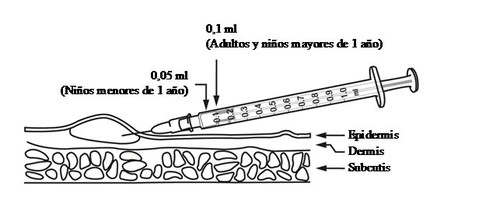
BCG Vaccine should be administered using a 1 mL syringe graduated in hundredths of mL (1/100 mL), equipped with a short-bevel 25G or 26G needle. Jet injectors or multiple puncture devices must not be used for administration of this vaccine.
Overdose or incorrect administration
An overdose increases the risk of suppurative lymphadenitis and may lead to excessive eschar formation.
Massive overdose increases the risk of adverse effects of BCG vaccine.
Deep injection of the vaccine increases the risk of suppurative ulcer, lymphadenitis and abscess formation.
Management of complications following BCG vaccination
Advice should be sought regarding the appropriate treatment regimen for managing systemic infections or persistent local infections following BCG vaccination.
Sensitivity of the BCG strain to antibiotics:
The table below indicates minimum inhibitory concentration (MIC) values for selected antituberculosis drugs against Danish Strain 1331 [determined by the Bactec 460 method].
The MIC for isoniazid is 0.4 mg/L. There is no consensus on whether Mycobacterium bovis should be classified as susceptible, intermediate or resistant to isoniazid when the MIC is 0.4 mg/L. However, based on the criteria established for Mycobacterium tuberculosis, the strain is considered to have intermediate susceptibility.
Drug | Minimum Inhibitory Concentration (MIC) |
Isoniazid | 0.4 mg/l |
Streptomycin | 2.0 mg/l |
Rifampicin | 2.0 mg/l |
Ethambutol | 2.5 mg/l |
The Danish strain 1331 is resistant to pyrazinamide.