Barigraf AD 333.2 g powder for oral suspension
Spain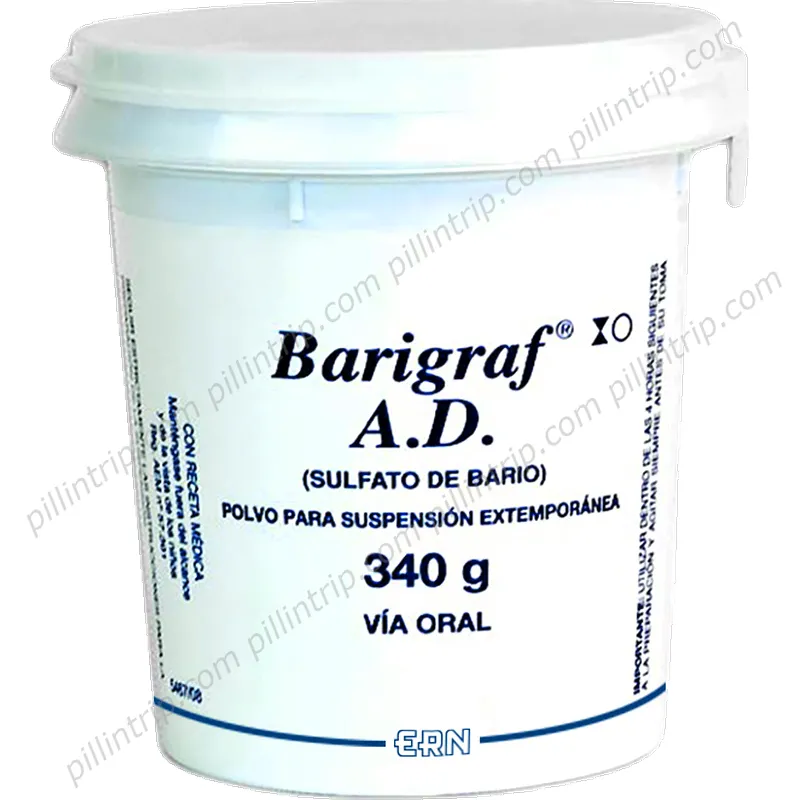
Table of Contents
Package leaflet: Information for the user
Introduction
Package leaflet: information for the user
BARIGRAF AD 333.2 g powder for oral suspension
Barium sulfate
Read all of this leaflet carefully before you start taking this medicine, because it contains important information for you.
- Keep this leaflet; you may need to read it again.
- If you have any questions, ask your doctor, pharmacist, or nurse.
- This medicine has been prescribed for you only, and you should not give it to other people, even if they have the same symptoms as you, because it may harm them.
- If you experience any adverse effects, consult your doctor, pharmacist, or nurse, even if they are adverse effects not listed in this leaflet.
Contents of the leaflet
- What Barigraf AD is and what it is used for
- What you need to know before taking Barigraf AD
- How to take Barigraf AD
- Possible adverse effects
- How to store Barigraf AD
- Contents of the pack and other information
1. What Barigraf AD is and what it is used for
This medicine is for diagnostic use only.
Barigraf AD belongs to a group of medicines called radiological contrast agents for X-rays, which contain barium sulfate with suspending agents.
Barigraf AD is a radio-opaque diagnostic agent used to enhance contrast during visualization of the esophagus and gastrointestinal tract by means of certain radiological techniques:
- Its oral use is indicated as a contrast medium in radiological examinations (X-rays) of the esophagus, stomach, and duodenum using the double-contrast technique.
Barigraf AD is indicated in the pediatric population for opacification of the upper and lower gastrointestinal tract only in simple contrast X-ray examinations, as an aid in the diagnosis of pathologies affecting these organs.
2. What you need to know before taking Barigraf AD
Do not take Barigraf AD:
- If you are allergic (hypersensitive) to the active substance or to any of the other components of this medicine (listed in section 6).
- If you have inflammation of the abdominal cavity walls (irritated peritoneum).
- If you have or suspect you have a complete obstruction of the gastrointestinal tract.
- If you have narrowing of the pylorus (pyloric stenosis).
- If you have or suspect you have a perforation of the gastrointestinal tract.
- If you have postoperative gastrointestinal suture dehiscence (opening of the suture).
- If you have a history of or suspect intestinal perforation.
- If you have intestinal fistulas.
- If you have tracheoesophageal or bronchoesophageal fistulas.
- If you have recently suffered injuries or chemical burns in the esophagogastric-intestinal tract.
- If you have inadequate blood supply (ischemia) to the intestinal wall.
- If you have an inflammatory bowel disease called "necrotizing enterocolitis".
- If you are about to undergo gastrointestinal surgery.
- During the 7 days following endoscopic resection.
- During the 4 weeks following concomitant radiotherapy.
Warnings and precautions
Consult your doctor, pharmacist, or nurse before starting to take Barigraf AD.
Special care should be taken when administering Barigraf AD:
- If you are an elderly person with diseases, mainly cardiovascular, as the examination may be stressful for you.
- If you have high-grade stenosis (narrowing), especially those located further from the stomach (distal), or conditions and diseases with a high risk of perforation, such as known gastrointestinal fistulas and carcinomas, inflammatory bowel disease, diverticulitis (inflammation of a diverticulum), diverticulosis, and amebiasis (infection caused by amoebae), as in these cases a careful benefit/risk assessment is required.
During the radiological examination, penetration of barium sulfate into parenteral areas such as tissues, vascular space, body cavities, or respiratory tract must be prevented to avoid potentially serious adverse reactions.
You should also ensure adequate hydration after the procedure to prevent severe constipation.
To avoid potentially serious adverse reactions, during the diagnostic process, penetration of barium sulfate into areas outside the gastrointestinal tract (parenteral) such as tissues, vascular space, body cavities, or respiratory tract must be prevented.
In the event of massive product aspiration, intravasation (penetration into blood vessels), or perforation, immediate specialized medical intervention, intensive care, or even surgery may be necessary.
During the radiological examination, barium sulfate may accumulate in colonic diverticula, potentially promoting and/or worsening infectious processes at these sites.
If barium sulfate coproliths (baroliths) form due to thickening of the barium sulfate suspension, administration of laxatives and/or saline purgatives (containing salts or minerals) is recommended.
Other medicines and Barigraf AD
Inform your doctor or pharmacist if you are taking, have recently taken, or might need to take any other medicines.
Certain medicines may interact with Barigraf AD; in such cases, it may be necessary to adjust the dose or discontinue treatment with one of the medicines. It is especially important that you inform your doctor if you are taking any of the following medicines:
- Medicines that reduce intestinal peristalsis (wave-like contractions along the intestine): Taking these medicines may cause thickening of the barium sulfate suspension, which may increase the risk of constipation.
Pregnancy and breastfeeding
If you are pregnant or breastfeeding, think you may be pregnant, or plan to become pregnant, consult your doctor or pharmacist before using this medicine.
The safety of barium contrast agents in pregnant patients has not been sufficiently established. Radiological examinations should not be performed in pregnant women unless strictly necessary or when the benefit to the mother outweighs the risk to the fetus. In any case, due to the teratogenic effects of radiation exposure during pregnancy, regardless of whether a contrast agent is used or not, the benefit of the radiological examination must be carefully evaluated.
The safety of Barigraf AD in women who are breastfeeding has not been investigated. Contrast agents are excreted in breast milk in minimal amounts. Harm to the infant is not expected, and your doctor will assess the benefit/risk balance before proceeding with the examination.
The use of Barigraf AD is not contraindicated during breastfeeding.
Driving and use of machines
Barigraf AD does not affect the ability to drive or operate tools or machinery.
Barigraf AD contains sodium (sodium saccharin, sodium citrate) and sorbitol (E-420)
This medicine contains 0.22 mg of sodium (main component of table/cooking salt) per g of Barigraf AD, equivalent to 73.6 mg of sodium per 340 g glass of Barigraf AD. This corresponds to 3.68% of the maximum daily sodium intake recommended for an adult.
This medicine contains 12.88 mg of sorbitol per g of Barigraf AD (4.38 g per 340 g glass of Barigraf AD). Sorbitol is a source of fructose. If your doctor has informed you (or your child) that you have an intolerance to certain sugars, or if you (or your child) have been diagnosed with hereditary fructose intolerance (HFI), a rare genetic disorder in which patients cannot metabolize fructose, consult your doctor (or your child's doctor) before receiving this medicine.
3. How to take Barigraf AD
Follow exactly the administration instructions for this medicine given by your doctor. If in doubt, consult your doctor or pharmacist again.
Medical personnel will administer Barigraf AD orally.
Your doctor will determine the correct amount and dosing schedule of the product required for your radiographic examination, depending on your age, weight, and the technique to be used.
Use in children and adolescents
In infants and children, the dose will be appropriately adjusted by the doctor according to the child's age, body weight, and the specific requirements of pediatric radiodiagnosis.
For elderly patients, there are no special dosage recommendations.
Consult your doctor if you require clarification regarding the examination procedure. It is important to follow your doctor's instructions after the examination is completed.
Patient preparation
You should drink plenty of water after the examination to reduce the risk of constipation.
Patient preparation for X-ray examination of the stomach:
If abundant acid secretion (stomach acidity) is observed on an empty stomach, your doctor may aspirate the gastric secretion as much as possible, or schedule the examination for another day (in the morning, as early as possible).
Some physicians use acid secretion inhibitors (medications that reduce the amount of acid produced in the stomach) prior to the X-ray examination, in order to enhance the adherence of the contrast medium to the stomach walls. The test result may be improved by additionally administering, via intravenous or intramuscular route, an antispasmodic agent that reduces gastric tone, decreases peristalsis, and delays gastric emptying.
To distend the different regions of the stomach, it is recommended to simultaneously administer a medication with carbon dioxide-forming effect.
Patient preparation for pediatric use:
Newborn patients (neonates) do not need to be fasting. Children aged 1–24 months should fast for 4 hours before the test, children aged 2–4 years for 6 hours, and children aged 4–14 years for 8 hours prior to the examination, although in the latter case they may drink a small amount of water up to 3 hours before the study.
In young children, it is advisable not to give the last feeding prior to the examination to facilitate contrast ingestion.
If you take more Barigraf AD than you should
Rarely, repeated administration of barium sulfate suspensions may cause stomach cramps and diarrhea. These reactions are transient and not considered serious.
In examinations involving high-dose barium enemas, an electrolyte imbalance in blood serum may occur due to the large amount of water retained by the contrast medium. In such cases, the risk may be reduced by adding a sodium chloride enema. Serum electrolyte balance is restored through appropriate infusion therapy.
In case of overdose or accidental ingestion, contact the Toxicology Information Service. Telephone 91.562.04.20, indicating the name of the medicine and the amount ingested.
If you forget to take Barigraf AD
Do not take a double dose to make up for forgotten doses.
If you stop taking Barigraf AD
If you have any further questions about the use of this medicine, ask your doctor, pharmacist, or nurse.
4. Possible adverse effects
Like all medicines, Barigraf AD can cause adverse effects, although not everyone experiences them.
Serious adverse reactions reported with barium sulfate formulations are generally associated with faulty administration techniques or pre-existing pathological conditions.
Rare adverse effects (may affect up to 1 in 1,000 people)
- Allergic reactions (urticaria, anaphylactic shock, skin rashes).
Very rare adverse effects (may affect up to 1 in 10,000 people)
- Entry of barium into the bloodstream and blockage of a blood vessel.
- Formation of baroliths that may cause obstruction of the large intestine.
Adverse effects of unknown frequency (cannot be estimated from available data)
- Aspiration pneumonitis.
- Increase or worsening of intestinal obstruction.
- In inflammation of the large intestine, barium sulfate may become retained and cause or worsen infectious processes.
Reporting of adverse effects
If you experience any adverse effect, consult your doctor, pharmacist, or nurse, even if it is a possible adverse effect not listed in this leaflet. You may also report them directly through the Spanish Pharmacovigilance System for Human Medicinal Products: https://www.notificaram.es. By reporting adverse effects, you can help provide more information on the safety of this medicine.
5. Storage of Barigraf AD
No special storage conditions are required.
Keep in the original packaging to protect from moisture.
Keep this medicine out of the sight and reach of children.
Do not use this medicine after the expiry date stated on the container. The expiry date refers to the last day of the month indicated.
Medicines must not be disposed of via wastewater or household waste. Dispose of unused medicines and their containers at the SIGRE collection point at your pharmacy. If you are unsure, ask your pharmacist how to dispose of medicines and containers you no longer need. This will help protect the environment.
6. Contents of the pack and other information
Composition of Barigraf AD
- The active substance is Barium Sulfate. 100 g of oral suspension powder contains 98 g of barium sulfate.
- 1 glass of 340 g of oral suspension powder contains 333.2 g of barium sulfate.
- Other components are: Sorbitol (E-420), Ethylmaltol, Sodium Saccharin (E-954), Sodium Citrate (E-331), Citric Acid Monohydrate, Hydrolyzed Carrageenan, Gatti Gum, Cassis Flavor, Strawberry Flavor, Simethicone, Polyethylene Glycol 20 Glycerol Laurate, FD&C Red No. 40 Aluminum Lake.
Presentation of the product and contents of the pack
Barigraf AD is presented as a powder in a single-dose polyethylene glass.
Each pack contains 340 g of oral suspension powder.
Barigraf AD is available in packs of 1 unit and clinical packs of 10 units.
Only certain pack sizes may be marketed.
Marketing Authorization Holder:
Laboratorios ERN, S.A.
C/Perú, 228 - 08020 Barcelona, Spain
Manufacturers:
Laboratorios Edefarm S.L
Polígono Industrial Enchilagar del Rullo. Nave 117. 46191 Vilamarxant. Valencia. Spain.
Or
Laboratorios ERN, S.A.
C/Gorgs Lladó, 188
Pol. Ind. Can Salvatella
08210 Barberá del Vallés (Barcelona), Spain.
Date of the most recent review of this leaflet: January 2016
Other sources of information
Detailed and up-to-date information on this medicinal product is available on the website of the Spanish Agency of Medicines and Health Products (AEMPS): http://www.aemps.gob.es
This information is intended solely for physicians and healthcare professionals:
Instructions for the correct preparation of the suspension
Detach the powder from the bottom of the glass by inverting it. It is recommended to first mix the contents of the glass with a small amount of drinking water to obtain a homogeneous paste. Then, add more drinking water gradually to the paste until reaching the desired powder/water ratio (see section 4.2 Posology and method of administration in the Summary of Product Characteristics). Mix the mixture vigorously for 1 minute, let it stand for 5 minutes, and then mix again vigorously for 1 minute. Ensure that all the powder has been wetted and that there are no lumps.
The prepared suspension should be administered 15 minutes before starting the radiological examination.
If using a mechanical mixer/shaker, take special care to avoid incorporating air bubbles into the preparation.
The resulting suspension must have a uniform consistency and be free of particle aggregates.
If necessary, to administer the suspension at body temperature, hot water at 35–40°C may be used. Water must not be heated above 60°C due to the presence of thermosensitive excipients. In this case, the temperature of the suspension should be checked.
The complete Summary of Product Characteristics for Barigraf AD is supplied as a separate document within the product pack, providing healthcare professionals with additional scientific and practical information on the administration and use of this medicinal product.
Please consult the Summary of Product Characteristics (the Summary of Product Characteristics must be included in the package).