BalcoGA 20 mg film-coated tablets EFG
Spain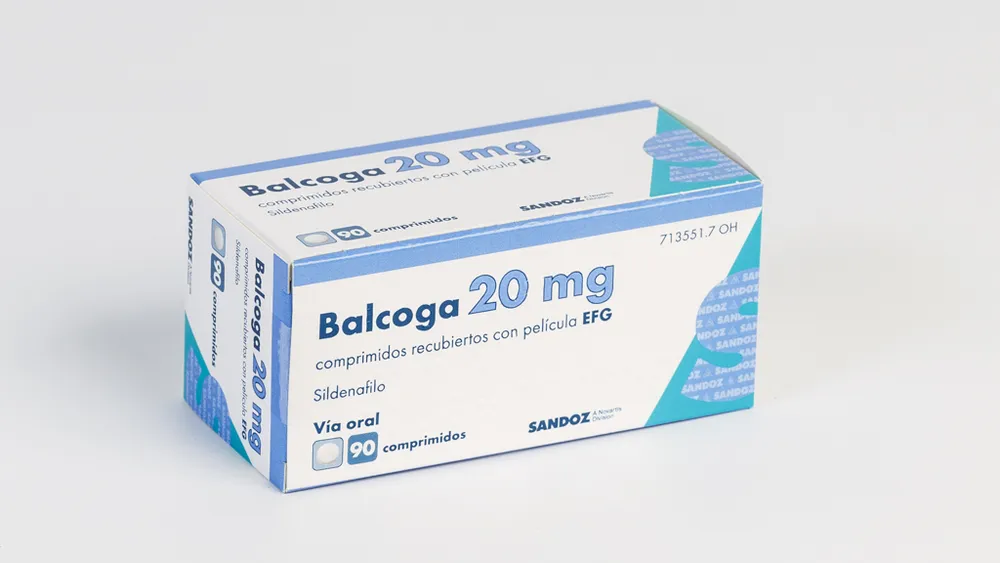
Table of Contents
Package leaflet: Information for the user
Introduction
Package leaflet: information for the patient
Balcoga 20 mg film-coated tablets EFG
Sildenafil
Read the entire leaflet carefully before you start taking this medicine, because it contains important information for you.
-
Keep this leaflet, as you may need to read it again.
-
If you have any questions, ask your doctor or pharmacist.
-
This medicine has been prescribed for you only, and you should not give it to other people, even if they have the same symptoms as you, because it may harm them.
- If you experience any adverse effects, consult your doctor or pharmacist, even if they are adverse effects not listed in this leaflet. See section 4.
Contents of the leaflet
- What Balcoga is and what it is used for
- What you need to know before taking Balcoga
- How to take Balcoga
- Possible side effects
- How to store Balcoga
- Contents of the pack and other information
1. What Balcoga is and what it is used for
Balcoga contains the active substance sildenafil, which belongs to a group of medicines called phosphodiesterase type 5 (PDE5) inhibitors.
Balcoga lowers blood pressure in the lungs by dilating the blood vessels in the lungs. Balcoga is used to treat high blood pressure in the blood vessels of the lung (pulmonary arterial hypertension) in adults and children and adolescents aged 1 to 17 years.
2. What you need to know before taking Balcoga
Do not take Balcoga:
- if you are allergic to sildenafil or any of the other ingredients of this medicine (listed in section 6),
- if you are taking medicines containing nitrates or nitric oxide donors such as amyl nitrite ("poppers").
These medicines are often prescribed to relieve chest pain (or angina pectoris). Balcoga may significantly increase the effects of these medicines. You must inform your doctor if you are taking any of these medicines. If you are unsure, consult your doctor or pharmacist.
- if you are taking riociguat. This medicine is used to treat pulmonary arterial hypertension (i.e., high blood pressure in the lungs) and chronic thromboembolic pulmonary hypertension (i.e., high blood pressure in the lungs caused by blood clots). PDE5 inhibitors, such as Balcoga, have been shown to increase the hypotensive effect of this medicine. If you are taking riociguat or are unsure, consult your doctor,
- if you have recently had a stroke or heart attack, or if you have severe liver disease or very low blood pressure (<90/50 mmHg),
- if you are taking a medicine to treat fungal infections such as ketoconazole or itraconazole, or medicines containing ritonavir (for AIDS),
- if you have previously experienced vision loss due to a problem with blood flow to an eye nerve called non-arteritic anterior ischemic optic neuropathy (NAION).
Warnings and precautions
Consult your doctor before starting Balcoga if:
- you have a lung disease caused by blockage or narrowing of a vein in the lungs rather than blockage or narrowing of an artery,
- you have a serious heart condition,
- you have a problem with the pumping chambers of the heart,
- you have high blood pressure in the blood vessels of the lungs,
- you have low blood pressure at rest,
- you are losing large amounts of body fluids (dehydration), which may occur when you sweat excessively or do not drink enough fluids. This may happen if you are ill with fever, vomiting, or diarrhea,
- you suffer from a rare inherited eye disease (retinitis pigmentosa),
- you have a red blood cell disorder (sickle cell anemia), blood cell cancer (leukemia), bone marrow cancer (multiple myeloma), or any disease or deformity of the penis,
- you currently have a stomach ulcer, bleeding disorders (such as hemophilia), or nosebleeds,
- you are using medicines for erectile dysfunction.
When PDE5 inhibitors, including sildenafil, are used to treat erectile dysfunction (ED), the following adverse visual effects have been reported with unknown frequency: decrease or sudden, temporary or permanent partial or complete vision loss in one or both eyes.
If you experience sudden reduction or loss of vision, stop taking this medicine and consult your doctor immediately (see also section 4).
Prolonged and sometimes painful erections have been observed in men taking sildenafil. If you have an erection lasting longer than 4 hours, stop taking this medicine and consult your doctor immediately (see also section 4).
Special precautions in patients with kidney or liver problems
Inform your doctor if you have kidney or liver problems, as a dose adjustment may be necessary.
Children
Balcoga must not be administered to children under 1 year of age.
Other medicines and Balcoga
Inform your doctor or pharmacist if you are taking, have recently taken, or might need to take any other medicines.
- medicines containing nitrates or nitric oxide donors such as amyl nitrite ("poppers"). These medicines are often used to relieve chest pain or angina pectoris (see section 2. What you need to know before taking Balcoga),
- inform your doctor or pharmacist if you are taking riociguat,
- treatments for pulmonary hypertension (e.g., bosentan, iloprost),
- medicines containing St. John's wort (herbal remedy), rifampicin (used to treat bacterial infections), carbamazepine, phenytoin, and phenobarbital (used, among others, to treat epilepsy),
- medicines that inhibit blood coagulation (e.g., warfarin), although no adverse effects have been reported,
- medicines containing erythromycin, clarithromycin, telithromycin (antibiotics used to treat certain bacterial infections), saquinavir (for AIDS), or nefazodone (for depression), as dose adjustment may be necessary,
- alpha-blocker therapy (e.g., doxazosin) for the treatment of hypertension or prostate problems, as the combination of these two medicines may cause symptoms of low blood pressure (e.g., dizziness, fainting),
- medicines containing sacubitril/valsartan, used to treat heart failure.
Taking Balcoga with food and drinks
You should not drink grapefruit juice while being treated with Balcoga.
Pregnancy and lactation
If you are pregnant or breastfeeding, think you may be pregnant, or plan to become pregnant, consult your doctor or pharmacist before using this medicine.
Sildenafil should not be used during pregnancy unless absolutely necessary.
Sildenafil should not be administered to women of childbearing age unless adequate contraceptive methods are used.
Balcoga passes into breast milk at very low levels and is not expected to harm your baby.
Driving and using machines
Balcoga may cause dizziness and affect vision. You should know how you react to this medicine before driving or operating machinery.
Balcoga contains sodium
This medicine contains less than 1 mmol of sodium (23 mg) per film-coated tablet; hence, it is essentially "sodium-free".
3. How to take Balcoga
Follow exactly the instructions for administering this medicine as given by your doctor. If in doubt, consult your doctor or pharmacist again.
For adults, the recommended dose is 20 mg three times a day (taken at intervals of 6 to 8 hours), taken with or without food.
Use in children and adolescents
For children and adolescents aged 1 to 17 years, the recommended dose is 10 mg three times a day for children and adolescents ≤ 20 kg, or 20 mg three times a day for children and adolescents > 20 kg, administered with or without food. Higher than recommended doses must not be used in children.
This medicine should only be used in cases where a dose of 20 mg three times a day is required.
For administration in patients weighing equal to or less than 20 kg and in other younger patients who cannot swallow tablets, other more suitable pharmaceutical forms may be used.
If you take more Balcoga than you should
Do not take more medicine than your doctor has prescribed.
If you have taken more Balcoga than you should, contact your doctor, pharmacist, or call the Toxicology Information Service immediately at telephone number: 91 562 04 20, indicating the medicine and the amount taken.
Taking more than the prescribed amount may increase the risk of known adverse effects.
If you forget to take Balcoga
If you forget to take Balcoga, take the missed dose as soon as you remember, and then continue taking your medicine at the regular times. Do not take a double dose to make up for forgotten doses.
If you stop taking Balcoga
Stopping treatment with Balcoga suddenly may lead to worsening of your symptoms.
Do not stop taking this medicine unless your doctor tells you to. Your doctor will advise you on how to gradually reduce the dose over a few days before stopping completely.
If you have any further questions about the use of this medicine, ask your doctor or pharmacist.
4. Possible adverse effects
Like all medicines, this medicine can cause adverse effects, although not everyone will experience them.
If you experience any of the following adverse effects, stop taking Balcoga and inform your doctor immediately (see section 2):
- if you experience a sudden reduction or loss of vision (frequency not known),
- if you have an erection lasting continuously for more than 4 hours. Prolonged and sometimes painful erections have been reported after taking sildenafil in men (frequency not known).
Adults
Very commonly reported adverse effects (may affect more than 1 in 10 patients) were: headache or facial flushing, indigestion, diarrhoea, and pain in arms and legs.
Commonly reported adverse effects (may affect up to 1 in 10 patients) are: skin infection, flu-like symptoms, nasal sinus inflammation, reduction in the number of red blood cells (anaemia), fluid retention, difficulty sleeping, anxiety, migraine, tremor, tingling sensation, burning sensation, reduced sense of touch, bleeding from the back of the eye, vision disturbances, blurred vision, light sensitivity, effects on colour perception, eye irritation, red eyes, dizziness, bronchitis, nosebleed, runny nose, cough, nasal congestion, stomach inflammation, gastroenteritis, burning sensation, haemorrhoids, abdominal distension, dry mouth, hair loss, skin redness, night sweats, muscle pain, back pain, and increased body temperature.
Uncommonly reported adverse effects (may affect up to 1 in 100 patients) included: reduced visual acuity, double vision, unusual sensation in the eye, penile bleeding, presence of blood in semen and/or urine, and breast enlargement in men.
Skin rashes, decreased or sudden loss of hearing, and reduction in blood pressure have also been reported with unknown frequency (cannot be estimated from available data).
Children and adolescents
The following serious adverse effects have been frequently reported (may affect up to 1 in 10 patients): pneumonia, heart failure, right-sided heart failure, cardiogenic shock, high blood pressure in the lungs, chest pain, dizziness, respiratory infections, bronchitis, viral infection of the stomach and intestines, urinary tract infections, and dental perforations.
The following serious adverse effects considered related to treatment have been reported uncommonly (may affect up to 1 in 100 patients): allergic reaction (such as skin rash, swelling of the face, lips and tongue, sneezing, difficulty breathing or swallowing), seizures, irregular heartbeat, hearing disturbances, shortness of breath, inflammation of the gastrointestinal tract, and sneezing due to airflow disturbances.
Very commonly reported adverse effects (may affect more than 1 in 10 people) were: headache, vomiting, throat infection, fever, diarrhoea, flu, and nosebleed.
Frequently reported adverse effects (may affect up to 1 in 10 patients) were: nausea, increased frequency of erections, pneumonia, and runny nose.
Reporting of adverse effects
If you experience any adverse effects, consult your doctor or pharmacist, even if they are possible adverse effects not listed in this leaflet. You can also report them directly via the Spanish Pharmacovigilance System for Human Medicines: https://www.notificaram.es. By reporting adverse effects, you can help provide more information on the safety of this medicine.
5. Storage of Balcoga
Keep this medicine out of the sight and reach of children.
Do not use this medicine after the expiry date which is stated on the container and blister after EXP/CAD. The expiry date refers to the last day of the month indicated.
This medicine does not require any special storage conditions.
Medicines should not be disposed of via wastewater or household waste. Unused containers and medicines should be returned to the SIGRE collection point at your pharmacy. If you are unsure, please ask your pharmacist how to dispose of containers and medicines you no longer need. This will help protect the environment.
6. Contents of the pack and other information
Composition of Balcoga
- The active substance is sildenafil. Each film-coated tablet contains sildenafil citrate equivalent to 20 mg of sildenafil.
- The other components are:
Tablet core: microcrystalline cellulose, anhydrous calcium hydrogen phosphate, sodium croscarmellose, copovidone, magnesium stearate.
Coating: hypromellose, titanium dioxide (E171), macrogol 4000.
Appearance of the product and pack contents
Balcoga is a white, round film-coated tablet (diameter 7.1 mm), biconvex, marked with “20” on one side, packed in PVC/Aclar/aluminum blisters.
Pack sizes: 30, 90, 100, 150, 300 tablets and multiple pack of 300 (2 packs of 150 and 3 packs of 100) film-coated tablets.
Only some pack sizes may be marketed.
Marketing Authorization Holder and Manufacturer
Marketing Authorization Holder
Sandoz Farmacéutica, S.A.
Centro Empresarial Parque Norte
Edificio Roble
C/ Serrano Galvache, 56
28033 Madrid
Spain
Manufacturer
Salutas Pharma GmbH
Otto-von-Guericke-Allee 1,
D - 39179 Barleben,
Germany
Date of the most recent revision of the package leaflet: December 2023.
Detailed information on this medicinal product is available on the website of the Spanish Agency of Medicines and Medical Devices (AEMPS) http://www.aemps.gob.es/