Azithromycin Tarbis 40 mg/ml powder for oral suspension in bottle EFG
Spain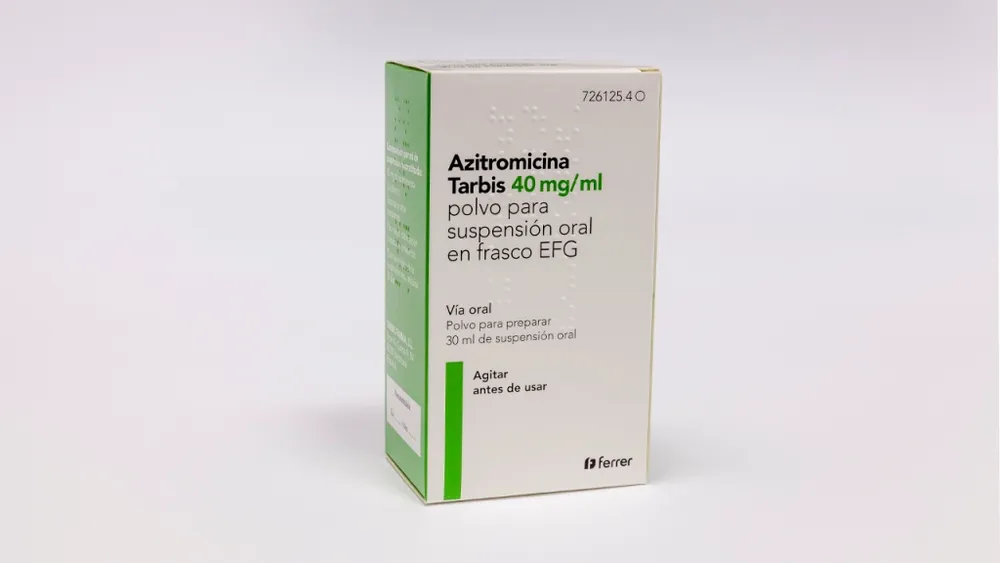
Table of Contents
- Package leaflet: Information for the user
- Introduction
- 1. What Azithromycin Tarbis 40 mg/ml is and what it is used for
- 2. What you need to know before taking Azithromycin Tarbis 40 mg/ml
- 3. How to take Azithromycin Tarbis 40 mg/ml
- 4. Possible adverse effects
- **Reporting of adverse reactions**
- 5. Storage of Azithromycin Tarbis 40 mg/ml
- 6. Contents of the pack and other information
Package leaflet: Information for the user
Introduction
Package leaflet: information for the user
Azithromycin Tarbis 40 mg/ml powder for oral suspension in bottle EFG
Azithromycin (dihydrate)
Read the entire leaflet carefully before you start taking this medicine, because it contains important information for you.
- Keep this leaflet, as you may need to read it again.
- If you have any questions, ask your doctor or pharmacist.
- This medicine has been prescribed for you only, and you should not give it to others, even if they have the same symptoms as you, because it could harm them.
- If you experience any adverse reactions, consult your doctor or pharmacist, even if they are adverse reactions not listed in this leaflet. See section 4.
Leaflet contents
- What Azithromycin Tarbis 40 mg/ml is and what it is used for
- What you need to know before taking Azithromycin Tarbis 40 mg/ml
- How to take Azithromycin Tarbis 40 mg/ml
- Possible side effects
- How to store Azithromycin Tarbis 40 mg/ml
- Contents of the pack and other information
1. What Azithromycin Tarbis 40 mg/ml is and what it is used for
Azithromycin belongs to a group of antibiotics known as macrolide antibiotics.
Antibiotics are used to treat bacterial infections and are not effective against viral infections such as flu or the common cold.
It is important that you follow your doctor's instructions regarding dose, dosing interval, and duration of treatment.
Do not store or reuse this medicine. If you have any antibiotic left over after completing your treatment, return it to the pharmacy for proper disposal. Medicines must not be disposed of via wastewater or household waste.
It is used to treat the following infections:
- Upper and lower respiratory tract infections, such as otitis media, sinusitis, pharyngotonsillitis, bronchitis, and pneumonia.
- Skin and soft tissue infections.
- Sexually transmitted diseases.
2. What you need to know before taking Azithromycin Tarbis 40 mg/ml
Do not take Azithromycin Tarbis:
- if you are allergic (hypersensitive) to azithromycin, to any other macrolide antibiotic, or to any of the other ingredients of this medicine (listed in section 6).
Warnings and precautions
Consult your doctor or pharmacist before starting to take Azithromycin Tarbis:
- If you have a severe liver disease. In this case, inform your doctor.
- If you develop diarrhea during treatment or after treatment has ended, inform your doctor.
- As with other antibiotics, overgrowth of fungi (fungal superinfection) may occur during treatment with this medicine. If this happens to you, inform your doctor.
- If you experience any allergic reaction during treatment with Azithromycin Tarbis, characterized by symptoms such as itching, redness, skin rash, swelling, or difficulty breathing. If this occurs, you must inform your doctor immediately.
Children
Azithromycin Tarbis must not be given to children under 6 months of age.
Use of Azithromycin Tarbis with other medicines
Inform your doctor or pharmacist if you are taking, have recently taken, or might need to take any other medicines.
Azithromycin may interact with other medicines. Inform your doctor or pharmacist if you are taking any of the following medicines:
- Ergot derivatives (such as ergotamine, used for the treatment of migraine).
- Cyclosporine (a medicine used in transplant patients).
- Digoxin (a medicine used to treat heart arrhythmias).
- Colchicine (used for gout and familial Mediterranean fever).
- Antacids, cimetidine (medicines used for digestive problems). If you are taking antacids and Azithromycin Tarbis, it is recommended to avoid administering both medicines at the same time of day.
- Dicoumarol anticoagulants (medicines used to prevent blood clots).
- Nelfinavir, zidovudine (medicines for the treatment of infections caused by the human immunodeficiency virus).
- Terfenadine (a medicine used to treat allergies and hay fever).
- Rifabutin (a medicine for the treatment of pulmonary tuberculosis and non-pulmonary infections caused by mycobacteria).
Pregnancy and breastfeeding
If you are pregnant or breastfeeding, think you may be pregnant, or are planning to become pregnant, consult your doctor or pharmacist before using this medicine.
The use of Azithromycin Tarbis during pregnancy and breastfeeding is not recommended unless, in the physician's judgment, the benefit outweighs the risk to the child.
Driving and operating machinery
There is no evidence that Azithromycin Tarbis has any effect on the ability to drive or operate machinery.
Azithromycin Tarbis contains sucrose
This medicine contains sucrose. If your doctor has informed you of an intolerance to certain sugars, consult with him before taking this medicine.
Patients with diabetes mellitus should be aware that this medicine contains 3.6 g of sucrose per 5 ml of reconstituted suspension.
3. How to take Azithromycin Tarbis 40 mg/ml
Follow exactly the instructions given by your doctor for taking this medicine. If in doubt, consult your doctor or pharmacist again.
Remember to take your medicine.
Your doctor will tell you how long to take Azithromycin Tarbis. Do not stop treatment early, as there is a risk of disease relapse.
The dose will be determined by your doctor according to your individual needs and the type of infection. To achieve optimal efficacy, strictly follow your doctor's instructions regarding dose and duration of treatment.
The recommended dose is:
Adults (including elderly patients): To more easily adjust the dose, it is advisable to use other presentations.
The recommended dose is 500 mg once daily for 3 consecutive days, for a total dose of 1500 mg. Alternatively, the same total dose may be administered over 5 days, with 500 mg on the first day, followed by 250 mg daily from day 2 to day 5.
For the treatment of sexually transmitted infections, the dose is 1000 mg taken as a single oral dose.
Children and adolescents: In general, with the sole exception of treatment for streptococcal pharyngotonsillitis, the recommended dose is 10 mg/kg/day, given as a single dose for 3 consecutive days. Alternatively, the same total dose may be administered over 5 days, with 10 mg/kg on the first day, followed by 5 mg/kg/day from day 2 to day 5, given as a single daily dose. The dosing schedule according to body weight is as follows:
-
Less than 15 kg: 10 mg/kg/day (given as a single dose) for 3 consecutive days; alternatively, 10 mg/kg on day 1, followed by 5 mg/kg once daily for the next 4 days.
-
15–25 kg: 200 mg/day (given as a single dose) for 3 consecutive days; alternatively, 200 mg on day 1, followed by 100 mg once daily for the next 4 days.
-
26–35 kg: 300 mg/day (given as a single dose) for 3 consecutive days; alternatively, 300 mg on day 1, followed by 150 mg once daily for the next 4 days.
-
36–45 kg: 400 mg/day (given as a single dose) for 3 consecutive days; alternatively, 400 mg on day 1, followed by 200 mg once daily for the next 4 days.
-
Over 45 kg: Same adult dose (500 mg/day, given as a single dose for 3 days).
For the treatment of streptococcal pharyngotonsillitis, a dose of 20 mg/kg/day should be administered for 3 consecutive days, without exceeding the maximum daily dose of 500 mg.
If you think that the effect of Azithromycin Tarbis is too strong or too weak, tell your doctor or pharmacist.
Method of administration
Azithromycin Tarbis 40 mg/ml powder for oral suspension in bottle is administered orally. To facilitate administration, each bottle is supplied with an oral dosing syringe.
The powder for suspension may exceed the fill line marked on the bottle. This is normal and due to the specific density of the preparation.
Preparation of the suspension:
-
Invert the bottle and gently shake until all the powder moves freely.
-
Open the bottle and add the following amount of water according to the bottle size, using the provided dosing syringe:
- 15 ml bottle: add 10 ml of water
- 30 ml bottle: add 15 ml of water
-
Place the perforated plastic cap and press it down until it is fully inserted into the mouth of the bottle.
-
Close the bottle with the metal cap.
-
Shake vigorously until a homogeneous suspension is obtained. The level of the suspension will reach the mark indicated on the label.
-
Remember to shake the suspension before each dose.
Administration of the preparation:
- Remove the metal safety cap. Insert the dosing syringe into the perforated plastic cap.
- While keeping the syringe inserted, invert the bottle so that it remains in an upright position.
- Draw up the suspension into the syringe to the mark corresponding to the dose prescribed by your doctor.
- Turn the bottle back upright, remove the syringe, and administer the dose.
- Wash the syringe after each use.
If you take more Azithromycin Tarbis than you should
Contact your doctor or pharmacist immediately.
In case of overdose or accidental ingestion, contact your doctor or pharmacist immediately or call the Toxicology Information Service at: 91 562 04 20, indicating the medication and the amount ingested.
If you forget to take Azithromycin Tarbis
Do not take a double dose to make up for missed doses.
If you have any further questions about the use of this medicine, ask your doctor or pharmacist.
4. Possible adverse effects
Like all medicines, this medicine may cause adverse effects, although not everybody gets them.
Most of the adverse effects observed in clinical trials were mild to moderate in nature, reversible upon discontinuation of the drug, and primarily affected the gastrointestinal system, consisting mainly of nausea, vomiting, diarrhoea, or abdominal pain. Potentially serious adverse reactions such as laryngeal oedema (due to allergic reaction) or disturbances in liver function accompanied by yellowing of the skin occurred rarely.
In addition, during treatment with Azitromicina Tarbis, any of the following adverse effects described for azithromycin when administered orally may occur:
- Thrombocytopenia (reduction in the number of platelets) and transient episodes of mild neutropenia (reduction in the number of white blood cells).
- Reactions including aggression, nervousness, agitation, anxiety, dizziness/vertigo, seizures, headache, somnolence, and hyperactivity.
- Hearing disturbances and, very rarely, taste disturbances.
- Cardiac disorders.
- Gastrointestinal disorders such as anorexia, nausea, vomiting/diarrhoea (rarely leading to dehydration), loose stools, abdominal discomfort (pain/cramps), constipation, flatulence, severe diarrhoea, and very rarely, tongue discoloration.
- Alterations in liver function (rarely severe) and kidney function.
- Skin reactions such as itching, rash, photosensitivity, fluid accumulation, or urticaria (hives). Very rarely, serious skin reactions have occurred. Rare: skin rash characterized by the rapid appearance of red skin areas dotted with small pustules (small blisters filled with white/yellow fluid).
- Joint pain.
- Fungal vaginal infection (vaginitis).
- Fungal infections, fatigue, tingling sensations, and allergic-type reactions.
Reporting of adverse reactions
If you experience any type of adverse reaction, consult your doctor or pharmacist, even if it is a possible adverse reaction not listed in this leaflet. You may also report them directly through the Spanish Pharmacovigilance System for Human Medicinal Products: https://www.notificaram.es. By reporting adverse reactions, you can help provide more information on the safety of this medicine.
5. Storage of Azithromycin Tarbis 40 mg/ml
Keep this medicine out of the sight and reach of children.
Do not store the reconstituted suspension at temperatures above 25°C.
Record the date (day and month) of suspension reconstitution in the box provided for this purpose on both the carton and the vial label.
Do not use this medicine after 10 days from the date of reconstitution; after this period, discard any remaining product.
Do not use this medicine after the expiry date stated on the label and packaging after EXP. The expiry date refers to the last day of the month indicated.
Medicines must not be disposed of via wastewater or household waste. Dispose of unused medicines and their containers at the SIGRE collection point at your pharmacy. If you have any doubts, ask your pharmacist how to properly dispose of unused medicines and their packaging. This helps protect the environment.
6. Contents of the pack and other information
Composition of Azithromycin Tarbis 40 mg/ml
- The active substance is azithromycin. Each ml of reconstituted suspension contains 40 mg of azithromycin (dihydrate).
- The other components (excipients) are: sucrose, hydroxypropylcellulose (E-463), anhydrous trisodium phosphate, xanthan gum (E-415), cherry flavor, vanilla flavor, and banana flavor.
Appearance of the medicine and contents of the pack
Azithromycin Tarbis 40 mg/ml is a powder for oral suspension in a bottle.
Each pack contains one 15 ml or 30 ml bottle.
Only certain pack sizes may be marketed.
Marketing Authorization Holder and Manufacturer
Marketing Authorization Holder:
TARBIS FARMA, S.L.
Gran Vía Carlos III, 94
08028-BARCELONA (Spain)
Manufacturer:
KERN PHARMA, S.L.
Polígono Ind. Colón II
Venus, 72
08228 Terrassa (Barcelona)
Date of the most recent revision of this leaflet: May 2018
Detailed and up-to-date information on this medicinal product is available on the website of the Spanish Agency of Medicines and Medical Devices (AEMPS) http://www.aemps.gob.es/