Azacitidine Betapharm 25 mg/ml powder for injection suspension EFG
Spain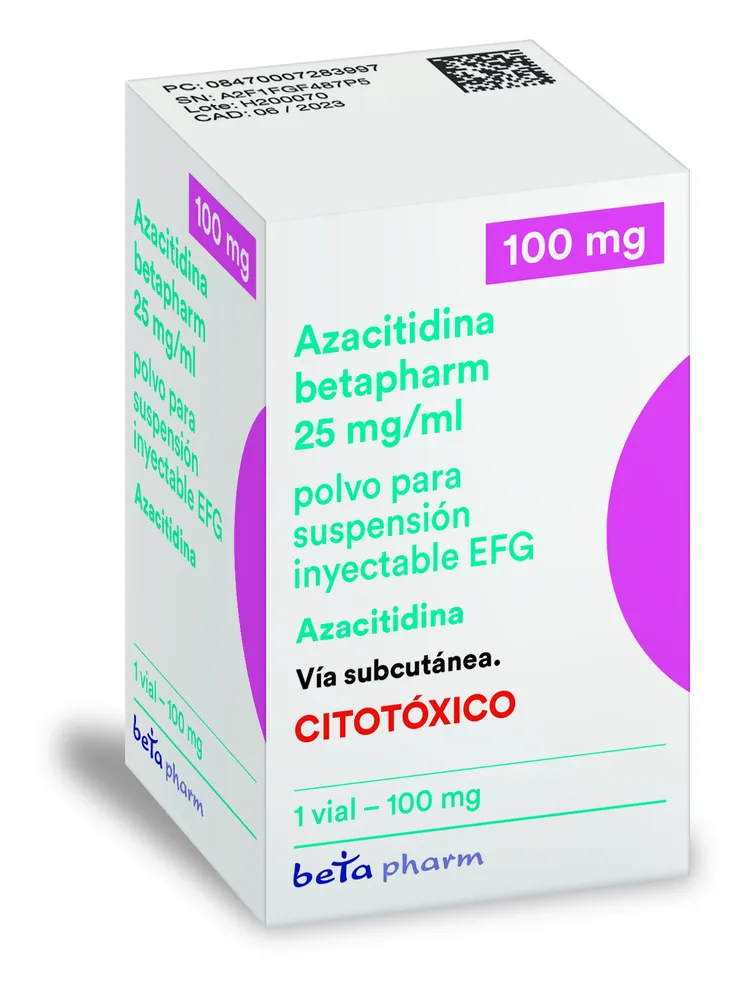
Table of Contents
- Package leaflet: Information for the user
- Introduction
- 1. What Azacitidina betapharm is and what it is used for
- 2. What you need to know before starting Azacitidina betapharm
- 3. How to use Azacitidina betapharm
- 4. Possible adverse effects
- 5. Storage of Azacitidina betapharm
- 6. Contents of the pack and other information
Package leaflet: Information for the user
Introduction
Package leaflet: information for the user
Azacitidina betapharm 25 mg/ml powder for injectable suspension EFG
azacitidine
Read all of this leaflet carefully before you start using this medicine, as it contains important information for you.
- Keep this leaflet, as you may need to read it again.
- If you have any questions, ask your doctor, pharmacist or nurse.
- If you experience any side effects, talk to your doctor, pharmacist or nurse, even if it is a side effect not listed in this leaflet. See section 4.
Contents of the leaflet
- What Azacitidina betapharm is and what it is used for
- What you need to know before using Azacitidina betapharm
- How to use Azacitidina betapharm
- Possible side effects
- How to store Azacitidina betapharm
- Contents of the pack and other information
1. What Azacitidina betapharm is and what it is used for
What Azacitidina betapharm is
Azacitidina betapharm is an anticancer agent belonging to a group of medicines called "antimetabolites". Azacitidina betapharm contains the active substance "azacitidine".
What Azacitidina betapharm is used for
Azacitidina betapharm is used in adults who are not eligible for stem cell transplantation to treat:
- High-risk myelodysplastic syndromes (MDS).
- Chronic myelomonocytic leukemia (CMML).
- Acute myeloid leukemia (AML).
These diseases affect the bone marrow and can cause problems in the normal production of blood cells.
How Azacitidina betapharm works
Azacitidina betapharm works by preventing the growth of cancer cells. Azacitidine is incorporated into the genetic material of cells (ribonucleic acid [RNA] and deoxyribonucleic acid [DNA]). It is believed to act by altering the way cells turn genes on or off, interfering with the production of new RNA and DNA. These actions are thought to correct the abnormalities in maturation and growth of healthy blood cells in the bone marrow caused by myelodysplastic disorders, and to kill cancer cells in leukemia.
Consult your doctor or nurse if you have any questions about how Azacitidina betapharm works or why this medicine has been prescribed for you.
2. What you need to know before starting Azacitidina betapharm
Do not use Azacitidina betapharm
- If you are allergic to azacitidine or to any of the other ingredients of this medicine (listed in section 6).
- If you have advanced liver cancer.
- During breastfeeding.
Warnings and precautions
Talk to your doctor, pharmacist, or nurse before starting treatment with Azacitidina betapharm:
- If you have low platelet counts, red blood cells, or white blood cells.
- If you have kidney disease.
- If you have liver disease.
- If you have ever had heart disease or myocardial infarction, or have a history of lung disease.
Blood tests
Before starting treatment with Azacitidina betapharm and at the beginning of each treatment period (called a "cycle"), you will have blood tests. These tests are performed to ensure that you have an adequate number of blood cells and that your liver and kidneys are functioning properly.
Children and adolescents
Use of Azacitidina betapharm is not recommended in children and adolescents under 18 years of age.
Other medicines and Azacitidina betapharm
Tell your doctor or pharmacist if you are taking, have recently taken, or might need to take any other medicines. This is because Azacitidina betapharm may affect how other medicines work. Likewise, other medicines may affect how Azacitidina betapharm works.
Pregnancy, breastfeeding, and fertility
If you are pregnant or breastfeeding, think you might be pregnant, or are planning to become pregnant, consult your doctor or pharmacist before using this medicine.
Pregnancy
You must not use Azacitidina betapharm during pregnancy because it may harm the unborn baby.
Use an effective method of contraception during treatment and for three months after treatment ends.
Inform your doctor immediately if you become pregnant during treatment.
Breastfeeding
Azacitidina betapharm must not be used during breastfeeding. It is unknown whether this medicine is excreted in human milk.
Fertility
Men must not father a child while receiving treatment with Azacitidina betapharm. Use an effective method of contraception during treatment and for three months after treatment ends.
Talk to your doctor if you wish to preserve your sperm before starting this treatment.
Driving and using machines
Do not drive or operate tools or machinery if you experience adverse effects such as fatigue.
3. How to use Azacitidina betapharm
Before administering Azacitidina betapharm, your doctor will give you another medicine to prevent nausea and vomiting at the beginning of each treatment cycle.
-
The recommended dose is 75 mg/m2 of body surface area. Your doctor will determine your dose of this medicine based on your general condition, height, and weight. Your doctor will monitor your progress and, if necessary, may adjust your dose.
-
Azacitidina betapharm is administered daily for one week, followed by a three-week rest period. This "treatment cycle" will be repeated every four weeks. You will usually receive at least six treatment cycles.
A doctor or nurse will administer this medicine as an injection under the skin (subcutaneous route). It can be given under the skin of the thigh, abdomen, or arm (above the elbow).
If you have any further questions about the use of this medicine, ask your doctor, pharmacist, or nurse.
4. Possible adverse effects
Like all medicines, this medicine can cause adverse effects, although not everybody will experience them.
Immediately inform your doctor if you notice any of the following adverse effects:
- Drowsiness, tremors, jaundice, abdominal swelling and easy bruising. These may be symptoms of liver failure, which can be potentially fatal.
- Swelling of legs and feet, back pain, reduced urine output, increased thirst, rapid pulse, dizziness and nausea, vomiting or loss of appetite and confusion, restlessness or fatigue. These may be symptoms of kidney failure, which can be potentially fatal.
- Fever. This could be due to an infection resulting from low white blood cell counts, which can be potentially fatal.
- Chest pain or difficulty breathing, which may be accompanied by fever. This may be due to a lung infection known as "pneumonia" and can be potentially fatal.
- Bleeding. For example, blood in the stools due to bleeding in the stomach or intestines, or bleeding inside the head. These may be symptoms of low platelet levels in the blood.
- Difficulty breathing, swelling of the lips, itching or skin rash. These may be due to an allergic reaction (hypersensitivity).
Other adverse effects include:
Very common adverse effects (may affect more than 1 in 10 people)
- Decreased red blood cell count (anaemia). You may feel tired and look pale.
- Decreased white blood cell count. This may be accompanied by fever. You are also more likely to get infections.
- Low platelet count in the blood (thrombocytopenia). You are more prone to bleeding and bruising.
- Constipation, diarrhoea, nausea, vomiting.
- Pneumonia.
- Chest pain, difficulty breathing.
- Tiredness (fatigue).
- Reaction at the injection site, including redness, pain or a skin reaction.
- Loss of appetite.
- Joint pain.
- Bruising.
- Skin rash.
- Red or purple spots under the skin.
- Abdominal pain.
- Itching.
- Fever.
- Pain in nose and throat.
- Dizziness.
- Headache.
- Difficulty sleeping (insomnia).
- Nosebleeds (epistaxis).
- Muscle pain.
- Weakness (asthenia).
- Weight loss.
- Low blood potassium levels.
Common adverse effects (may affect up to 1 in 10 people)
- Bleeding inside the head.
- Blood infection caused by bacteria (sepsis). This may be due to low white blood cell counts in the blood.
- Bone marrow failure. This may cause low levels of red and white blood cells and platelets.
- A type of anaemia in which there is a reduction in red and white blood cells and platelets.
- Urinary tract infection.
- A viral infection causing herpes-like lesions.
- Bleeding from the gums, stomach or intestine, bleeding from the lower back due to haemorrhoidal bleeding, bleeding in the eyes, bleeding under or into the skin (haematoma).
- Blood in the urine.
- Ulcers in the mouth or tongue.
- Skin changes at the injection site. These may include swelling, a hard lump, bruising, bleeding into the skin (haematoma), rash, itching and changes in skin colour.
- Redness of the skin.
- Skin infection (cellulitis).
- Infection of nose and throat, or sore throat.
- Pain or excessive discharge from the nose or sinuses (sinusitis).
- High or low blood pressure (hypertension or hypotension).
- Difficulty breathing when moving.
- Pain in the throat and larynx.
- Indigestion.
- Drowsiness (lethargy).
- Feeling unwell.
- Anxiety.
- Feeling confused.
- Hair loss.
- Kidney failure.
- Dehydration.
- White coating covering the tongue, inside of the cheeks, and sometimes the palate, gums and tonsils (fungal infection in the mouth).
- Fainting.
- Drop in blood pressure upon standing (orthostatic hypotension), causing dizziness when standing up or sitting.
- Sleepiness, drowsiness (somnolence).
- Bleeding due to a catheter site.
- A condition affecting the intestine that may cause fever, vomiting and stomach pain (diverticulitis).
- Fluid around the lungs (pleural effusion).
- Shivering (chills).
- Muscle spasms.
- Itchy skin rash (urticaria).
- Fluid accumulation around the heart (pericardial effusion).
Uncommon adverse effects (may affect up to 1 in 100 people)
- Allergic reaction (hypersensitivity).
- Tremors.
- Liver failure.
- Painful, large, raised plum-coloured spots on the skin and fever.
- Painful skin ulcers (pyoderma gangrenosum).
- Inflammation of the lining surrounding the heart (pericarditis).
Rare adverse effects (may affect up to 1 in 1000 people)
- Dry cough.
- Painless swelling of the fingertips (digital clubbing).
- Tumour lysis syndrome – metabolic complications may occur during cancer treatment and sometimes even without treatment. These complications arise due to the products released from dying tumour cells and may include: changes in blood biochemistry, high levels of potassium, phosphate, uric acid and low calcium levels, leading to changes in kidney function and heart rhythm, seizures and, occasionally, death.
Frequency not known (cannot be estimated from the available data)
- Deep skin layer infection that spreads rapidly, damaging skin and tissue, which can be potentially fatal (necrotising fasciitis).
Reporting of adverse effects
If you experience any adverse effect, talk to your doctor, pharmacist or nurse, even if it is a possible adverse effect not listed in this leaflet. You can also report them directly through the national reporting system listed in Appendix V. By reporting adverse effects, you can help provide more information on the safety of this medicine.
5. Storage of Azacitidina betapharm
Your doctor, pharmacist, or nurse is responsible for the storage of Azacitidina betapharm. They are also responsible for the proper preparation and disposal of any unused Azacitidina betapharm.
Keep this medicine out of the sight and reach of children.
Do not use this medicine after the expiry date stated on the vial label and the carton. The expiry date refers to the last day of the month indicated.
Unopened vials of this medicine do not require special storage conditions.
If used immediately
The suspension must be administered within 45 minutes of preparation.
If used later
If the Azacitidina betapharm suspension is prepared using non-refrigerated water for injections, the suspension must be placed in a refrigerator (between 2 °C and 8 °C) immediately after preparation and may be stored in the refrigerator for up to 8 hours.
If the Azacitidina betapharm suspension is prepared using refrigerated water for injections (between 2 °C and 8 °C), the suspension must be placed in a refrigerator (between 2 °C and 8 °C) immediately after preparation and may be stored in the refrigerator for up to 22 hours.
The suspension should be allowed to reach room temperature (20 °C to 25 °C) for up to 30 minutes before administration.
The suspension must be discarded if it contains large particles.
6. Contents of the pack and other information
Composition of Azacitidina betapharm
- The active substance is azacitidine. One vial contains 100 mg of azacitidine. After reconstitution with 4 ml of water for injections, the reconstituted suspension contains 25 mg/ml of azacitidine.
- The other ingredient is mannitol (E 421).
Appearance of the product and contents of the pack
Azacitidina betapharm is a white or almost white powder for injectable suspension supplied in a glass vial containing 100 mg of azacitidine. Each pack contains one vial.
Marketing Authorization Holder
betapharm Arzneimittel GmbH
Kobelweg 95
86156 Augsburg
Germany
Manufacturer
betapharm Arzneimittel GmbH
Kobelweg 95
86156 Augsburg
Germany
Or
Dr. Reddy's Laboratories (UK) Limited
6 Riverview Road, East Riding Of Yorkshire
HU17 0LD Beverley
United Kingdom
For further information on this medicinal product, please contact the local representative of the Marketing Authorization Holder:
Belgium/Belgium/Belgique betapharm Arzneimittel GmbH Tel/Tel: + 49 821 74881 0 | Lithuania betapharm Arzneimittel GmbH Tel: + 49 821 74881 0 |
Bulgaria betapharm Arzneimittel GmbH Tel.: +49 821 74881 0 | Luxembourg/Luxembourg betapharm Arzneimittel GmbH Tel/Tel: + 49 821 74881 0 |
Czech Republic betapharm Arzneimittel GmbH Tel: +49 821 74881 0 | Hungary betapharm Arzneimittel GmbH Tel.: + 49 821 74881 0 |
Denmark betapharm Arzneimittel GmbH Tlf: + 49 821 74881 0 | Malta betapharm Arzneimittel GmbH Tel: + 49 821 74881 0 |
Germany betapharm Arzneimittel GmbH Kobelweg 95 86156 Augsburg Tel: + 49 821 74881 0 | Netherlands betapharm Arzneimittel GmbH Tel: + 49 821 74881 0 |
Estonia betapharm Arzneimittel GmbH Tel: + 49 821 74881 0 | Norway betapharm Arzneimittel GmbH Tlf: + 49 821 74881 0 |
Greece betapharm Arzneimittel GmbH Tel: + 49 821 74881 0 | Austria betapharm Arzneimittel GmbH Tel: + 49 821 74881 0 |
Spain Reddy Pharma Iberia S.A.U. Avenida Josep Tarradellas nº 38 E-08029 Barcelona Tel: + 34 93 355 49 16 | Poland betapharm Arzneimittel GmbH Tel.: + 49 821 74881 0 |
France Reddy Pharma SAS 9 avenue Edouard Belin F-92500 Rueil-Malmaison Tel: + 33 1 85 78 17 25 | Portugal betapharm Arzneimittel GmbH Tel: + 49 821 74881 0 |
Croatia betapharm Arzneimittel GmbH Tel: + 49 821 74881 0 | Romania Dr. Reddy´s Laboratories Romania SRL Nicolae Caramfil st., No. 71-73, 5th floor Bucharest 1 014142-RO Tel: + 4021 224 0032 |
Ireland betapharm Arzneimittel GmbH Tel: + 49 821 74881 0 | Slovenia betapharm Arzneimittel GmbH Tel: + 49 821 74881 0 |
Iceland betapharm Arzneimittel GmbH Sími: + 49 821 74881 0 | Slovakia betapharm Arzneimittel GmbH Tel: + 49 821 74881 0 |
Italy Dr. Reddy’s S.R.L. Piazza Santa Maria Beltrade, 1 I-20123 Milano Tel: + 39(0)2 74281364 | Finland betapharm Arzneimittel GmbH Puh/Tel: + 49 821 74881 0 |
Cyprus betapharm Arzneimittel GmbH Tel: + 49 821 74881 0 | Sweden betapharm Arzneimittel GmbH Tel: + 49 821 74881 0 |
Latvia betapharm Arzneimittel GmbH Tel: + 49 821 74881 0 | United Kingdom Dr. Reddy's Laboratories (UK) Limited 6 Riverview Road, East Riding Of Yorkshire HU17 0LD Beverley Tel: + 44(0)1482 389858 |
Date of the most recent review of this summary:
Detailed information on this medicine is available on the website of the European Medicines Agency: http://www.ema.europa.eu/. There are also links to other websites about rare diseases and orphan medicines.
This information is intended for healthcare professionals only:
Safe handling recommendations
Azacitidina betapharm is a cytotoxic medicine and, as with other potentially toxic compounds, caution must be taken when handling and preparing azacitidine suspensions. Procedures for the proper handling and disposal of anticancer medicines must be followed.
If reconstituted azacitidine comes into contact with the skin, the area must be washed immediately and thoroughly with water and soap. If contact occurs with mucous membranes, they must be thoroughly rinsed with water.
Incompatibilities
This medicine must not be mixed with other medicinal products except those mentioned below (see "Reconstitution procedure").
Reconstitution procedure
Azacitidina betapharm must be reconstituted with water for injections. The shelf life of the reconstituted medicine can be extended by reconstituting it with refrigerated water for injections (between 2 °C and 8 °C). Information on storage of the reconstituted medicine is provided below.
- Assemble the following items:
Vial(s) of azacitidine; vial(s) of water for injections; non-sterile surgical gloves; alcohol-impregnated wipes; 5 ml syringes with needles.
-
Draw up 4 ml of water for injections into the syringe, ensuring that any trapped air is purged from the syringe.
-
Insert the needle of the syringe containing 4 ml of water for injections through the rubber stopper of the azacitidine vial; then inject the water for injections into the vial.
-
After removing the syringe and needle, the vial must be shaken vigorously until a uniform cloudy suspension is obtained. After reconstitution, each ml of suspension contains 25 mg of azacitidine (100 mg/4 ml). The reconstituted product is a cloudy, homogeneous suspension without aggregates. The suspension must be discarded if large particles or aggregates are present. Do not filter the suspension after reconstitution, as this may remove the active ingredient. Note that some adapters, infusion needles, and closed systems contain filters; therefore, such systems must not be used for administering the medicine after reconstitution.
-
Clean the rubber stopper and insert a new syringe with a needle into the vial. Then invert the vial, ensuring that the needle tip is below the liquid level. Pull back the plunger to withdraw the required amount of medicine for the correct dose, ensuring that any trapped air in the syringe is purged. Then remove the syringe with the needle from the vial and discard the needle.
-
Next, firmly attach a new subcutaneous injection needle (25 gauge is recommended) to the syringe. The needle must not be purged before injection to reduce the incidence of local reactions at the injection site.
-
When more than one vial is required, repeat all the above steps for preparing the suspension. For doses requiring more than one vial, the dose should be divided into equal parts; for example, a 150 mg dose = 6 ml; two syringes with 3 ml in each syringe. Due to retention in the vial and needle, it may not be possible to withdraw all the suspension from the vial.
-
The contents of the dosing syringe must be resuspended immediately before administration. The temperature of the suspension at the time of injection should be approximately between 20 °C and 25 °C. To resuspend, roll the syringe vigorously between the palms of the hands until a uniform cloudy suspension is obtained. The suspension must be discarded if large particles or aggregates are present.
Storage of the reconstituted medicine
For immediate use
Azacitidina betapharm suspension may be prepared immediately before use, and the reconstituted suspension must be administered within 45 minutes. If more than 45 minutes elapse, the reconstituted suspension must be properly discarded and a new dose prepared.
For later use
When reconstituted with unrefrigerated water for injections, the reconstituted suspension must be placed in a refrigerator (temperature between 2 °C and 8 °C) immediately after reconstitution and must be stored in the refrigerator for no more than 8 hours. If the time in the refrigerator exceeds 8 hours, the suspension must be properly discarded and a new dose prepared.
When reconstituted with refrigerated water for injections (between 2 °C and 8 °C), the reconstituted suspension must be placed in a refrigerator (between 2 °C and 8 °C) immediately after reconstitution and must be stored in the refrigerator for no more than 22 hours. If the time in the refrigerator exceeds 22 hours, the suspension must be properly discarded and a new dose prepared.
The syringe containing the reconstituted suspension must be allowed to reach a temperature of approximately between 20 °C and 25 °C for a maximum of 30 minutes before administration. If more than 30 minutes elapse, the suspension must be properly discarded and a new dose prepared.
Calculation of an individual dose
The total dose, based on body surface area (BSA), can be calculated as follows:
Total dose (mg) = dose (mg/m²) × BSA (m²)
The following table is provided only as an example for calculating individual azacitidine doses, based on an average BSA of 1.8 m².
Dose, mg/m2 (% of initial recommended dose) | Total dose based on a BSA value of 1.8 m2 | Number of vials required | Total volume of reconstituted suspension required |
75 mg/m2 (100 %) | 135 mg | 2 vials | 5.4 ml |
37.5 mg/m2 (50 %) | 67.5 mg | 1 vial | 2.7 ml |
25 mg/m2 (33 %) | 45 mg | 1 vial | 1.8 ml |
Administration method
Do not filter the suspension after reconstitution.
Reconstituted Azacitidina betapharm must be injected subcutaneously (insert the needle at an angle of 45° to 90°) using a 25-gauge needle into the arm, thigh, or abdomen.
Doses exceeding 4 ml must be administered at two separate injection sites.
Injection sites should be rotated. New injections must be administered at least 2.5 cm away from the previous site and never into sensitive, bruised, red, or hardened areas.
Disposal
Any unused medicine and all materials that have come into contact with it must be disposed of in accordance with local regulations.