Avancort 27.5 micrograms/spray suspension for nasal spray
Spain
Table of Contents
Package leaflet: Information for the user
Introduction
Package leaflet: information for the user
Avancort 27.5 micrograms/spray, nasal spray suspension
fluticasone furoate
Read the entire leaflet carefully before you start using this medicine, because it contains important information for you.
- Keep this leaflet, as you may need to read it again.
- If you have any questions, ask your doctor, pharmacist or nurse.
- This medicine has been prescribed for you only, and you should not give it to other people, even if they have the same symptoms as you, because it may harm them.
- If you experience any adverse effects, consult your doctor, pharmacist or nurse, even if they are adverse effects not listed in this leaflet. See section 4.
Leaflet contents
- What Avancort is and what it is used for
- What you need to know before using Avancort
- How to use Avancort
- Possible adverse effects
- How to store Avancort
- Contents of the pack and other information
1. What Avancort is and what it is used for
Avancort belongs to a group of medicines called glucocorticoids. Fluticasone furoate works by reducing inflammation caused by allergy (rhinitis), and therefore helps relieve allergy symptoms.
Avancort nasal spray suspension is used to treat the symptoms of allergic rhinitis, including nasal congestion, increased nasal discharge or nasal itching, sneezing, and watery eyes, eye itching or redness, in adults and children aged 6 years and older.
Allergic symptoms may occur at certain times of the year due to allergies to plant or tree pollen (hay fever), or may occur throughout the year due to allergies to animals, house dust mites, or moulds, among some of the most common triggers.
2. What you need to know before using Avancort
Do not use Avancort
- if you are allergic to fluticasone furoate or to any of the other ingredients of this medicine (listed in section 6).
Warnings and precautions
Talk to your doctor, pharmacist, or nurse before starting to use Avancort.
Children and adolescents
Do not use in children under 6 years of age.
The use of Avancort:
- may cause delayed growth in children when used for prolonged periods. Your doctor will regularly monitor the child's height and ensure that the child receives the lowest effective dose.
- may cause eye disorders such as glaucoma (increased pressure in the eye) or cataracts (loss of transparency of the lens). Inform your doctor if you have previously had any of these conditions, or if you experience blurred vision or other visual disturbances while using fluticasone furoate.
Other medicines and Avancort
Inform your doctor or pharmacist if you are taking, have recently taken, or might need to take any other medicines, including those obtained without a prescription.
It is especially important that you inform your doctor if you are taking or have recently taken any of the following medicines:
- steroid tablets or injectable steroids
- steroid creams
- medicines for asthma
- ritonavir or cobicistat, used in the treatment of AIDS
- ketoconazole, used to treat fungal infections
Your doctor will assess whether you should take fluticasone furoate together with these medicines. Your doctor may wish to monitor you closely if you are taking any of these medicines, as they may increase the effects of Avancort.
Fluticasone furoate should not be used at the same time as other nasal sprays containing steroids.
Pregnancy and breastfeeding
If you are pregnant or breastfeeding, think you may be pregnant, or are planning to become pregnant, consult your doctor before using this medicine.
Do not use Avancort if you are pregnant, or planning to become pregnant, unless instructed by your doctor or pharmacist.
Do not use Avancort while breastfeeding unless instructed by your doctor or pharmacist.
Driving and using machines
Avancort is unlikely to affect your ability to drive or operate machinery.
Avancort contains benzalkonium chloride
This medicine contains 8.25 micrograms of benzalkonium chloride per spray and 13.75 micrograms of polysorbate per spray.
Benzalkonium chloride may cause irritation or inflammation inside the nose, especially when used for long-term treatment.
Polysorbates may cause allergic reactions.
Inform your doctor or pharmacist if you experience discomfort when using the spray.
3. How to use Avancort
Follow exactly the instructions for using this medicine as given by your doctor or pharmacist. If you are unsure, consult your doctor or pharmacist again.
When to use Avancort
- Use once daily.
- Use at the same time each day.
This medicine will treat your symptoms throughout the day and night.
How long it takes for Avancort to take effect
Some people may not feel the full effects until several days after starting to use Avancort.
However, it is generally effective within 8 to 24 hours after use.
How much to use
Adults and children aged 12 years and older
- The usual starting dose is 2 sprays in each nostril once daily.
- Once symptoms are under control, the dose may be reduced to 1 spray in each nostril once daily.
Children aged 6 to 11 years
- The usual starting dose is 1 spray in each nostril once daily.
- If symptoms are very severe, your doctor may increase the dose to 2 sprays in each nostril once daily until symptoms are controlled. After that, the dose may be reduced to 1 spray in each nostril once daily.
How to use the nasal spray
Avancort has little or no taste or smell. It is sprayed into the nose as a fine mist. Be careful not to spray the medicine into your eyes. If this happens, rinse your eyes with water.
A step-by-step guide for using the nasal spray is provided below section 6 of this leaflet. Follow the guide carefully to get the full benefit from using Avancort.
See Step-by-step guide for using the nasal spray below section 6.
If you use more Avancort than you should
Consult your doctor or pharmacist.
If you forget to use Avancort
If you forget to take a dose, take it as soon as you remember.
If it is almost time for your next dose, wait until then. Do not take a double dose to make up for forgotten doses.
If you have any other questions about the use of this medicine, or if you experience any discomfort when using the nasal spray, ask your doctor, pharmacist, or nurse.
4. Possible adverse effects
Like all medicines, this medicine can cause adverse effects, although not everyone experiences them.
Allergic reactions: seek medical help immediately
Allergic reactions to Avancort are rare and affect fewer than 1 in 1,000 people. In a small number of individuals, allergic reactions may become more severe and can even be life-threatening if not treated. Symptoms include:
- development of wheezing, cough, or breathing difficulties
- sudden feeling of weakness or dizziness (leading to collapse or loss of consciousness)
- swelling of the face
- skin rash or redness.
In many cases, these symptoms may indicate less serious adverse effects. However, you should remain alert, as they may potentially be serious – therefore, if you notice any of these symptoms:
Contact your doctor as soon as possible.
Very common adverse effects (may affect more than 1 in 10 people)
- Nosebleeds (usually minor), especially if Avancort is used for more than 6 weeks continuously.
Common adverse effects (may affect up to 1 in 10 people)
- Nasal ulceration – which may cause irritation or discomfort in your nose. Bloodstained discharge may occur when you blow your nose.
- Headache.
- Shortness of breath.
Uncommon adverse effects (may affect up to 1 in 100 people)
- Pain, burning, irritation, painful sensation in the nose, or nasal dryness.
Rare adverse effects (may affect up to 1 in 10,000 people)
- Small holes (perforations) in the nasal septum that separates the nostrils.
Frequency not known (frequency cannot be estimated from available data)
- Slowed growth in children.
- Blurred vision or temporary changes in vision with prolonged use.
- Chest tightness causing difficulty in breathing.
- Voice disorder, loss of voice.
- Taste disturbance, loss of taste, loss of smell.
The use of nasal corticosteroids may affect the normal production of hormones in your body, especially if high doses are used for prolonged periods. In children, these adverse effects may result in slower growth.
Reporting of adverse effects
If you experience any adverse effect, consult your doctor, pharmacist, or nurse, even if it is a possible adverse effect not listed in this leaflet. You can also report them directly via the Spanish Pharmacovigilance System for Human Medicinal Products: https://www.notificaram.es. By reporting adverse effects, you can help provide more information on the safety of this medicine.
5. Storage of Avancort
Keep this medicine out of sight and reach of children.
It is preferable to store Avancort 27.5 micrograms/spray, nasal spray suspension in an upright position.
Always keep the cap on.
Do not use this medicine after the expiry date stated on the label and the carton after “EXP:”. The expiry date refers to the last day of the month indicated. Avancort must be used within 2 months after first opening.
Medicines should not be disposed of via wastewater or household waste. Unused medicines and their containers should be returned to the SIGRE collection point at your pharmacy. Ask your pharmacist how to dispose of medicines and containers you no longer need. This helps protect the environment.
6. Contents of the pack and other information
Composition of Avancort
- The active substance is fluticasone furoate. Each spray delivers 27.5 micrograms of fluticasone furoate.
- The other components are: glucose, microcrystalline cellulose (E460), sodium carmellose (E466), polysorbate 80 (E433), benzalkonium chloride, disodium edetate, and purified water (see section 2).
Appearance of the product and contents of the pack
The medicine is a white nasal spray suspension contained in a 15 ml amber Type III glass bottle equipped with a metered-dose spray pump, a nasal applicator (sprayer), and a cap.
Avancort is available in one pack size: 1 bottle containing 120 sprays.
Marketing Authorisation Holder and Manufacturer
Marketing Authorisation Holder
Laboratorios Cinfa, S.A.
Carretera Olaz-Chipi, 10. Polígono Industrial Areta
31620 Huarte (Navarra) – Spain
Manufacturer
Laboratorios Cinfa, S.A.
Carretera Olaz-Chipi, 10. Polígono Industrial Areta
31620 Huarte (Navarra) – Spain
Curida AS
Solbærvegen 5,
2409 Elverum,
Norway
This medicine is authorised in the Member States of the European Economic Area under the following names:
Austria: Fluticasonfuroat Goibela 27,5 Mikrogramm/Sprühstoß Nasenspray, Suspension
Spain: Avancort 27.5 micrograms/spray, nasal spray suspension
Date of the most recent revision of this leaflet: March 2025
Other sources of information
Step-by-step guide for using the nasal spray.
STEP-BY-STEP GUIDE FOR USING THE NASAL SPRAY
Appearance of the nasal spray
The nasal spray is contained in an amber glass bottle. It contains 120 sprays.
Five important points you should know about how to use the nasal spray
- Avancort is contained in an amber glass bottle. If you need to check how much remains, hold the nasal spray upright against the light. This way you will be able to see the level through the window.
- When using the nasal spray for the first time, you must shake it vigorously with the cap on for 10 seconds. This is important because Avancort is a dense suspension that becomes liquid when shaken well. It will only spray when it is liquid.
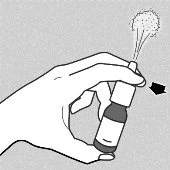
- Press the dosing button firmly and completely to release the mist through the nasal applicator – see drawing a.
- Always keep the cap on the nasal spray when not in use. The cap prevents dust from entering, seals tightly under pressure, and helps prevent the nasal applicator from becoming blocked.
- Never use a pin or any other sharp object to unblock the nasal applicator. This would damage the nasal spray.
Preparing the nasal spray for use
You must prepare the nasal spray:
- Before first use
- If it has been left uncovered for 5 days or if you have not used the intranasal device for 30 days or more.
Preparing the nasal spray helps ensure you always receive the full dose of medicine. Follow these steps:
- Shake the nasal spray vigorously with the cap on for 10 seconds.
- Remove the cap.
- Hold the nasal spray upright, then tilt and point the nasal applicator away from you.
- Press the dosing button firmly and completely – see drawing a. Repeat this at least 6 times until a fine mist is released into the air.
 a
a
The nasal spray is now ready for use.
Using the nasal spray
- Shake the nasal spray vigorously.
- Remove the cap.
- Blow your nose to clear the nostrils, then tilt your head slightly forward.
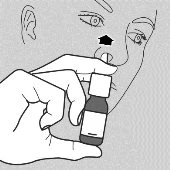
- Insert the nasal applicator into one nostril. Slightly orient the tip of the nasal applicator outward, away from the nasal septum. This helps the medicine reach the correct area of the nose – see drawing b.
 b
b
- Press the dosing button firmly and completely while inhaling through your nose.
- Remove the nasal applicator and breathe out through your mouth.
- If your dose is 2 sprays in each nostril, repeat steps 4 to 6.
- Repeat steps 4 to 7 in the other nostril.
- Replace the cap on the nasal spray.
Cleaning the nasal spray
After each use:
- Wipe the nasal applicator with a clean, dry tissue.
- Do not use water to clean it.
- Never use a pin or any other sharp object on the nasal applicator.
- Always replace the cap after use.
If the nasal spray does not seem to be working:
- Check whether there is still medicine left. Look at the level through the window. If the level is very low, there may not be enough liquid for the nasal spray to work.
- Check whether the nasal spray has been damaged.
- If you think the nasal applicator may be blocked, do not use a pin or any other sharp object to unblock it.
- Try re-priming it by following the instructions in “Preparing the nasal spray for use”.
- If it still does not work, or if a stream of liquid is produced, take the nasal spray to your pharmacy and consult your pharmacist.
Detailed information on this medicine is available on the website of the Spanish Agency for Medicines and Health Products (AEMPS) http://www.aemps.gob.es/
You can access detailed and up-to-date information on this medicine by scanning with your mobile phone (smartphone) the QR code included in the package leaflet and carton. You can also access this information at the following web address: https://cima.aemps.es/cima/dochtml/p/89779/P_89779.html
QR code: https://cima.aemps.es/cima/dochtml/p/89779/P_89779.html