Atrovent Nasal 0.30 mg/ml solution for nasal spray
Spain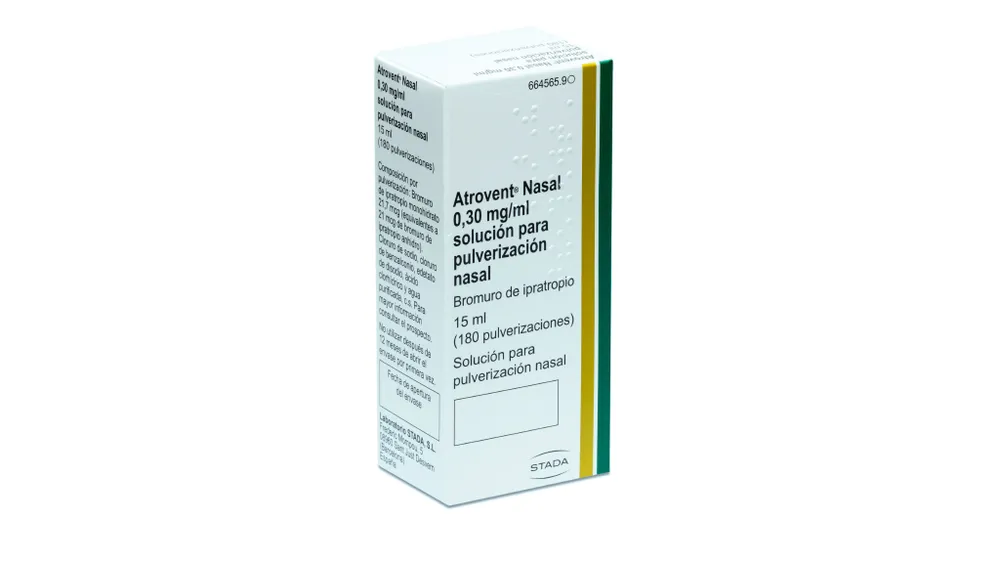
Table of Contents
Package leaflet: Information for the user
Introduction
PACKAGE LEAFLET: INFORMATION FOR THE USER
Atrovent Nasal 0.30 mg/ml solution for nasal spray
Ipratropium bromide
Read the entire leaflet carefully before you start using this medicine.
- Keep this leaflet, as you may need to read it again.
- If you have any questions, ask your doctor or pharmacist.
- This medicine has been prescribed for you only and should not be given to other people, even if they have the same symptoms, as it may harm them.
- If you consider any of the side effects you experience to be severe, or if you notice any side effects not listed in this leaflet, inform your doctor.
Contents of the leaflet:
- What Atrovent Nasal is and what it is used for
- Before using Atrovent Nasal
- How to use Atrovent Nasal
- Possible side effects
- How to store Atrovent Nasal
- Further information
1. What Atrovent Nasal is and what it is used for
Atrovent Nasal belongs to a group of medicines called anticholinergic bronchodilators, which work by relaxing the muscles of the bronchi, thereby facilitating airflow and improving breathing.
Rhinitis is an inflammation of the mucous membrane of the nasal passages. Atrovent Nasal is a medicine used to relieve the symptoms of rhinorrhea (runny nose) caused by allergic and non-allergic rhinitis.
2. Before using Atrovent Nasal
Do not use Atrovent Nasal
- If you are allergic (hypersensitive) to ipratropium bromide or substances similar to ipratropium such as atropine or its derivatives, or to any of the other components of Atrovent Nasal.
Take special care with Atrovent Nasal
- If you are predisposed to narrow-angle glaucoma (increased internal eye pressure), prostatic hyperplasia (enlarged prostate), or bladder neck obstruction (if the urinary passage from the bladder is obstructed).
- If you have cystic fibrosis (a disease affecting secretions of mucous and sweat glands, impacting several organs), you may be more prone to gastrointestinal motility disorders.
Immediately after administration of Atrovent Nasal, immediate hypersensitivity reactions (rapid-onset allergic reactions) such as urticaria, angioedema (sudden swelling of the skin or mucous membranes), buccopharyngeal edema (swelling of the mouth and pharynx), and anaphylaxis (generalized allergic reaction) may occur.
Isolated cases of ocular complications have been reported, for example, mydriasis (pupil dilation), narrow-angle glaucoma (increased internal eye pressure), and eye pain due to accidental spraying of ipratropium bromide aerosol into the eyes, alone or in combination with a β2-adrenergic agonist (medications that relax bronchial muscles, such as salbutamol). Therefore, it is essential to strictly follow your doctor's instructions regarding the correct administration of Atrovent Nasal.
Eye pain or discomfort, blurred vision, visual halos (diffuse lights), or colored images, together with eye redness due to conjunctival congestion (the inner tissue of the eyelid) and corneal edema (loss of corneal transparency), may be signs of acute narrow-angle glaucoma (increased internal eye pressure). If any combination of these symptoms occurs, notify your doctor immediately.
Use of other medicines
Inform your doctor or pharmacist if you are using or have recently used any other medicines, including those obtained without a prescription.
There is no reported evidence that using Atrovent Nasal together with other drugs commonly prescribed for perennial rhinitis (rhinitis occurring year-round), such as antihistamines (medications used to treat allergies), decongestants, or nasal steroids (other medications used to reduce nasal mucosal inflammation), increases the occurrence of side effects. Although Atrovent Nasal is absorbed into the bloodstream only in minimal amounts, there remains a possibility that its effect may be enhanced when administered concomitantly with other anticholinergic medications, including inhaled ipratropium bromide aerosols for oral inhalation.
Pregnancy
Consult your doctor or pharmacist before using any medicine.
Although preclinical studies have not demonstrated any risk, the safety of Atrovent Nasal during pregnancy has not been established. If pregnancy is suspected or confirmed, the benefits of treatment should be weighed against any potential risks to the fetus.
Breast-feeding
Consult your doctor or pharmacist before using any medicine.
It is unknown whether ipratropium bromide passes into breast milk. However, it is unlikely that ipratropium bromide would pass to the infant in significant amounts, especially when administered nasally. Nevertheless, since many drugs can pass into breast milk, caution should be exercised when administering this medicine to nursing women.
Driving and using machines
No studies on the effects on the ability to drive and use machines have been conducted. However, it should be noted that adverse effects such as dizziness, difficulty focusing the eyes, pupil dilation, and blurred vision may occur during treatment with Atrovent Nasal. Therefore, caution is advised when driving or operating machinery. If patients experience these effects, they should avoid potentially hazardous activities such as driving or operating machinery.
Atrovent Nasal contains benzalkonium chloride
This medicine contains 0.25 mg of benzalkonium chloride per ml.
Benzalkonium chloride may cause irritation or inflammation inside the nose, especially when used over long treatment periods.
3. How to use Atrovent Nasal
Follow exactly the administration instructions for Atrovent Nasal provided by your doctor. Consult your doctor or pharmacist if you have any doubts.
Your doctor will determine the duration of treatment.
If you consider that the effect of Atrovent Nasal is too strong or too weak, inform your doctor or pharmacist.
The administration of Atrovent Nasal should be adjusted according to the individual needs of each patient; patients must remain under medical supervision during treatment.
The usual dose is:
Adults and adolescents over 12 years of age: 2 sprays in each nostril, 2–3 times daily.
Children from 6 to 12 years of age: 2 sprays in each nostril, twice daily.
However, the optimal dose may vary depending on the individual response of each patient and should be determined by the physician.
Method of administration:
-
Remove the protective cap.
-
Before using the spray for the first time, press the pump several times (approximately 7 times) until the first spray is released (see figure 1). To prime the pump, hold the bottle with the thumb, index, and middle fingers.
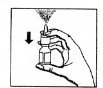 Ensure the bottle is pointed upwards and away from the eyes. Press firmly and quickly with the thumb (figure 1). The pump is now ready for use.
(figure 1)
If the pump has not been used for more than 24 hours, re-prime it with 1 or 2 sprays.
-
Before using the nasal spray, blow your nose to clear the nasal passages.
-
Close one nostril with a finger and tilt your head slightly forward. Holding the bottle as shown in figure 1, insert the nasal applicator into the other nostril (see figure 2). Direct the applicator toward the back and outer side of the nose.

(figure 2)
-
Activate the pump once by pressing firmly and quickly upward with the thumb. After each spray, inhale deeply and exhale through the mouth.
-
After spraying and removing the applicator, tilt your head backward for a few seconds to allow the spray to spread over the back of the nose.
-
Administer a second spray in the same nostril following the same procedure.
-
Administer two sprays in the other nostril following the same instructions.
-
Replace the protective cap after use.
If Atrovent Nasal is accidentally sprayed into the eyes, rinse immediately with cold water.
If the nasal applicator becomes blocked, remove the protective cap. Hold the nasal applicator under warm running water for about one minute. Dry the applicator, prime the pump (step 2), and replace the protective cap.
If you use more Atrovent Nasal than you should
No specific symptoms of overdose have been reported. Due to the wide safety margin and because Atrovent Nasal is administered topically, severe anticholinergic symptoms are not expected. Minor anticholinergic symptoms such as dry mouth, visual accommodation disorders, and increased cardiac pressure may occur.
If you have used more Atrovent Nasal than you should, contact your doctor, pharmacist, or call the Toxicology Information Service immediately at telephone number 91 562 04 20, indicating the medication and the amount taken.
4. Possible adverse effects
Like all medicines, Atrovent Nasal can cause adverse effects, although not everyone experiences them.
Frequent adverse effects (occurring in at least 1 in 100 patients) are headache; throat irritation, nasal dryness, nosebleeds, and nasal discomfort.
Uncommon adverse effects (occurring in at least 1 in 1,000 patients) are anaphylactic reactions (severe allergic reactions), hypersensitivity, dizziness, visual halos (diffuse lights), or colored images associated with eye redness (glaucoma), increased internal eye pressure, eye pain, pupil dilation, accommodation disorder (difficulty of the eye to focus), blurred vision, visual halos (diffuse lights), eye redness, corneal edema (swelling of the cornea), supraventricular tachycardia, atrial fibrillation, increased heart rate, dryness of mouth and throat, bronchospasm (chest tightness, wheezing, or shortness of breath), laryngospasm (contraction of the larynx causing breathing difficulty), pharyngeal edema (throat swelling), oral edema (mouth swelling), stomatitis (inflammation of the mouth), skin rash, angioedema (swelling of the face, lips, mouth, tongue, or throat that may cause difficulty swallowing or breathing), urinary retention, gastrointestinal motility disorders, and nausea.
Rare adverse effects (occurring in at least 1 in 10,000 patients) are palpitations, pruritus (itching), and urticaria.
If you consider any of the adverse effects you experience to be severe, or if you notice any adverse effects not listed in this leaflet, inform your doctor or pharmacist.
Reporting of adverse effects:
If you experience any type of adverse effect, consult your doctor or pharmacist, even if it is a possible adverse effect not mentioned in this leaflet. You may also report them directly via the Spanish Pharmacovigilance System for Human Medicines: https://www.notificaram.es. By reporting adverse effects, you can help provide more information on the safety of this medicine.
5. Storage of Atrovent Nasal
Keep out of the reach and sight of children.
Do not use Atrovent Nasal after the expiry date stated on the container. The expiry date refers to the last day of the month indicated.
No special storage conditions are required.
Do not use more than 12 months after first opening the container.
Medicines must not be disposed of via wastewater drains or household waste. Dispose of unused medicines and their containers at the SIGRE Point at your pharmacy. If in doubt, ask your pharmacist how to dispose of medicines and containers you no longer need. This will help protect the environment.
6. Additional information
Composition of Atrovent Nasal
- The active substance is ipratropium bromide. Each ml of solution contains 0.31 mg of ipratropium bromide monohydrate (equivalent to 0.30 mg of anhydrous ipratropium bromide). One spray delivers 21.7 micrograms of ipratropium bromide monohydrate, equivalent to 21 micrograms of anhydrous ipratropium bromide.
- The other components are: sodium chloride, benzalkonium chloride, disodium edetate, hydrochloric acid, and purified water.
Presentation of the product and contents of the pack
Pack containing 15 ml (180 sprays) of solution for nasal spray.
Marketing Authorization Holder
Laboratorio STADA, S.L.
Frederic Mompou, 5
08960 Sant Just Desvern (Barcelona), Spain
Manufacturer
Istituto De Angeli S.r.l.
Localita i Prulli
50066 Reggello (Florence), Italy
or
BOEHRINGER INGELHEIM PHARMA GMBH & CO. KG
Birkendorfer Strasse, 65
D-88397 Biberach am der Riss
Germany
This patient information leaflet was approved in July 2013
Detailed and up-to-date information on this medicinal product is available on the website of the Spanish Agency of Medicines and Health Products (AEMPS) http://www.aemps.gob.es/.