Atrovent Monodosis 250 mcg/2 ml solution for inhalation by nebulizer
Spain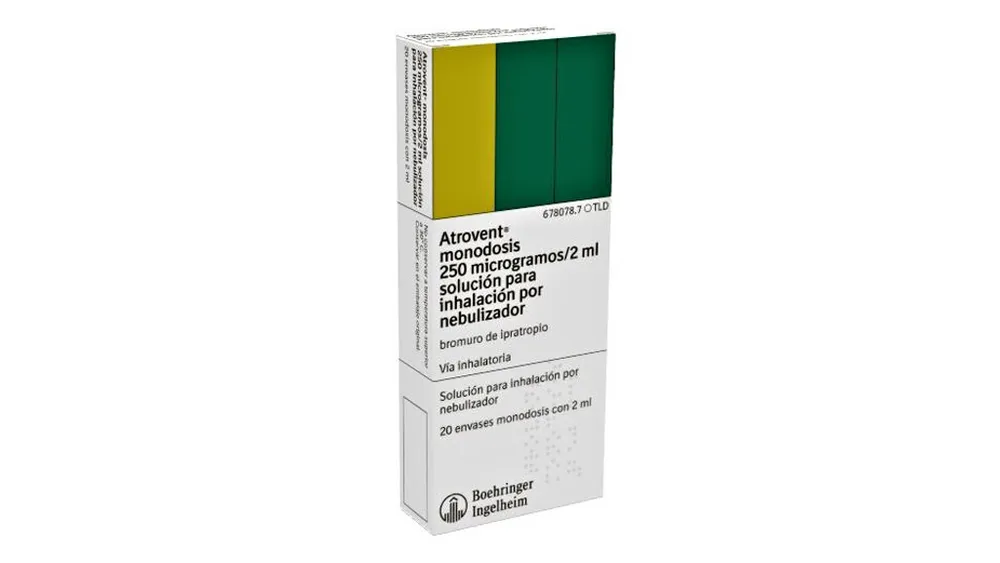
Table of Contents
- Package Leaflet: Information for the User
- Introduction
- 1. What Atrovent Monodose is and what it is used for
- 2. What you need to know before using Atrovent Monodosis
- 3. How to use Atrovent Monodosis
- *Acute attacks*
- 4. Possible adverse effects
- 5. Storage of Atrovent Monodose
- 6. Contents of the pack and other information
Package Leaflet: Information for the User
Introduction
Package Leaflet: Information for the Patient
Atrovent Monodose 250 micrograms/2 ml solution for inhalation by nebulizer
ipratropium bromide
Read this entire leaflet carefully before you start using this medicine, because it contains important information for you.
- Keep this leaflet, as you may need to read it again.
- If you have any questions, ask your doctor or pharmacist.
- This medicine has been prescribed for you only and must not be given to other people, even if they have the same symptoms as you, because it could harm them.
- If you experience any adverse reactions, consult your doctor or pharmacist, even if they are adverse reactions not listed in this leaflet. See section 4.
Leaflet Contents
- What Atrovent Monodose is and what it is used for
- What you need to know before using Atrovent Monodose
- How to use Atrovent Monodose
- Possible side effects
- How to store Atrovent Monodose
- Contents of the pack and other information
1. What Atrovent Monodose is and what it is used for
Atrovent Monodose belongs to a group of medicines called anticholinergic bronchodilators, which work by relaxing the muscles of the bronchi, thus facilitating airflow and improving breathing.
Atrovent Monodose 250 micrograms/2 ml solution for inhalation by nebulizer is a medicine used in the treatment of reversible airway obstruction in children aged 6 to 12 years.
Atrovent Monodose may be administered together with beta-adrenergics (other bronchodilator medicines, such as salbutamol) in the treatment of acute bronchospasm causing reversible airway obstruction, in cases where treatment with a beta-adrenergic medicine alone does not provide sufficient bronchial muscle relaxation.
2. What you need to know before using Atrovent Monodosis
Do not use Atrovent Monodosis:
- If you are allergic (hypersensitive) to ipratropium bromide, to substances similar to ipratropium such as atropine or its derivatives, or to any of the other ingredients listed in section 6.
- During acute episodes of bronchial spasms (difficulty breathing) where a rapid response is required.
Warnings and precautions:
Consult your doctor or pharmacist before starting to use Atrovent Monodosis.
-
If you are predisposed to narrow-angle glaucoma (increased internal eye pressure), have prostate enlargement (benign prostatic hyperplasia), or urinary flow obstruction (difficulty urinating).
-
Isolated cases of eye complications, such as mydriasis (pupil dilation), narrow-angle glaucoma (increased internal eye pressure), and eye pain, have occurred when ipratropium bromide, alone or in combination with a ?2-adrenergic agonist (medications that dilate bronchial muscles, such as salbutamol), has entered the eyes due to improper administration.
-
Eye pain or discomfort, blurred vision, visual halos (diffuse lights), or colored images associated with eye redness due to conjunctival congestion and corneal edema (swelling) may be signs of increased internal eye pressure (narrow-angle glaucoma). If any combination of these symptoms occurs, consult your doctor immediately to initiate treatment with a miotic eye drop (which causes pupil constriction and reduces internal eye pressure).
-
Contact of the product with the eyes should be avoided during nebulization, especially in patients predisposed to increased intraocular pressure; therefore, the use of a mouthpiece or a nasal mask is recommended.
-
Patients with cystic fibrosis (a disease affecting secretions from mucous and sweat glands, impacting several organs) may be more prone to gastrointestinal motility disorders.
-
Rarely, immediate hypersensitivity reactions (rapid-onset allergic reactions) may occur after administration of Atrovent Monodosis, such as urticaria, angioedema (sudden swelling of skin or mucous membranes), skin rash, bronchospasm (contraction of bronchial muscles causing breathing difficulty), and oropharyngeal edema (swelling of the mouth and throat).
-
As with other drugs administered by inhalation, Atrovent Monodosis may cause paradoxical bronchospasm, which can be life-threatening. If this occurs, treatment must be stopped immediately and your doctor should be informed to switch to an alternative therapy.
Other medicines and Atrovent Monodosis
Inform your doctor or pharmacist if you are taking, have recently taken, or might need to take any other medicines.
Concomitant long-term administration of Atrovent Monodosis with other anticholinergic drugs is not recommended.
Beta-adrenergic agents (e.g., salbutamol) and xanthine derivatives (e.g., theophylline) are other bronchodilator medications and may enhance the bronchodilator effect. Atrovent Monodosis may increase the anticholinergic effects of other drugs.
Atrovent Monodosis may be administered together with other drugs commonly used in the treatment of reversible airway obstruction, including beta-adrenergic agents (e.g., salbutamol), methylxanthines (e.g., theophylline), steroids, and sodium cromoglycate, without interactions requiring dose adjustments.
Concomitant administration of nebulized ipratropium bromide and beta-mimetics may increase the risk of acute glaucoma in patients with a history of narrow-angle glaucoma (increased intraocular pressure).
Inhalation solutions of Atrovent Monodosis and sodium cromoglycate containing benzalkonium chloride as a preservative should not be administered simultaneously in the same nebulizer due to the risk of precipitation.
Pregnancy, breastfeeding, and fertility
If you are pregnant or breastfeeding, think you may be pregnant, or are planning to become pregnant, consult your doctor or pharmacist before using this medicine.
Although this preparation is especially indicated in pediatric use, the usual precautions in pregnancy and breastfeeding are specified below.
Although preclinical studies have not demonstrated any risk, the safety of this medicine during pregnancy has not been established. Therefore, the usual precautions for using medicines during pregnancy should be observed, especially during the first three months.
It is unknown whether ipratropium bromide passes into breast milk. However, it is unlikely that significant amounts would be ingested by the infant, particularly because the preparation is administered by inhalation. Nevertheless, caution is advised when administering this medicine to breastfeeding women.
Driving and using machines
No studies on the effects on the ability to drive or operate machinery have been conducted. However, it should be noted that adverse effects such as dizziness, difficulty focusing the eyes, pupil dilation, and blurred vision may occur during treatment with Atrovent. Therefore, caution is advised when driving or operating machinery.
3. How to use Atrovent Monodosis
Follow exactly the instructions for use of this medicine provided by your doctor or pharmacist. If in doubt, consult your doctor or pharmacist again.
Remember to use your medicine.
Your doctor will determine the duration of treatment.
If you think that the effect of Atrovent Monodosis is too strong or too weak, tell your doctor or pharmacist.
The Atrovent Monodosis solution may be inhaled (nebulized) using devices called ultrasonic, electric, or manual nebulizers (e.g. Bird, De Vilbiss, Pari), or with intermittent positive pressure breathing assistance. If wall oxygen supply is available, the solution should be administered with a flow rate of 6–8 liters per minute.
It is recommended that the particle size of the nebulized solution range between 1 and 10 microns, although approximately 50% of the total aerosol mass should consist of particles smaller than 5 microns.
If necessary, the solution may be diluted with physiological saline.
Instructions for the use of single-dose containers:
Single-dose containers are intended only for inhalation via appropriate nebulizing devices and must not be administered orally.
|
|
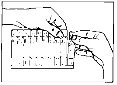
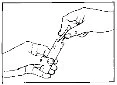
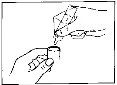
Since the single-dose units do not contain preservatives, it is important that their contents be used immediately after opening to avoid contamination. Partially used, opened, or damaged single-dose units must be discarded.
The administration of Atrovent Monodosis solution should be adjusted according to the individual needs of each patient; patients must remain under medical supervision during treatment. It is recommended not to exceed the recommended daily dose, either for acute treatment or for maintenance therapy. The recommended doses are:
Children aged 6 to 12 years:
Maintenance treatment
1 single-dose unit, 3–4 times daily.
Acute attacks
In cases where only a beta-adrenergic drug is used, it may not provide sufficient bronchial muscle relaxation. In such cases, Atrovent Monodose may be administered in combination with an inhaled beta-adrenergic agent (e.g. salbutamol), the dose of which will be determined by the physician. The dose of Atrovent Monodose in this case is 1 single-dose container; repeated doses may be administered until the patient stabilizes.
Generally, the recommended daily dose should not be exceeded during treatment. Daily doses exceeding 1 mg (more than 4 single-dose containers) should be administered exclusively under medical supervision.
If treatment does not result in significant improvement or if the patient's condition worsens, medical advice must be sought to determine an alternative treatment. In the case of acute dyspnea or rapidly worsening dyspnea (breathing difficulties), immediate medical consultation is required.
If you use more Atrovent Monodose than you should:
Specific manifestations of overdose have not been reported. Due to the wide therapeutic margin of Atrovent Monodose and the inhaled route of administration, serious anticholinergic symptoms are not expected to occur.
In the event of mild anticholinergic symptoms such as dry mouth, visual accommodation disorders (eye focusing problems), or tachycardia (increased heart rate), treatment should be symptomatic to relieve these effects.
If you have used more Atrovent Monodose than prescribed, consult your doctor, pharmacist, or call the Toxicology Information Service at telephone number 91 562 04 20, indicating the medication and the amount taken.
If you forget to use Atrovent Monodose
Do not use a double dose to make up for missed doses.
If you have any further questions about the use of this medicine, ask your doctor or pharmacist.
4. Possible adverse effects
Like all medicines, this medicine may cause adverse effects, although not everyone experiences them.
Frequent adverse effects (affecting at least 1 in 100 patients) are headache (cephalalgia), dizziness, cough, throat irritation, nausea, dry mouth, gastrointestinal motility disorders (for example: changes in bowel habits, gastroesophageal reflux, dyspepsia (indigestion)).
Uncommon adverse effects (affecting at least 1 in 1,000 patients) are hypersensitivity, anaphylactic reaction (severe allergic reaction), blurred vision, mydriasis (pupil dilation), increased internal eye pressure, visual halos (hazy lights) or colored images associated with eye redness (glaucoma), eye pain, visual halos (hazy lights), eye redness, corneal edema (swelling of the cornea), palpitations, supraventricular tachycardia, constipation, diarrhea, vomiting, stomatitis (inflammation of the mouth), oral edema (swelling of the mouth), rash, pruritus (itching), angioedema (swelling of the face, lips, mouth, tongue, or throat that may cause difficulty swallowing or breathing), and urinary retention.
Rare adverse effects (affecting at least 1 in 10,000 patients) are bronchospasm (chest tightness, wheezing, or shortness of breath), paradoxical bronchospasm (narrowing of the bronchial walls due to the inhalation itself), laryngeal spasm, pharyngeal edema (throat swelling), dry throat, visual accommodation disorder (difficulty of the eye to focus), urticaria, increased heart rate, and atrial fibrillation.
Very rare adverse effects (affecting less than 1 in 10,000 patients) are tremors, metallic or unpleasant taste, nasal congestion, insomnia, unusual tiredness or weakness, and hypotension.
If you consider any of the adverse effects you experience to be severe, or if you notice any adverse effects not listed in this leaflet, inform your doctor or pharmacist.
Reporting of adverse effects
If you experience any type of adverse effect, consult your doctor or pharmacist, even if it is a possible adverse effect not listed in this leaflet. You may also report them directly through the Spanish Pharmacovigilance System for Human Medicines: https://www.notificaram.es. By reporting adverse effects, you can help provide more information on the safety of this medicine.
5. Storage of Atrovent Monodose
Keep this medicine out of sight and reach of children.
Do not use this medicine after the expiry date stated on the packaging. The expiry date refers to the last day of the month indicated.
Do not store above 30°C. Store in the original packaging.
Medicines must not be disposed of via wastewater or household waste. Dispose of unused medicines and their containers at the SIGRE collection point at your pharmacy. Ask your pharmacist how to properly discard medicines and containers you no longer need. This helps protect the environment.
6. Contents of the pack and other information
Composition of Atrovent Monodose
- The active substance is ipratropium bromide. Each 2 ml single-dose container contains 261 micrograms of ipratropium bromide monohydrate (equivalent to 250 micrograms of anhydrous ipratropium bromide).
- The other components are: sodium chloride, hydrochloric acid, and purified water.
Appearance of the medicinal product and contents of the pack
Atrovent Monodose 250 micrograms/2 ml is a solution for inhalation by nebulizer, supplied in packs of 20 single-dose units containing 2 ml of solution for inhalation by nebulizer, and in hospital packs containing 100 single-dose units of 2 ml solution for nebulization.
Marketing Authorization Holder
Boehringer Ingelheim España, S.A.
Prat de la Riba, 50
08174 Sant Cugat del Vallès (Barcelona)
Spain
Manufacturer
Laboratoire Unither
Zone Industrielle de Longpré
10 rue Andre Durouchez
80084 AMIENS Cedex 2
France
This leaflet was approved in April 2019
Detailed and up-to-date information on this medicinal product is available on the website of the Spanish Agency of Medicines and Health Products (AEMPS) http://www.aemps.gob.es/.