Atosiban SUN 6.75 mg/0.9 ml solution for injection EFG
Spain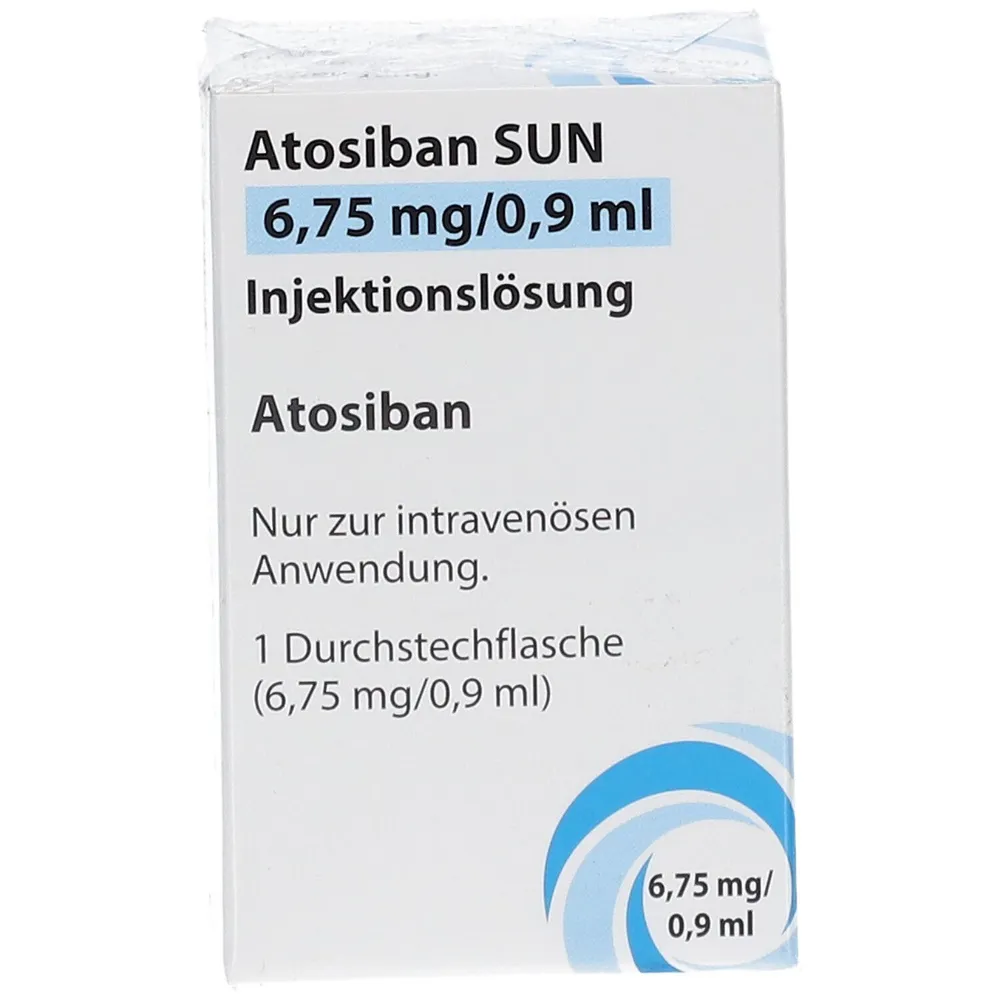
Table of Contents
- Package leaflet: Information for the user
- Introduction
- 1. What Atosiban SUN is and what it is used for
- 2. What you need to know before Atosiban SUN is administered to you
- 3. How Atosiban SUN will be administered to you
- 4. Possible adverse effects
- 5. Storage of Atosiban SUN
- 6. Package contents and other information
Package leaflet: Information for the user
Introduction
Package leaflet: information for the user
Atosiban SUN 6.75 mg/0.9 ml solution for injection EFG
atosiban
Read all of this leaflet carefully before you are given this medicine because it contains important information for you.
- Keep this leaflet. You may need to read it again.
- If you have any questions, ask your doctor, midwife or pharmacist.
- If you get any side effects, talk to your doctor or pharmacist. This includes any possible side effects not listed in this leaflet. See section 4.
Contents of the leaflet
- What Atosiban SUN is and what it is used for
- What you need to know before you are given Atosiban SUN
- How Atosiban SUN will be given to you
- Possible side effects
- How to store Atosiban SUN
- Contents of the pack and other information
1. What Atosiban SUN is and what it is used for
Atosiban SUN contains atosiban. Atosiban SUN is used to delay premature delivery of your baby. Atosiban SUN is used in pregnant adult women, from week 24 to week 33 of pregnancy.
Atosiban SUN works by reducing the strength of contractions of your uterus (womb). It also makes contractions occur less frequently. This occurs because the action of the natural hormone called "oxytocin", the hormone that causes the womb (uterus) to contract, is blocked.
2. What you need to know before Atosiban SUN is administered to you
Do not use Atosiban SUN
-
If you are allergic to atosiban or to any of the other ingredients of this medicine (listed in section 6).
-
If you are pregnant for less than 24 weeks.
-
If you are pregnant for more than 33 weeks.
-
If your waters have broken (premature rupture of membranes) and you are at or beyond 30 weeks of pregnancy.
-
If your baby (fetus) has an abnormal heartbeat.
-
If you are experiencing vaginal bleeding and your doctor wants to initiate delivery so your baby is born immediately.
-
If you have a condition called “severe pre-eclampsia” and your doctor wants to initiate delivery so your baby is born immediately. Severe pre-eclampsia is when you have very high blood pressure, fluid retention, and/or protein in your urine.
-
If you have a condition called “eclampsia,” which is similar to “severe pre-eclampsia” but also includes seizures. This means delivery must begin so your baby is born immediately.
-
If your baby has died.
-
If you have or may have an infection in the womb (uterus).
-
If your placenta is blocking the birth canal.
-
If your placenta is detaching from the wall of your womb.
-
If you or your baby have other conditions that could make continuing the pregnancy dangerous.
Do not use Atosiban SUN if any of these situations apply to you. If you are unsure, tell your doctor, midwife, or pharmacist before Atosiban SUN is administered to you.
Warnings and precautions
Talk to your doctor, midwife, or pharmacist before Atosiban SUN is administered to you:
-
If you think your waters have broken (premature rupture of membranes).
-
If you have kidney or liver problems.
-
If you are between 24 and 27 weeks pregnant.
-
If you are carrying more than one baby.
-
If you experience contractions again, treatment with Atosiban SUN may be repeated up to three more times.
-
If your baby is small for the duration of the pregnancy.
-
If your uterus is unable to contract after birth. This may cause bleeding.
-
If you are carrying more than one baby and/or are taking medications that may delay your baby’s birth, such as medications used for high blood pressure. This may increase the risk of pulmonary oedema (fluid accumulation in the lungs).
If any of these situations apply to you (or if you are unsure), inform your doctor, midwife, or pharmacist before Atosiban SUN is administered to you.
Children and adolescents
Atosiban SUN has not been studied in pregnant women under 18 years of age.
Use of Atosiban SUN with other medicines
Tell your doctor, midwife, or pharmacist if you are taking, have recently taken, or might need to take any other medicines.
Pregnancy and breastfeeding
If you are pregnant and breastfeeding a baby, breastfeeding must be discontinued during treatment with Atosiban SUN.
3. How Atosiban SUN will be administered to you
Atosiban SUN will be administered to you in a hospital by a doctor, nurse, or midwife. They will determine the amount you need. They will also ensure that the solution is clear and free of particles.
Atosiban SUN is administered intravenously in three steps:
- A first intravenous bolus injection of 6.75 mg in 0.9 ml will be given slowly into a vein over one minute.
- Then, a continuous infusion (drip) of 18 mg per hour will be administered for 3 hours.
- After that, a further continuous infusion (drip) of 6 mg per hour will be given for up to 45 hours, or until uterine contractions have stopped.
The total duration of treatment should not exceed 48 hours.
Additional courses of Atosiban SUN may be given if contractions resume. Treatment with Atosiban SUN may be repeated up to three more times.
During treatment with Atosiban SUN, your contractions and the baby's heart rate may be monitored.
It is recommended not to repeat the treatment more than three times during one pregnancy.
4. Possible adverse effects
Like all medicines, this medicine may cause adverse effects, although not everyone experiences them. The adverse effects observed in mothers were generally mild in intensity. There are no known adverse effects on the fetus or newborn.
The following adverse effects may occur with this medicine:
Very common (affect more than 1 in 10 people)
- Feeling unwell (nausea).
Common (affect less than 1 in 10 people)
-
Headache.
-
Dizziness.
-
Flushing.
-
Feeling sick (vomiting).
-
Rapid heartbeat.
-
Low blood pressure. Signs may include feeling dizzy or lightheaded.
-
Reaction at the injection site.
-
Increased blood sugar levels.
Uncommon (affect less than 1 in 100 people)
- Increase in body temperature (fever).
- Difficulty sleeping (insomnia).
- Itching.
- Rash.
Rare (affect less than 1 in 1,000 people)
-
Your uterus is unable to contract after the baby’s birth. This may cause bleeding.
-
Allergic reactions.
You may experience difficulty breathing or pulmonary edema (fluid accumulation in the lungs), particularly if you are pregnant with more than one baby and/or are being treated with other medicines that may delay your baby’s birth, such as medicines used for high blood pressure.
Reporting of adverse effects
If you experience any type of adverse effect, consult your doctor, midwife, or pharmacist, even if it is a possible adverse effect not listed in this leaflet. You may also report them directly through the national reporting system detailed in Appendix V. By reporting adverse effects, you can help provide more information on the safety of this medicine.
5. Storage of Atosiban SUN
Keep this medicine out of the sight and reach of children.
Do not use this medicine after the expiry date stated on the label after EXP. The expiry date is the last day of the month indicated.
Store in a refrigerator (2°C - 8°C). After opening the vial, the medicine should be used immediately.
Keep in the original packaging to protect from light.
Do not use this medicine if you notice particles or discoloration of the contents before administration.
Medicines must not be disposed of via wastewater or household waste. Ask your pharmacist how to dispose of medicines and packaging no longer required. This will help protect the environment.
6. Package contents and other information
Composition of Atosiban SUN
- The active substance is atosiban.
- Each vial of Atosiban SUN 6.75 mg/0.9 ml solution for injection contains atosiban acetate equivalent to 6.75 mg of atosiban in 0.9 ml.
- The other components are mannitol, hydrochloric acid 1M, and water for injections.
Appearance of the product and contents of the pack
Atosiban SUN 6.75 mg/0.9 ml solution for injection is a clear, colourless solution free from particles.
One pack contains one vial containing 0.9 ml of solution.
Marketing Authorisation Holder and Manufacturer
Sun Pharmaceutical Industries Europe B.V.
Polarisavenue 87
2132 JH Hoofddorp
The Netherlands
Further information about this medicinal product is available from the local representative of the Marketing Authorisation Holder.

Deutschland
Sun Pharmaceuticals Germany GmbH
Hemmelrather Weg 201
51377 Leverkusen
Deutschland
tel. +49 214 403 990
España
Sun Pharma Laboratorios, S.L.
Rambla de Catalunya 53-55
08007 Barcelona
España
tel. +34 93 342 78 90
France
Sun Pharma France
31 Rue des Poissonniers
92200 Neuilly-Sur-Seine
France
tel. +33 1 41 44 44 50
Italia
Sun Pharma Italia Srl
Viale Giulio Richard, 3
20143 Milano
Italia
tel. +39 02 33 49 07 93
Polska
Ranbaxy (Poland) Sp. z o.o.
ul. Idzikowskiego 16
00-710 Warszawa
Polska
tel. +48 22 642 07 75
România
Terapia S.A.
Str. Fabricii nr 124
Cluj-Napoca, Judetul Cluj
România
tel. +40 (264) 501 500
United Kingdom (Northern Ireland)
Ranbaxy UK Ltd
a Sun Pharma Company
Millington Road 11
Hyde Park, Hayes 3
5th Floor
UB3 4AZ HAYES
United Kingdom
tel. +44 (0) 208 848 8688
Date of latest revision of this leaflet:
Other sources of information
Detailed information on this medicinal product is available on the European Medicines Agency website: http://www.ema.europa.eu.
INFORMATION INTENDED FOR HEALTHCARE PROFESSIONALS ONLY
This information is intended for healthcare professionals only: (See also section 3).
Instructions for use:
Before using Atosiban SUN, the solution should be inspected to ensure it is clear and free from particles.
Atosiban SUN is administered intravenously in three consecutive stages:
-
An initial intravenous bolus injection of 6.75 mg in 0.9 ml is given slowly over one minute.
-
A continuous infusion is administered for 3 hours at a rate of 24 ml/hour.
-
A continuous infusion is administered for up to 45 hours, or until uterine contractions have decreased, at a rate of 8 ml/hour.
The total duration of treatment should not exceed 48 hours. Additional treatment cycles with Atosiban SUN may be administered if contractions recur. Repeating treatment more than three times during one pregnancy is not recommended.