Atepodin 100 mg powder and solvent for solution for injection
Spain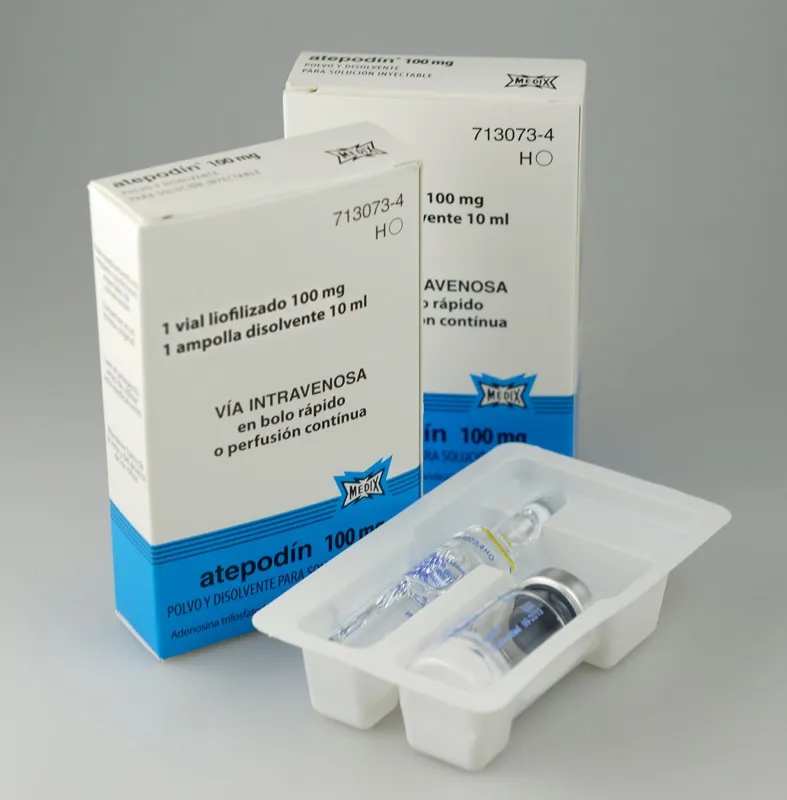
Table of Contents
Package leaflet: Information for the user
Introduction
Package leaflet: information for the patient
ATEPODIN 100 mg powder and solvent for injection solution
Adenosine triphosphate (disodium salt)
Read all of this leaflet carefully before you start using this medicine, because it contains important information for you.
- Keep this leaflet as you may need to read it again.
- If you have any questions, ask your doctor or nurse.
- This medicine has been prescribed for you only, and you should not give it to other people, even if they have the same symptoms as you, because it could harm them.
- If you experience any adverse reactions, consult your doctor or nurse, even if they are adverse reactions not listed in this leaflet. See section 4.
Contents of this leaflet
- What Atepodin is and what it is used for
- What you need to know before you use Atepodin
- How to use Atepodin
- Possible side effects
- How to store Atepodin
- Contents of the pack and other information
1. What Atepodín is and what it is used for
This medicinal product is for diagnostic and therapeutic use.
Atepodín contains the active substance adenosine triphosphate (disodium salt). It is used as an antiarrhythmic for the treatment and aid in the diagnosis of a type of cardiac rhythm disorder called paroxysmal tachycardia. It is also used as a coronary vasodilator, because it increases blood flow in the heart muscle, for cardiac imaging tests with radiopharmaceuticals that visualize such blood flow, exclusively in adults who are unable to exercise sufficiently for such a test.
2. What you need to know before using Atepodín
Do not use Atepodín if:
- You are allergic to adenosine triphosphate (disodium salt) or any of the other components of this medicine (listed in section 6).
- You have a heart rhythm disorder such as second- or third-degree atrioventricular (AV) block, or sinoatrial node dysfunction, unless you have a functioning artificial pacemaker.
- You have unstable angina that has not been stabilized with medical treatment.
- You have very low blood pressure (severe hypotension).
- You have decompensated heart failure.
- You have asthma or another serious respiratory condition causing bronchospasm or bronchoconstriction.
- You are a premature infant or newborn.
Warnings and precautions
Administration of Atepodín must be performed exclusively in a hospital setting equipped with cardiac monitoring and cardio-respiratory resuscitation equipment.
Take special care with Atepodín:
Before administering Atepodín, your doctor needs to know if:
- You have a heart rhythm disorder known as long QT syndrome.
- You suffer from a type of supraventricular tachycardia associated with Wolff-Parkinson-White syndrome.
- You have low blood volume (hypovolemia), or disorders of the autonomic nervous system, or stenosis of the left main coronary artery, or valvular heart disease due to valve narrowing, or inflammation of the membrane surrounding the heart (pericarditis), or fluid accumulation around the heart (pericardial effusion), or stenosis of the main neck artery (carotid artery) with cerebrovascular insufficiency.
- You have elevated intracranial pressure.
- You have liver or kidney disease, as large amounts of benzyl alcohol (present in the vial of the appropriate solvent) may accumulate in the body and cause adverse effects (metabolic acidosis).
Before administration of Atepodín:
- Ensure metabolic balance.
- Continuously monitor your heart and pulse.
- Avoid taking dipyridamole for at least two days prior to administration of Atepodín.
Children and adolescents
The safety and efficacy of Atepodín in children and adolescents have not been established, and no dosage recommendation can be made.
Atepodín contains benzyl alcohol (present in the vial of the appropriate solvent), which has been associated with the risk of serious adverse effects, including respiratory problems ("gasping syndrome") in children. Do not administer this medicine to your newborn (up to 4 weeks of age) unless specifically recommended by your doctor.
Atepodín should not be used for more than one week in children under 3 years of age unless directed by your doctor or pharmacist.
Use of Atepodín with other medicines
Inform your doctor or pharmacist if you are taking:
- Methylxanthines: any product containing methylxanthines (e.g., caffeine and theophylline) should be avoided for at least 24 hours prior to administration of Atepodín.
- Dipyridamole: dipyridamole should be avoided for at least two days prior to administration of Atepodín, when possible.
- Other cardioactive medicines: carbamazepine, verapamil, quinidine, and diazepam.
Use of Atepodín with food and drinks
In patients undergoing pharmacological stress testing, administration of Atepodín with food or beverages may alter its effects. Therefore, tea, cola, coffee, cocoa, and chocolate should not be consumed for at least 24 hours before administration of the medicine.
Pregnancy, breastfeeding, and fertility
If you are pregnant or breastfeeding, think you may be pregnant, or are planning to become pregnant, consult your doctor before using this medicine. This is because large amounts of benzyl alcohol (present in the vial of the appropriate solvent) may accumulate in your body and cause adverse effects (metabolic acidosis).
Pregnancy
There are no data or the data are limited regarding the use of adenosine triphosphate (disodium salt) in pregnant women. Animal studies are insufficient in terms of reproductive toxicity. The use of adenosine triphosphate (disodium salt) during pregnancy is not recommended unless your doctor considers that the benefit outweighs the risk to the mother and fetus.
Breastfeeding
It is unknown whether adenosine metabolites are excreted in breast milk.
Atepodín should not be used during breastfeeding.
Fertility
Fertility studies have not been conducted with Atepodín.
Driving and use of machines
No studies have been conducted on the effects of Atepodín on the ability to drive or operate machinery. Administration of Atepodín may cause adverse reactions such as dizziness, headache, and shortness of breath shortly after administration. However, most adverse reactions are mild and transient. Therefore, the influence of Atepodín on the ability to drive or operate machinery is expected to be none or negligible once treatment has ended and these reactions have resolved.
Atepodín contains 0.15 ml of benzyl alcohol per vial of appropriate solvent, equivalent to 0.157 mg/vial of appropriate solvent. Benzyl alcohol may cause allergic reactions.
Atepodín contains less than 1 mmol of sodium (23 mg) per vial; hence, it is essentially "sodium-free".
3. How to use Atepodín
ATEPODIN 100 mg IS FOR HOSPITAL USE ONLY, SINCE ELECTROPHYSIOLOGICAL MONITORING AND CARDIOPULMONARY RESUSCITATION MUST BE AVAILABLE.
Since Atepodín causes a rapid increase in heart rate, you must remain sitting or lying down and should be monitored at frequent intervals after the injection until electrocardiogram parameters, heart rate, and blood pressure have returned to levels prior to Atepodín administration.
It must be administered intravenously either as a rapid injection or by continuous infusion, according to the dosage regimen indicated below depending on the intended use:
- For diagnostic and therapeutic use in supraventricular tachycardias
Adults:
-
Therapeutic dose: a rapid intravenous bolus of 10 mg (<2 seconds) is recommended. If no reversion occurs within 2 minutes, a second bolus of 15 mg may be administered. If tachycardia has not reverted after 1 or 2 minutes, a third dose of 20 mg may be given.
-
Diagnostic dose: the dosage regimen described above may be administered up to the point of obtaining sufficient diagnostic information.
-
For diagnostic use as a pharmacological stress agent:
Adults:
It is recommended to administer diluted Atepodín as a continuous peripheral intravenous infusion at a rate of 160 μg/kg/min for five minutes.
Elderly patients, or those with hepatic or renal impairment:
In any of the aforementioned indications, dose adjustment is not necessary.
Repeated use:
This product should be administered only once within a 24-hour period.
If you have received more Atepodín than you should have:
Overdose would cause severe hypotension, slowing of heart rate, or cardiac arrest, which would resolve rapidly upon discontinuation of the infusion. Intravenous administration of aminophylline or theophylline may be required.
4. Possible adverse effects
Like all medicines, this medicine may cause adverse effects, although not everyone experiences them.
Effects related to the known pharmacological characteristics of adenosine triphosphate (disodium salt) are common (30–80 %), but generally self-limiting and extremely transient. It may be necessary to interrupt the infusion if the effect is poorly tolerated.
Adverse reactions are grouped below according to their frequency:
- Very common (affects more than 1 in 10 users):
Flushing, facial redness, gasping or urge to breathe deeply (dyspnea), headache, chest pain or tightness, and abdominal discomfort.
- Common (affects less than 1 in 10 users):
Dizziness, vertigo; numbness, tingling or prickling sensation (paresthesia), hypotension, a heart condition known as atrioventricular (AV) block, increased heart rate, dry mouth and throat, neck or jaw discomfort.
- Uncommon (affects less than 1 in 100 users):
Metallic taste, sweating, discomfort in the legs, arms or back, feeling of general malaise/weakness/pain, nervousness, slow heart rate (bradycardia).
- Rare (affects less than 1 in 1,000 users):
Difficulty breathing (bronchospasm), nasal congestion, cough, somnolence, blurred vision, ringing or buzzing in the ear (tinnitus), sensation of urinary urgency, discomfort in the nipples, and tremors.
- Very rare (affects less than 1 in 10,000 users):
Respiratory failure and injection site reactions.
- Frequency not known (cannot be estimated from available data):
Severe heart problem that may lead to cardiac arrest (asystole), irregular heart rhythm (fibrillation), fainting or brief loss of consciousness (syncope), seizures, absence of spontaneous breathing (apnea), and respiratory arrest, nausea and vomiting.
Spasm of the coronary artery that may cause a heart attack.
Reporting of adverse effects
If you experience any type of adverse effect, consult your doctor, even if it is a possible adverse effect not listed in this leaflet. You may also report them directly via the Spanish Pharmacovigilance System for Human Medicinal Products: https://www.notificaram.es. By reporting adverse effects, you can help provide more information on the safety of this medicine.
5. Storage of Atepodín
Keep this medicine out of the sight and reach of children.
Store in the original container.
Use immediately after reconstitution. Do not use the remaining content of a reconstituted vial.
Do not use this medicine after the expiry date stated on the packaging after Exp. The expiry date refers to the last day of the month indicated.
Do not use this medicine if there are any visible signs of deterioration.
Medicines must not be disposed of via wastewater or household waste. Disposal of unused medicine and of all materials that have been in contact with it must be carried out in accordance with local regulations.
6. Contents of the pack and other information
Composition of Atepodín
- The active substance is adenosine triphosphate (disodium salt). Each vial contains 100 mg of adenosine triphosphate (disodium salt).
- The other components are glycocol, benzyl alcohol (0.015 mg/ml when reconstituted), and water for injections.
Atepodín contains benzyl alcohol (present in the ampoule of the suitable solvent) (see section 2).
Presentation of the product and contents of the pack
Box containing a single-use vial with a white lyophilized powder and a clear, colorless ampoule with water for injections.
Marketing Authorization Holder
Laboratorios Medix, S.A.
c/ Del Plástico 5, nave 9, Pol. Ind. Miralcampo
19200 - Azuqueca de Henares (Guadalajara)
Manufacturer
Laboratorio Reig Jofré, S.A.
C/ Gran Capitán, 10, Sant Joan Despí
08970 Barcelona
Further information on this medicinal product is available upon request to the local representative of the Marketing Authorization Holder.
Date of the most recent review of this leaflet: August 2023
Other sources of information
Detailed and up-to-date information on this medicinal product is available on the website of the Spanish Agency of Medicines and Medical Devices (AEMPS): http://www.aemps.es/
This information is intended exclusively for physicians or healthcare professionals:
The complete summary of product characteristics for Atepodín is included as a separate document within the product packaging, providing additional scientific and practical information for healthcare professionals on the administration and use of this medicinal product.
Please consult the summary of product characteristics.