Articaine/epinephrine Normon 40 mg/ml + 10 micrograms/ml solution for injection EFG
Spain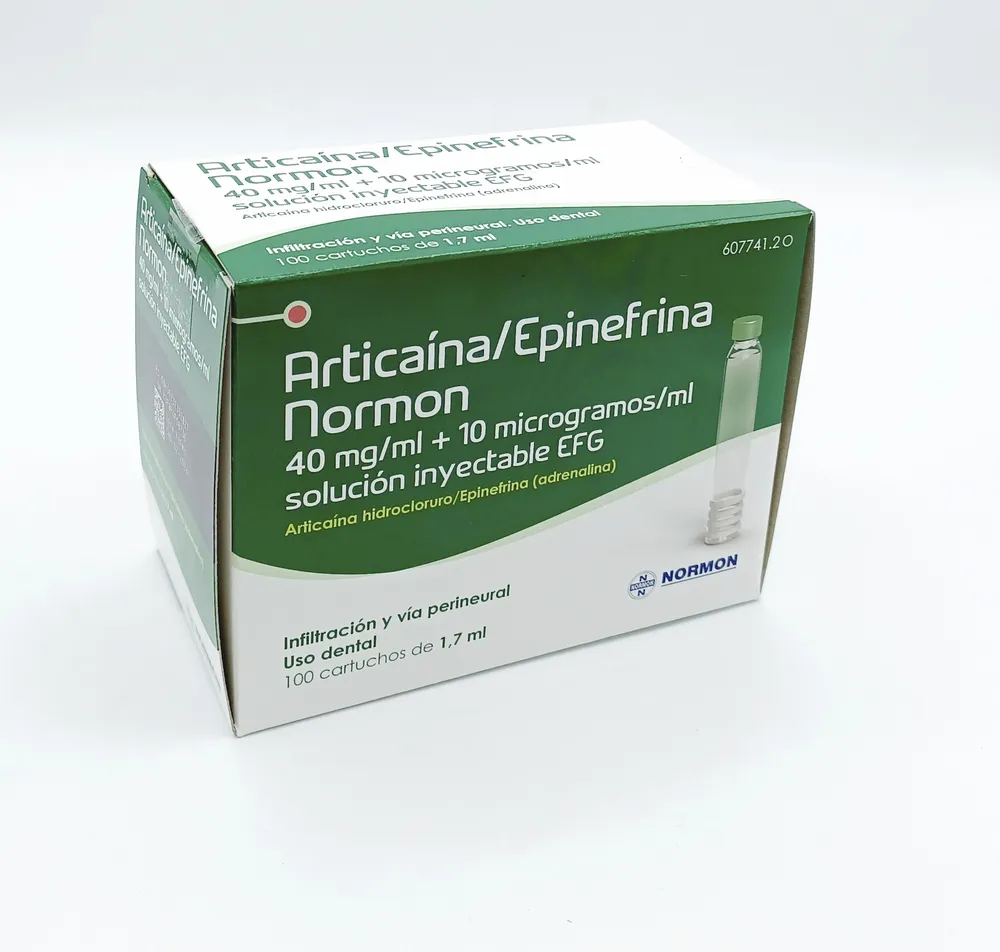
Table of Contents
- Package leaflet: Information for the user
- Introduction
- 1. What Articaïna/Epinephrine Normon is and what it is used for
- 2. What you need to know before using Articaine/Epinephrine Normon
- 3. How to use Articaine/Epinephrine Normon
- 4. Possible adverse effects
- 5. Storage of Articaine/Epinephrine Normon
- 6. Contents of the pack and other information
Package leaflet: Information for the user
Introduction
Package leaflet: information for the patient
Articaïne/Epinephrine Normon 40 mg/ml + 10 micrograms/ml solution for injection EFG
hydrochloride articaïne/epinephrine (adrenaline)
Read the entire leaflet carefully before you start using this medicine, as it contains important information for you.
-
Keep this leaflet, as you may need to read it again.
-
If you have any questions, consult your dentist, doctor or pharmacist.
-
If you experience any adverse reactions, consult your dentist, doctor or pharmacist, even if they are adverse reactions not listed in this leaflet. See section 4.
Leaflet contents
- What Articaïne/Epinephrine Normon is and what it is used for
- What you need to know before using Articaïne/Epinephrine Normon
- How to use Articaïne/Epinephrine Normon
- Possible side effects
- How to store Articaïne/Epinephrine Normon
- Contents of the pack and other information
1. What Articaïna/Epinephrine Normon is and what it is used for
Articaïna/Epinephrine Normon is a local anesthetic (a medicine used to numb a specific area) for use in dentistry. It contains the local anesthetic articaine, as well as epinephrine (adrenaline). Epinephrine constricts blood vessels at the injection site, causing local ischemia in the area and prolonging the effect of the local anesthetic.
Articaïna/Epinephrine Normon is used for infiltration anesthesia and nerve block anesthesia prior to dental procedures. This includes:
- Surgical interventions on the mucous membrane and bone tissue requiring stronger ischemia.
- Surgical interventions on the pulp (amputation and removal).
- Extraction of ankylosed or fractured teeth (osteotomy).
- Longer surgical procedures.
- Percutaneous osteosynthesis.
- Cystectomy.
- Mucogingival procedures.
- Apical root resection.
2. What you need to know before using Articaine/Epinephrine Normon
Do not use Articaine/Epinephrine Normon
- If you are allergic to articaine or to other local anaesthetics of the amide acid type.
- If you are allergic to epinephrine or to any of the other components of this medicine (listed in section 6).
- If you have severe cardiac arrhythmias (e.g., second- or third-degree AV block).
- If you have a very low pulse.
- If you suffer from congestive heart failure (acute heart weakness, e.g., unexpected chest pain at rest or following myocardial injury [e.g., heart attack]).
- If you have very low blood pressure.
- If you have bronchial asthma and are sulfite-sensitive (asthma attacks triggered by sulfites).
- If you have epilepsy that is not controlled by appropriate medical treatment.
Due to the effects of the active ingredient epinephrine, articaine/epinephrine should not be used:
- If you have elevated intraocular pressure (glaucoma).
- If you have hyperthyroidism.
- If you experience episodes of rapid heart rate (paroxysmal tachycardia).
- If you have a specific type of cardiac arrhythmia (absolute arrhythmia with fast and irregular heartbeat).
- If you have had a heart attack within the last 3 to 6 months.
- If you have undergone coronary bypass surgery within the last 3 months.
- If you are taking certain beta-blockers (e.g., propranolol), there is a risk of developing a hypertensive crisis (very high blood pressure) or severe slowing of the heart rate.
- If you have pheochromocytoma (an adrenaline-producing tumour usually located in the adrenal medulla).
- If you have very high blood pressure.
- If you are being treated simultaneously with certain antidepressants and antiparkinsonian drugs (tricyclic antidepressants or MAO inhibitors), as these active substances may enhance the cardiovascular effects of epinephrine; this may apply up to 14 days after discontinuing treatment with MAO inhibitors.
Articaine/epinephrine must not be administered intravenously (into a vein).
Due to its epinephrine content, Articaine/Epinephrine Normon is not indicated for anaesthesia of the distal phalanx of the extremities (e.g., fingers and toes), as there is a risk of blocking local blood flow.
Warnings and precautions
Consult your dentist or pharmacist before using Articaine/Epinephrine Normon:
- If you have a deficiency of a specific enzyme (cholinesterase deficiency), as a prolonged and sometimes increased effect of articaine/epinephrine may be expected.
- If you have inflammation or infection at the injection site. In such cases, increased absorption of articaine/epinephrine may be anticipated, which could reduce its effectiveness.
- If you are over 70 years of age.
- If you have reduced oxygen levels in body tissues (hypoxia), elevated potassium levels in blood (hyperkalaemia), or metabolic disturbances due to excess acid in the blood (metabolic acidosis).
Articaine/Epinephrine Normon should only be used after a thorough medical evaluation:
- If you have coagulation disorders.
- If you have impaired kidney function (e.g., nephritis).
- If you have impaired liver function (e.g., hepatic cirrhosis).
- If you are simultaneously receiving other local anaesthetics, i.e., drugs causing reversible loss of sensation, including inhaled anaesthetics such as halothane (see "Other medicines and Articaine/Epinephrine Normon").
- If you have epilepsy (see section 4).
- If you are simultaneously taking platelet aggregation inhibitors or anticoagulants to prevent constriction and/or hardening of blood vessels in the arms and legs.
- If you have low blood pressure.
- If you have myasthenia gravis, a disease causing muscle weakness.
- If you have porphyria, a disease causing neurological complications or skin problems.
- In case of reduced oxygen levels in body tissues (hypoxia), elevated potassium levels in blood (hyperkalaemia), and metabolic disturbances due to excess acid in the blood (metabolic acidosis).
If you suffer from any of the following conditions, Articaine/Epinephrine Normon 40 mg/ml + 10 micrograms/ml should only be used after a thorough medical evaluation, and your dentist should consider administering Articaine/Epinephrine Normon 40 mg/ml + 5 micrograms/ml instead of Articaine/Epinephrine Normon 40 mg/ml + 10 micrograms/ml due to its lower epinephrine content:
-
Cardiovascular disorders, such as:
- Heart failure (myocardial weakness).
- Coronary artery disease (narrowing of the coronary vessels).
- Angina pectoris (impaired blood supply to the heart with chest pain and pressure).
- After a heart attack.
- Cardiac arrhythmias (irregular heart rate).
- High blood pressure.
- Arteriosclerosis (narrowing of arteries due to deposits, e.g., blood lipids).
- Impaired cerebral blood circulation.
- After a stroke.
-
Chronic bronchitis, emphysema (abnormal lung distension).
-
Diabetes mellitus.
-
Severe anxiety disorder.
Your dentist will review your medical history:
- And concomitant medication to prevent adverse effects.
- Will perform a test injection if there is a risk of allergy to the medicine.
- Will select the lowest possible dose.
- And will carefully check before injection that no blood vessel has been punctured.
The use of this medicine may cause prolonged numbness in the mouth area after dental treatment. In young children, extreme caution must be taken to prevent them from biting themselves, as this may lead to soft tissue injury.
After using articaine/epinephrine, you should not eat until the local anaesthesia has worn off.
Other medicines and Articaine/Epinephrine Normon
Inform your dentist or pharmacist if you are taking, have recently taken, or might need to take any other medicines.
It is especially important to inform your dentist if you are taking any of the following:
- Sedatives (with central sedative effects, e.g., benzodiazepines, opioids), for example, to reduce anxiety related to your dental appointment.
- Tricyclic antidepressants for treating depression (such as amitriptyline, desipramine, imipramine, nortriptyline, maprotiline, and protriptyline), or COMT inhibitors for treating Parkinson's disease (such as entacapone or tolcapone).
- MAO inhibitors for treating depressive or anxiety disorders (e.g., moclobemide, phenelzine, tranylcypromine, linezolid).
- Medicines for cardiac arrhythmias (e.g., digitalis, quinidine).
- Medicines for migraine attacks (such as methysergide or ergotamine).
- Medicines for heart and blood pressure (such as guanadrel, guanethidine, propranolol, nadolol).
- Vasoconstrictors (such as cocaine, amphetamines, phenylephrine, pseudoephedrine, oxymetazoline) to increase blood pressure: If used within the last 24 hours, scheduled dental treatment should be postponed.
- Neuroleptics (e.g., phenothiazines).
If you are simultaneously receiving other local anaesthetics, their effects on the cardiovascular and nervous systems may be enhanced.
Articaine/Epinephrine Normon contains the active ingredient epinephrine. This active substance constricts blood vessels and increases blood pressure. The hypertensive effect of epinephrine may be intensified by other medicines used to treat depression and Parkinson's disease. Tricyclic antidepressants and MAO inhibitors should not be taken concurrently (please see section 2 "What you need to know before using Articaine/Epinephrine Normon").
If you are taking certain beta-blockers (e.g., propranolol), you should not be administered articaine/epinephrine (see section "Do not use Articaine/Epinephrine Normon").
Epinephrine may inhibit insulin release from the pancreas, thereby reducing the effectiveness of oral antidiabetic medicines (medicines for treating diabetes mellitus).
If articaine/epinephrine is used simultaneously with certain inhaled anaesthetics (e.g., halothane), cardiac arrhythmias may be triggered.
Please note: In patients treated with anticoagulants (e.g., heparin or acetylsalicylic acid), accidental puncture of a blood vessel during local anaesthetic administration may cause severe bleeding; furthermore, these patients generally have an increased tendency to bleed.
Use of Articaine/Epinephrine Normon with food
After the procedure, avoid eating and chewing gum until normal sensation returns; otherwise, there is a risk of biting your lips, cheeks, or tongue. This is especially important for children.
Pregnancy and breastfeeding
If you are pregnant or breastfeeding, think you may be pregnant, or are planning to become pregnant, consult your dentist or doctor before using this medicine.
If you are pregnant, your dentist should use articaine/epinephrine only after a careful assessment of risks and benefits.
Regarding the use of articaine, there is no documented experience during pregnancy except at the time of birth. Experimental animal studies have shown that epinephrine at doses higher than those used in dental anaesthesia has harmful effects on offspring. Accidental intravascular injection of articaine/epinephrine in the mother may lead to reduced uterine blood flow due to epinephrine.
If you are pregnant, Articaine/Epinephrine Normon 40 mg/ml + 5 micrograms/ml should be preferred over Articaine/Epinephrine Normon 40 mg/ml + 10 micrograms/ml, as the former contains less epinephrine.
The active substances in Articaine/Epinephrine Normon are rapidly metabolized in the body. Consequently, harmful amounts of active substances are not transferred into breast milk. Therefore, during short-term use of articaine/epinephrine, interruption of breastfeeding is not necessary. Breastfeeding can be resumed 5 hours after anaesthesia.
At doses used for dental treatment, no negative effects on reproductive capacity are expected.
Driving and using machines
After the procedure, your dentist will decide when you may resume active participation in road traffic or operating machinery. In relevant studies, local anaesthesia with articaine did not cause any detectable impairment of normal driving ability.
If you experience side effects such as dizziness, visual disturbances, or fatigue, you must not drive or operate machinery until you feel better again (usually within 30 minutes after dental treatment).
Use in athletes
This medicine contains epinephrine, which may lead to a positive result in doping control tests.
Articaine/Epinephrine Normon contains sodium
This medicine contains less than 1 mmol of sodium (23 mg) per cartridge; hence, it is essentially "sodium-free".
Articaine/Epinephrine Normon contains sodium metabisulfite (E233)
Rarely, it may cause severe hypersensitivity reactions and bronchospasm.
If there is a risk of allergic reaction, your dentist will choose another anaesthetic.
3. How to use Articaine/Epinephrine Normon
Only physicians and dentists are qualified to use Articaine/Epinephrine Normon.
Your dentist will choose between Articaine/Epinephrine Normon 40 mg/ml + 5 micrograms/ml and Articaine/Epinephrine Normon 40 mg/ml + 10 micrograms/ml, and will determine the appropriate dose based on your age, weight, general health status, and the dental procedure.
The lowest dose sufficient to achieve effective anesthesia (numbness) should be used.
This medicine is administered by slow injection into the oral cavity.
Your dentist will decide the dosage and method of administration of Articaine/Epinephrine Normon, generally guided by the following recommendations:
Dosage
For uncomplicated extraction of upper teeth in a non-inflammatory stage, an injection of 1.7 ml per tooth is usually sufficient. In some cases, a supplementary injection of 1 to 1.7 ml may be required to achieve complete local numbness. In most cases, painful gum injections are not necessary.
If an incision or puncture of the gum is required, an injection of approximately 0.1 ml per puncture site is sufficient.
For the extraction of a row of adjacent teeth, the full dose of articaine/epinephrine is usually not required. The number of injections can typically be reduced.
For straight forceps extraction of lower premolars in a non-inflammatory stage, an injection of 1.7 ml per tooth is generally sufficient. If complete effectiveness is not yet achieved, your dentist may administer a supplementary injection of 1 to 1.7 ml. Only if complete anesthesia is still not achieved may your dentist perform anesthesia of the entire lower jaw nerve (mandibular anesthesia), which is customary in such cases.
For oral surgery, your dentist will individually adjust the dose of articaine/epinephrine according to the severity and duration of the procedure.
During a treatment session, adults may receive up to 7 mg of articaine per kilogram of body weight. Amounts up to 500 mg (corresponding to 12.5 ml of injectable solution) are generally well tolerated.
Elderly patients and patients with severe hepatic and renal function disorders
In elderly patients and in patients with severe hepatic and renal function disorders (e.g., nephritis or hepatic cirrhosis), elevated plasma levels of articaine may occur. If you belong to one of these patient groups, your dentist must take special care to use the smallest possible amount of anesthetic sufficient for the procedure.
Use in children and adolescents
When Articaine/Epinephrine Normon is used in children, the minimum volume necessary for adequate anesthesia should be used. The injection dose must be individually determined considering the child's age and weight. A maximum dose of 7 mg of articaine per kilogram of body weight (0.175 ml/kg) must not be exceeded.
The use of this medicine has not been studied in children under 1 year of age.
Method of administration
Articaine/Epinephrine Normon is intended for use in the oral cavity.
To prevent infections (e.g., transmission of hepatitis), new and sterile syringes and needles must always be used for each injection.
To avoid intravascular injection, an aspiration test should generally be performed at two levels before injection—i.e., rotating the needle 90°, or preferably 180°. When using cylindrical ampoules, Uniject® K or Uniject® K vario are especially suitable for this purpose. Injection pressure should be adjusted according to tissue sensitivity.
Warnings
Proper function and optimal protection against glass breakage are ensured by using appropriate injection holders (infiltration anesthesia: Uniject® K or Uniject® K vario; intraligamentary anesthesia: Ultraject®). Damaged cylindrical ampoules must not be used for injection.
For single use only. Any unused solution must be discarded.
The solution should be clear and colorless. If it is discolored or cloudy, the medicine must not be used.
If you use more Articaine/Epinephrine Normon than you should
It is unlikely that you will be given too much of this injection, but if you start to feel unwell, inform your dentist immediately. Symptoms of overdose include severe weakness, pale skin, headache, feelings of agitation or restlessness, disorientation, loss of balance, involuntary tremors or shivering, pupil dilation, blurred vision, difficulty focusing clearly, speech disturbances, dizziness, seizures, stupor, loss of consciousness, coma, yawning, abnormally slow or rapid breathing that could lead to temporary respiratory arrest, and ineffective cardiac contraction (known as cardiac arrest).
In case of overdose or accidental ingestion, contact your dentist, physician, pharmacist immediately, or call the Toxicology Information Service at telephone number: 91 562 04 20, indicating the medicine and the amount ingested.
If you have any further questions about the use of this medicine, contact your dentist, physician, or pharmacist.
4. Possible adverse effects
Like all medicines, this medicine can cause adverse effects, although not everyone experiences them.
While you are in your dentist's office, your dentist will carefully monitor the effects of Articaine/Epinephrine Normon.
Immediately inform your dentist, doctor, or pharmacist if you notice any of the following serious adverse effects:
- Swelling of the face, tongue, or throat, difficulty swallowing, hives, or difficulty breathing (angioedema).
- Rash, itching, neck swelling, and difficulty breathing: These may be symptoms of an allergic reaction (hypersensitivity).
- A combination of drooping eyelid and pupil constriction (Horner’s syndrome).
These adverse effects are rare (may affect up to 1 in 1,000 people).
However, in some patients, other side effects not mentioned above may occur.
Frequent (may affect up to 1 in 10 people)
- Gum inflammation.
- Nausea.
- Vomiting.
- Uncomfortable sensations (paresthesia).
- Neuropathic pain (pain due to nerve injury).
- Metallic taste, taste distortions, or loss of taste sensation.
- Reduced sensitivity in the mouth or facial area (hypesthesia).
- Headache.
- Increased, unpleasant, or unusual tactile perception.
- Increased sensitivity to heat.
- Abnormally rapid heartbeat.
- Abnormally slow heartbeat.
- Low blood pressure.
- Swelling of the tongue, lips, and gums.
Uncommon (may affect up to 1 in 100 people)
- Dizziness.
- Burning sensation.
- Elevated blood pressure.
- Inflammation of the tongue and mouth.
- Diarrhea.
- Rash, itching.
- Neck pain or injection site pain.
Rare (may affect up to 1 in 1,000 people)
-
Hypersensitivity reactions (allergic or allergy-like reactions) may occur. These may present as swelling and/or inflammation at the injection site. Hypersensitivity reactions not limited to the injection site may manifest as:
- Redness.
- Itching.
- Red, watery eyes.
- Rhinorrhea.
- Facial swelling (angioedema) with swelling of the upper and/or lower lip and/or cheeks.
- Swelling in the throat area with tightness and difficulty swallowing.
- Hives.
- Difficulty breathing, even anaphylactic shock.
-
Nervousness, anxiety states.
-
Facial nerve disorders (facial paralysis).
-
Drowsiness.
-
Involuntary eye movements.
-
During or shortly after local anesthetic injection in the head area, visual disturbances (blurred vision, double vision, dilated pupils, blindness) may occur. These are usually transient.
-
Drooping eyelid and pupil constriction (Horner’s syndrome).
-
Sunken eyeball due to a change in the volume of the eye socket (enophthalmos).
-
Tinnitus, hearing hypersensitivity.
-
Palpitations.
-
Flushing.
-
Wheezing (bronchial spasms), asthma.
-
Breathing difficulty.
-
Gum peeling and ulceration.
-
Peeling at the injection site.
-
Hives (urticaria).
-
Muscle spasms, involuntary muscle contractions.
-
Fatigue, weakness.
-
Chills.
Very rare (may affect up to 1 in 10,000 people)
- Persistent loss of sensation, extensive numbness, and loss of taste sensation.
Frequency not known (cannot be estimated from available data)
-
Skin redness (erythema).
-
Extreme sense of well-being (euphoria).
-
Disorders of the heart's impulse formation or conduction system (conduction disorders, AV block).
-
Cardiac arrhythmias, heart failure, and shock (sometimes potentially fatal).
-
Depending on the dose (especially at excessively high doses or in case of accidental intravascular injection), central nervous system disorders, e.g.:
- Restlessness, nervousness.
- Lethargy, dizziness, even loss of consciousness, coma.
- Respiratory disturbances up to respiratory arrest.
- Muscle tremors, muscle spasms up to seizures.
-
Nerve damage (e.g., of the facial nerve) may occur during any dental procedure and therefore cannot be ruled out. It may be caused by the course of nerves through the injection area or by incorrect injection technique. Facial nerve paralysis may occur. A reduction in taste sensation is also possible.
-
At the injection site, accidental intravascular injection may lead to inadequate oxygen supply to the tissue and even tissue necrosis.
-
Increased blood volume in a body part, leading to obstruction of blood vessels.
-
Dilation or constriction of blood vessels.
-
Hoarseness.
-
Difficulty swallowing.
-
Cheek swelling and local swelling.
-
Burning sensation on the tongue (burning mouth syndrome).
-
Unusual sweating.
-
Worsening of neuromuscular symptoms in Kearns-Sayre syndrome.
-
Sensation of heat or cold.
-
Trismus.
Sodium metabisulfite (E233) may trigger severe hypersensitivity reactions and bronchial spasms (bronchospasms). Hypersensitivity reactions may present as vomiting, diarrhea, wheezing, acute asthma attacks, altered consciousness, or shock.
Additional side effects in children
In young children, compared to adults, there is a higher risk of bite injuries and therefore soft tissue injuries due to prolonged numbness of the oral area after dental treatment.
Special warnings
If an adverse effect occurs suddenly or worsens rapidly, inform a doctor immediately. This is especially important because some of these side effects (e.g., drop in blood pressure or difficulty breathing) may be life-threatening.
Reporting of adverse effects
If you consider any of the adverse effects you experience to be severe, or if you notice any effect not listed here. This includes any adverse effect not mentioned in this leaflet. You may also report them directly via the Spanish Pharmacovigilance System for Human Medicines: www.notificaRAM.es. By reporting adverse effects, you can help provide more information on the safety of this medicine.
5. Storage of Articaine/Epinephrine Normon
Keep this medicine out of the sight and reach of children.
Do not use this medicine after the expiry date stated on the label and the carton after EXP. The expiry date refers to the last day of the month indicated.
Store below 25°C.
Do not freeze.
Keep cartridges in the outer packaging to protect them from light.
Do not use this medicine if you notice that the solution is cloudy or has changed colour.
Cartridges are for single use only. Use immediately after opening the cartridge. Discard any remaining solution.
Medicines should not be disposed of via wastewater or household waste. Dispose of unused medicines and their containers at the SIGRE collection point at your pharmacy. Your dentist will know how to dispose of medicines no longer in use. This way, you will help protect the environment.
6. Contents of the pack and other information
Composition of Articaine/Epinephrine Normon
- The active substances are articaine hydrochloride and epinephrine. One milliliter of injectable solution contains 40 mg of articaine hydrochloride and 10 micrograms of adrenaline (epinephrine).
Each 1.7 ml cartridge of Articaine/Epinephrine Normon injectable solution contains 68 mg of articaine hydrochloride and 17 micrograms of adrenaline (epinephrine).
- The other ingredients are: sodium chloride, sodium metabisulfite (E233), hydrochloric acid and water for injectable preparations.
Appearance of the product and contents of the pack
Articaine/Epinephrine Normon is a clear, colourless solution, practically free from visible particles.
Colourless type I glass cartridge.
Grey bromobutyl rubber plunger.
Aluminium cap with an inner grey bromobutyl rubber disc.
Cartridge holder (PVC/Aluminium blister).
Pack containing 1 cartridge of 1.7 ml.
Pack containing 50 cartridges of 1.7 ml.
Pack containing 100 cartridges of 1.7 ml.
Only certain pack sizes may be marketed.
Marketing Authorization Holder and Manufacturer
LABORATORIOS NORMON, S.A.
Ronda de Valdecarrizo, 6 - 28760 Tres Cantos - Madrid (SPAIN)
This medicinal product is authorized in the European Economic Area member states under the following names:
Portugal Normocain
Bulgaria Normocain
France CHLORHYDRATE D’ARTICAINE NORMON 40mg/ml ADRENALINE 1/100 000, solution injectable
Rumania Normocain 40 mg/ 0.010 mg/ml solutie injectabila
Date of the most recent revision of this leaflet: May 2023
Detailed information on this medicinal product is available on the website of the Spanish Agency of Medicines and Health Products (AEMPS) (http://www.aemps.gob.es/).