Arsenic trioxide STADA 1 mg/ml concentrate for infusion solution EFG
Spain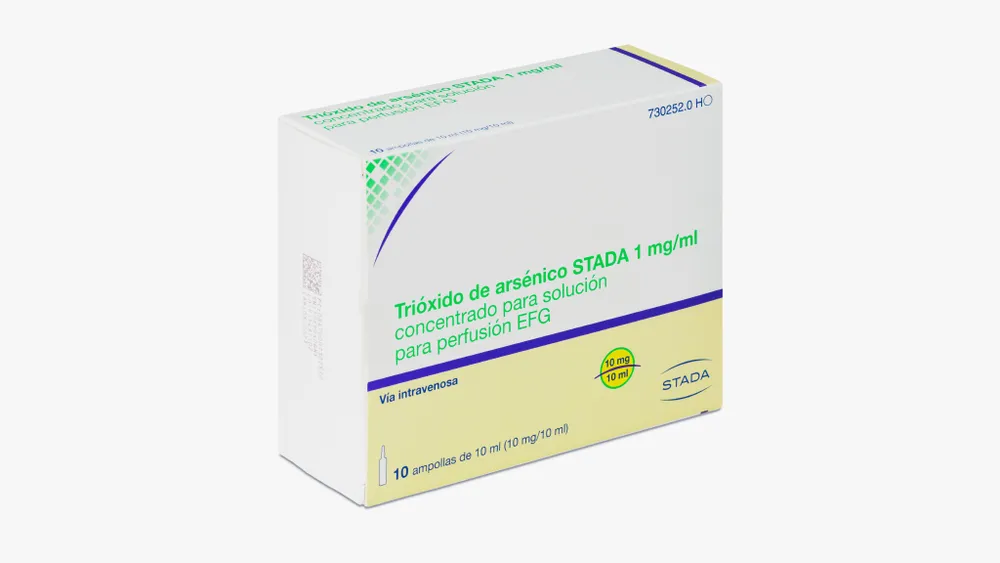
Table of Contents
- Package leaflet: Information for the user
- Introduction
- 1. What Trióxido de arsénico Stada is and what it is used for
- 2. What you need to know before Trióxido de arsénico Stada is administered to you
- 3. How Trióxido de arsénico Stada is administered
- 4. Possible adverse effects
- 5. Storage of Arsenic Trioxide Stada
- 6. Contents of the pack and other information
Package leaflet: Information for the user
Introduction
Package leaflet: information for the patient
Stada Arsenic trioxide 1 mg/ml concentrate for solution for infusion EFG
Read the entire leaflet carefully before you are given this medicine, because it contains important information for you.
- Keep this leaflet as you may need to read it again.
- If you have any questions, ask your doctor, pharmacist or nurse.
- This medicine has been prescribed for you only, and you should not give it to other people, even if they have the same symptoms as you, because it may harm them.
- If you experience any adverse reactions, consult your doctor, pharmacist or nurse, even if they are adverse reactions not listed in this leaflet. See section 4.
Contents of the leaflet
- What Trióxido de arsénico Stada is and what it is used for
- What you need to know before you are given Trióxido de arsénico Stada
- How Trióxido de arsénico Stada is administered
- Possible adverse effects
- How to store Trióxido de arsénico Stada
- Contents of the pack and other information
1. What Trióxido de arsénico Stada is and what it is used for
This medicine is used in adult patients with low- to intermediate-risk newly diagnosed acute promyelocytic leukemia (APL), and in adult patients whose disease has not responded to other treatments. APL is a unique type of myeloid leukemia, a disease that causes abnormal production of white blood cells, bleeding, and bruising.
2. What you need to know before Trióxido de arsénico Stada is administered to you
Inform your doctor or pharmacist if you are taking or have recently taken any other medicines, including those obtained without a prescription.
This medicine must be administered under the supervision of a physician experienced in the treatment of acute leukemias.
Do not receive Trióxido de arsénico Stada
If you are allergic to arsenic trioxide or to any of the other components of this medicine (listed in section 6).
Warnings and precautions
You must consult your doctor or nurse before being administered arsenic trioxide if:
- You have renal insufficiency.
- You have any liver problems.
Your doctor will take the following precautions:
- Blood tests will be performed to analyze the levels of potassium, magnesium, calcium, and creatinine in your blood before the first dose of arsenic trioxide.
- An electrocardiogram (ECG) must be performed before the first dose.
- Blood tests (potassium, calcium, liver function) will be repeated throughout your treatment with arsenic trioxide.
- Additionally, an electrocardiogram will be performed twice weekly.
- If you are at risk of a certain type of cardiac arrhythmia (e.g., torsades de pointes ventricular tachycardia or QT interval prolongation), your heart will be continuously monitored.
- Your doctor may monitor your health during and after treatment, as arsenic trioxide, the active substance in this medicine, may cause other cancers. You must report any new or unusual symptoms or conditions whenever you visit your doctor.
- Monitoring of cognitive and motor functions if you are at risk of vitamin B1 deficiency.
Children and adolescents
Arsenic trioxide is not recommended for children or adolescents under 18 years of age.
Other medicines and Trióxido de arsénico Stada
Inform your doctor or pharmacist if you are taking, have recently taken, or might need to take any other medicines, including those obtained without a prescription.
In particular, inform your doctor:
- If you are taking any medicine that may cause changes in heart rhythm, including:
- Certain types of antiarrhythmics (medicines used to correct irregular heartbeats, e.g., quinidine, amiodarone, sotalol, dofetilide)
- Medicines used to treat psychosis (loss of contact with reality; e.g., thioridazine)
- Medicines used to treat depression (e.g., amitriptyline)
- Certain types of medicines used to treat bacterial infections (e.g., erythromycin and sparfloxacin)
- Certain medicines used to treat allergies such as hay fever, known as antihistamines (e.g., terfenadine and astemizole)
- Any medicine that causes a decrease in blood magnesium or potassium levels (e.g., amphotericin B)
- Cisapride (a medicine used to relieve certain stomach problems)
The effect of these medicines on heart rhythm may be worsened by arsenic trioxide. You must ensure you inform your doctor about all medicines you are taking.
- If you are taking or have recently taken any medicine that may affect the liver.
If you have any doubts, show the bottle or packaging to your doctor.
Use of Trióxido de arsénico Stada with food and drink
There are no restrictions regarding food or drink while receiving arsenic trioxide.
Pregnancy
Consult your doctor or pharmacist before using any medicine. Arsenic trioxide may cause harm to the fetus if administered to pregnant women.
If you are able to become pregnant, you must use an effective method of contraception during treatment with arsenic trioxide.
If you are pregnant or become pregnant during treatment with arsenic trioxide, consult your doctor.
Men must use effective contraceptive methods during treatment with arsenic trioxide.
Breast-feeding
Consult your doctor or pharmacist before using any medicine. Arsenic from arsenic trioxide passes into breast milk.
Since arsenic trioxide may harm breastfed infants, avoid breast-feeding during treatment with arsenic trioxide.
Driving and use of machines
The influence of arsenic trioxide on your ability to drive and use machines is expected to be none or negligible.
If you experience discomfort or do not feel well after an injection of arsenic trioxide, you should wait until symptoms have disappeared before driving or using machines.
Trióxido de arsénico Stada contains sodium
This medicine contains less than 1 mmol of sodium (23 mg) per dose; i.e., it is essentially "sodium-free".
3. How Trióxido de arsénico Stada is administered
Duration and frequency of treatment
Patients with newly diagnosed acute promyelocytic leukemia
Your doctor will administer arsenic trioxide once daily by intravenous infusion. During the first treatment cycle, you may receive treatment every day for up to 60 days, or until your doctor considers that your disease has improved. If your disease responds to arsenic trioxide, you will receive 4 additional treatment cycles of 20 doses, administered 5 days per week (followed by 2 days off) for 4 weeks (followed by a 4-week break). Your doctor will decide exactly how long you should continue arsenic trioxide treatment.
Patients with acute promyelocytic leukemia whose disease has not responded to other treatments
Your doctor will administer arsenic trioxide once daily by intravenous infusion. During your first treatment cycle, you may receive treatment every day for up to 50 days, or until your doctor considers that your disease has improved. If your disease responds to arsenic trioxide, you will receive a second treatment cycle consisting of 25 doses, administered 5 days per week (followed by 2 days off), over 5 weeks. Your doctor will decide exactly how long you should continue arsenic trioxide treatment.
Method and route of administration
Arsenic trioxide must be diluted with a glucose-containing solution or a sodium chloride-containing solution.
Arsenic trioxide is normally administered by a doctor or nurse. It is given by intravenous infusion (drip) into a vein over 1–2 hours, although the infusion may last longer if adverse effects such as flushing or dizziness occur.
Arsenic trioxide must not be mixed or administered through the same tubing as other medications.
If you are given more Trióxido de arsénico Stada than you should
You may experience seizures, muscle weakness, and confusion. If this occurs, treatment with arsenic trioxide must be stopped immediately, and your doctor will treat the arsenic overdose.
If you have any further questions about the use of this medicine, ask your doctor, pharmacist, or nurse.
4. Possible adverse effects
Like all medicines, this medicine can cause adverse effects, although not everyone gets them.
Tell your doctor or nurse immediately if you notice any of the following adverse effects, as they could be signs of a serious condition called "differentiation syndrome", which could be life-threatening:
- difficulty breathing
- cough
- chest pain
- fever
Tell your doctor or nurse immediately if you notice one or more of the following adverse effects, as they could be signs of an allergic reaction:
- difficulty breathing
- fever
- sudden weight gain
- fluid retention
- fainting
- palpitations (strong heartbeat felt in the chest)
While being treated with arsenic trioxide, you may experience some of the following reactions:
Very common adverse effects (may affect more than 1 in 10 people):
- fatigue (tiredness), pain, fever, headache
- nausea, vomiting, diarrhoea
- dizziness, muscle pain, numbness or tingling
- skin rash or itching, increased blood sugar, oedema (swelling due to excess fluid)
- shortness of breath, palpitations, abnormalities in electrocardiogram
- low potassium or magnesium levels in blood, abnormalities in liver or kidney function tests, including high levels of bilirubin or gamma-glutamyl transferase in blood
Common adverse effects (may affect up to 1 in 10 people):
- decreased blood cell counts (platelets, red blood cells and/or white blood cells), increased white blood cell count
- chills, weight gain
- fever due to infection and low white blood cell counts, herpes zoster infection
- chest pain, pulmonary haemorrhage, hypoxia (reduced oxygen levels), fluid accumulation in the pericardium or lungs, hypotension, irregular heart rhythm
- seizures, bone or joint pain, inflammation of blood vessels
- increased sodium or magnesium, presence of ketones in blood and urine (ketoacidosis), abnormalities in kidney function tests, kidney failure
- stomach (abdominal) pain
- redness of the skin, facial swelling, blurred vision
Frequency not known (cannot be estimated from available data):
- lung infection, blood infection
- lung inflammation with chest pain and breathing difficulty, heart failure
- dehydration, confusion
- brain disease (encephalopathy, Wernicke's encephalopathy) with various manifestations, including difficulty using arms and legs, speech disorders and confusion
Reporting of adverse effects
If you experience any type of adverse effect, talk to your doctor or pharmacist, even if it is a possible adverse effect not listed in this leaflet. You can also report them directly via the Spanish System for Pharmacovigilance of Human Medicines: https://www.notificaram.es. By reporting adverse effects, you can help provide more information on the safety of this medicine.
5. Storage of Arsenic Trioxide Stada
Keep this medicine out of the sight and reach of children.
For the presentation in ampoules
Do not use this medicine after the expiry date stated on the label of the ampoule and on the carton.
For the presentation in vials
Do not use this medicine after the expiry date stated on the label of the vial and on the carton.
No special storage conditions are required.
After dilution with 0.9% sodium chloride solution or 5% glucose solution, arsenic trioxide is chemically and physically stable for 24 hours at 25°C and for 72 hours under refrigeration (2–8°C). From a microbiological standpoint, the product should be used immediately. If not used immediately, the conditions and duration of storage prior to use are the responsibility of the user and normally should not exceed 24 hours at 2–8°C, unless the dilution has been carried out under validated and controlled aseptic conditions.
Do not use this medicine if you notice any foreign particles or if the solution is discolored.
Medicines should not be disposed of via wastewater or household waste. Ask your pharmacist how to properly dispose of unused medicines and their packaging. This will help protect the environment.
6. Contents of the pack and other information
Composition of Arsenic Trioxide Stada
- The active substance is arsenic trioxide (1 mg/1 ml).
- The other components are sodium hydroxide, hydrochloric acid (as pH adjuster) and water for injections.
Appearance of the product and contents of the container
For the presentation in ampoules
Arsenic Trioxide Stada is a concentrate for solution for infusion. Arsenic trioxide is supplied in glass ampoules as a concentrated, sterile, clear, colourless, aqueous solution which is prepared and diluted in hospital and administered by infusion into a blood vessel.
Each carton contains 10 single-use glass ampoules. Each ampoule contains 10 mg of arsenic trioxide.
For the presentation in vials
Arsenic Trioxide Stada is a concentrate for solution for infusion. Arsenic trioxide is supplied in glass vials as a concentrated, sterile, clear, colourless, aqueous solution which is prepared and diluted in hospital and administered by infusion into a blood vessel.
Each carton contains 10 single-use glass vials. Each 12 ml vial contains 12 mg of arsenic trioxide.
Marketing Authorisation Holder
Laboratorio Stada, S.L.
C/Frederic Mompou, 5
08960 Sant Just Desvern (Barcelona)
Spain
Manufacturer
SVUS Pharma a.s.
Smetanovo nábreží 1238/20a
Hradec Králové 500 02
Czech Republic
or
STADA Arzneimittel AG
Stadastrasse 2 – 18
61118 Bad Vilbel
Germany
or
Centrafarm Services B.V.
Van de Reijtstraat 31-E
4814 NE Breda
The Netherlands
Date of the most recent revision of this leaflet: September 2023
Detailed and up-to-date information on this medicine is available on the website of the Spanish Agency of Medicines and Health Products (AEMPS) http://www.aemps.gob.es/
This information is intended for healthcare professionals only:
AN ASEPTIC TECHNIQUE MUST BE STRICTLY FOLLOWED DURING HANDLING OF ARSENIC TRIOXIDE SINCE IT DOES NOT CONTAIN PRESERVATIVES.
Dilution of Arsenic Trioxide Stada
Arsenic Trioxide Stada must be diluted before administration.
Personnel must be adequately trained in handling and diluting arsenic trioxide and must wear appropriate protective equipment.
For the presentation in ampoules
Opening the ampoule: Hold the arsenic trioxide ampoule with the coloured tip facing upwards and towards you. Shake or tap it gently so that any fluid present in the neck flows down into the body of the ampoule. Then press with your thumb on the coloured tip and break the ampoule while firmly holding the body of the ampoule with the other hand.
Dilution: Carefully insert the needle of a syringe into the ampoule and withdraw the entire contents. Arsenic trioxide must be diluted immediately with 100 to 250 ml of 50 mg/ml (5%) glucose injection solution or 9 mg/ml (0.9%) sodium chloride injection solution. Polypropylene plastic bags are used for the dilution of the final product.
Any unused portions from each ampoule must be properly discarded. Do not store any unused portion for later administration.
For the presentation in vials
Dilution: Remove the transparent flip-off cap. Carefully insert the needle of a syringe through the rubber stopper into the vial and withdraw the required volume. Arsenic trioxide must be diluted immediately with 100 to 250 ml of 50 mg/ml (5%) glucose injection solution or 9 mg/ml (0.9%) sodium chloride injection solution. Polypropylene plastic bags are used for the dilution of the final product.
Any unused portions from each vial must be properly discarded. Do not store any unused portion for later administration.
Use of Arsenic Trioxide Stada
Arsenic Trioxide Stada is for single use only. It must not be mixed or co-administered concomitantly through the same intravenous line with other medicinal products.
Arsenic trioxide is administered intravenously over 1–2 hours, but the duration of infusion may be extended up to 4 hours if vasomotor reactions occur. A central venous catheter is not required.
The diluted solution must be clear and colourless. Parenteral solutions should be inspected visually for particulate matter and discoloration prior to administration. Do not use the preparation if particles are observed.
After dilution in intravenous solutions, arsenic trioxide is chemically and physically stable for 24 hours at 25°C and for 72 hours under refrigeration (2–8°C). From a microbiological standpoint, the product should be used immediately. If not used immediately, the conditions and duration of storage prior to use are the responsibility of the user and normally should not exceed 24 hours at 2–8°C, unless dilution has been carried out under validated and controlled aseptic conditions.
Procedure for correct disposal
Disposal of unused medicine and of all materials that have been in contact with it must be carried out in accordance with local regulations.