Arixtra 7.5 mg/0.6 ml solution for injection, pre-filled syringe
Spain
Table of Contents
Package leaflet: Information for the user
Introduction
Package leaflet: information for the user
Arixtra 5 mg/0.4 ml solution for injection
Arixtra 7.5 mg/0.6 ml solution for injection
Arixtra 10 mg/0.8 ml solution for injection
fondaparinux sodium
Read all of this leaflet carefully before you start using this medicine because it contains important information for you.
-
Keep this leaflet. You may need to read it again.
-
If you have any questions, ask your doctor or pharmacist.
-
This medicine has been prescribed for you only and must not be given to other people, even if they have the same symptoms as you, because it may harm them.
-
If you experience any side effects, talk to your doctor or pharmacist, even if it is a side effect not listed in this leaflet. See section 4.
Contents of this leaflet:
-
What Arixtra is and what it is used for
-
What you need to know before using Arixtra
-
How to use Arixtra
-
Possible side effects
-
How to store Arixtra
-
Contents of the pack and other information
1. What Arixtra is and what it is used for
Arixtra is a medicine used to treat or help prevent the formation of blood clots in blood vessels (an antithrombotic agent). Arixtra contains a synthetic substance called fondaparinux sodium. This substance inhibits the action of coagulation factor Xa “ten-A” in the blood and thereby prevents the formation of unwanted blood clots (thrombi) in blood vessels.
Arixtra is used to treat adults who have a blood clot in the blood vessels of their legs (deep vein thrombosis) and/or in their lungs (pulmonary embolism).
2. What you need to know before using Arixtra
Do not use Arixtra:
-
if you are allergic to fondaparinux sodium or to any of the other ingredients of this medicine
-
(listed in section 6).
-
if you are experiencing significant bleeding
-
if you have bacterial endocarditis (infection of the heart)
-
- if you have severe kidney disease.
-
Tell your doctor if you think any of these situations apply to you. If so, you must not use
Arixtra.
Warnings and precautions:
Talk to your doctor or pharmacist before using Arixtra:
-
if you have previously had complications during treatment with heparin or heparin-like medicines that caused a decrease in blood platelets (heparin-induced thrombocytopenia)
-
if you are at risk of uncontrolled bleeding (haemorrhage), such as:
- gastric ulcer
-
bleeding disorders
-
recent intracranial haemorrhage (bleeding in the brain)
-
recent brain, spinal105 or eye surgery;
-
if you have severe liver disease
-
if you have kidney disease
-
if you are 75 years of age or older.
-
Tell your doctor if any of these situations apply to you.
Children and adolescents
Arixtra has not been studied in children or adolescents under 17 years of age.
Using Arixtra with other medicines
Tell your doctor or pharmacist if you are taking, have recently taken, or might need to take any other medicines, including those obtained without a prescription.
Using other medicines may affect how Arixtra works or may be affected by Arixtra.
Pregnancy and breastfeeding
Arixtra should not be prescribed to pregnant women unless strictly necessary. Breastfeeding is not recommended during treatment with Arixtra. If you are pregnant, breastfeeding, think you may be pregnant, or are planning to become pregnant, consult your doctor or pharmacist before using this medicine.
Arixtra contains sodium
This medicine contains less than 23 mg of sodium per dose and is therefore considered essentially “sodium-free”.
The Arixtra syringe contains latex
The needle cap of the syringe contains latex, which may cause allergic reactions in individuals sensitive to latex.
- Tell your doctor if you are allergic to latex before being treated with Arixtra.
3. How to use Arixtra
Follow exactly the administration instructions for this medication as indicated by your doctor or pharmacist. If in doubt, consult your doctor or pharmacist.
Your weight | Normal dose |
Less than 50 kg | 5 mg once daily |
Between 50 and 100 kg | 7.5 mg once daily |
Over 100 kg | 10 mg once daily. This dose may be reduced to |
7.5 mg once daily if you have moderate renal | |
disease. |
Should be injected at approximately the same time each day.
How to administer Arixtra
-
Arixtra is administered by subcutaneous injection into a skin fold formed in the lower abdominal area. The syringes are pre-filled with the exact dose you need. Different syringes are available for the 5 mg, 7.5 mg, and 10 mg doses. For a detailed description of how to use Arixtra, see the end of the leaflet.
-
Do not inject Arixtra into a muscle (intramuscularly).
How long you should use Arixtra
You should use Arixtra for the length of time prescribed by your doctor, as Arixtra protects you from a serious condition.
If you inject more Arixtra than you should
Contact your doctor or pharmacist immediately, as there is an increased risk of bleeding.
If you forget to use Arixtra
- Take the missed dose as soon as you remember. Do not inject a double dose to make up for the missed dose.
- If you are unsure, contact your doctor or pharmacist.
If you stop using Arixtra
If you stop treatment before your doctor tells you to, the blood clot may not have been adequately treated, and you may be at risk of developing a new blood clot in a vein in your leg or lung. Before stopping treatment, contact your doctor or pharmacist.
If you have any further questions about the use of this medicine, ask your doctor or pharmacist.
4. Possible adverse effects
Like all medicines, this medicine can cause adverse effects, although not everyone will experience them.
Symptoms to watch for
Severe allergic reactions (anaphylaxis): these are very rare (up to 1 in every 10,000 patients) in patients using Arixtra. Symptoms include:
-
swelling, sometimes of the face or mouth (angioedema), causing difficulty swallowing or breathing
-
collapse
-
Contact a doctor immediately if you experience these symptoms. Stop using Arixtra.
Frequent adverse effects
These may affect more than 1 in every 100 patients treated with Arixtra.
- bleeding (e.g. from the surgical site, from a pre-existing stomach ulcer, or from the nose, gums, blood in urine, coughing up blood, ocular bleeding, bleeding into joints, internal bleeding in the uterus)
- localized accumulation of blood (in any organ or body tissue)
- anaemia (reduction in the number of red blood cells)
- bruising
Uncommon adverse effects
These may affect up to 1 in every 100 patients treated with Arixtra.
- swelling (edema)
- headache
- pain
- chest pain
- difficulty breathing
- skin rash or skin itching
- wound discharge from the surgical site
- fever
- feeling dizzy or experiencing dizziness (nausea or vomiting)
- reduction or increase in the number of platelets (blood cells necessary for clotting)
- increase in certain chemical substances (enzymes) produced by the liver
Rare adverse effects
These may affect up to 1 in every 1,000 patients treated with Arixtra.
- allergic reaction
- internal bleeding in the brain, liver, or abdomen
- anxiety or confusion
- fainting or dizziness, low blood pressure
- drowsiness or fatigue
- flushing
- cough
- pain and inflammation at the injection site
- wound infection
- increase in blood levels of non-protein nitrogen
- leg pain or stomach pain
- indigestion
- diarrhoea or constipation
- increase in bilirubin (a substance produced by the liver) in the blood
- decrease in blood potassium levels
- pain around the upper abdomen or heartburn
If you experience any adverse effects, consult your doctor or pharmacist, even if they are effects not listed in this leaflet.
Reporting of adverse effects
If you experience any type of adverse effect, talk to your doctor or pharmacist, even if they are possible adverse effects not mentioned in this leaflet. You may also report them directly through the national reporting system listed in Appendix V. By reporting adverse effects, you can help provide more information on the safety of this medicine.
5. Storage of Arixtra
-
Keep this medicine out of the sight and reach of children.
-
Store below 25°C. Do not freeze.
-
It is not necessary to store Arixtra in the refrigerator.
Do not use this medicine:
-
after the expiry date stated on the label and carton
-
if you notice the presence of particles or a change in the solution's colour
-
if you observe that the syringe is damaged
-
if the syringe has been opened and will not be used immediately.
Disposal of syringes
Medicines or syringes must not be disposed of via wastewater or household waste. Ask your pharmacist how to dispose of medicines and containers you no longer need. This will help protect the environment.
6. Package contents and other information
Composition of Arixtra
The active substance:
-
5 mg of fondaparinux sodium in 0.4 ml of injectable solution
-
7.5 mg of fondaparinux sodium in 0.6 ml of injectable solution
-
10 mg of fondaparinux sodium in 0.8 ml of injectable solution
The other components are sodium chloride, water for injections, and hydrochloric acid and/or sodium hydroxide to adjust pH (see section 2).
Arixtra does not contain any animal-derived products.
Appearance of the product and contents of the pack
Arixtra is a clear, colourless or slightly yellowish injectable solution. It is supplied in a single-use prefilled syringe equipped with a safety system designed to help prevent accidental needlestick injuries after use.
It is available in packs of 2, 7, 10 and 20 prefilled syringes. Not all pack sizes may be marketed.
Marketing Authorisation Holder and Manufacturer
Marketing Authorisation Holder:
Viatris Healthcare Limited, Damastown Industrial Park, Mulhuddart, Dublin 15, DUBLIN, Ireland
Manufacturer:
Aspen Notre Dame de Bondeville, 1 rue de l'Abbaye, F-76960 Notre Dame de Bondeville, France.
Date of the most recent revision of this leaflet:
Other sources of information
Detailed information on this medicine is available on the European Medicines Agency website: http://www.ema.europa.eu
Further information on this medicine is available upon request by contacting the local representative of the Marketing Authorisation Holder.
Belgium/Belgium/Belgium Viatris Tel/Tel: + 32 (0)2 658 61 00 ???????? ?????????? Tel.: +359 2 44 55400 Czech Republic Viatris CZ s.r.o. Tel: + 420 222 004 400 | Lithuania Viatris UAB Tel: +370 5 205 1288 Luxembourg/Luxembourg Viatris Tel/Tel: + 32 (0)2 658 61 00 (Belgium/Belgium) Hungary Viatris Healthcare Kft. Tel.: + 36 1 465 2100 |
Denmark Viatris ApS Tlf: +45 28 11 69 32 | Malta V.J. Salomone Pharma Ltd Tel: + 356 21 22 01 74 |
Germany Viatris Healthcare GmbH Tel: +49 800 0700 800 | Netherlands Mylan Healthcare BV Tel: +31 (0)20 426 3300 |
Estonia Viatris OÜ Tel: + 372 6363 052 | Norway Viatris AS Tlf: + 47 66 75 33 00 |
Greece Viatris Hellas Ltd Tel: +30 2100 100 002 | Austria Mylan Österreich GmbH Tel: +43 1 86390 |
Spain Viatris Pharmaceuticals, S.L. Tel: +34 900 102712 | Poland Mylan Healthcare Sp. z o.o. Tel.: + 48 22 546 64 00 |
France Viatris Santé Tél: + 33 (0)4 37 25 75 00 | Portugal Viatris Healthcare, Lda. Tel: + 351 21 412 72 00 |
Croatia Viatris Hrvatska d.o.o. Tel: +385 1 23 50 599 | Romania BGP Products SRL Tel: +40 372 579 000 |
Ireland Mylan Ireland Limited Tel: +353 1 8711600 | Slovenia Viatris d.o.o. Tel: + 386 1 23 63 180 |
Iceland Icepharma hf Tel: +354 540 8000 | Slovakia Viatris Slovakia s.r.o. Tel: +421 2 32 199 100 |
Italy Viatris Italia S.r.l. Tel: + 39 02 612 46921 | Finland Viatris Oy Tel/Puh: +358 20 720 9555 |
Cyprus Varnavas Hadjipanayis Ltd Tel: +357 2220 7700 | Sweden Viatris AB Tel: + 46 (0)8 630 19 00 |
Latvia Viatris SIA Tel: +371 676 055 80 | United Kingdom (Northern Ireland) Mylan IRE Healthcare Limited +353 18711600 |
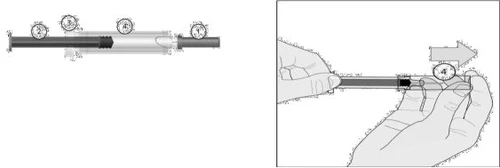
Figure 3. Syringe with a manual needle protection system, with the safety cap covering the needle AFTER USE
Types of safety syringes:
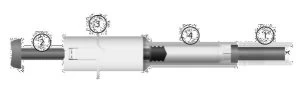
There are two types of safety syringes for Arixtra, designed to protect against accidental needlestick injuries after use. One type has an automatic needle protection system and the other has a manual system.
Components of the syringes:
- Needle shield
? Plunger
? Gripping area (for fingers) - Needle safety cap
Figure 1. Syringe with an automatic needle protection system
Syringe with a manual needle protection system
Figure 2. Syringe with a manual needle protection system
DESCRIPTION OF THE METHOD OF USE OF ARIXTRA Instructions for Use
These instructions apply to both types of syringes (with automatic and manual needle protection systems).
If there is a difference in instructions between the syringes, it will be clearly specified.
-
Wash your hands thoroughly with soap and water, and dry them with a towel.
-
Remove the syringe from its packaging and check that:
-
The expiration date has not passed
-
The solution is clear, colorless, and free of particles
-
The syringe has not been opened or damaged
-
Sit or lie down in a comfortable position. Select a site in the lower abdominal area (belly), at least 5 cm below the navel (Figure A).
For each injection, alternate between the left and right sides of the lower abdomen. This will help reduce discomfort at the injection site.
If injection into the lower abdomen is not possible, consult your doctor.
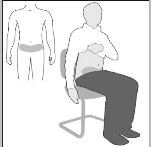
Figure A
-
Clean the injection site with an alcohol swab or alcohol-soaked cotton.
-
Remove the needle shield: first by twisting it (Figure B1), then by pulling it straight away from the syringe barrel (Figure B2).
Discard the needle shield.
Important note
-
Do not touch the needle, and avoid contact with any surface before the injection.
-
It is normal to see a small air bubble in the syringe. Do not attempt to remove this air bubble before administering the injection, as this may result in loss of some medication.
-
Gently pinch the previously cleaned skin to form a skin fold. Hold the skin fold between your thumb and index finger throughout the injection (Figure C).
-
Firmly hold the syringe by the gripping area. Insert the needle fully into the skin fold at a right angle (Figure D).
Figure B1
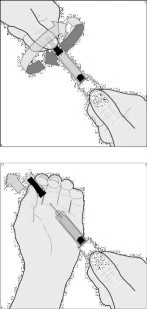
Figure B
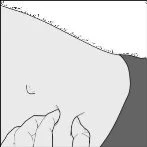
Figure C
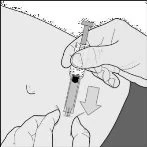
Figure D
- Inject ALL the contents of the syringe by fully depressing the plunger to the end (Figure E).
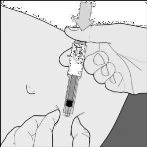
Figure E
Syringe with automatic system
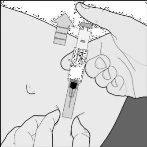
- Release the plunger, and the needle will automatically retract from the skin into a safety cap, where it will be permanently locked (Figure F).
Figure F
Syringe with manual system
- After the injection, hold the needle safety cap with the fingers of one hand, grasp the gripping area with the fingers of the other hand, and pull backward. This action releases the cap. Slide the cap along the syringe barrel until it locks into position, covering the needle as shown in Figure 3.
Do not dispose of the used needle in the household waste bin. Dispose of it according to the instructions provided by your doctor or pharmacist.