Aricept 5 mg film-coated tablets
Spain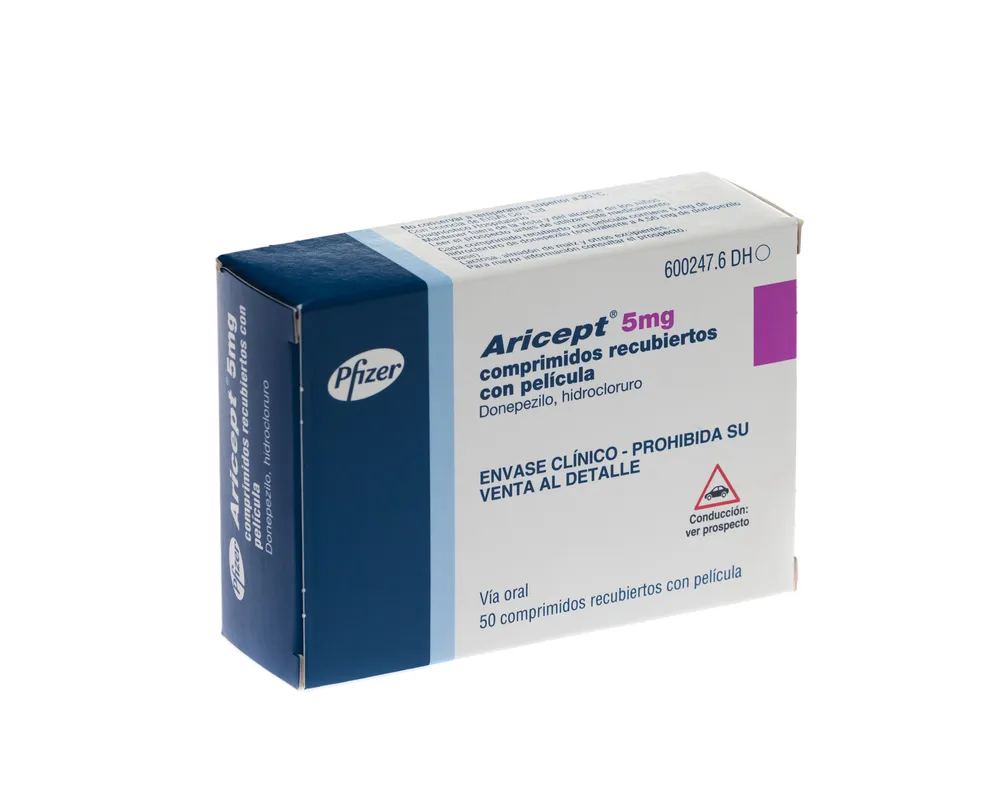
Table of Contents
Package leaflet: Information for the user
Introduction
Package leaflet: information for the user
Aricept 5 mg film-coated tablets
Donepezil hydrochloride
Read the entire leaflet carefully before you start taking this medicine, because it contains important information for you.
- Keep this leaflet, as you may need to read it again.
- If you have any questions, ask your doctor or pharmacist.
- This medicine has been prescribed for you only, and you should not give it to others, even if they have the same symptoms as you, because it may harm them.
- If you experience any adverse effects, consult your doctor or pharmacist, even if they are adverse effects not listed in this leaflet.
Leaflet contents:
- What Aricept is and what it is used for
- What you need to know before taking Aricept
- How to take Aricept
- Possible side effects
- How to store Aricept
- Contents of the pack and other information
1. What Aricept is and what it is used for
Aricept belongs to a group of medicines called acetylcholinesterase inhibitors. Donepezil hydrochloride increases the levels in the brain of a substance involved in memory (acetylcholine), by slowing down the breakdown of this substance.
It is used to treat the symptoms of mild to moderately severe Alzheimer's disease. The symptoms include increasing memory loss, confusion, and changes in behavior.
2. What you need to know before taking Aricept
Do not take Aricept:
- if you are allergic to donepezil hydrochloride, to piperidine derivatives, or to any of the other ingredients of this medicine (listed in section 6).
Warnings and precautions
Talk to your doctor before starting Aricept if you have or have had:
- a history of stomach or duodenal ulcer
- heart disease (such as irregular or very slow heartbeats, heart failure, myocardial infarction)
- a heart condition known as "QT interval prolongation" or a history of certain abnormal heart rhythms called torsade de pointes, or if anyone in your family has "QT interval prolongation"
- low levels of magnesium or potassium in the blood
- seizures
- asthma or chronic lung disease
- difficulty urinating or mild kidney disease.
You should avoid taking Aricept together with other acetylcholinesterase inhibitors and other cholinergic agonists or antagonists.
Other medicines and Aricept
Tell your doctor or pharmacist if you are taking, have recently taken, or might need to take any other medicines, especially if you are taking any of the following:
- medicines for heart rhythm problems, for example amiodarone or sotalol
- medicines for depression, for example citalopram, escitalopram, amitriptyline, fluoxetine
- medicines for psychosis, e.g. pimozide, sertindole, or ziprasidone
- medicines for bacterial infections, for example, clarithromycin, erythromycin, levofloxacin, moxifloxacin, rifampicin
- antifungal medicines, such as ketoconazole
- other medicines for treating Alzheimer's disease, for example galantamine
- painkillers or treatments for arthritis such as aspirin, non-steroidal anti-inflammatory drugs (NSAIDs) such as ibuprofen or sodium diclofenac
- quinidine and beta-blockers for treating irregular heartbeats, such as propranolol and atenolol
- phenytoin and carbamazepine (for treating epilepsy)
- cholinergic agonists and medicines with anticholinergic activity (acting on the central nervous system) such as tolterodine
- succinylcholine, diazepam, and other neuromuscular blockers (to produce muscle relaxation)
- general anaesthesia
If you are undergoing surgery with general anaesthesia, you must inform your doctor that you are taking Aricept, as this may affect the amount of anaesthetic required.
Aricept may be used in patients with mild to moderate renal or hepatic impairment. Inform your doctor if you have any kidney or liver disease. Patients with severe liver disease should not take Aricept.
Taking Aricept with food, drinks and alcohol
This medicine should be taken with a glass of water.
Aricept should not be taken with alcohol, as alcohol may alter the effect of this medicine.
Pregnancy, breast-feeding and fertility
If you are pregnant, breastfeeding, think you may be pregnant, or are planning to become pregnant, consult your doctor or pharmacist before using this medicine.
You must not take Aricept if you are breastfeeding your child.
Driving and using machines
Your illness may affect your ability to drive or operate machinery, and you should not carry out these activities unless your doctor has told you it is safe to do so. Aricept may cause fatigue, dizziness, somnolence, and muscle cramps, especially at the beginning of treatment or when the dose is increased. If you experience these effects, you should not drive or operate machinery.
This medicine contains lactose. If your doctor has told you that you have an intolerance to certain sugars, consult with them before taking this medicine.
3. How to take Aricept
Follow exactly the administration instructions for this medicine as given by your doctor. If in doubt, consult your doctor or pharmacist again.
Aricept is administered orally.
Treatment with Aricept starts with one 5 mg tablet taken once daily with a little water, at night immediately before going to bed. After one month of treatment, your doctor may instruct you to increase the dose to 10 mg once daily at night. The maximum recommended dose is 10 mg per day.
If you experience abnormal dreams, nightmares, or difficulty sleeping (see section 4), your doctor may recommend that you take Aricept in the morning.
If you have mild or moderate hepatic impairment (liver disease) or renal impairment (kidney disease), you may take Aricept. Inform your doctor before starting treatment if you have liver or kidney problems. Patients with severe hepatic impairment (liver disease) must not take Aricept.
Use in children
The use of Aricept in children is not recommended.
If you take more Aricept than you should
If you have taken more Aricept than you should, contact your doctor, pharmacist, or call the Toxicology Information Service immediately at: 91 562 04 20, indicating the medication and the amount taken.
Symptoms of overdose may include nausea (feeling sick), vomiting (being sick), salivation, sweating, slowed heart rate, low blood pressure (dizziness or lightheadedness upon standing), breathing difficulties, loss of consciousness, and seizures.
If you forget to take Aricept
Do not take a double dose to make up for missed doses.
If you stop taking Aricept
Do not stop treatment with Aricept unless your doctor tells you to. If you stop taking Aricept, the benefits of treatment will gradually disappear.
If you have any further questions about the use of this medicine, ask your doctor or pharmacist.
4. Possible adverse effects
Like all medicines, Aricept can cause adverse effects, although not everyone experiences them.
The following adverse effects have been reported in people taking Aricept.
Contact your doctor if you experience any of these effects during treatment with Aricept.
Serious adverse effects:
You should inform your doctor immediately if you notice the following serious adverse effects, as you may require urgent medical treatment.
- Liver damage, for example, hepatitis. Symptoms of hepatitis include nausea or vomiting (feeling sick or being sick), loss of appetite, general malaise, fever, itching, yellowing of the skin and eyes, and dark-colored urine (affects between 1 and 10 in every 10,000 people).
- Stomach or duodenal ulcers. Symptoms of ulcers include stomach pain and discomfort (indigestion) between the navel and the sternum (affects between 1 and 10 in every 1,000 people).
- Bleeding in the stomach or intestine. This may cause you to have black, tarry stools or visible rectal bleeding (affects between 1 and 10 in every 1,000 people).
- Dizziness (fainting) or seizures (affects between 1 and 10 in every 1,000 people).
- Fever with muscle rigidity, sweating, and decreased level of consciousness (may be symptoms of a condition called "Neuroleptic Malignant Syndrome") (affects fewer than 1 in every 10,000 patients).
- Muscle weakness, tenderness, or pain, especially if you also feel unwell, have fever, or have dark-colored urine. This may be due to abnormal muscle breakdown, which can be life-threatening and lead to kidney problems (a condition called rhabdomyolysis).
The estimated frequency of occurrence of adverse effects is as follows:
Very common: may affect more than 1 in 10 patients
- Diarrhea
- Malaise
- Headache
Common: may affect between 1 and 10 in every 100 patients
- Cold symptoms
- Loss of appetite
- Hallucinations
- Agitation
- Aggressive behaviour
- Abnormal dreams and nightmares
- Fainting
- Dizziness
- Difficulty sleeping
- Vomiting
- Abdominal discomfort
- Urinary incontinence
- Rash
- Itching
- Muscle cramps
- Fatigue
- Pain
- Accidents (patients may be more prone to falls and accidental injuries)
Uncommon: may affect between 1 and 10 in every 1,000 patients
- Seizures
- Slowing of heart rate (bradycardia)
- Gastrointestinal bleeding, stomach and duodenal ulcers (a part of the intestine)
- Increase in a type of enzyme (muscle creatine kinase) in the blood
Rare: may affect between 1 and 10 in every 10,000 patients
- Extrapyramidal symptoms (such as tremor or stiffness in the hands or legs)
- Cardiac conduction disturbances
- Liver function abnormalities, including hepatitis
Frequency not known (cannot be estimated from available data)
- Increased libido, hypersexuality
- Pisa syndrome (a condition involving involuntary muscle contractions with abnormal bending of the body and head to one side)
- Changes in heart activity that may be seen on an electrocardiogram (ECG), known as "QT interval prolongation"
- Fast and irregular heartbeat, fainting which may be symptoms of a potentially life-threatening disorder known as torsade de pointes
Reporting of adverse effects
If you experience any type of adverse effects, consult your doctor or pharmacist, even if they are adverse effects not listed in this leaflet. You may also report them directly via the Spanish Pharmacovigilance System for Human Medicinal Products, Website: www.notificaRAM.es
5. Storage of Aricept
Keep this medicine out of the sight and reach of children.
Store below 30ºC.
Do not use Aricept after the expiry date stated on the carton. The expiry date refers to the last day of the month indicated.
Medicines must not be disposed of via wastewater or household waste. Dispose of unused medicines and their containers at the SIGRE collection point at your pharmacy. If you are unsure, ask your pharmacist how to dispose of medicines and containers you no longer need. This will help protect the environment.
6. Contents of the pack and other information
Composition of Aricept 5 mg film-coated tablets
- The active substance is donepezil hydrochloride. Each tablet contains 5 mg of donepezil hydrochloride.
- The other components are: lactose monohydrate, gluten-free maize starch, microcrystalline cellulose, hypromellose, magnesium stearate, talc, polyethylene glycol, hypromellose and titanium dioxide (E171).
Appearance of the product and contents of the pack
- Aricept 5 mg is presented as film-coated tablets. The tablets are round, biconvex, white in colour and marked with “5” on one side and “ARICEPT” on the other.
Aricept 5 mg film-coated tablets are available in a pack size of 28 tablets in a unit-dose blister made of PVC with an aluminium foil backing.
Marketing Authorisation Holder and Manufacturer
Marketing Authorisation Holder:
Eisai GmbH
Edmund-Rumpler-Straße 3
60549 Frankfurt am Main
Germany
Manufacturer:
Fareva Amboise
Zone Industrielle
29 route des Industries
37530 Pocé-sur-Cisse
France
or
Eisai GmbH
Edmund-Rumpler-Straße 3
60549 Frankfurt am Main
Germany
For further information about this medicinal product, please contact the local representative of the Marketing Authorisation Holder:
Eisai Farmacéutica, S.A.
Parque Empresarial Cristalia.
Calle Via de los Poblados 3, Edf. 7/8
4th floor
28033 Madrid
Tel: + (34) 91 455 94 55
Date of the most recent revision of this leaflet: December 2022
"Detailed and up-to-date information on this medicinal product is available on the website of the Spanish Agency for Medicines and Health Products (AEMPS) http://www.aemps.gob.es/"