Arganova 100 mg/ml concentrate for solution for infusion
Spain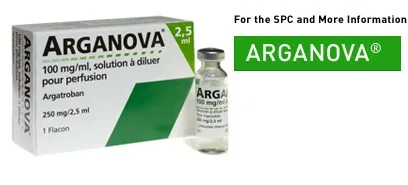
Table of Contents
Package leaflet: Information for the user
Introduction
PACKAGE LEAFLET: INFORMATION FOR THE USER
Arganova 100 mg/ml concentrate for solution for infusion
argatroban monohydrate
Read the entire leaflet carefully before you start using this medicine because it contains important information for you
- Keep this leaflet as you may need to read it again.
- If you have any questions, consult your doctor or pharmacist.
- If you experience any adverse reactions, consult your doctor, pharmacist, or nurse, even if they are adverse reactions not listed in this leaflet. See section 4.
Leaflet contents
- What Arganova is and what it is used for
- What you need to know before using Arganova
- How to use Arganova
- Possible side effects
- How to store Arganova
- Contents of the pack and other information
1. What Arganova is and what it is used for
Arganova is an anticoagulant (a medicine that helps prevent blood clots from forming in your bloodstream). It works by blocking the action of thrombin, a substance in the blood that is important for blood clotting.
Arganova is used if you have a disorder known as heparin-induced thrombocytopenia type II (HIT type II). If you have HIT type II, you are at risk of developing blood clots in your circulation, which may lead to heart attacks, strokes, breathing problems, and impaired blood flow to your limbs. Arganova can help prevent these problems or stop them from worsening.
2. What you need to know before using Arganova
Do not use Arganova
You must not be given Arganova:
- If you have uncontrolled bleeding.
- If you are allergic (hypersensitive) to argatroban or to any of the other components of Arganova.
- If you have severe liver impairment.
Warnings and precautions
Arganova will be administered with special caution in the following cases:
- If you have an increased risk of bleeding.
- If you have recently received injections or infusions of other anticoagulants, such as heparin.
- If you have any liver disease.
Children and adolescents
It is not recommended to administer this medicine to children or adolescents, as the effective and safe dose of Arganova has not been clearly established.
Use of Arganova with other medicines
Inform your doctor or pharmacist if you are using or have recently used any other medicines, including those obtained without a prescription.
Combining Arganova with other anticoagulant drugs or drugs that dissolve blood clots may increase the risk of bleeding.
Since Arganova contains ethanol, it may affect the action of other medicines containing metronidazole (for infections) or disulfiram (for alcoholism).
Pregnancy, breastfeeding, and fertility
If you are pregnant, breastfeeding, think you may be pregnant, or plan to become pregnant, consult your doctor before receiving Arganova.
As a precautionary measure, it is preferable to avoid using Arganova during pregnancy.
Avoid breastfeeding while you are receiving Arganova. See also the section "Arganova contains alcohol".
Driving and using machines
Since Arganova contains alcohol, you must not drive or operate machinery during treatment. (See also "Arganova contains alcohol").
Arganova contains alcohol
This product contains 50% ethanol (alcohol), corresponding to 400 mg/ml before dilution, which equals 0.5% by volume after dilution according to instructions. Therefore, the daily dose may contain up to 5 ml (4 g) of alcohol, equivalent to 100 ml of beer or 40 ml of wine.
This medicine may be harmful to individuals suffering from alcoholism.
The alcohol content should be taken into account in pregnant or breastfeeding women, children, and high-risk groups such as patients with liver disease, epilepsy, or brain damage. See also "Pregnancy, breastfeeding, and fertility".
If you are addicted to alcohol, consult your doctor or pharmacist before taking this medicine.
It is unlikely that the amount of alcohol contained in this medicine will have any noticeable effect in adults or adolescents. However, the amount of alcohol in this medicine may alter the effect of other medicines. Consult your doctor or pharmacist if you are taking other medicines. Since this medicine is usually administered slowly over several hours, the effects of alcohol may be reduced.
Arganova contains sorbitol
This medicine contains 750 mg of sorbitol in each vial (2.5 ml), equivalent to 300 mg/ml.
Sorbitol is a source of fructose. If you have hereditary fructose intolerance (HFI), a rare genetic disorder, you must not receive this medicine. Patients with HFI cannot metabolize fructose, which may lead to serious adverse effects. Consult your doctor before receiving this medicine if you have HFI.
3. How to use Arganova
Arganova will always be administered by a healthcare professional. Arganova will be given to you intravenously (into a vein) as a continuous infusion. Your doctor will decide the dose and duration of treatment.
4. Possible adverse effects
Like all medicines, Arganova may cause adverse effects, although not everyone experiences them.
The most common adverse effect is bleeding. Significant bleeding may occur in approximately 5% of patients, and minor bleeding in about 39%.
Contact your doctor immediately if you experience any of the following symptoms:
? bleeding or bruising
? blood in urine or stools
? vomiting or coughing up blood
? black stools
? difficulty breathing
? cold, clammy skin
? dry mouth
? dilated pupils or weak, rapid pulse
These symptoms may indicate that you are experiencing bleeding.
Frequent side effects (may affect up to 1 in 10 users):
? anemia
? blood clots
? bleeding, including small and numerous spots on the skin and mucous membranes (purpura)
? nausea
Uncommon side effects (may affect up to 1 in 100 users):
? infections, such as urinary tract infections
? changes in blood test values
? blood clots
? loss of appetite
? low blood sugar levels
? low blood sodium levels
? confusion
? dizziness
? fainting
? headache
? stroke
? muscle disorders
? speech disorders
? vision problems
? deafness
? heart attacks
? fluid in the pericardium
? irregular heartbeat
? increased heart rate
? hypotension
? hypertension
? venous inflammation
? shock
? reduced oxygen supply to tissues
? breathing difficulties
? fluid around the lungs
? hiccups
? coughing up blood or blood in vomit or stools
? constipation
? diarrhoea
? stomach inflammation
? difficulty swallowing
? tongue disorders
? abnormal liver function
? jaundice (yellowing of the skin and eyes)
? abnormal liver function blood tests
? skin rash, including hives
? itching
? increased sweating
? hair loss
? muscle weakness
? muscle pain
? kidney failure
? fever
? pain
? fatigue
? injection site reaction
? swelling of the legs
? increased wound discharge
? abnormal laboratory test results
Not known (frequency cannot be estimated from available data):
? Cases of bleeding in the brain have been reported
Reporting of adverse effects
If you experience any adverse effect, consult your doctor, pharmacist, or nurse, even if it is a possible adverse effect not listed in this leaflet. You may also report them directly via the Spanish Pharmacovigilance System for Human Medicines: www.notificaRAM.es.
By reporting adverse effects, you can help provide more information on the safety of this medicine.
5. Storage of Arganova
Keep out of the sight and reach of children.
Store the vial in the outer packaging to protect it from light.
Do not refrigerate or freeze.
Reconstituted solutions must not be exposed to direct sunlight.
Do not use solutions if they are cloudy or contain particles.
Diluted solution: Chemical and physical in-use stability has been demonstrated for up to 14 days at temperatures of 25 °C and from 2 °C to 8 °C in an infusion solution of sodium chloride 9 mg/ml (0.9%) or glucose 50 mg/ml (5%), or in an intravenous infusion preparation of sodium lactate.
From a microbiological standpoint, the product should be used immediately. If not used immediately, the user is responsible for the storage times and conditions during use, which normally should not exceed 24 hours at a temperature of 2 °C to 8 °C, unless the dilution was carried out under validated and controlled aseptic conditions.
Do not use Arganova after the expiry date stated on the carton or vial after EXP. The expiry date refers to the last day of the month indicated.
6. Contents of the pack and other information
Composition of Arganova
The active substance of Arganova is argatroban monohydrate.
One vial with 2.5 ml of concentrate for solution for infusion contains 250 mg of argatroban monohydrate.
The other components are:
anhydrous ethanol
sorbitol (E-420i)
water for injections.
Nature and contents of the container
This medicinal product is a clear, colourless or slightly yellow concentrate for solution for infusion. Each vial contains 2.5 ml of solution, and the vials are packed in cardboard boxes containing 1 or 6 vials.
Only certain pack sizes may be marketed.
Marketing Authorisation Holder
Ethypharm, 194, Bureaux de la Colline, Bâtiment D, 92213 Saint-Cloud cedex, France.
Manufacturer
Tjoapack Netherlands B.V., Nieuwe Donk 9, Etten-Leur, 4879AC, The Netherlands.
Fisiopharma, Nucleo Industriale, 84020 Palomonte (SA), Italy
For further information about this medicinal product, please contact the local representative of the Marketing Authorisation Holder:
Aguettant Ibérica S.L.
Baldiri Reixac, 4-8, Torre I, 08028 Barcelona
Spain
Tel: +34 93 403 37 80
This medicinal product is authorised in the Member States of the European Economic Area under the following names:
Denmark | Novastan |
Spain | Arganova |
Italy | Novastan |
Norway | Novastan |
United Kingdom | Exembol |
Sweden | Novastan |
This patient information leaflet was approved in: 03/2021
This information is intended for healthcare professionals only.
Instructions for use, handling, and disposal
Arganova must be diluted in a 9 mg/ml (0.9%) sodium chloride solution for infusion, a 50 mg/ml (5%) glucose solution for infusion, or a lactated Ringer's solution for intravenous infusion to a final concentration of 1 mg/ml. The vial should be discarded if the solution is cloudy or contains any insoluble precipitate.
Each 2.5 ml vial should be diluted 100-fold by mixing with 250 ml of diluent. Each vial is for single use only. Use 250 mg (2.5 ml) per 250 ml of diluent or 500 mg (5 ml) per 500 ml of diluent.
The reconstituted solution should be mixed by gently inverting the infusion bag or bottle repeatedly for one minute. The diluted solution should be clear and practically free from visible particles. During reconstitution, the solution may show slight transient turbidity due to the formation of microprecipitates, which dissolve rapidly upon mixing. The pH of the reconstituted intravenous solution prepared according to instructions ranges from 3.2 to 7.5.
It is not necessary to protect from sunlight by measures such as covering intravenous lines with aluminum foil. No significant loss of potency has been observed during simulated administration of the solution through intravenous lines.
Disposal of unused medicine and of all materials that have come into contact with it should be carried out in accordance with local regulations.