Aralevo 5 mg film-coated tablets EFG
Spain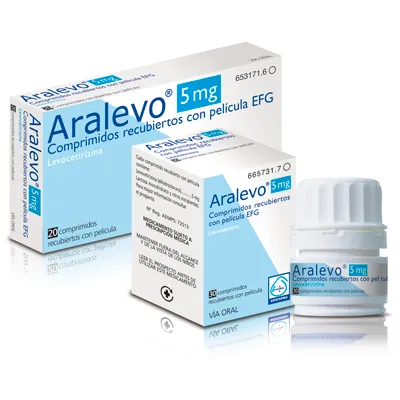
Table of Contents
Package leaflet: Information for the user
Introduction
Package leaflet: information for the user
Aralevo 5 mg Film-coated tablets EFG
Levocetirizine dihydrochloride
Read the entire leaflet carefully before you start taking this medicine, because it contains important information for you.
- Keep this leaflet, as you may need to read it again.
- If you have any questions, ask your doctor or pharmacist.
- This medicine has been prescribed for you only, and you should not give it to others, even if they have the same symptoms as you, because it may harm them.
- If you experience any adverse effects, consult your doctor or pharmacist, even if they are effects not listed in this leaflet.
Contents of the leaflet
- What Aralevo is and what it is used for
- What you need to know before taking Aralevo
- How to take Aralevo
- Possible side effects
- How to store Aralevo
- Contents of the pack and other information
1. What Aralevo is and what it is used for
This medicine is an antihistamine used to treat allergies. The active substance of Aralevo is levocetirizine dihydrochloride.
For the treatment of disease signs (symptoms) associated with allergic conditions such as:
Chronic urticaria of unknown origin (chronic idiopathic urticaria).
2. What you need to know before starting to take Aralevo
Do not take Aralevo
- If you are allergic (hypersensitive) to levocetirizine dihydrochloride or to any antihistamine or to any of the other components of Aralevo (see “Composition of Aralevo”).
- If you have severe impairment of kidney function (severe renal insufficiency with creatinine clearance less than 10 ml/min).
Take special care with Aralevo
- The use of Aralevo is not recommended in children under 6 years of age, as the film-coated tablets do not allow for dose adjustment.
Use of other medicines
Inform your doctor or pharmacist if you are using or have recently used any other medicines, including those obtained without a prescription.
Taking Aralevo with food and drink
Caution is advised when taking Aralevo together with alcohol.
In sensitive patients, concomitant intake of cetirizine or levocetirizine and alcohol or other agents acting on the central nervous system may produce effects on the central nervous system, although the cetirizine racemate has been shown not to potentiate the effect of alcohol.
Pregnancy and breastfeeding
Consult your doctor or pharmacist before taking any medicine.
Inform your doctor if you are pregnant, trying to become pregnant, or are breastfeeding.
Driving and using machines
Some patients treated with Aralevo may experience drowsiness, fatigue, and exhaustion. If you are going to drive, perform potentially hazardous activities, or operate machinery, you are advised to wait and observe your response to the medication first. However, in special tests conducted in healthy individuals, no disturbances in attention, reaction capacity, or driving ability were detected after taking levocetirizine at the recommended dose.
Important information about some of the components of Aralevo
This medicine contains lactose. If your doctor has informed you that you have an intolerance to certain sugars, consult him before taking this medicine.
3. How to take Aralevo
Follow exactly the instructions for using Aralevo provided by your doctor. Consult your doctor or pharmacist if you have any doubts.
The usual dose for adults and children aged 6 years and older is one tablet daily.
Patients with renal impairment should receive a reduced dose according to the severity of their kidney disease.
Patients with hepatic impairment only should take the normal prescribed dose.
Patients with both hepatic and renal impairment should take a reduced dose based on the severity of their kidney disease, and in children the dose will depend on body weight; your doctor will determine the appropriate dose.
The use of Aralevo is not recommended in children under 6 years of age.
The tablets should be swallowed whole with water and may be taken either on an empty stomach or with food.
If you take more Aralevo than you should
A significant overdose may cause drowsiness in adults. In children, it may initially cause agitation and restlessness followed by drowsiness.
In case of overdose or accidental ingestion, contact your doctor or pharmacist immediately or call the Toxicology Information Service at telephone number 91 562 04 20 (indicating the medicine and the amount ingested).
If you forget to take Aralevo
If you have forgotten to take Aralevo, or if you have taken a lower dose than prescribed by your doctor, do not take a double dose to make up for the missed doses. Simply wait until the time of your next scheduled dose and take the normal prescribed dose.
If you stop taking Aralevo
Stopping treatment with Aralevo earlier than planned should not have harmful effects, although the symptoms of the disease may gradually reappear with a severity no greater than that observed before starting treatment with Aralevo.
If you have any further questions about the use of this product, ask your doctor or pharmacist.
4. Possible adverse effects
Like all medicines, Aralevo can cause adverse effects, although not everyone experiences them.
Currently, the estimated frequency is divided as follows:
Very common: at least 1 in 10 patients
Common: at least 1 in 100 patients
Uncommon: at least 1 in 1,000 patients
Rare: at least 1 in 10,000 patients
Very rare: less than 1 in 10,000 patients, including isolated cases
Frequency not known: cannot be estimated from available data.
Frequent adverse effects have been described, mostly mild to moderate in severity, such as dry mouth, headache, fatigue, and somnolence.
Uncommon adverse effects include exhaustion and abdominal pain.
Frequency not known: oculogyric crisis (uncontrolled circular movements of the eyes).
Other adverse effects that have been reported include palpitations, seizures, visual disturbances, edema, pruritus (itching), skin rash, urticaria (swelling, redness, and itching of the skin), shortness of breath, weight gain, muscle pain, aggressive or agitated behavior, hepatitis, abnormal liver function, and nausea.
At the first signs of a hypersensitivity reaction, stop taking Aralevo and consult your doctor immediately. Symptoms of a hypersensitivity reaction may include: swelling of the mouth, tongue, face and/or neck, difficulty breathing or swallowing together with hives (angioedema), sudden drop in blood pressure which may lead to collapse or shock, and which may be fatal.
If you consider any of the adverse effects you experience to be severe, or if you notice any adverse effects not listed in this leaflet, inform your doctor or pharmacist.
5. Storage of Aralevo
No special storage conditions are required.
Keep out of the reach and sight of children.
Do not use Aralevo after the expiry date stated on the packaging after EXP. The expiry date refers to the last day of the month indicated.
Do not use Aralevo if you notice any visible signs of deterioration.
Medicines should not be disposed of via wastewater or household waste. Ask your pharmacist how to dispose of medicines and packaging that you no longer need. This will help protect the environment.
6. Contents of the container and other information
Composition of Aralevo
- The active substance is levocetirizine dihydrochloride.
Each film-coated tablet contains 5 mg of levocetirizine dihydrochloride.
- The other components are microcrystalline cellulose, monohydrate lactose, anhydrous colloidal silica, magnesium stearate, and Opadry white.
Appearance of the product and contents of the container
The film-coated tablets are white, round, and scored.
They are packed in blisters of 2x10, and in bottles of 30 film-coated tablets.
Marketing Authorization Holder and Manufacturer
ARAFARMA GROUP, S.A.
C/ Fray Gabriel de San Antonio, 6-10
Pol. Ind. del Henares
19180 Marchamalo (Guadalajara), Spain.
This leaflet was last reviewed in July 2018