Apo-Go Pen 10 mg/ml solution for injection
Spain
Table of Contents
Package leaflet: Information for the user
Introduction
Package leaflet: Information for the user
APO-go PEN 10 mg/ml solution for injection Apomorphine hydrochloride
(* Abbreviated as APO-go in the text)
For use in adults
Read this entire leaflet carefully before you start using this medicine, because it contains important information for you.
- Keep this leaflet, as you may need to read it again.
- If you have any questions, consult your doctor, nurse, or pharmacist.
- This medicine has been prescribed for you and should not be given to other people, even if they have the same symptoms, as it may harm them.
- If you experience any adverse effects, consult your doctor or pharmacist, even if they are effects not listed in this leaflet. See section 4.
Contents of the leaflet:
- What APO-go Pen is and what it is used for.
- What you need to know before using APO-go Pen.
- How to use APO-go Pen.
- Possible side effects.
- How to store APO-go Pen.
- Contents of the pack and other information.
1. What APO-go Pen is and what it is used for
APO-go Pen contains an injectable solution of apomorphine that is injected under the skin (subcutaneously). The active substance in APO-go Pen is apomorphine hydrochloride. Each milliliter of solution contains 10 mg of apomorphine.
Apomorphine hydrochloride is a medicine belonging to a group known as dopaminergic agonists. APO-go Pen is used to treat Parkinson's disease. Apomorphine helps reduce the time spent in the "off" state or immobile state in patients who have previously been treated with levodopa and/or other dopaminergic agonists for Parkinson's disease. Your doctor or nurse will help you recognize the signs indicating when you should use this medicine.
Despite the name of the medicine, apomorphine does not contain morphine.
2. What you need to know before using APO-go PEN
Before using APO-go Pen, your doctor will perform an ECG (electrocardiogram) and ask for a list of all other medications you are taking. This ECG will be repeated during the first few days of treatment and at any time your doctor considers necessary. Your doctor will also ask about any other medical conditions you may have, especially those related to the heart. Some of these questions and additional tests may be repeated at each medical visit. If you experience symptoms that could be related to the heart, such as palpitations, fainting, or dizziness, you must inform your doctor immediately. You should also inform your doctor if you have diarrhea or start taking a new medication.
Do not use APO-go Pen if:
- you are under 18 years of age
- you have difficulty breathing
- you have dementia or Alzheimer's disease
- you have a mental illness with symptoms such as hallucinations, delusions, confusion, or loss of touch with reality
- you have liver problems
- you have severe dyskinesia (involuntary movements) or severe dystonia (inability to move) despite taking levodopa
- you are allergic to apomorphine or any of the other components of this medicine (listed in section 6)
- you or a family member have an abnormality in your electrocardiogram (ECG) known as "long QT interval syndrome"
- you are taking ondansetron (a medicine used to treat nausea and vomiting)
Warnings and precautions
Talk to your doctor, pharmacist, or nurse before using APO-go Pen if:
- you have kidney problems
- you have lung problems
- you have heart problems
- you have low blood pressure or feel weak or dizzy when standing up
- you are taking other medicines for high blood pressure
- you have nausea or vomiting
- your Parkinson's disease causes certain mental problems such as hallucinations and confusion
- you are elderly or feel weak
Inform your doctor if you or your family members/caregivers notice that you are developing impulses or urges to behave in ways that are unusual for you and that you cannot resist the impulse, drive, or temptation to carry out certain activities that could be harmful to you or others. These behaviors are called impulse control disorders and may include compulsive gambling, excessive eating or spending, abnormally increased sex drive, or increased sexual thoughts or feelings. Your doctor may need to adjust or stop your dose.
Some patients develop symptoms of addiction that lead to a compulsive desire to take high doses of APO-go Pen and other medicines used to treat Parkinson's disease.
If any of the situations described occur, please inform your doctor or nurse.
Children and adolescents
APO-go Pen must not be used in children and adolescents under 18 years of age.
Use of APO-go Pen with other medicines
Inform your doctor or pharmacist if you are taking, have recently taken, or might need to take any other medicines.
Talk to your doctor or pharmacist before taking this medicine if:
- you are taking medicines that affect how your heart beats. This includes medicines used to treat heart rhythm problems (such as quinidine and amiodarone), depression (such as tricyclic antidepressants like amitriptiline and imipramine), bacterial infections (macrolide antibiotics such as erythromycin, azithromycin, and clarithromycin), and domperidone.
- you are taking ondansetron (a medicine used to treat nausea and vomiting), as this may cause severe drops in blood pressure and loss of consciousness.
If you use this medicine at the same time as other medicines, the effect of these medicines may be altered. This is particularly true for:
- medicines such as clozapine used to treat mental disorders
- medicines to lower blood pressure
- other medicines used to treat Parkinson's disease
Your doctor will inform you if you need to change the dose of apomorphine or any other medicine you are taking.
If, in addition to APO-go Pen, you are also using levodopa (another medicine for Parkinson's disease), your doctor should perform regular blood tests.
Use of APO-go Pen with food and drink
Food and drink do not affect how this medicine works.
Pregnancy and breastfeeding
APO-go Pen must not be used during pregnancy unless clearly necessary.
If you are pregnant or breastfeeding, think you may be pregnant, or plan to become pregnant, consult your doctor or pharmacist before using this medicine.
It is unknown whether APO-go Pen is excreted in breast milk. Consult your doctor if you are breastfeeding or plan to start. Your doctor will advise you whether you should continue or stop breastfeeding and whether you should continue or stop taking this medicine.
Consult your doctor or pharmacist before using any medicine.
Driving and using machines
APO-go Pen may cause drowsiness and a strong desire to sleep. You must not drive or operate machinery if this medicine causes these effects.
APO-go Pen contains sodium metabisulfite: APO-go Pen contains sodium metabisulfite (E-222), which in rare cases may cause severe allergic reactions with symptoms such as skin rash or itching, difficulty breathing, swelling of the eyelids, face or lips, or swelling or redness of the tongue. If you experience these adverse effects, go immediately to the nearest hospital.
APO-go Pen contains less than 23 mg (1 mmol) of sodium per 10 ml and is therefore considered essentially "sodium-free".
3. How to use APO-go PEN
Before using APO-go Pen, your doctor will check that you tolerate this medicine and an antiemetic medicine that you must take at the same time.
Always follow exactly the instructions for administration given by your doctor or pharmacist. If in doubt, consult your doctor or pharmacist again.
You must take domperidone at least 2 days before using APO-go Pen to prevent nausea or vomiting.
Do not use APO-go Pen if:
- the solution has turned green
- the solution is cloudy or you see particles in it.
Where to inject APO-go Pen
- inject APO-go Pen under the skin (subcutaneously) as instructed by your doctor or nurse
- do not inject APO-go Pen into a vein.
What dose to use
The amount of APO-go Pen you should use and how often depends on your individual needs. Your doctor will discuss this with you and advise you on the dose to use. The correct dose for you will be determined during your visit to the specialist.
- The usual daily dose ranges between 3 mg and 30 mg.
- You may need up to 100 mg per day.
- You will usually require between 1 and 10 injections per day.
- Each injection should not exceed a dose of 10 mg.
Before using APO-go Pen, study the following diagram and your pen to become familiar with your medicine.
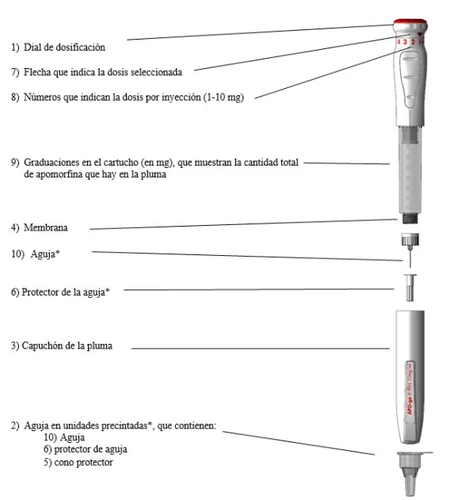
- The package does NOT contain needles for use with your pen. Use pen needles no longer than 12.7 mm in length and no thinner than 0.31 mm (30G) in gauge.
Pen needles recommended for use with insulin pens are compatible with APO-go Pen.
IMPORTANT: do not pull the red cap dose dial (see 1) before selecting your dose (see “How to select your correct dose”).
Attaching the needle
(a) Before using APO-go Pen, you will need sterile gauze and a needle with its outer shield (see 2).
(b) Remove the pen from its packaging and take off the cap (see 3).
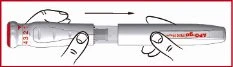
(c) Clean the pen membrane with sterile gauze (see 4).
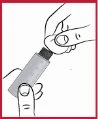
(d) Remove the paper from the outer shield (see 2).
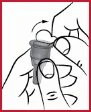
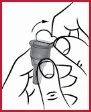
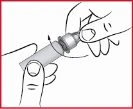
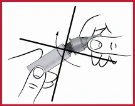
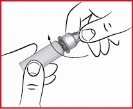
(e) It is important to attach the needle straight onto the pen, as shown in the drawing above. If the needle is crooked, it may cause leakage from the pen.
(f) Screw the outer shield (see 2) onto the membrane clockwise until tight. This secures the needle firmly.
(g) Remove the outer shield (see 5), but do not discard it. Do not yet remove the needle cap (see 6).
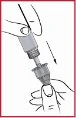
(h) Replace the pen cap (see 3).
How to select the correct dose
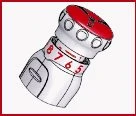
(i) Press and hold the red cap dose dial (see 1) and turn it clockwise until the arrow points to the dose prescribed by your doctor (see 7, 8); then release the red cap dose dial. The dose is now selected and does not need to be adjusted again for subsequent injections.
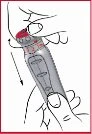
Important: if you have turned past the prescribed dose while rotating the dial, continue pressing and turning in the same direction until the correct dose is reached. Never pull and turn the red cap dose dial at the same time.
If your dose is 1 mg, first expel a 1 mg dose into a tissue and then discard the tissue. This is called “priming” the pen and is important because it ensures a correct dose is delivered the first time the pen is used. After priming, select the required dose and inject the pen as usual (see “How to perform the injection”). If the first dose is greater than 1 mg, priming is not necessary.
How to perform the injection
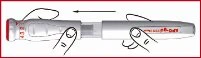
(j) Once your dose is selected, carefully pull out the red cap dose dial to its full extent. Check the red scale on the plunger (see 9) and inject only if the visible line corresponds to the desired dose.
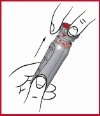
(k) Clean the skin area where the injection will be given with sterile gauze.
(l) Remove the pen cap (see 3).
(m) Remove the needle cap (see 6).
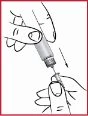
(n) Insert the needle (see 10) into the skin as instructed by your doctor.
(o) To inject the dose, press the red cap dose dial (see 1) down completely, using your thumb if possible. Once the red cap dose dial is fully pressed, count to three before removing the needle.
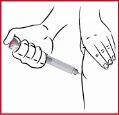
(p) Place the outer shield (see 5) over the used needle and gently push it on until secure. Then, unscrew the needle by turning it counterclockwise. Keep the needle inside the outer shield and dispose of it safely, for example in a sharps container or an empty coffee jar.
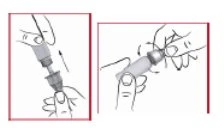
How to prepare for the next injection
(q) Remove the pen cap and check whether there is enough apomorphine left in the cartridge to perform the next injection. If so, attach a new needle as described above.
(r) If there is not enough apomorphine left for another injection, prepare a new pen.
(s) Finally, replace the pen cap.
If you use more APO-go Pen than you should
In case of overdose or accidental ingestion, contact your doctor immediately or call the Toxicology Information Service at 91 562 04 20, stating the medicine and amount ingested.
- Inform your doctor or contact the nearest hospital emergency department immediately.
- You may notice your heart beating more slowly, nausea or vomiting, excessive drowsiness and/or difficulty breathing. You may also feel weak or dizzy, especially when standing up, due to a drop in blood pressure. Lying down with your feet raised will help you feel better.
If you forget to use APO-go Pen
If you miss a dose, wait until the next scheduled dose. Do not use a double dose to make up for the missed dose.
If you stop using APO-go Pen
Do not stop using APO-go Pen without first consulting your doctor.
If you have any further questions about the use of this medicine, ask your doctor, pharmacist, or nurse.
4. Possible adverse effects
Like all medicines, this medicine can cause adverse effects, although not everyone will experience them.
If you experience an allergic reaction, stop treatment with APO-go Pen and contact your doctor or the nearest hospital emergency department immediately. Symptoms of an allergic reaction may include:
- rash
- difficulty breathing
- swelling of the face, lips, throat, or tongue.
APO-go Pen may sometimes cause the following adverse effects:
Very common (may affect more than 1 in 10 people):
- development of lumps under the skin at the injection site that are painful, uncomfortable, and may become red and itchy. To help prevent these lumps, it is recommended to change the injection site each time the needle is inserted
- hallucinations (seeing, hearing, or feeling things that are not real).
Common (may affect up to 1 in 10 people):
- nausea and vomiting, particularly when starting treatment with APO-go Pen. If you are taking domperidone and still experience nausea or vomiting, or if you are not taking domperidone but have nausea or vomiting, consult your doctor as soon as possible
- tiredness or excessive drowsiness
- confusion or hallucinations
- yawning
- feeling dizzy or weak when standing up.
Uncommon (may affect up to 1 in 100 people):
- Increased involuntary movements or worsening of tremors during "on" periods.
- Haemolytic anaemia (abnormal destruction of red blood cells in blood vessels or other parts of the body). This is an uncommon adverse effect that may occur in patients who are also taking levodopa.
- Sudden sleep attacks.
- Rash.
- Difficulty breathing.
- Ulceration at the injection site.
- Reduction in the number of red blood cells, which may lead to paleness of the skin and cause weakness and shortness of breath.
- Reduction in the number of platelets, increasing the risk of bleeding or bruising.
Rare (may affect up to 1 in 1,000 patients):
- Allergic reaction.
- Eosinophilia (abnormally high number of white blood cells in the blood or body tissues).
Frequency not known: cannot be estimated from the available data:
-
Swelling of legs, feet, or fingers.
-
Inability to resist the impulse, desire, or temptation to carry out an action that could be harmful to yourself or others, which may include:
- Strong urge to gamble excessively, despite serious personal or family consequences.
- Marked change or increase in sexual interest and behavior towards oneself or others, for example, increased sexual drive.
- Uncontrollable spending or excessive shopping.
- Binge eating (consuming large amounts of food in a short period of time) or compulsive eating (eating more food than normal and more than needed to satisfy hunger).
-
Fainting.
-
Aggression, agitation.
-
Headache.
Tell your doctor if you experience any of these behaviors; your doctor will advise you on how to manage or reduce the symptoms.
Reporting of adverse effects
If you experience any type of adverse effect, talk to your doctor or pharmacist, even if it is a possible adverse effect not listed in this leaflet. You can also report them directly via the Spanish Pharmacovigilance System for Human Medicines: https://www.notificaRAM.es. By reporting adverse effects, you can help provide more information on the safety of this medicine.
5. Storage of APO-go PEN
Keep this medicine out of the sight and reach of children.
Do not use this medicine after the expiry date stated on the label and on the carton. The expiry date refers to the last day of the month indicated.
Do not store above 25°C. Keep the cartridge in its original cardboard box to protect it from light.
Store under the same storage conditions after opening and between successive uses.
Do not use this medicine if the solution has turned green. It should only be used if the solution is clear, colourless, and free from visible particles.
When starting to use a new APO-go Pen container, it may be used for up to 48 hours. Do not reuse it after this period. Use a new pen.
To dispose of your pens safely, always remove the needle from the pen before discarding it, for example, into a sharps container or an empty coffee jar.
When the sharps container is full, give it to your doctor or pharmacist for safe disposal. If the pen is completely empty, it may be disposed of with household waste.
Medicines must not be disposed of via wastewater or household waste. Return unused medicines and their packaging to the SIGRE point at your pharmacy. If you are unsure, ask your pharmacist how to dispose of medicines and packaging you no longer need. This will help protect the environment.
6. ADDITIONAL INFORMATION
Composition of APO-go PEN
- The active substance is apomorphine hydrochloride. Each millilitre of APO-go PEN contains 10 mg of apomorphine hydrochloride. Each APO-go PEN contains 3 ml of injectable solution.
- The other components (excipients) are:
- sodium metabisulfite (E223)
- hydrochloric acid (37%)
- water for injection.
See section 2: Apo-go PEN contains sodium hydrogen sulfite.
Nature of the product and contents of the pack
APO-go PEN 10 mg/ml is a disposable multi-dose pen-type injection system incorporating a transparent glass cartridge containing apomorphine injectable solution. The solution is clear, practically colourless, odourless, and free from visible particles.
Pack sizes contain 1, 5 or 10 pens in a moulded plastic tray within a cardboard box.
APO-go Pen is available in packs of 1, 5 or 10 pens and in multiple packs containing 5 boxes with 5 pens each.
Only certain pack sizes may be marketed.
Marketing Authorisation Holder
STADA Arzneimittel AG
Stadastraße 2–18
61118 Bad Vilbel, Germany
Manufacturer
Laboratoire Aguettant
1 Rue Alexander Fleming
Boite Postale 7144
69353 Lyon, Cedex 07 – France
or
STADA Arzneimittel AG
Stadastr. 2–18
61118 Bad Vilbel
Germany
For further information about this medicinal product, please contact the local representative of the Marketing Authorisation Holder:
ITALFARMACO S.A.
San Rafael, 3
28108 Alcobendas (Madrid)
Spain
This medicinal product is authorised in the Member States of the European Economic Area and in the United Kingdom (Northern Ireland) under the following names:
Austria, Germany: APO-go PEN 10 mg/ml Injektionslösung
Belgium: APO-GO®-PEN 10 mg/ml oplossing voor injectie
Bulgaria: A?O-?o® ??????? 10mg/ml ??????????? ???????
Cyprus: APO-go Συσκευ? τ?που π?νας 10 mg/ml Εν?σιμο Δι?λυμα
Czech Republic: Britaject PEN
Denmark: APO-go PEN 10mg/ml Injektionsvæske, opløsning
Estonia: APO-go, 10 mg/ml süstelahus pen-süstlis
Finland: Apogo PEN 10 mg/ml injektioneste, liuos
Greece: APO-go Συσκευ? τ?που π?νας10 mg/ml Εν?σιμο Δι?λυμα
Ireland, Malta, United Kingdom: APO-go Pen 10mg/ml solution for injection
Latvia: APO-go PEN 10 mg/ml škidums injekcijam
Lithuania: Britaject 10 mg/ml injekcinis tirpalas
Luxembourg: APO-go® PEN 10mg/ml Solution Injectable
Netherlands: APO-go PEN, Oplossing Voor injectie 10mg/ml
Norway: Britaject 10 mg/ml injeksjonsvæske, oppløsning i ferdigfylt penn
Portugal: Apo-go Pen 10 mg/ml Solução injectável
Romania: APO-go 10 mg/ml solutie injectabila în pen multidoza
Slovenia: APO-go 10 mg/ml raztopina za injiciranje v peresniku
Spain: APO-go PEN 10 mg/ml Solución inyectable
Sweden: APO-go PEN 10 mg/ml Injektionsvätska, lösning
Date of the most recent revision of this leaflet: March 2025
Detailed and up-to-date information on this medicinal product is available on the website of the Spanish Agency of Medicines and Health Products (AEMPS) http://www.aemps.gob.es