Apadin 1 mg/ml eye drops solution
SpainTable of Contents
- Patient Information Leaflet
- Introduction
- 1. What Apadin is and what it is used for
- 2. What you need to know before using Apadin
- **Children**
- **Apadin contains disodium hydrogen phosphate dodecahydrate**
- 3. How to use Apadin
- 4. Possible adverse effects
- 5. Storage of Apadin
- 6. Contents of the pack and other information
Patient Information Leaflet
Introduction
Patient Information Leaflet
Apadin 1 mg/ml eye drops solution.
Olopatadine
Read the entire leaflet carefully before you start using this medicine, because it contains important information for you.
- Keep this leaflet as you may need to read it again.
- If you have any questions, ask your doctor or pharmacist.
- This medicine has been prescribed for you only, and you should not give it to other people, even if they have the same symptoms as you. It may harm them.
- If you experience any adverse effects, talk to your doctor or pharmacist, even if they are adverse effects not listed in this leaflet. See section 4.
Leaflet Contents
- What Apadin is and what it is used for
- What you need to know before using Apadin
- How to use Apadin
- Possible side effects
- How to store Apadin
- Contents of the pack and other information
1. What Apadin is and what it is used for
Apadin is indicated for the treatment of signs and symptoms of seasonal allergic conjunctivitis.
Allergic conjunctivitis. Certain elements (called allergens), such as pollen, house dust, or animal hair, can cause allergic reactions leading to itching, redness, and inflammation of the surface of the eyes.
Olopatadine belongs to the group of medicines used for the treatment of allergic eye conditions. It works by reducing the intensity of the allergic reaction.
2. What you need to know before using Apadin
Do not use Apadin
??If you are allergic (hypersensitive) to olopatadine or to any of the other ingredients of this medicine (listed in section 6).
??You must not use Apadin if you are breastfeeding.
Warnings and precautions
Consult your doctor or pharmacist before starting to use olopatadine.
You must remove your contact lenses from your eyes before using olopatadine.
Children
Do not use Apadin in children under 3 years of age. Do not administer this medicine to children under 3 years of age because there are no data indicating that it is safe and effective in children under 3 years of age.
Use of Apadin with other medicines
Inform your doctor or pharmacist if you are taking, have recently taken, or might need to take any other medicines.
If you are using another eye drop or ophthalmic ointment, wait at least 5 minutes between the application of each medicine. Ophthalmic ointments should be administered last.
Pregnancy, breastfeeding, and fertility
If you are pregnant or breastfeeding, think you may be pregnant, or are planning to become pregnant, consult your doctor or pharmacist before using this medicine.
You must not use Apadin if you are breastfeeding. Consult your doctor before using this medicine.
Driving and using machines
Immediately after applying Apadin, you may notice blurred vision. Do not drive or operate machinery until this effect has disappeared.
Apadin contains benzalkonium chloride
This medicine contains 0.5 mg of benzalkonium chloride in each 5 ml, which is equivalent to 0.1 mg/ml.
The preservative in Apadin, benzalkonium chloride, can be absorbed by soft contact lenses and may alter the colour of contact lenses. Remove contact lenses before using this medicine and wait 15 minutes before reinserting them.
Benzalkonium chloride may cause eye irritation, especially if you have dry eye or other corneal diseases (the transparent layer at the front of the eye). Consult your doctor if you experience a foreign body sensation, stinging, or eye pain after using this medicine.
Apadin contains disodium hydrogen phosphate dodecahydrate
This medicine contains 16.72 mg of phosphates (in 63.05 mg of disodium hydrogen phosphate dodecahydrate) in each 5 ml vial, equivalent to 3.34 mg/ml.
If you suffer from severe corneal damage (the transparent layer at the front of the eye), treatment with phosphates may, in very rare cases, cause blurred vision due to calcium accumulation.
3. How to use Apadin
Follow exactly the administration instructions for this medicine given by your doctor or pharmacist. If you are unsure, consult your doctor or pharmacist.
The recommended dose is one drop in one eye or both eyes, twice daily – in the morning and in the afternoon.
Use this amount unless your doctor gives you other instructions. Apadin should only be applied to both eyes if your doctor has specifically instructed you to do so. Continue treatment for the period of time indicated by your doctor.
Olopatadine should only be used as eye drops.
Instructions for use

1 2
? Take the Apadin bottle and position yourself in front of a mirror.
? Wash your hands.
? Take the bottle and unscrew the cap.
? After removing the cap, remove the plastic seal ring before use.
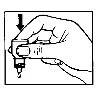
? Hold the bottle upside down between your thumb and little finger.
? Tilt your head backwards. Gently pull down the eyelid to form a pouch, into which the drop should be instilled (Figure 1).
? Bring the tip of the bottle close to the eye. Using a mirror may be helpful.
? Do not touch the eye, eyelid, surrounding areas, or any other surfaces with the dropper tip, as this could contaminate the remaining drops in the bottle.
? Gently press the base of the bottle to release one drop of Apadin at a time.
? Do not squeeze the bottle; it is designed so that a gentle pressure on the base is sufficient (Figure 2).
? If applying drops to both eyes, repeat the above steps for the other eye.
? Immediately after use, tightly screw the cap back onto the bottle.
? Use one bottle before opening the next.
? If a drop misses the eye, try again.
If you use more Apadin than you should
You can remove it by rinsing your eyes with lukewarm water. Do not apply further drops until the next scheduled dose.
If you forget to use Apadin
Apply one drop as soon as you remember, and then continue with your next dose as usual.
However, if it is almost time for your next dose, do not apply the missed dose and continue with your next scheduled dose. Do not apply a double dose to make up for the missed dose.
If you stop using Apadin
Do not stop using this medicine without first consulting your doctor.
If you have any further questions about the use of this medicine, consult your doctor or pharmacist.
4. Possible adverse effects
Like all medicines, this medicine may cause adverse effects, although not everyone experiences them.
The following adverse effects have been observed with Olopatadine:
Frequent: may affect up to 1 in 10 people
Eye effects: eye pain, eye irritation, dry eye, abnormal sensation in the eye, eye discomfort
General effects: headache, fatigue, dry nose, bad taste in the mouth
Uncommon: may affect up to 1 in 100 people
Eye effects: blurred, decreased or abnormal vision, corneal disorder, inflammation of the eye surface with or without surface damage, conjunctival infection or inflammation, ocular discharge, light sensitivity, increased tear production, eye itching, eye redness, eyelid abnormalities, itching, redness, swelling or crusting of the eyelid.
General effects: decreased or abnormal perception of stimuli, dizziness, runny nose, dry skin, skin inflammation.
Frequency not known: (cannot be estimated from available data)
Eye effects: eye swelling, corneal swelling, change in pupil size
General effects: difficulty breathing, increased allergic symptoms, facial swelling, numbness, generalized weakness, nausea, vomiting, sinus infection, skin redness and itching.
In very rare cases, some patients with severe damage to the transparent layer at the front of the eye (the cornea) have developed dark spots on the cornea due to calcium accumulation during treatment.
Reporting of adverse effects
 If you experience any type of adverse effect, consult your doctor or pharmacist, even if it is a possible adverse effect not listed in this leaflet. You may also report them directly through the Spanish Pharmacovigilance System for Human Medicines: https://www.notificaram.es. By reporting adverse effects, you can help provide more information on the safety of this medicine.
5. Storage of Apadin
Keep this medicine out of the sight and reach of children.
Do not use this medicine after the expiry date stated on the bottle and the carton, after “EXP”. The expiry date refers to the last day of the month indicated.
This medicine does not require any special storage conditions.
To prevent infection, the bottle must be discarded four weeks after first opening, and a new bottle should be used. Record the date of opening in the space provided on the label of each bottle and carton.
Do not use this medicine if you notice any change in colour or odour.
Medicines must not be disposed of via wastewater or household waste. Dispose of containers and unused medicines at the SIGRE collection point at your pharmacy. If you are unsure, ask your pharmacist how to dispose of containers and medicines you no longer need. This will help protect the environment.
6. Contents of the pack and other information
Composition of Apadin
- The active substance is olopatadine. Each ml of solution contains 1 mg of olopatadine (as hydrochloride).
- The other components are benzalkonium chloride, hydrochloric acid (E507) (pH adjustment), disodium hydrogen phosphate dodecahydrate (E339), sodium chloride, sodium hydroxide (E524) (pH adjustment), and water for injections.
Appearance of the product and contents of the pack
Apadin is a clear, colourless liquid (a solution), practically free from particles.
It is supplied in a container consisting of a 5 ml low-density polyethylene (LDPE) opaque bottle with an LDPE dropper and a high-density polyethylene (HDPE) screw cap with a safety closure.
Pack sizes
1 x 5 ml (1 bottle containing 5 ml of solution).
Marketing Authorization Holder and Manufacturer
Marketing Authorization Holder:
TIEDRA FARMACÉUTICA, S.L.
C/ Colón, 7, 30510 Yecla (Murcia)
Spain
Manufacturer:
actrevo GmbH
Großer Burstah 25, 20457 Hamburg
Germany
DRUGSRUS Ltd.,
5 Sandridge Close, Harrow, Middlesex, HA1 1XD,
United Kingdom
This medicinal product is authorized in the Member States of the European Economic Area under the following names:
ES: Apadin 1mg/ml eye drops solution
Date of the most recent revision of this leaflet: 04/2023.
Detailed and up-to-date information on this medicinal product is available on the website of the Spanish Agency of Medicines and Health Products (AEMPS): http://www.aemps.gob.es