Antabuse 250 mg tablets
Spain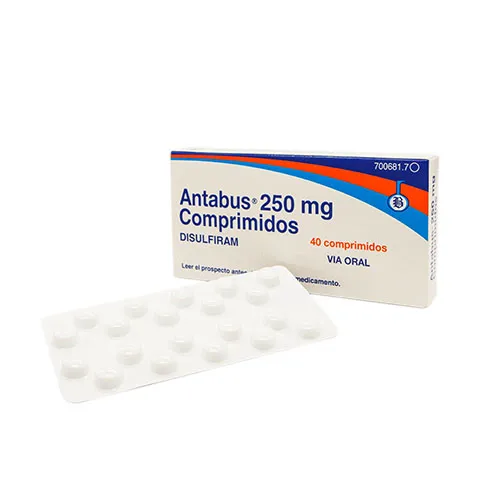
Table of Contents
Package leaflet: Information for the user
Introduction
PACKAGE LEAFLET: INFORMATION FOR THE USER
Antabus 250 mg tablets
Disulfiram
Read the entire leaflet carefully before you start taking this medicine, as it contains important information for you.
|
Package leaflet contents:
- What Antabus is and what it is used for
- What you need to know before taking Antabus
- How to take Antabus
- Possible side effects
- Storage of Antabus
- Contents of the pack and other information
1. What Antabus is and what it is used for
Antabus is indicated for the treatment of alcohol dependence (chronic alcoholism), as part of integrated rehabilitation programs.
The patient must be adequately motivated so that treatment is carried out with the patient's voluntary cooperation. It is important to have social and family support that encourages the cessation of alcohol consumption.
Disulfiram (the active substance in Antabus) acts as a deterrent to alcohol consumption in patients who require help in the treatment of chronic alcoholism.
After alcohol ingestion, alcohol is converted in the body to acetaldehyde, which is then further metabolized. Disulfiram blocks the enzyme that degrades acetaldehyde (aldehyde dehydrogenase), causing accumulation of acetaldehyde in the blood. The increased blood concentration of acetaldehyde contributes to the reaction that occurs after alcohol ingestion in patients treated with disulfiram; this reaction consists of a series of unpleasant physical effects. This reaction is also known as the Antabus effect.
2. What you need to know before starting to take Antabus
Do not take Antabus
- If you are allergic (hypersensitive) to disulfiram or any of the other components of Antabus.
- If you have hypersensitivity to thiuram compounds used in pesticides and vulcanization processes.
- If you have severe myocardial disease or coronary occlusion (serious heart diseases).
- If you are experiencing psychotic states (psychiatric disturbances).
- If you have ingested alcohol.
- If you are using preparations containing alcohol.
- If you are currently or recently being treated with:
- metronidazole,
- paraldehyde, or
- medications containing alcohol.
- If you have severe hepatic insufficiency (serious liver disease).
- If you have severe renal insufficiency (serious kidney disease).
- If you are addicted to opioids or are undergoing treatment with opioids such as morphine, heroin, or codeine: concomitant use of Antabus and opioids triggers opioid withdrawal syndrome.
- If you are addicted to cocaine and alcohol: concomitant use of Antabus, alcohol, and cocaine increases blood levels of cocaine.
- If you are addicted to cocaine: dopamine levels increase.
- If you are pregnant or think you may be pregnant.
Warnings and precautions
Consult your doctor or pharmacist before starting to take Antabus.
Do not take Antabus until you have abstained from alcohol for at least 24 hours.
If you are being treated with disulfiram, you must not be exposed to ethylene dibromide or its vapors.
In the following cases, consult your doctor before starting to take Antabus:
- If you have diabetes mellitus
- If you have hypothyroidism
- If you are epileptic.
- If you are being treated with phenytoin due to risk of intoxication
- If you have cerebrovascular diseases.
- If you have acute or chronic nephritis or renal insufficiency (kidney diseases).
- If you have cirrhosis or hepatic insufficiency (liver diseases).
- If you are being treated with oral anticoagulants, as dose adjustment may be necessary.
Periodic blood tests are recommended during treatment to monitor liver function, blood counts, and biochemical parameters.
Use of Antabus with other medicines
Inform your doctor or pharmacist if you are taking or have recently taken, or might need to take any other medicine, including those obtained without a prescription, homeopathic remedies, herbal medicines, and other health-related products.
Especially with the following medicines:
- Propylene glycol: increased blood concentration and toxicity of propylene glycol may occur.
- Hydantoin (antiepileptic and anticonvulsant medicine): may lead to increased blood concentration and toxicity of hydantoins.
- Oral anticoagulants (e.g., warfarin): disulfiram may prolong prothrombin time. Anticoagulant dosage adjustment should be considered.
- Metronidazole (antibiotic medicine): a possible synergistic effect of both may lead to acute psychotic reaction and confusion.
- Phenytoin (antiepileptic medicine): concomitant administration with phenytoin may increase blood levels of phenytoin and the risk of phenytoin intoxication. Blood levels of phenytoin should be monitored and dosage adjustments made during disulfiram treatment. Evidence suggests that phenobarbitone is not affected by disulfiram.
- Isoniazid (medicine for the treatment of tuberculosis): increased toxicity of both medicines may occur. Adverse effects associated with concomitant use of isoniazid include ataxia and mood and behavioral changes.
- Benzodiazepines (hypnotic medicines) with oxidative metabolism (e.g., diazepam, chlordiazepoxide): the effects of these benzodiazepines—but not oxazepam—are enhanced or prolonged with concomitant use of disulfiram. Increased blood concentration and toxicity of these benzodiazepines.
- Theophylline (medicine for the treatment of respiratory diseases such as asthma): may lead to theophylline toxicity.
- Tranylcypromine (antidepressant medicine): delirious states due to tranylcypromine toxicity may occur.
- Clozapine (medicine for the treatment of schizophrenia and certain psychotic disorders): disulfiram blocks the metabolism of clozapine, enhancing its efficacy. On the other hand, it reduces the likelihood of mental disturbances caused by disulfiram.
- Amitriptyline (antidepressant medicine): mental status disturbances have been reported with concomitant use of disulfiram.
- Rifampicin (antibiotic medicine): consult your doctor if you are undergoing treatment, as disulfiram may affect its metabolism.
- Others. Increased toxicity of certain drugs has been observed in rats. These include: morphine, pethidine, amphetamine, and barbiturates.
Significant interactions could occur due to concomitant use of disulfiram and drugs:
- that affect blood pressure regulation
- that act on the central nervous system.
Consult your doctor before taking antacids or iron salts, as they may affect disulfiram metabolism.
Taking Antabus with food and drinks
You must avoid the use of alcohol in masked forms. Some products, foods, and medicines contain alcohol in their composition, so the composition of such products should be carefully checked.
The disulfiram-alcohol reaction may occur even with a minimal amount of alcohol.
Examples of preparations that may contain alcohol include:
- Sauces,
- Vinegar,
- Mouthwashes,
- Cough syrups,
- After-shave lotions.
Special caution should also be exercised with low-alcohol beverages or those labeled as “non-alcoholic,” as consuming sufficient quantities may cause unpleasant reactions.
Disulfiram-alcohol reaction
Effects of the disulfiram-alcohol reaction appear within 10 minutes after alcohol ingestion. Even small amounts of alcohol can trigger this reaction, causing:
Flushing, palpitations in the head and neck, pulsating headache (headache), difficulty breathing, nausea, profuse vomiting, sweating, thirst, chest pain (pain in the chest), palpitations, dyspnea and hyperventilation (feeling of fatigue), tachycardia (rapid heartbeat), hypotension (low blood pressure), syncope (loss of consciousness), marked restlessness, weakness, dizziness, blurred vision, and confusion.
In severe reactions, respiratory depression (respiratory failure), cardiovascular collapse, arrhythmias, myocardial infarction, acute congestive heart failure (heart diseases), loss of consciousness, seizures, and even death may occur.
If you consume alcohol within 3 weeks after stopping disulfiram, you may experience this reaction.
The intensity of the reaction varies from person to person, but is generally proportional to the amount of disulfiram and alcohol ingested.
The duration of the reaction ranges from two to four hours, and sometimes longer in most cases, or as long as alcohol remains in the blood.
Pregnancy, lactation, and fertility
Pregnancy
If you are pregnant, think you may be pregnant, or plan to become pregnant, consult your doctor before using this medicine.
Your doctor should evaluate the benefit-risk balance during pregnancy and the effects of alcoholism during this period.
Lactation
If you are breastfeeding, consult your doctor before using this medicine. Your doctor must decide whether it is necessary to discontinue breastfeeding or discontinue treatment, considering the benefits of breastfeeding for the child and the benefits of treatment for the mother.
Fertility
No effects on fertility have been observed.
Driving and use of machines
The influence of disulfiram on the ability to drive and use machines is none or negligible. Nevertheless, patients should exercise caution when driving or operating machinery until they are certain that disulfiram treatment does not cause adverse effects.
3. How to take Antabus
Follow exactly the administration instructions for Antabus provided by your doctor. If in doubt, consult your doctor again.
Antabus is administered orally with a little water. It is preferably taken upon waking; however, in patients experiencing sedative effects, it may be taken at bedtime.
The dosage will be determined according to each individual case. Alternatively, to minimize sedative effects, the initial dose may be reduced.
It is important that you do not drink alcohol for at least 24 hours before taking your first dose of Antabus.
Antabus must only be administered by a physician. Initial treatment with Antabus is recommended to be carried out in a hospital or specialized clinic.
Adults
- Initial regimen
During the first phase of treatment, 1 to 2 tablets (250–500 mg) should be taken once daily for one or two weeks. The initial dose should not exceed 500 mg (2 tablets) of disulfiram per day.
Initial treatment with disulfiram is recommended to be conducted in a hospital or specialized clinic.
- Maintenance regimen
The maintenance dose is 250 mg daily (1 tablet). Under no circumstances should the daily dose exceed 500 mg (2 tablets).
Duration of treatment
Daily and uninterrupted administration of Antabus should be continued until the patient has fully reintegrated into society and a stable basis for self-control has been established. Depending on the individual patient, maintenance treatment may be required for months or even years.
Elderly patients
Same dosage as in adults. Dose adjustment is not necessary.
Use in children
No data are available; therefore, there is no recommendation for the use of Antabus in children.
If you take more Antabus than you should
High doses of disulfiram (up to 6 g/day) have low toxicity in humans. Symptoms of overdose include vomiting, headache, apathy, ataxia (loss of control of body movements), irritability, hallucinations, psychosis, loss of consciousness, and seizures.
Death occurs due to respiratory failure, preceded by ascending paralysis and lesions in various organs (liver, spleen, kidney, central nervous system, adrenal glands, heart).
In case of overdose or accidental ingestion, contact your doctor or pharmacist immediately or call the Toxicology Information Service at telephone number 915 620 420, indicating the medication and amount ingested.
If you forget to take Antabus
Do not take a double dose to make up for missed doses.
If you forget to take your dose and 12 hours or more have passed, do not take another dose.
If you are unsure whether 12 hours have passed since your last dose, do not take another dose.
In these cases, take the next dose at the usual scheduled time.
Important: Do not take two doses at the same time. |
If you interrupt treatment with Antabus
Do not stop treatment, even if you notice an improvement in symptoms. Your doctor will determine the duration of treatment.
If you have any further questions about the use of this product, consult your doctor or pharmacist.
4. Possible adverse effects
Like all medicines, Antabus can cause adverse effects, although not everyone will experience them.
If you develop any of the following signs, stop taking Antabus and speak to your doctor immediately:
- yellowing of the skin (jaundice). These are signs of liver problems.
- mental disturbances
- blindness
- tachycardia with changes in the electrocardiogram
The following adverse effects may occur during treatment with Antabus:
Frequent adverse effects (may affect up to 1 in 10 patients):
- psychiatric disturbances (depression, mania)
- drowsiness, headache
- pain and tingling in arms and legs, muscle problems such as weakness or difficulty controlling muscle movements, problems digesting food or even swallowing, dizziness or fainting, sexual problems such as erectile dysfunction, inability to detect the urge to urinate (peripheral neuritis(1))
- Loss of vision in one eye within one or a few hours, changes in how the pupil reacts to bright light, loss of color vision, pain when moving the eye (optic neuritis)
- Tingling in lower limbs, pain, decreased sensitivity, muscle pain, muscle atrophy (polyneuritis)
- nausea, vomiting, diarrhea
- abnormalities in blood tests indicating impaired liver function (elevated transaminases and bilirubin)
- numbness, fatigue, general malaise, halitosis (bad breath), abdominal pain, loss of taste, metallic or garlic-like taste
Uncommon adverse effects (may affect up to 1 in 100 patients):
- fatigue, dystonic reactions (involuntary muscle contractions)
- itching of the skin, redness or inflammation of the skin, skin sensitivity, localized skin swelling, skin rash, skin lesions of any type: redness, rash, papules (pimple-like), vesicles and blisters (allergic dermatitis (skin lesions)(2))
Rare adverse effects (may affect up to 1 in 1,000 patients):
- changes in vision
- yellowing of the skin (jaundice)
- reduced libido (sexual desire)
Very rare adverse effects (may affect up to 1 in 10,000 patients):
- psychotic episodes (mental disturbances), including paranoia, schizophrenia, mood changes
- seizures, confusion
- Hepatitis (inflammatory liver disease), (liver injury) hepatotoxicity, hepatocellular damage, fulminant hepatitis and (liver cell death) hepatic necrosis, which may lead to liver failure, hepatic coma, and death
Adverse effects with unknown frequency (cannot be estimated from available data):
- papilledema (swelling of the optic disc) characterized by blurred vision or decreased vision
- acneiform skin eruptions. Cases of phototoxicity have been reported
- erectile dysfunction (erectile impairment)
- congenital malformations (fetal malformations)
- elevated cholesterol
- arterial hypertension (high blood pressure)
(1) Patients undergoing maintenance treatment with disulfiram 500 mg/day tend to develop peripheral neuropathy. This neuropathy improves when disulfiram treatment is discontinued.
(2) As a general rule, occasional skin rashes can be easily managed by concomitant administration of an antihistamine (a drug used to treat allergies).
Reporting of adverse effects
If you experience any type of adverse effect, consult your doctor or pharmacist, even if it is a possible adverse effect not listed in this leaflet. You may also report them directly via the Spanish Pharmacovigilance System for Human Medicines: https://www.notificaram.es.
By reporting adverse effects, you can help provide more information on the safety of this medicine.
5. Storage of Antabus
Keep this medicine out of the sight and reach of children.
Do not use Antabus after the expiry date stated on the packaging after "Exp". The expiry date refers to the last day of the month indicated.
No special storage conditions are required.
Medicines must not be disposed of via wastewater or household waste. Ask your pharmacist how to dispose of medicines and packaging that you no longer need. This will help protect the environment.
6. Contents of the pack and other information
Composition of Antabus
- The active substance is Disulfiram. Each tablet contains 250 mg of disulfiram.
- The other components are: Magnesium stearate, Microcrystalline cellulose PH-101, Talc, Povidone K30, Colloidal anhydrous silica, Dibasic calcium phosphate dihydrate, Sodium carboxymethyl starch Type A (potato starch).
Appearance of the product and contents of the pack
Antabus 250 mg tablets are presented in white PVC/aluminum blisters containing 40 tablets per pack.
Marketing Authorization Holder and Manufacturer
LABORATORIOS BOHM, S.A.
C/ Molinaseca, 23-25. Polígono Industrial Cobo Calleja.
28947 Fuenlabrada. (Madrid)
91 642 18 18
Date of the most recent review of this leaflet
May 2014.