Anso rectal ointment
Spain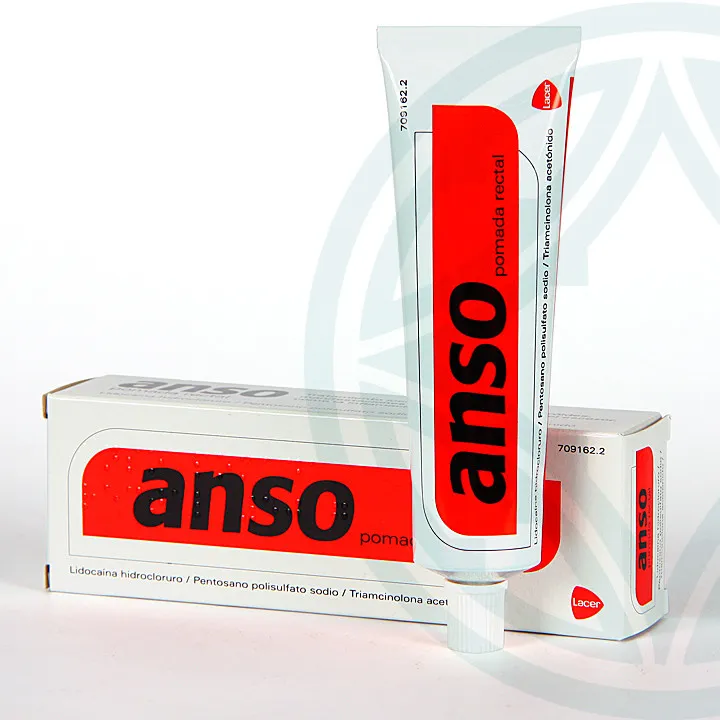
Table of Contents
- Package leaflet: Information for the user
- Introduction
- 1. What Anso rectal ointment is and what it is used for
- 2. What you need to know before using Anso rectal ointment
- 3. How to use Anso rectal ointment
- 4. Possible adverse effects
- 5. Storage of Anso rectal ointment
- 6. Package contents and other information
Package leaflet: Information for the user
Introduction
Package leaflet: information for the user
ANSO rectal ointment
Lidocaine hydrochloride/pentosan polysulfate sodium/triamcinolone acetonide
Read the entire leaflet carefully before you start using this medicine, because it contains important information for you.
Follow exactly the instructions for administering this medicine as described in this leaflet or as directed by your doctor or pharmacist.
- Keep this leaflet, as you may need to read it again.
- If you need advice or more information, consult your pharmacist.
- If you experience any adverse effects, consult your doctor or pharmacist, even if they are adverse effects not listed in this leaflet. See section 4.
- You should consult a doctor if your condition worsens or does not improve after 7 days.
Contents of the leaflet
- What ANSO rectal ointment is and what it is used for
- What you need to know before using ANSO rectal ointment
- How to use ANSO rectal ointment
- Possible adverse effects
- How to store ANSO rectal ointment
- Contents of the pack and other information
1. What Anso rectal ointment is and what it is used for
Contains active ingredients for relief of hemorrhoid symptoms, with anti-inflammatory activity, such as the corticosteroid triamcinolone acetonide; another ingredient that acts on pain or itching, the local anesthetic lidocaine; and sodium pentosan polysulfate, which is anticoagulant and promotes the dissolution of small blood clots.
Anso rectal ointment is indicated for the local symptomatic treatment of manifestations associated with hemorrhoids, such as inflammation, pain, itching, or burning.
Anso rectal ointment is indicated in adults over 18 years of age.
2. What you need to know before using Anso rectal ointment
Do not use Anso rectal ointment:
- If you are allergic to lidocaine or other amide-type local anesthetics, to pentosan polysulfate sodium or related compounds, to triamcinolone, or to any of the other components of this medicine (listed in section 6).
- If you have hemorrhoidal bleeding (bleeding hemorrhoids).
- If you have any infection in the affected area.
Warnings and precautions
Consult your doctor or pharmacist before starting to use Anso rectal ointment.
- If this product causes irritation, you must stop using it and consult your doctor.
- Do not apply the medicine if the area is irritated, infected, or injured.
- Avoid contact with the eyes or areas near the eyes. Wash your hands thoroughly after application.
- Do not use Anso rectal ointment in excessive doses, for prolonged periods, or under occlusive dressings or diapers (tight, non-breathable materials), as increased absorption significantly raises the risk of adverse effects (see section 4).
- If there is an infection in the area to be treated, your doctor will prescribe a specific treatment.
- Exercise caution if you are taking anticoagulant medicines (which prevent blood clotting) or non-steroidal anti-inflammatory drugs (NSAIDs, for pain and/or fever), to avoid potential bleeding, although no cases have been reported with the use of Anso rectal ointment.
- Use with caution in elderly patients or patients with damaged or weakened mucosa, as they may be more sensitive to the systemic effects of the active ingredients due to increased absorption.
Cases of perianal ulcers, which may be extensive, deep, and painful, have been reported, mainly after prolonged use of the ointment (see section 4). To prevent their occurrence, follow the instructions for use of this ointment (see section 3). If perianal ulcers develop, stop treatment and consult your doctor.
Use in athletes
Athletes are advised that this medicine contains a component that may result in a positive analytical finding in doping controls.
Children and adolescents
Anso rectal ointment must not be used in children under 18 years of age, as no studies have been conducted in this population.
Children are more sensitive to the toxicity of exogenous corticosteroids than adults and are also more sensitive to the adverse effects of lidocaine.
Other medicines and Anso rectal ointment
Inform your doctor or pharmacist if you are taking, have recently taken, or might need to take any other medicines.
Although unlikely, if sufficient absorption occurs, this medicine could interact with antiarrhythmic medicines (for heart conditions).
Pregnancy, breastfeeding, and fertility
If you are pregnant or breastfeeding, think you may be pregnant, or are planning to become pregnant, consult your doctor or pharmacist before using this medicine.
During pregnancy, the use of Anso rectal ointment is not recommended and should be reserved only for cases where the potential benefit outweighs the possible risk to the fetus or newborn.
A decision must be made whether to discontinue breastfeeding or discontinue treatment with Anso rectal ointment, taking into account the benefit of breastfeeding for the child and the benefit of treatment for the mother.
Driving and use of machines
Anso rectal ointment does not affect the ability to drive or operate machinery.
Anso rectal ointment contains cetostearyl alcohol, polyoxyl 40 hydrogenated castor oil, butylated hydroxyanisole (E320), ethyl parahydroxybenzoate (E214), propyl parahydroxybenzoate (E216), and propylene glycol.
This medicine may cause local skin reactions (such as contact dermatitis) because it contains cetostearyl alcohol and butylated hydroxyanisole (E320), and may also cause eye and mucous membrane irritation due to butylated hydroxyanisole (E320).
It may cause allergic reactions (possibly delayed) because it contains ethyl parahydroxybenzoate (E214) and propyl parahydroxybenzoate (E216).
It may cause skin reactions because it contains polyoxyl 40 hydrogenated castor oil.
This medicine contains 10 mg of propylene glycol.
3. How to use Anso rectal ointment
Follow exactly the instructions for use provided in this leaflet or those given by your doctor or pharmacist. If in doubt, ask your doctor or pharmacist.
The recommended dose is:
- Adults over 18 years of age:
Anal and/or rectal use
Applications are recommended after bowel movement and personal hygiene.
Before applying Anso, clean the affected area with lukewarm water and a mild soap.
Dry the area and then apply the ointment.
As a general rule, apply 1 to 3 times daily a 1–2 cm strip of ointment to the affected area.
Apply the ointment to the anal region using a finger, using the fingertip to gently overcome sphincter resistance. Wash your hands thoroughly after use.
If the ointment needs to be applied inside the rectum, screw the included applicator onto the tube and insert the tip into the anus. Then, apply a small amount of ointment by gently squeezing the tube.
If symptoms worsen or last longer than 7 days, discontinue use and consult your doctor.
If you use more Anso rectal ointment than you should
Excessive use of topical corticosteroids (amounts exceeding those recommended) may cause adverse effects (see section 4).
Excessive application of lidocaine, or use under occlusive dressing, or on irritated or broken skin, may lead to absorption and cause reactions such as irregular heartbeats, seizures, or breathing difficulties.
In case of overdose or accidental ingestion, contact your doctor or pharmacist immediately, call the Toxicology Information Service at telephone number 915 62 04 20, or go to a medical center, indicating the medication and the amount ingested.
If you forget to use Anso rectal ointment
Do not apply a double dose to make up for a missed dose.
If you have any further questions about the use of this medicine, ask your doctor or pharmacist.
4. Possible adverse effects
Like all medicines, this medicine can cause adverse effects, although not everyone will experience them.
The occurrence of adverse effects is more likely with prolonged use or excessive doses, and when applied with occlusive materials (tight-fitting and poorly breathable).
The assessment of adverse effects is based on the following frequencies:
Uncommon: may affect up to 1 in 100 people.
Rare: may affect up to 1 in 1,000 people.
Frequency not known: cannot be estimated based on available data.
Uncommon:
Adverse reactions may occur at the application site, such as burning, itching, irritation.
Rare:
Thinning of the skin (atrophy), small dilated blood vessels in the skin (telangiectasia), stretch marks, acne, specific skin inflammation around the mouth (perioral dermatitis), redness, loss of skin pigmentation (hypopigmentation).
Frequency not known:
Hypersensitivity, especially to lidocaine, with allergic reaction or anaphylactic reactions that could cause swelling under the skin, breathing difficulties due to bronchial narrowing, skin inflammation, involuntary contraction of the larynx, hives, itching, and shock.
Allergic contact dermatitis, dryness, maceration of the skin, perianal ulcers (see section 2).
Adverse effects may occur not only in the treated area but also in completely different areas of the body, due to absorption of the active substances through the skin. For example, a condition characterized by a rounded face, obesity, fat accumulation in the neck area, delayed wound healing, etc. (Cushing's syndrome); increased blood pressure, fluid retention (edema), cataracts, hair loss.
Reporting of adverse effects
If you experience any type of adverse effect, consult your doctor or pharmacist, even if it is a possible adverse effect not listed in this leaflet. You may also report them directly via the Spanish Pharmacovigilance System for Human Medicines: www.notificaRAM.es. By reporting adverse effects, you can help provide more information on the safety of this medicine.
5. Storage of Anso rectal ointment
Keep this medicine out of the sight and reach of children.
Keep the tube tightly closed.
Do not use this medicine after the expiry date stated on the packaging after EXP. The expiry date refers to the last day of the month indicated.
Medicines must not be disposed of via wastewater or household waste. Dispose of unused containers and medicines at the SIGRE collection point at your pharmacy. If in doubt, ask your pharmacist how to dispose of containers and medicines you no longer need. This will help protect the environment.
6. Package contents and other information
Composition of Anso rectal ointment
-
The active substances are: lidocaine hydrochloride, pentosan polysulfate sodium and triamcinolone acetonide. Each gram of ointment contains 20 mg of lidocaine hydrochloride (2%), 10 mg of pentosan polysulfate sodium (1%) and 0.1 mg of triamcinolone acetonide (0.01%).
-
The other components (excipients) are: cetostearyl alcohol, sodium cetostearyl sulfate, polyoxyethylene castor oil, butylhydroxyanisole (E320), citric acid (E330), macrogol cetostearyl ether, decyl oleate, ethyl parahydroxybenzoate (E214), propyl parahydroxybenzoate, phenoxyethanol, sorbitol (E420), propylene glycol, disodium edetate, thymol, hexetidine and purified water.
Appearance of the product and contents of the container
Anso is a white rectal ointment.
It is supplied in tubes containing 50 g of rectal ointment. The package includes an applicator cannula for rectal administration when appropriate.
Marketing Authorization Holder and Manufacturer
LACER, S.A. – Boters, 5
08290 Cerdanyola del Vallès
Barcelona - Spain
Date of the most recent revision of this leaflet: October 2023.
Detailed information on this medicinal product is available on the website of the Spanish Agency of Medicines and Health Products (AEMPS) http://www.aemps.gob.es/