AngituSS 6 mg/ml syrup
Spain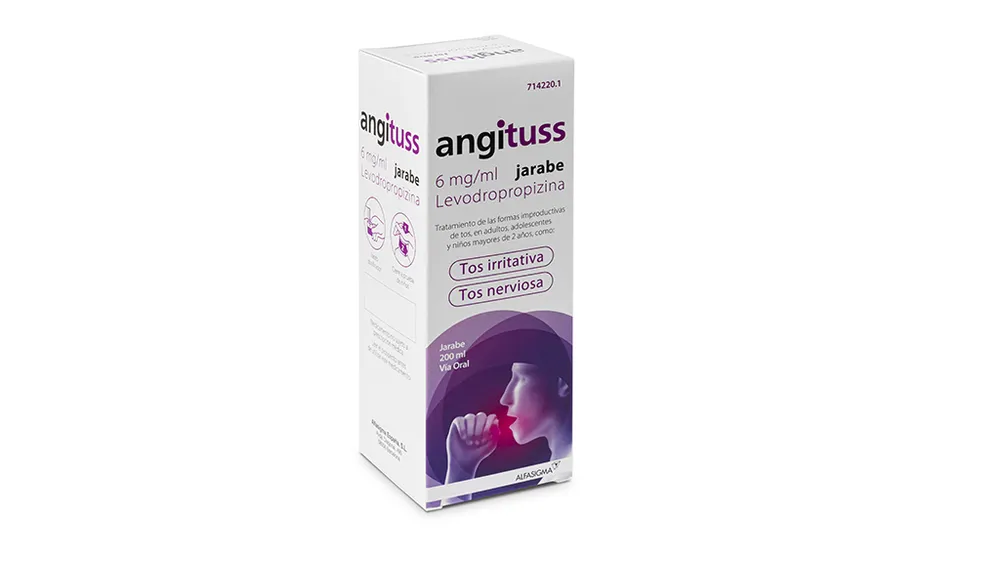
Table of Contents
- Package leaflet: Information for the user
- Introduction
- 1. What Angituss 6 mg/ml syrup is and what it is used for
- 2. What you need to know before taking Angituss 6 mg/ml syrup
- 3. How to take Angituss 6 mg/ml syrup
- 4. Possible adverse effects
- 5. Storage of Angituss 6 mg/ml syrup
- 6. Contents of the pack and other information
Package leaflet: Information for the user
Introduction
Package leaflet: information for the user
Angituss 6 mg/ml syrup
Levodropropizine
Read all of this leaflet carefully before you start taking this medicine, because it contains important information for you.
Follow exactly the instructions for use of this medicine as described in this leaflet or as directed by your doctor or pharmacist.
- Keep this leaflet, as you may need to read it again.
- If you need advice or more information, consult your pharmacist.
- If you experience any adverse effects, consult your doctor or pharmacist, even if they are not listed in this leaflet. See section 4.
- You should consult a doctor if your condition worsens or if you do not improve after 4 days.
Contents of the leaflet
- What Angituss 6 mg/ml syrup is and what it is used for
- What you need to know before taking Angituss 6 mg/ml syrup
- How to take Angituss 6 mg/ml syrup
- Possible adverse effects
- How to store Angituss 6 mg/ml syrup
- Contents of the pack and other information
1. What Angituss 6 mg/ml syrup is and what it is used for
Angituss syrup contains levodropropizine and belongs to a group of medicines called antitussives.
Angituss syrup is indicated for:
Treatment of non-productive forms of cough, such as irritative cough or nervous cough in adults, adolescents, and children over 2 years of age.
You should consult a doctor if symptoms worsen or do not improve after 4 days of treatment.
2. What you need to know before taking Angituss 6 mg/ml syrup
Do not take Angituss syrup
- If you are allergic to levodropropizine or to any of the other ingredients of this medicine (listed in section 6).
- If you have excessive mucus secretion in the bronchi or impaired mucus clearance (Kartagener syndrome, bronchial ciliary dyskinesia).
- During pregnancy and breastfeeding.
- Children under 2 years of age.
Warnings and precautions
Talk to your doctor or pharmacist before taking Angituss syrup:
- If you have hepatic or renal impairment.
- If you are diabetic.
Children
Do not administer to children under 2 years of age.
Other medicines and Angituss syrup
Inform your doctor or pharmacist if you are taking, have recently taken, or might need to take any other medicines.
No interactions or incompatibilities with other medicines have been observed. Caution is advised when administering this medicine concomitantly with anxiolytic drugs (which reduce anxiety), such as benzodiazepines, particularly in sensitive patients, as this may increase the sedative effect.
Taking Angituss syrup with food
Since there is no available information on the effect of food on the absorption of this product, it should be taken away from meals.
Pregnancy and breastfeeding
If you are pregnant or breastfeeding, think you may be pregnant, or are planning to become pregnant, consult your doctor or pharmacist before using this medicine.
The use of this medicine is not recommended during pregnancy, or in women of childbearing age who are not using contraceptive methods. Levodropropizine is excreted in breast milk. Therefore, its use is not recommended during breastfeeding.
Driving and using machines
This medicine may, although rarely, cause drowsiness. If you experience drowsiness, you should not drive or operate dangerous machinery.
Angituss syrup contains sucrose, methyl parahydroxybenzoate (E-218), propyl parahydroxybenzoate (E-216), and propylene glycol (E-1520)
This medicine contains sucrose. If your doctor has informed you that you have an intolerance to certain sugars, consult with him before taking this medicine.
Patients with diabetes mellitus should be aware that this medicine contains 4.0 g of sucrose per 10 ml dose.
May cause allergic reactions (possibly delayed) because it contains methyl parahydroxybenzoate (E-218) and propyl parahydroxybenzoate (E-216).
This medicine contains 2.25 mg of propylene glycol per ml.
This medicine contains less than 23 mg of sodium (1 mmol) per ml of oral solution; hence, it is essentially "sodium-free".
3. How to take Angituss 6 mg/ml syrup
Follow exactly the instructions for use provided in this leaflet or those indicated by your doctor or pharmacist. If in doubt, ask your doctor or pharmacist.
The recommended dose is:
Adults: 10 ml every 6–8 hours. Do not administer more than 3 times a day.
Adolescents:
Kg | ml 3 times a day |
31-45 | 7.5 |
Over 45 | 10 |
unless otherwise directed by a physician, but in no case shall more than 10 ml be administered three times a day.
Pediatric population
Children aged 2–6 years: only under medical supervision
The dose is calculated according to the patient's body weight, administering 1 mg per kg per dose, every 6–8 hours. No more than 3 doses in 24 hours. The amount of medication to be administered is indicated in the following table:
Kg | ml 3 times a day |
10-15 | 2.5 |
16-20 | 3 |
21-30 | 5 |
Antitussives are symptomatic medicines and should only be used while symptoms persist.
It is not advisable to use the medicine for more than 7 days.
Elderly patients do not require any adjustments or modifications in the dosage regimen. Your doctor will monitor you during treatment.
How to take:
This medicine is taken orally.
Measure the amount of medicine to be taken using the dosing cup provided in the package.
After use, wash the cup with water.
Do not take with food.
If your condition worsens or symptoms persist after 4 days of treatment, discontinue use and consult your doctor.
If you take more Angituss syrup than you should
You may experience mild and transient tachycardia (increased heart rate). Contact your doctor or pharmacist immediately.
In case of overdose or accidental ingestion, contact the Toxicology Information Service at telephone number 91 562 04 20, indicating the medicine and the amount ingested.
4. Possible adverse effects
Like all medicines, this medicine can cause adverse effects, although not everyone experiences them.
The adverse effects detected include:
Frequently (affects less than 1 in 10 patients but more than 1 in 100)
- Gastrointestinal disorders: nausea, pyrosis, dyspepsia, diarrhoea, vomiting, and abdominal pain.
- Nervous system disorders: fatigue and/or asthenia, clumsiness, somnolence, headache, and dizziness.
- Cardiac disorders: palpitations.
Rarely (affects less than 1 in 1,000 patients but more than 1 in 10,000)
- Skin and subcutaneous tissue disorders: allergic skin reactions have rarely been observed.
- Respiratory, thoracic and mediastinal disorders: dyspnoea (difficulty breathing).
Frequency not known
- Eye disorders: visual disturbances.
- Cardiac disorders: precordial pain (chest pain).
Reporting of adverse effects
If you experience any type of adverse effect, consult your doctor or pharmacist, even if it is a possible adverse effect not listed in this leaflet. You may also report them directly via the Spanish Pharmacovigilance System for Human Medicinal Products: https://www.notificaram.es. By reporting adverse effects, you can help provide more information on the safety of this medicine.
5. Storage of Angituss 6 mg/ml syrup
Keep this medicine out of the sight and reach of children.
No special storage conditions are required.
Do not use this medicine after the expiry date stated on the carton after EXP. The expiry date refers to the last day of the month indicated.
Medicines must not be disposed of via wastewater or household waste. Dispose of containers and unused medicines at the SIGRE Point in your pharmacy. Ask your pharmacist how to dispose of containers and medicines you no longer need. This will help protect the environment.
6. Contents of the pack and other information
Composition of Angituss syrup
- The active substance is levodropropizine. Each ml contains 6 mg of levodropropizine.
- The other components (excipients) are: citric acid monohydrate, cherry flavour (contains propylene glycol E-1520), sodium hydroxide, methylparahydroxybenzoate (E-218), propylparahydroxybenzoate (E-216), sucrose and purified water.
Nature of the product and contents of the container
Clear liquid with a cherry odour, supplied in dark glass bottles of 120 ml and 200 ml with a safety cap and a graduated plastic dosing cup with different measurement markings.
Only certain pack sizes may be marketed.
Marketing Authorisation Holder
Alfasigma España S.L.
C/ Aribau 195, 4º
08021 Barcelona. Spain
Manufacturer
Dompe Farmaceutici SPA
Via Campo di Pile, L’aquila
67100 – Italy
Or
Pharmaloop, S.L.
Bolivia, 15. Poligono Industrial Azque
28806 Alcala de Henares (Madrid), Spain
Date of the most recent revision of this leaflet: August 2023
Other sources of information
Detailed information on this medicinal product is available on the website of the Spanish Agency of Medicines and Health Products (AEMPS) http://www.aemps.gob.es/