Angifen 8.75 mg menthol-flavored pastilles for sucking
Spain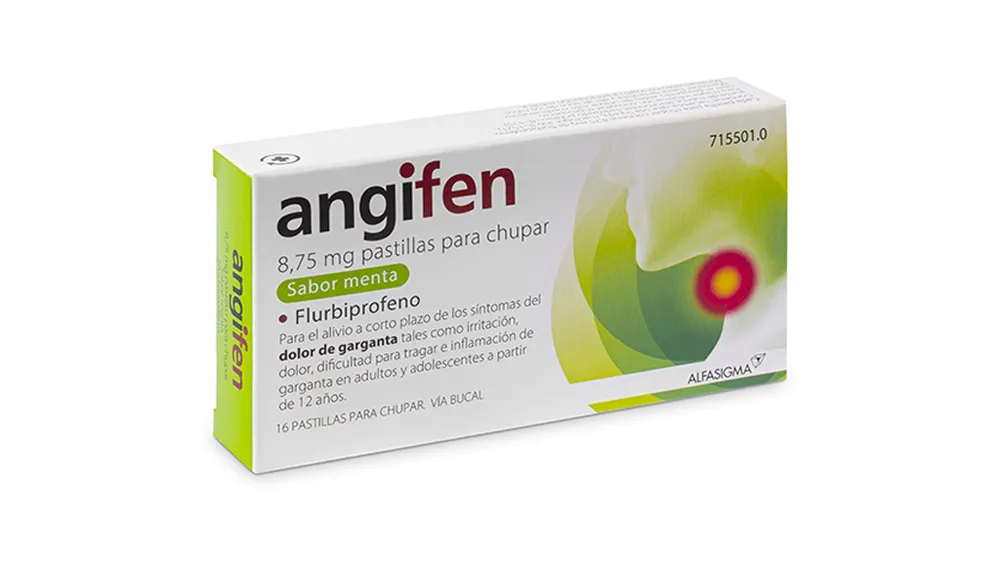
Table of Contents
Package leaflet: Information for the user
Introduction
Package leaflet: information for the user
Angifen 8.75 mg lozenges with mint flavour
Flurbiprofen
Read the entire leaflet carefully before you start taking this medicine, as it contains important information for you.
Follow exactly the instructions for use provided in this leaflet or those given by your doctor, pharmacist, or nurse.
- Keep this leaflet, as you may need to read it again.
- If you need advice or further information, consult your pharmacist.
- If you experience any adverse effects, consult your doctor, pharmacist, or nurse, even if they are possible adverse effects not listed in this leaflet. See section 4.
- You should consult a doctor if your condition worsens or does not improve after 3 days of treatment.
Contents of the leaflet
- What Angifen is and what it is used for
- What you need to know before taking Angifen
- How to take Angifen
- Possible adverse effects
- How to store Angifen
- Contents of the pack and other information
1. What Angifen is and what it is used for
Angifen contains flurbiprofen. Flurbiprofen belongs to a group of medicines called non-steroidal anti-inflammatory drugs (NSAIDs). These medicines work by modifying the body's response to pain, swelling, and fever.
Angifen is used for the short-term relief of sore throat symptoms such as pain, difficulty swallowing, and throat inflammation in adults and children aged 12 years and older.
You should consult a doctor if your condition worsens or does not improve after 3 days of treatment.
2. What you need to know before taking Angifen
Do not take Angifen
- if you are allergic to flurbiprofen or to any of the other ingredients of this medicine (listed in section 6)
- if after taking acetylsalicylic acid (Aspirin) or any other NSAID you have ever experienced asthma, sudden wheezing or difficulty breathing, nasal discharge, facial swelling, or itchy rash (urticaria)
- if you currently have or have ever had a stomach or intestinal ulcer (two or more episodes of gastric or intestinal ulcer)
- if after taking any other NSAID you have ever had gastrointestinal bleeding or perforation, severe colitis, or blood disorders
- if you are in the last trimester of pregnancy
- if you currently have or have ever had severe heart, kidney, or liver failure
Warnings and precautions
Talk to your doctor or pharmacist before taking Angifen:
- if you have ever had asthma or have allergies
- if you have tonsillitis (inflamed tonsils) or suspect you may have a bacterial throat infection (as you may need antibiotics)
- if you have an infection – see the section "Infections" below
- if you have heart, kidney, or liver problems
- if you have had a stroke
- if you have a history of bowel disease (ulcerative colitis, Crohn's disease)
- if you have high blood pressure
- if you have a chronic autoimmune disease (such as systemic lupus erythematosus or connective tissue disease)
- if you are elderly, as you are more likely to experience the adverse reactions described in this leaflet
- if you are in the first 6 months of pregnancy or are breastfeeding
Infections
Non-steroidal anti-inflammatory drugs (NSAIDs) may mask signs of infection such as fever and pain. This could delay the start of appropriate treatment for the infection, increasing the risk of complications. If you take this medicine while having an infection and your symptoms persist or worsen, consult your doctor or pharmacist immediately.
While taking Angifen
- At the first sign of a skin reaction (rash, peeling) or any other sign of allergic reaction, stop taking this medicine and consult a doctor immediately.
- Inform your doctor of any unusual abdominal symptoms you may experience (especially bleeding). Consult your doctor if your condition does not improve, worsens, or if new symptoms appear.
- The use of medicines containing flurbiprofen may be associated with a small increased risk of heart attack (myocardial infarction) or stroke. Any risk is more likely with high doses and prolonged treatment. Do not exceed the recommended dose or duration of treatment (3 days).
Children and adolescents
This medicine must not be used by children or adolescents under 12 years of age.
Other medicines and Angifen
Tell your doctor or pharmacist if you are taking, have recently taken, or might need to take any other medicines. In particular, if you are taking:
- acetylsalicylic acid (Aspirin) at low doses (up to 75 mg per day)
- medicines for high blood pressure or heart problems (antihypertensives, cardiac glycosides)
- diuretics (including potassium-sparing diuretics)
- medicines to thin the blood (anticoagulants, antiplatelet agents)
- medicines for gout (probenecid, sulfinpyrazone)
- other NSAIDs or corticosteroids (such as celecoxib, ibuprofen, sodium diclofenac, or prednisolone)
- mifepristone (a medicine used for abortion)
- quinolone antibiotics (such as ciprofloxacin)
- cyclosporine or tacrolimus (medicines used to suppress the immune system)
- phenytoin (a medicine for treating epilepsy)
- methotrexate (a medicine for treating autoimmune diseases or cancer)
- lithium or selective serotonin reuptake inhibitors (medicines for depression)
- oral antidiabetics (medicines for treating diabetes)
- zidovudine (a medicine for treating HIV)
Taking Angifen with food, drink, and alcohol
Alcohol consumption should be avoided during treatment with Angifen, as it may increase the risk of stomach or intestinal bleeding.
Pregnancy, breastfeeding, and fertility
Oral forms (e.g., tablets) of flurbiprofen may cause adverse effects in unborn babies. It is unknown whether the same risk applies with Angifen.
If you are pregnant or breastfeeding, think you may be pregnant, or are planning to have a baby, consult your doctor or pharmacist before taking this medicine. Do not use Angifen if you are in the last trimester of pregnancy. You should not take Angifen during the first six months of pregnancy unless clearly necessary and advised by your doctor. If treatment is needed during this period, the lowest possible dose for the shortest possible time should be used.
Flurbiprofen belongs to a group of medicines that may affect fertility in women. This effect is reversible upon stopping the medicine. Occasional use of this medicine is unlikely to affect your chances of becoming pregnant; however, inform your doctor before taking this medicine if you have difficulty conceiving.
Driving and using machines
No studies on the effects on the ability to drive and use machines have been conducted. However, if adverse reactions such as dizziness and/or visual disturbances occur, do not drive or operate machinery.
Angifen contains sucrose and glucose
This medicine contains sucrose and glucose. If your doctor has informed you that you have an intolerance to certain sugars, consult with him before taking this medicine.
This medicine contains 1.350 g of sucrose and 1.127 g of glucose per dose, which should be taken into account in patients with diabetes mellitus.
3. How to take Angifen
Follow exactly the instructions for administering this medicine as given by your doctor or pharmacist. If in doubt, consult your doctor or pharmacist again.
The lowest effective dose should be used for the shortest time necessary to relieve symptoms. If you have an infection, consult a doctor or pharmacist without delay if symptoms (such as fever and pain) persist or worsen (see section 2).
The recommended dose is: Adults and adolescents over 12 years of age:
1 tablet every 3-6 hours, as needed.
Do not take more than 5 tablets in 24 hours.
- Place one tablet in the mouth and suck it slowly.
- Move the tablet around in the mouth while sucking.
Use in children
This medicine must not be used in children under 12 years of age.
These tablets are intended for short-term treatment only.
Take the minimum number of tablets needed for the shortest duration necessary to relieve your symptoms. If irritation in the mouth occurs, discontinue treatment with the medicine.
Do not take Angifen for more than 3 days, unless advised otherwise by your doctor. If you do not improve, if your condition worsens, or if new symptoms appear, consult your doctor or pharmacist.
If you take more Angifen than you should
Call a doctor or pharmacist or go to the nearest hospital. Symptoms of overdose may include the following: stomach pain or, more rarely, diarrhea. Ringing in the ears, headache, and gastrointestinal bleeding may also occur.
In case of overdose or accidental ingestion, contact your doctor or pharmacist immediately or call the Toxicology Information Service at telephone number: 91 562 04 20, indicating the medicine and the amount taken.
If you have any further questions about the use of this product, ask your doctor or pharmacist.
4. Possible adverse effects
Like all medicines, this medicine can cause adverse effects, although not everyone experiences them.
STOP TAKING this medicine and consult your doctor immediately if you develop:
- allergic reactions such as asthma, wheezing or shortness of breath, itching, runny nose, skin rashes, etc.
- swelling of the face, tongue or throat causing difficulty breathing, palpitations, drop in blood pressure leading to shock (these effects may occur even when the medicine is used for the first time).
- severe skin reactions such as peeling, blisters or skin shedding.
Inform your doctor or pharmacist if you notice any of the following effects or any effect not described in this leaflet:
The following adverse effects may occur:
Frequent (may affect up to 1 in 10 people)
- dizziness, headache
- throat irritation
- mouth ulcers or mouth pain
- sore throat
- mouth discomfort (sensation of heat, burning, itching, tingling, etc.)
- nausea and diarrhea
- skin itching and pruritus
Uncommon (may affect up to 1 in 100 people)
- numbness
- drowsiness or difficulty sleeping
- worsening of asthma, wheezing, shortness of breath
- blisters in the mouth or throat, throat numbness
- dry mouth
- burning sensation in the mouth, altered taste sensation
- abdominal distension, abdominal pain, flatulence, constipation, indigestion, vomiting
- reduced throat sensitivity
- fever, pain
- skin rashes, skin itching
Rare (may affect up to 1 in 1,000 people)
- anaphylactic reaction
Frequency not known (cannot be estimated from available data)
- anemia, thrombocytopenia (low platelet count in the blood which may lead to bruising and bleeding)
- swelling (edema), high blood pressure, heart failure or heart attack
- severe forms of skin reaction such as blistering reactions, including Stevens-Johnson syndrome, Lyell's syndrome and toxic epidermal necrolysis
- hepatitis (inflammation of the liver).
Reporting of adverse effects
If you experience any type of adverse effect, consult your doctor or pharmacist, even if it is a possible adverse effect not listed in this leaflet. You can also report them directly via the Spanish Pharmacovigilance System for Human Medicines (www.notificaram.es). By reporting adverse effects, you can help provide more information on the safety of this medicine.
5. Storage of Angifen
Keep this medicine out of the sight and reach of children.
Do not use this medicine after the expiry date stated on the packaging after EXP. The expiry date is the last day of the month indicated.
Medicines must not be disposed of via wastewater or household waste. Return empty containers and any unused medicines to the SIGRE point at your pharmacy. Ask your pharmacist how to dispose of containers and medicines you no longer need. This will help protect the environment.
Do not store above 30 °C.
6. Contents of the pack and other information
Composition of Angifen
The active substance is flurbiprofen. One tablet contains 8.75 mg of flurbiprofen.
The other components (excipients) are:
Sucrose
Liquid glucose
Macrogol 300 (E-1521)
Peppermint oil
Levomenthol
Potassium hydroxide (E-525)
Appearance of the product and contents of the pack
Angifen 8.75 mg lozenges with mint flavour are presented as round tablets, light yellow to brown in colour, with a diameter of 19±1 mm.
The tablets are available in PVC-PVDC/Aluminium blisters.
Pack sizes: 8, 12, 6, 20, 24 mint-flavoured lozenges
Marketing Authorization Holder
Alfasigma España, S.L.
C/ Aribau 195, 4º
08021 Barcelona, SPAIN
Manufacturer
Lozy’s Pharmaceuticals, S.L.
Campus Empresarial s/n
31795 Lekaroz, Navarra
Spain
Terapia S.A.
Strada Fabricii nr. 124, Cluj-Napoca
Romania
This medicinal product is authorized in the European Economic Area member states under the following names:
Italy: Flurbiprofen Geiser 8.75 pastiglie
Portugal: Mentocaína F
Romania: Faringo Internsiv 8.75 pastile
Date of the most recent review of this leaflet: December 2023
Other sources of information
Detailed information on this medicinal product is available on the website of the Spanish Agency of Medicines and Medical Devices (AEMPS) http://www.aemps.gob.es/ .