Anexate 1 mg/10 ml solution for injection
Spain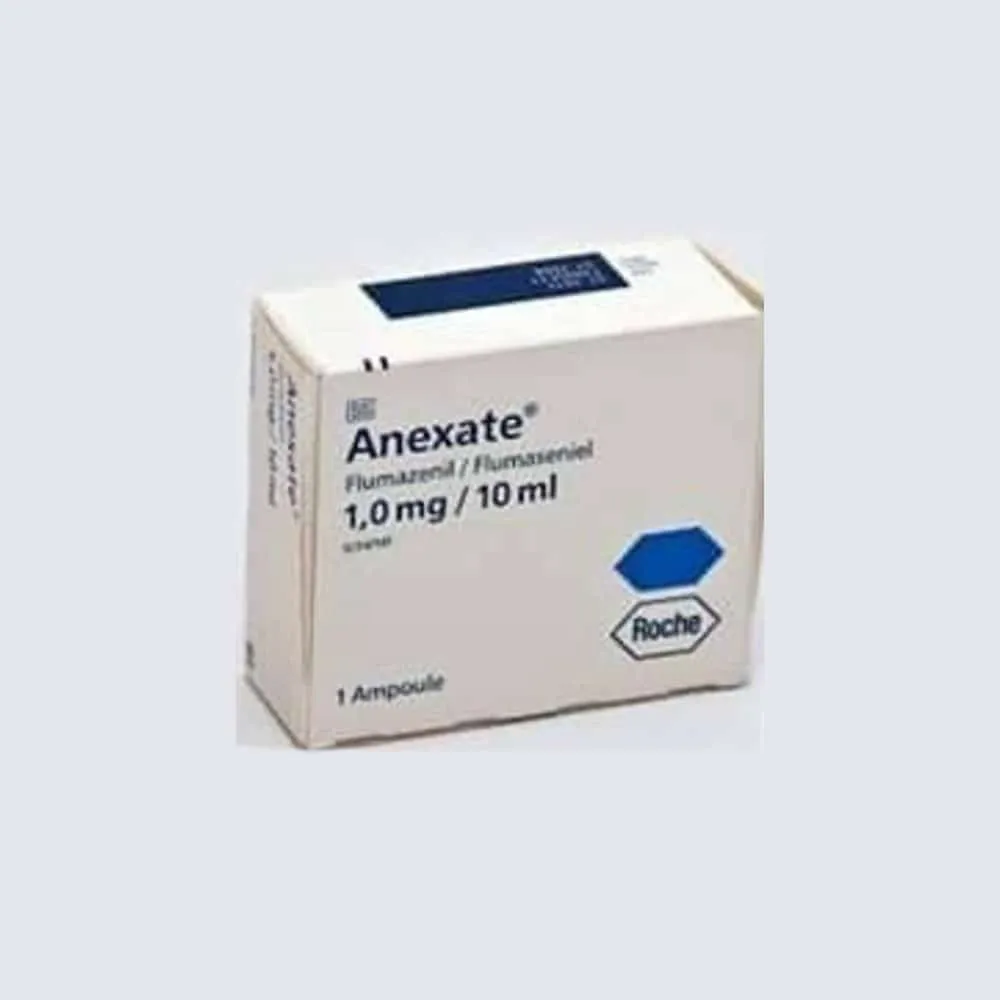
Table of Contents
Package leaflet: Information for the user
Introduction
Package leaflet: information for the user
Anexate 1 mg/10 ml injection solution
Flumazenil
Read the entire leaflet carefully before you start using this medicine, because it contains important information for you.
- Keep this leaflet as you may need to read it again.
- If you have any questions, ask your doctor or pharmacist.
- This medicine has been prescribed for you only and must not be given to other people, even if they have the same symptoms as you, because it could harm them.
- If you experience any adverse effects, consult your doctor or pharmacist, even if these effects are not listed in this leaflet. See section 4.
Leaflet contents:
- What Anexate is and what it is used for
- What you need to know before using Anexate
- How to use Anexate
- Possible adverse effects
- How to store Anexate
- Contents of the pack and other information
1. What Anexate is and what it is used for
Anexate contains an active substance called flumazenil, which is an antagonist of a group of medicines known as benzodiazepines.
Anexate is used to reverse, either fully or partially, the sedative or general anaesthetic effects of benzodiazepines in patients undergoing short diagnostic or therapeutic procedures. It is also used to counteract paradoxical reactions caused by benzodiazepines (a paradoxical reaction is when the treatment produces the opposite effect to what is normally expected).
Anexate is used for the diagnosis and/or treatment of benzodiazepine overdose in hospitalized patients in intensive care units. It may also be used as a diagnostic measure in cases of unconsciousness of unknown cause, to determine whether it is due to benzodiazepines, other drugs, or brain injury.
Anexate is also used in children over 1 year of age to reverse benzodiazepine-induced sedation.
2. What you need to know before using Anexate
Do not use Anexate
-
If you are allergic (hypersensitive) to flumazenil or to any of the other components of this medicine (listed in section 6).
-
If you are being treated with benzodiazepines to control conditions that could potentially endanger your life (elevated intracranial pressure, epileptic states).
-
If you have taken benzodiazepines together with other antidepressants (tricyclic antidepressants) that have made you unwell.
Warnings and precautions
Talk to your doctor or pharmacist before using Anexate. Inform your doctor if:
- You have a severe brain injury (and/or unstable intracranial pressure),
- You have epilepsy,
- You have severe liver problems,
- You have been treated with benzodiazepines for a long time,
- You have heart problems,
- You have a history of chronic or transient anxiety.
Anexate specifically reverses the effects of benzodiazepines; therefore, if you do not wake up after administration of Anexate, another cause should be considered.
It should not be administered during anesthesia until it has been confirmed that peripheral muscle-relaxing effects have disappeared.
Since the effect of flumazenil is usually shorter than that of benzodiazepines, resedation may occur. Therefore, you should be closely monitored, preferably in an intensive care unit, until the effect of Anexate has completely worn off.
After major surgery, postoperative pain should be taken into account, and it may be preferable to keep you slightly sedated.
In cases of overdose involving a mixture of drugs, Anexate should be administered with special caution due to the potential emergence of toxic effects from the other drugs (seizures and disturbances in heart rhythm).
If you have been treated with Anexate to counteract the effects of benzodiazepines, you should be monitored for an adequate period to prevent the occurrence of adverse effects.
Anexate is not recommended for the treatment of benzodiazepine dependence or for managing benzodiazepine withdrawal symptoms.
Children and adolescents
As a general rule, this medicine is not recommended for use in children under one year of age (see section 3 How to use Anexate).
Use of Anexate with other medicines
Inform your doctor or pharmacist if you are taking, have recently taken, or might need to take any other medicines.
Certain medicines may interact with Anexate. It is important that you inform your doctor if you are taking any of the following:
- Benzodiazepines
- Non-benzodiazepine agonists such as zopiclone, triazolopyridazines, and other antidepressants.
After treatment with Anexate, consult your doctor before taking any other medicine.
Pregnancy and breastfeeding
If you are pregnant or breastfeeding, think you may be pregnant, or are planning to become pregnant, consult your doctor or pharmacist before using this medicine.
It is unknown whether Anexate passes into breast milk. If you are breastfeeding, you should not be treated with Anexate except in emergencies and by parenteral administration. Your doctor will decide what is most appropriate in your case.
Driving and using machines
Do not drive, as this medicine may affect your ability to drive or operate machinery for up to 24 hours after treatment with Anexate, since the effects of previously taken or administered benzodiazepines may reappear.
Anexate contains sodium
Anexate 1 mg/10 ml solution for injection contains 36.7 mg of sodium (the main component of table/cooking salt) per vial. This corresponds to 1.9% of the maximum daily recommended sodium intake for an adult.
3. How to use Anexate
Follow exactly the administration instructions for this medicine given by your doctor or pharmacist. If in doubt, consult your doctor or pharmacist again.
Dosages may vary widely and will depend on your individual condition. The dose you receive may also depend on your weight, age, general health status, level of sedation, and your response to this medicine.
In anesthesia
The recommended initial dose is 0.2 mg i.v., administered over 15 seconds. If the desired level of consciousness is not achieved within 60 seconds after the first dose, your doctor will administer an additional dose of 0.1 mg, repeating it if necessary at 60-second intervals, up to a maximum total dose of 1 mg. The usual dose ranges between 0.3 and 0.6 mg.
In intensive care units and in the diagnosis of unconsciousness of unknown origin
An initial dose of 0.3 mg i.v. is recommended. If the desired level of consciousness is not achieved within 60 seconds, your doctor will administer an additional dose of 0.1 mg, repeating it if necessary at 60-second intervals, up to a total dose of 2 mg.
If drowsiness recurs, Anexate may be administered as one or more bolus doses, and an i.v. infusion of 0.1–0.4 mg per hour may be useful, with the infusion rate individually adjusted according to the desired level of consciousness.
If unexpected signs of overstimulation occur, diazepam or midazolam should be carefully dosed and administered intravenously according to the patient's response. In anesthesia, it is recommended to inject 5 mg i.v. of the active substances mentioned.
Use in children and adolescents
Children over one year of age
The recommended initial dose is 10 micrograms/kg (up to 200 micrograms) administered intravenously over 15 seconds. If the desired level of consciousness is not achieved within 45 seconds thereafter, your doctor may administer, if necessary, additional doses equal to the initial dose at 60-second intervals (up to a maximum of 4), up to a maximum total dose of 50 micrograms/kg or 1 mg, whichever is lower. There are no data on the safety and efficacy of repeated administration of flumazenil in children in case of resedation.
Children under one year of age
Due to limited experience, Anexate should be used with caution in the reversal of conscious sedation in children under 1 year of age, in the treatment of poisoning in children, neonatal resuscitation, and in reversing the sedative effects of benzodiazepines used for induction of general anesthesia in children.
Until sufficient data are available, Anexate should not be used in children under 1 year of age unless the risks to the patient (especially in cases of accidental overdose) have been weighed against the benefits of treatment.
If you use more Anexate than you should
Although symptoms of overdose have not been observed, if you have been given more Anexate than you should have received, consult your doctor or pharmacist immediately.
In case of overdose or accidental ingestion, contact the Toxicology Information Service. Telephone: (91) 562 04 20.
4. Possible adverse effects
Like all medicines, Anexate may cause adverse effects, although not everyone will experience them.
Anexate is well tolerated in both children and adults. In adults, it is well tolerated even at doses higher than those recommended.
The frequency of these adverse effects is classified into the following categories:
- Very common: may affect more than 1 in 10 people
- Common: may affect up to 1 in 10 people
- Uncommon: may affect up to 1 in 100 people
- Rare: may affect up to 1 in 1,000 people
- Very rare: may affect up to 1 in 10,000 people
- Frequency not known: frequency cannot be estimated from the available data.
Generally, these reactions disappear rapidly without requiring special treatment.
Immune system disorders
- Frequency not known: Hypersensitivity reactions (allergy), including anaphylaxis, may occur.
Psychiatric disorders
-
Uncommon: Anxiety and fear following rapid administration of Anexate, usually not requiring treatment.
-
Frequency not known: Withdrawal syndrome, with symptoms such as agitation (excitement, restlessness), anxiety (distress, fear), emotional lability (episodes of laughing or crying), confusion, and sensory distortions (illusions, hallucinations).
These symptoms may occur following rapid administration of flumazenil in patients who have received high doses and/or prolonged treatment with benzodiazepines.
Panic attacks (in patients with a history of panic reactions), abnormal crying, agitation, and aggressive reactions.
In general, adverse effects in children are similar to those in adults. When this medicine has been used to reverse sedation in children, abnormal crying, agitation, and aggressive reactions have been reported.
Nervous system disorders
- Frequency not known: Seizures in patients with epilepsy or severe hepatic impairment, particularly after prolonged benzodiazepine treatment or in cases of mixed drug overdose.
Cardiac disorders
- Uncommon: Palpitations (strong and rapid heartbeats) following rapid administration of flumazenil.
Vascular disorders
- Frequency not known: Transient increase in blood pressure (upon awakening).
Gastrointestinal disorders
- Common: Nausea and postoperative vomiting, especially if opioids (narcotics) have also been used.
Skin and subcutaneous tissue disorders
- Frequency not known: Flushing (redness).
General disorders and administration site conditions
- Frequency not known: Chills, following rapid administration of flumazenil.
In cases of mixed drug overdose, particularly involving tricyclic antidepressants, toxic effects such as seizures or cardiac arrhythmias may occur; these effects may emerge when flumazenil reverses the effects of benzodiazepines.
If you consider any of the adverse effects you experience to be severe or if you notice any adverse effect not mentioned in this leaflet, inform your doctor or pharmacist.
Reporting of adverse effects
If you experience any type of adverse effect, consult your doctor or pharmacist, even if they are adverse effects not listed in this leaflet. You can also report them directly via the Spanish Pharmacovigilance System for Human Medicines: www.notificaRAM.es/. By reporting adverse effects, you can help provide more information on the safety of this medicine.
5. Storage of Anexate
Keep this medicine out of the sight and reach of children.
No special storage conditions are required.
Do not use this medicine after the expiry date stated on the packaging after EXP. The expiry date is the last day of the month indicated.
6. Package contents and other information
Composition of Anexate
The active substance is flumazenil. Each millilitre of solution contains 0.1 mg of flumazenil.
The other components are: sodium edetate, glacial acetic acid, sodium chloride, sodium hydroxide and water for injections.
Appearance of the product and contents of the pack
Anexate 1 mg/10 ml is presented as an injectable solution. Each pack contains 5 ampoules of 10 ml each, containing 1 mg of flumazenil.
Marketing Authorisation Holder and Manufacturer
Marketing Authorisation Holder
CHEPLAPHARM Arzneimittel GmbH
Ziegelhof 24
17489 Greifswald
Germany
Manufacturer
CHEPLAPHARM Arzneimittel GmbH
Ziegelhof 23-24
17489 Greifswald
Germany
Local representative
Laboratorios Rubió S.A.
C/ Industria 29
Pol. Industrial Comte de Sert
08755 Castellbisbal (Barcelona)
Spain
Date of the most recent review of this leaflet: October 2020
“Detailed and up-to-date information on this medicine is available on the website of the Spanish Agency of Medicines and Health Products (AEMPS) http://www.aemps.gob.es/”
This information is intended for healthcare professionals only:
Anexate is recommended for intravenous use only and should be administered by an anaesthetist or experienced physician.
Anexate may be administered diluted or undiluted. Anexate is compatible with 5% glucose in water, Ringer's lactate and normal saline solutions.
When Anexate is drawn into a syringe or mixed with any of these solutions, the solution should be discarded after 24 hours. Careful dosing is required to achieve the desired effect.
Anexate may also be used in conjunction with other resuscitation measures. Since the duration of action of some benzodiazepines exceeds that of Anexate, repeated doses may be required if sedation recurs after awakening.
Rapid injection of Anexate should be avoided. In patients who have received high doses and/or prolonged treatment with benzodiazepines in the preceding weeks, rapid injection of doses equal to or greater than 1 mg may cause withdrawal symptoms, including palpitations, agitation, anxiety, emotional lability, as well as mild confusion and sensory distortions.
Anexate is not recommended for the treatment of benzodiazepine dependence or for controlling benzodiazepine withdrawal symptoms.