Anagrelide Bluefish 0.5 mg hard capsules EFG
Spain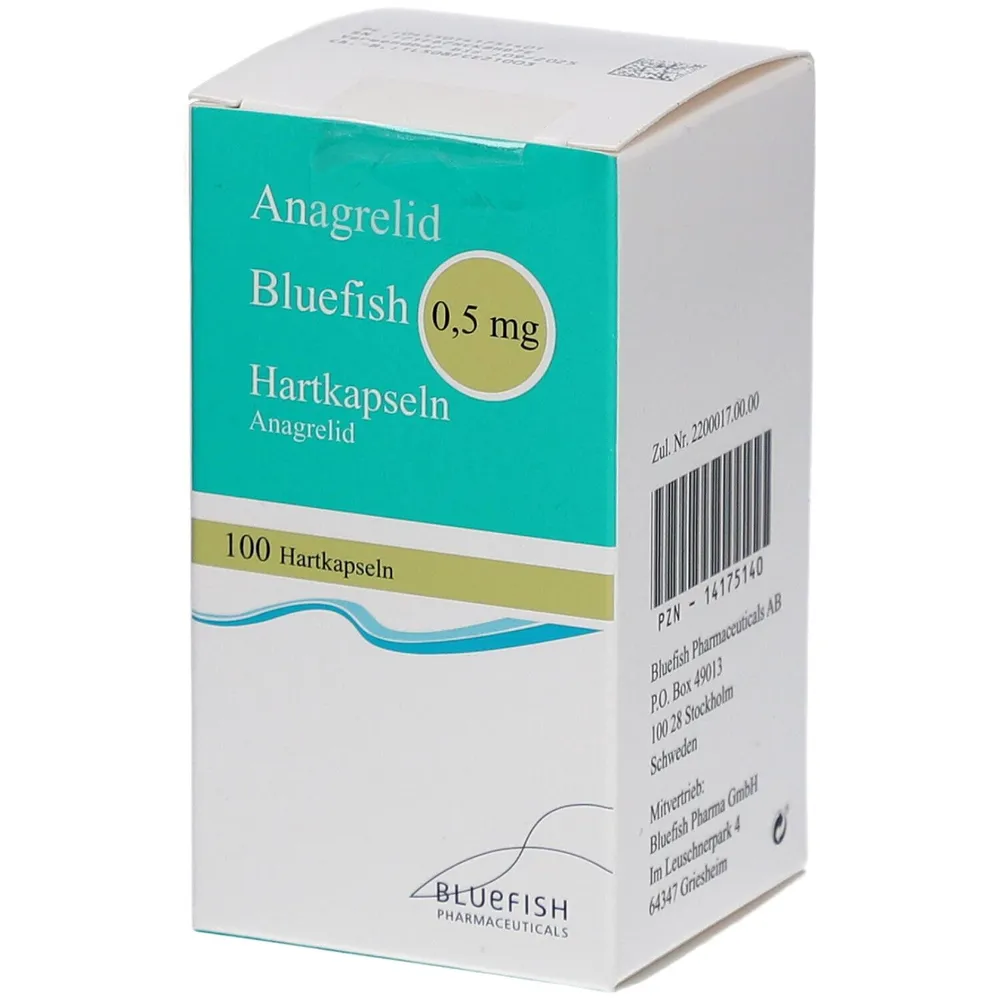
Table of Contents
Patient Information Leaflet
Introduction
Package leaflet: Information for the patient
Anagrelide Bluefish 0.5 mg hard capsules EFG
anagrelide
Read the entire leaflet carefully before you start taking this medicine, as it contains important information for you.
- Keep this leaflet, as you may need to read it again.
- If you have any questions, consult your doctor, pharmacist, or nurse.
- This medicine has been prescribed for you only. Do not give it to others, even if they have the same symptoms as you, because it could harm them.
- If you experience any adverse effects, consult your doctor, pharmacist, or nurse, even if they are adverse effects not listed in this leaflet. See section 4.
Leaflet contents
- What Anagrelide Bluefish is and what it is used for
- What you need to know before taking Anagrelide Bluefish
- How to take Anagrelide Bluefish
- Possible side effects
- How to store Anagrelide Bluefish
- Contents of the pack and other information
1. What Anagrelide Bluefish is and what it is used for
Anagrelide Bluefish contains the active substance anagrelide. Anagrelide Bluefish is a medicine that interferes with platelet development. It reduces the number of platelets produced by the bone marrow, resulting in a decrease in blood platelet count towards a more normal level. For this reason, it is used to treat patients with essential thrombocythemia.
Essential thrombocythemia is a condition in which the bone marrow produces an excessive number of blood cells known as platelets. A high number of platelets in the blood can lead to serious circulation and blood clotting problems.
2. What you need to know before taking Anagrelide Bluefish
Do not take Anagrelide Bluefish
- if you are allergic to anagrelide or to any of the other ingredients of this medicine (listed in section 6). Allergic reactions may present as rash, itching, swelling of the face and lips, or difficulty breathing
- if you have moderate or severe liver problems
- if you have moderate or severe kidney problems.
Warnings and precautions
Talk to your doctor before starting Anagrelide Bluefish:
- if you have or think you might have a heart problem
- if you were born with prolonged QT interval or have a family history of prolonged QT interval (seen on ECG, the heart's electrical recording), or if you are taking other medicines that cause abnormal changes in the ECG, or if you have low levels of electrolytes, e.g., potassium, magnesium, or calcium (see section “Other medicines and Anagrelide Bluefish”).
if you have liver or kidney problems.
When used together with acetylsalicylic acid (a substance found in many medicines used to relieve pain and reduce fever, as well as to prevent blood clotting, also known as aspirin), there is an increased risk of major bleeding (haemorrhage) (see section “Taking Anagrelide Bluefish with other medicines”).
While being treated with Anagrelide Bluefish, you must take the exact dose prescribed by your doctor. Do not stop taking the medicine without informing your doctor first. You should not stop taking this medicine suddenly without consulting your doctor. Abruptly stopping the medicine may increase the risk of stroke.
Signs and symptoms of stroke may include sudden numbness or weakness in the face, arm, or leg, especially on one side of the body; sudden confusion; sudden difficulty speaking or understanding speech; sudden trouble seeing in one or both eyes; sudden trouble walking, dizziness, loss of balance or coordination; or sudden severe headache with no known cause. Please consult your doctor immediately.
Children and adolescents
Information on the use of Anagrelide Bluefish in children and adolescents is limited, and therefore this medicine should be used with caution.
Other medicines and Anagrelide Bluefish
Inform your doctor or pharmacist if you are taking, have recently taken, or might need to take any other medicines.
Tell your doctor if you are taking any of the following medicines:
- medicines that may affect heart rhythm, for example, sotalol, amiodarone
- fluvoxamine, used to treat depression
- certain types of antibiotics, such as enoxacin, used to treat infections
- theophylline, used to treat asthma and serious breathing problems
- medicines to treat heart conditions such as, for example, milrinone, enoximone, amrinone, olprinone, and cilostazol
- acetylsalicylic acid (a substance found in many medicines used to relieve pain and reduce fever, as well as to prevent blood clotting, also known as aspirin)
- other medicines to treat conditions affecting blood platelets, such as clopidogrel
- omeprazole, used to reduce the amount of acid produced in the stomach
- oral contraceptives: if you experience severe diarrhoea while taking this medicine, the effectiveness of the oral contraceptive may be reduced and it is recommended to use an additional contraceptive method (e.g., condom). Please refer to the instructions in the leaflet of the oral contraceptive you are taking.
If used together, either Anagrelide Bluefish or these medicines may not work properly. Consult your doctor or pharmacist if you have any doubts.
Pregnancy and breastfeeding
If you are pregnant or planning to become pregnant, consult your doctor. If you are pregnant, you must not take Anagrelide Bluefish. Women who could become pregnant should ensure they use effective contraception while taking Anagrelide Bluefish. Consult your doctor if you need advice on contraception.
Consult your doctor if you are breastfeeding or plan to breastfeed. You must not take Anagrelide Bluefish while breastfeeding. If you are taking Anagrelide Bluefish, you must stop breastfeeding.
Driving and using machines
Some patients taking Anagrelide Bluefish have reported dizziness. Do not drive or operate machinery if you feel dizzy.
Anagrelide Bluefish contains lactose
This medicine contains lactose. If your doctor has informed you that you have an intolerance to certain sugars, consult with him before taking this medicine.
Anagrelide Bluefish contains sodium
This medicine contains less than 1 mmol of sodium (23 mg) per capsule; that is, essentially “sodium-free”.
3. How to take Anagrelide Bluefish
Follow exactly the instructions for use of this medicine as given by your doctor. If in doubt, consult your doctor or pharmacist again.
The amount of Anagrelide Bluefish patients may take can vary, as it depends on the condition being treated. Your doctor will prescribe the dose most suitable for your case.
The usual starting dose of Anagrelide Bluefish is 1 mg. This dose consists of one 0.5 mg capsule taken twice daily for at least one week. After this period, your doctor may increase or decrease the number of capsules you need to take until the dose best suited to your condition and providing the most effective treatment is reached.
The capsules must be swallowed whole with a glass of water. Do not crush the capsules or dissolve the contents in liquid. You may take the capsules with food, after meals, or on an empty stomach. It is recommended to take the capsule(s) at the same time each day.
Do not take more or fewer capsules than your doctor has recommended. Do not stop taking the medicine without first informing your doctor. You must not stop taking this medicine suddenly on your own.
Your doctor will arrange for you to have regular blood tests to monitor whether the medicine is effective and to check that your liver and kidneys are functioning properly.
If you take more Anagrelide Bluefish than you should
If you take more Anagrelide Bluefish than prescribed, or if someone else has taken this medicine, inform your doctor or pharmacist immediately. You should show them the Anagrelide Bluefish packaging.
In case of overdose or accidental ingestion, go to a medical center or call the Toxicology Information Service at telephone number: 91 562 04 20, stating the medicine and the amount taken.
If you forget to take Anagrelide Bluefish
Take the missed dose as soon as you remember. Then take the next dose at the usual time. Do not take a double dose to make up for forgotten doses.
4. Possible adverse effects
Like all medicines, this medicine can cause adverse effects, although not everyone will experience them.
Serious adverse effects:
Uncommon: Heart failure (symptoms include shortness of breath, chest pain, swelling of legs due to fluid accumulation), serious problem with heart rate or heart rhythm (ventricular tachycardia, supraventricular tachycardia, or atrial fibrillation), inflammation of the pancreas causing severe back and abdominal pain (pancreatitis), vomiting blood or passing dark or bloody stools, severe decrease in blood cell count which may cause weakness, bruising, bleeding, or infections (pancytopenia), pulmonary hypertension (symptoms include shortness of breath, swelling of legs or ankles, and bluish discoloration of lips and skin).
Rare: Kidney failure (when passing little or no urine), heart attack.
If you notice any of these adverse effects, contact your doctor immediately.
Very common adverse effects: may affect more than 1 in 10 patients
Headache.
Common adverse effects: may affect up to 1 in 10 patients
Dizziness, tiredness, fast heartbeat, strong or irregular heartbeat (palpitations), feeling sick (nausea), diarrhoea, stomach pain, flatulence, vomiting, decreased red blood cell count (anaemia), fluid retention or rash.
Uncommon adverse effects: may affect up to 1 in 100 patients
Feeling weak or unwell, high blood pressure, irregular heartbeat, fainting, chills or fever, indigestion, loss of appetite, constipation, bruising, bleeding, swelling (oedema), weight loss, muscle pain, joint pain, back pain, loss or reduced sensation or numbness (especially in the skin), abnormal sensation such as tingling or numbness, insomnia, depression, confusion, restlessness, dry mouth, memory loss, feeling short of breath, nosebleeds, severe lung infection with fever, shortness of breath, cough, phlegm, hair loss, itching of the skin, changes in skin colour, impotence, chest pain, decreased platelet count in the blood which increases the risk of bleeding or bruising (thrombocytopenia), fluid accumulation in the lungs or increased liver enzymes. Your doctor may perform blood tests which could show elevated liver enzymes.
Rare adverse effects: may affect up to 1 in 1,000 patients
Bleeding gums, weight gain, severe chest pain (angina pectoris), heart muscle disease (symptoms include fatigue, chest pain, and palpitations), enlargement of the heart, fluid accumulation around the heart, painful spasm of the blood vessels in the heart (occurring at rest, usually at night or early morning) (Prinzmetal's angina), loss of coordination, difficulty speaking, dry skin, migraine, visual disturbances or double vision, ringing in the ears, dizziness upon standing (especially when standing up after sitting or lying down), increased need to urinate at night, pain, "flu-like" symptoms, drowsiness, dilation of blood vessels, inflammation of the large intestine (symptoms include diarrhoea usually accompanied by blood or mucus, stomach pain, fever), inflammation of the stomach (symptoms include: pain, nausea, vomiting), area of abnormal density in the lungs, increased creatinine levels in blood tests which may indicate kidney problems.
The following adverse effects have been reported, although the exact frequency is unknown:
- potentially life-threatening irregular heartbeat (torsade de pointes);
- liver inflammation, symptoms include nausea, vomiting, itching, yellowing of the skin and eyes, abnormal stool or urine colour (hepatitis);
- lung inflammation (symptoms include fever, cough, difficulty breathing or wheezing; this may lead to lung scarring) (allergic alveolitis including interstitial lung disease and pneumonitis);
- kidney inflammation (tubulointerstitial nephritis);
- stroke (see section 2).
Reporting of adverse effects
If you experience any adverse effect, talk to your doctor or pharmacist, even if it is a possible adverse effect not listed in this leaflet. You can also report them directly via the Spanish Pharmacovigilance System for Human Medicines: https://www.notificaRAM.es. By reporting adverse effects, you can help provide more information on the safety of this medicine.
5. Storage of Anagrelide Bluefish
Keep this medicine out of the sight and reach of children.
Do not use this medicine after the expiry date which is stated on the carton or on the label of the bottle after EXP. The expiry date refers to the last day of the month indicated.
This medicine does not require any special storage conditions.
If your doctor discontinues treatment, do not keep any leftover capsules unless your doctor instructs you otherwise. Medicines must not be disposed of via wastewater or household waste. Return unused medicines and their containers to the SIGRE point at your pharmacy. If you are in doubt, ask your pharmacist how to dispose of medicines and containers you no longer need. This will help protect the environment.
6. Contents of the pack and other information
Composition of Anagrelide Bluefish
The active substance is anagrelide. Each capsule contains 0.5 mg of anagrelide (as anagrelide hydrochloride).
The other components are:
Contents of the capsule: povidone (E 1201), crospovidone (E 1202), lactose, lactose monohydrate, microcrystalline cellulose (E 460) and magnesium stearate.
Capsule shell: gelatin, titanium dioxide (E 171), sodium lauryl sulfate and water.
Nature of the product and contents of the pack
Anagrelide Bluefish is presented as white, opaque hard gelatin capsules containing white to off-white granular powder. The approximate length is 14.3 mm and the width is 5.2 mm.
Anagrelide Bluefish 0.5 mg hard capsules EFG are supplied in HDPE bottles with a child-resistant closure made of polypropylene, containing a desiccant.
Pack sizes: 42 or 100 capsules.
Only some pack sizes may be marketed.
Marketing Authorization Holder and Manufacturer
Marketing Authorization Holder:
Bluefish Pharmaceuticals AB
P.O. Box 49013
100 28 Stockholm
Sweden
Manufacturer:
Bluefish Pharmaceuticals AB
Gävlegatan 22
113 30 Stockholm
Sweden
For further information about this medicinal product, contact the local representative of the Marketing Authorization Holder:
Bluefish Pharma S.L.U.,
P.O. Box 36007
28320 Las Rozas, Branch 36
Spain
This medicinal product is authorized in the European Economic Area (EEA) Member States and in the United Kingdom (Northern Ireland) under the following names:
Germany: Anagrelid Bluefish 0.5 mg Hard Capsules
Austria: Anagrelid Bluefish 0.5 mg Hard Capsules
Denmark: Anagrelid "Bluefish"
Spain: Anagrelida Bluefish 0,5 mg cápsulas duras EFG
Norway: Anagrelide Bluefish 0.5 mg harde kapsler
Iceland: Anagrelide Bluefish 0,5 mg hörð hylki
Poland: Anagrelide Bluefish 0,5 mg kapsulki twarde
Portugal: Anagrelida Bluefish 0.5 mg cápsulas
United Kingdom (Northern Ireland): Anagrelide 0.5 mg hard capsules
Sweden: Anagrelide Bluefish 0.5 mg hårda kapslar
Date of the most recent revision of this leaflet: April 2023
Detailed and up-to-date information on this medicinal product is available on the website of the Spanish Agency for Medicines and Health Products (AEMPS): http://www.aemps.gob.es/