Amiodarone Aurovitas 200 mg tablets EFG
Spain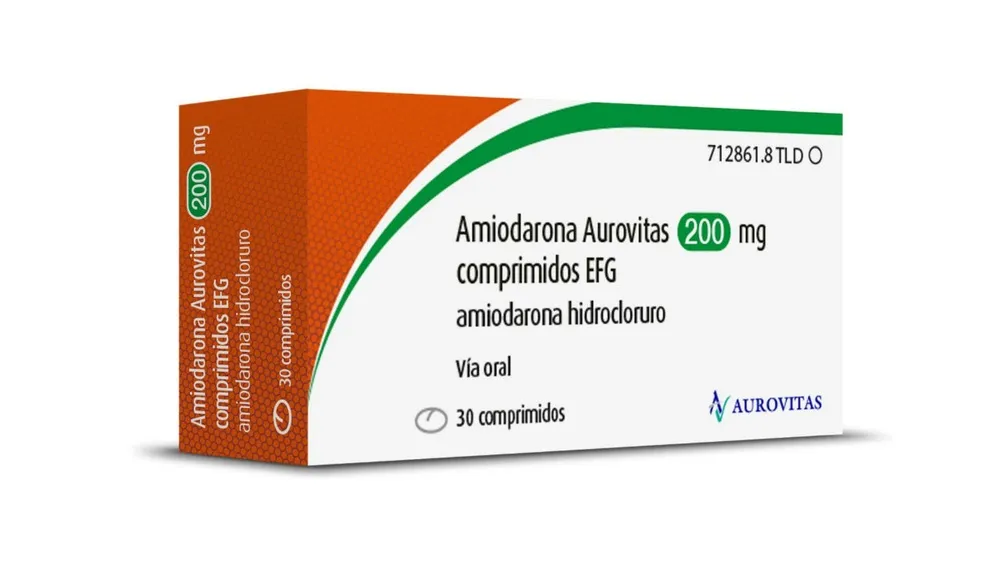
Table of Contents
- Package leaflet: Information for the user
- Introduction
- 1. What Amiodarona Aurovitas is and what it is used for
- 2. What you need to know before taking Amiodarone Aurovitas
- 3. How to take Amiodarone Aurovitas
- 4. Possible adverse effects
- 5. Amiodarone Aurovitas Storage
- 6. Package contents and other information
Package leaflet: Information for the user
Introduction
Package leaflet: information for the user
Amiodarone Aurovitas 200 mg tablets EFG
amiodarone hydrochloride
Read the entire leaflet carefully before you start taking this medicine, because it contains important information for you.
- Keep this leaflet, as you may need to read it again.
- If you have any questions, ask your doctor or pharmacist.
- This medicine has been prescribed for you only, and you should not give it to others, even if they have the same symptoms as you, because it may harm them.
- If you experience any adverse effects, consult your doctor or pharmacist, even if they are effects not listed in this leaflet. See section 4.
Contents of the leaflet
- What Amiodarone Aurovitas is and what it is used for
- What you need to know before taking Amiodarone Aurovitas
- How to take Amiodarone Aurovitas
- Possible side effects
- How to store Amiodarone Aurovitas
- Contents of the pack and other information
1. What Amiodarona Aurovitas is and what it is used for
Amiodarona Aurovitas contains an active substance called amiodarone hydrochloride. It belongs to a group of medicines known as antiarrhythmic agents.
It works by controlling irregular heartbeats (arrhythmias). By taking the tablets, it helps your heart rhythm return to normal.
Amiodarona Aurovitas can be used to:
- Treat irregular heart rhythms when no other medicine has worked or cannot be used.
- Treat a condition in which your heart beats unusually fast (Wolff-Parkinson-White syndrome), when no other medicine can be used or has not worked.
- Treat other types of fast or irregular heart rhythms known as "atrial flutter" or "atrial fibrillation". Amiodarona Aurovitas is used only when other medicines cannot be used.
- Treat sudden episodes of rapid heartbeats that may also be irregular.
Amiodarona Aurovitas is used only when other medicines cannot be used.
2. What you need to know before taking Amiodarone Aurovitas
Do not take Amiodarone Aurovitas:
- if you are allergic to iodine, amiodarone, or any of the other ingredients of this medicine (listed in section 6). Signs of an allergic reaction include: skin rash, difficulty swallowing or breathing, and swelling of the lips, face, throat, or tongue;
- if you have a slower than normal heart rate (sinus bradycardia) or suffer from another condition called sinoatrial block;
- if you have other heart rhythm disorders and do not have a pacemaker;
- if you have ever had thyroid problems. Your doctor must check your thyroid before prescribing this medicine;
- if you are taking other medicines that may affect your heart rhythm (see section “Other medicines and Amiodarone Aurovitas”);
- if you are breastfeeding (see section “Pregnancy and breastfeeding”).
Do not take this medicine if any of the above apply to you. If you are unsure, consult your doctor or pharmacist before taking Amiodarone Aurovitas.
Warnings and precautions
Talk to your doctor or pharmacist before starting Amiodarone Aurovitas:
- if you have heart failure;
- if you have liver problems;
- if you have lung problems or suffer from asthma;
- if you have vision problems, including a condition called optic neuritis;
- if you are due to undergo surgery;
- if you are elderly (over 65 years old). Your doctor will need to monitor you closely;
- if you have a pacemaker or an implanted cardioverter defibrillator (ICD). Your doctor will check that the device is working properly before you start taking the tablets, or if your dose is changed;
- very rare cases of potentially life-threatening skin rashes (Stevens-Johnson Syndrome, Toxic Epidermal Necrolysis) have occurred with amiodarone use. Symptoms may include: flu-like symptoms followed by a widespread, painful red or purple rash and blisters;
- if you are currently taking a medicine containing sofosbuvir for the treatment of hepatitis C, as this may cause a potentially life-threatening slowing of the heart rate. Your doctor may consider alternative treatments. If treatment with both amiodarone and sofosbuvir is required, you may need additional cardiac monitoring.
Seek immediate medical advice if you are taking a medicine containing sofosbuvir for the treatment of hepatitis C and during treatment you experience:
- slow or irregular heartbeat or heart rhythm problems;
- shortness of breath or worsening of existing shortness of breath;
- chest pain;
- dizziness;
- palpitations;
- fainting or near-fainting.
If you are on a heart transplant waiting list, your doctor may change your treatment. This is because taking amiodarone before heart transplantation has been associated with an increased risk of a life-threatening complication (primary graft dysfunction), in which the transplanted heart fails to function properly within the first 24 hours after surgery.
If you are unsure whether any of the above apply to you, speak with your doctor or pharmacist before taking Amiodarone Aurovitas.
Other medicines and Amiodarone Aurovitas
Inform your doctor or pharmacist if you are taking, have recently taken, or might need to take any other medicines. This includes over-the-counter medicines and herbal remedies. This is because amiodarone may alter the effects of other medicines, and some medicines may alter how amiodarone works.
In particular, do not take this medicine and consult your doctor if you are taking:
- other medicines for fast or irregular heartbeats (such as sotalol, quinidine, procainamide, disopyramide, or bretylium);
- medicines for infections (such as intravenous erythromycin, cotrimoxazole, moxifloxacin, or pentamidine);
- medicines for schizophrenia (such as chlorpromazine, thioridazine, fluphenazine, pimozide, haloperidol, amisulpride, or sertindole);
- medicines for other mental health conditions (such as lithium, doxepine, maprotiline, or amitriptyline);
- medicines for malaria (such as quinine, mefloquine, chloroquine, and halofantrine);
- medicines used for allergic rhinitis, rashes, or other allergies, known as antihistamines (such as terfenadine, astemizole, or mizolastine).
Consult your doctor if you are taking any of the following medicines:
- medicines that prolong your heartbeat (QT interval), such as medicines for infections (such as clarithromycin, ciprofloxacin, ofloxacin, or levofloxacin);
- medicines for heart problems called beta-blockers (such as propranolol);
- medicines for hepatitis C, a liver disease, such as sofosbuvir, daclatasvir, simeprevir, ledipasvir;
- medicines called calcium channel blockers – for chest pain (angina) or high blood pressure (such as diltiazem or verapamil);
- medicines for constipation (laxatives) such as bisacodyl or senna;
- medicines for high cholesterol (statins) such as simvastatin or atorvastatin.
The following medicines may increase the risk of side effects when taken with Amiodarone Aurovitas:
- amphotericin (when given intravenously) – used for fungal infections;
- medicines for inflammation (corticosteroids) such as hydrocortisone, betamethasone, or prednisolone;
- tablets to increase urine output (diuretics);
- general anaesthetics or high doses of oxygen – used during surgery;
- tetracosactide – used to investigate certain hormonal disorders.
Amiodarone Aurovitas may increase the effect of the following medicines:
- ciclosporin, tacrolimus, sirolimus – used to prevent transplant rejection;
- medicines for erectile dysfunction such as sildenafil, tadalafil, or vardenafil;
- fentanyl – used for pain relief;
- ergotamine – used for migraines;
- midazolam – used to relieve anxiety or help you relax before surgery;
- colchicine – used for the treatment of gout;
- flecainide – another medicine used for fast and irregular heartbeats. Your doctor should monitor your treatment and may reduce your flecainide dose by half;
- lidocaine – used as an anaesthetic;
- coumarins – used to prevent blood clotting;
- phenytoin – used to prevent seizures;
- digitalis – used for certain heart rhythm disorders;
- dabigatran – used to thin the blood.
If you are unsure whether any of the above apply to you, consult your doctor or pharmacist before taking Amiodarone Aurovitas.
Taking Amiodarone Aurovitas with food, drinks, and alcohol
Do not drink grapefruit juice while taking this medicine. This is because drinking grapefruit juice while taking Amiodarone Aurovitas may increase the risk of side effects.
Limit the amount of alcohol you drink while taking this medicine. This is because drinking alcohol while taking this medicine increases the risk of liver problems. Consult your doctor or pharmacist about how much alcohol you can safely drink.
Protect your skin from sunlight
Avoid direct sunlight while taking this medicine and for several months after stopping it. This is because your skin will become much more sensitive to sunlight and may burn, tingle, or develop severe blisters if you do not take the following precautions:
- Make sure you use high-factor sunscreen.
- Always wear a hat and clothing that covers your arms and legs.
Pregnancy, breastfeeding, and fertility
If you are pregnant or breastfeeding, think you may be pregnant, or plan to become pregnant, consult your doctor or pharmacist before using this medicine.
- Amiodarone Aurovitas is generally not given during pregnancy.
- Do not take this medicine if you are breastfeeding or plan to breastfeed. This is because small amounts of the medicine pass into breast milk.
Driving and using machines
Amiodarone Aurovitas may cause blurred vision or other symptoms that could affect your ability to drive. If you experience any of these effects, avoid driving or operating machinery.
Amiodarone Aurovitas contains lactose
This medicine contains lactose. If your doctor has informed you that you have an intolerance to certain sugars, consult them before taking this medicine.
Amiodarone Aurovitas contains sodium
This medicine contains less than 1 mmol of sodium (23 mg) per tablet; this is essentially “sodium-free”.
3. How to take Amiodarone Aurovitas
Follow exactly the dosage instructions for this medicine as prescribed by your doctor. If in doubt, consult your doctor or pharmacist again. This will help you achieve the best results and minimize the risk of adverse effects.
Starting dose
The recommended dose is 200 mg of amiodarone three times a day (600 mg total per day) for 8 to 10 days.
Maintenance dose
Once the desired effect has been achieved, the dose may be reduced to 100–400 mg (half a tablet to 2 tablets of amiodarone 200 mg) per day. In certain cases, amiodarone 200 mg may be administered once every two days (200 mg every two days is equivalent to 100 mg once daily).
Amiodarone 200 mg tablets should be taken with or immediately after food with water (for example, a glass of water).
Use in children and adolescents
Data on safety and efficacy in children are limited. Your doctor will determine the appropriate dose.
The tablet may be divided into equal doses.
If you take more Amiodarone Aurovitas than you should
If you take more Amiodarone Aurovitas than you should, consult your doctor or go to the emergency department immediately. Take the medicine packaging with you so the doctor knows what you have taken. The following symptoms may occur: dizziness, weakness or fatigue, confusion, slow heart rate, liver damage, or feeling sick.
In case of overdose or accidental ingestion, contact your doctor or pharmacist immediately, or call the Toxicology Information Service at 91 562 04 20, indicating the medicine and the amount ingested.
If you forget to take Amiodarone Aurovitas
If you forget a dose, take it as soon as you remember. However, if the next dose is due soon, skip the missed dose. Do not take a double dose to make up for a missed dose.
If you stop taking Amiodarone Aurovitas
Keep taking Amiodarone Aurovitas until your doctor tells you to stop. Do not stop taking Amiodarone Aurovitas just because you feel better. If you stop taking this medicine, rapid and irregular heartbeats may return. This could be dangerous.
If you have any further questions about the use of this medicine, ask your doctor or pharmacist.
Tests
Your doctor will carry out regular checks to monitor how your liver is functioning. Amiodarone Aurovitas may affect liver function. If this occurs, your doctor will decide whether you should continue taking these tablets.
Your doctor may carry out regular thyroid checks while you are taking this medicine. This is because Amiodarone Aurovitas contains iodine, which may cause thyroid problems.
Your doctor may carry out other regular checks such as blood tests, chest X-rays, electrocardiograms (electrical monitoring of heart rhythm), and eye examinations, both before and during treatment with Amiodarone Aurovitas.
If you have any further questions about the use of this medicine, consult your doctor or pharmacist.
4. Possible adverse effects
Like all medicines, this medicine can cause adverse effects, although not everyone will experience them.
Amiodarone Aurovitas may remain in your blood for up to one month after stopping treatment, so adverse effects could occur during this time.
Stop taking Amiodarone Aurovitas and go immediately to the doctor or hospital if:
- You have an allergic reaction. Signs may include: skin rash, swelling or breathing problems, swollen eyelids, face, throat or tongue.
Common (affects less than 1 in 10 people):
- Yellowing of the skin or eyes (jaundice), feeling sick or tired, loss of appetite, stomach pain or high temperature. These may be signs of liver damage or liver problems, which can be very dangerous.
- Difficulty breathing or tightness in the chest, persistent cough, wheezing, weight loss and fever. This may be due to lung inflammation, which can be very dangerous.
- Itching, red rash (eczema).
Uncommon (affects less than 1 in 100 people):
- Heartbeats becoming more irregular or erratic. This could lead to a heart attack, so you should go to hospital immediately.
- Dry mouth.
Very rare (affects less than 1 in 10,000 people):
- Loss of vision in one eye or dim, colourless vision. The eyes may feel painful or sensitive, and you may feel pain when moving them. This may be a condition called “optic neuropathy” or “neuritis”.
- Heartbeat becoming very slow or stopping. If this occurs, go to hospital immediately.
- Inflammation of the lungs, which can be very dangerous.
Frequency not known (frequency cannot be estimated from available data):
- Severe allergic reaction (anaphylactic reaction, anaphylactic shock); sudden inflammation of the pancreas (pancreatitis (acute)); decreased appetite; unusual muscle movements, stiffness, tremor and restlessness (parkinsonism); abnormal sense of smell (parosmia); confusion (delirium); potentially life-threatening skin reactions with rash, blisters, skin peeling and pain (toxic epidermal necrolysis (TEN), Stevens-Johnson syndrome (SJS), bullous dermatitis, drug reaction with eosinophilia and systemic symptoms (DRESS)); acute bleeding from the lungs. Potentially fatal complication after heart transplant (primary graft dysfunction) in which the transplanted heart stops functioning properly (see section 2, Warnings and precautions).
Stop taking Amiodarone Aurovitas and go immediately to the doctor if you notice any of the following serious adverse effects – you may need urgent medical treatment:
Common (affects less than 1 in 10 people):
- Feeling numb or weak, tingling or pins and needles anywhere in the body.
Very rare (affects less than 1 in 10,000 people):
- Skin rash caused by narrowed or blocked blood vessels (vasculitis).
- You may experience headache (which is usually worse in the morning and occurs after coughing or exertion), feeling unwell (nausea), seizures, weakness, vision problems or confusion. These symptoms may be signs of brain problems.
- Moving restlessly or unsteadily, slurred speech and slow speech.
- Feeling weak, dizzy, unusually tired and short of breath. These may be signs of a very slow heart rate (especially in people over 65 years of age) or other problems with the heart's natural rhythm.
There have been reports of some cases of bleeding in the lungs in patients taking Amiodarone Aurovitas. Inform your doctor immediately if you cough up blood.
Frequency not known (frequency cannot be estimated from available data):
- Chest pain, shortness of breath and irregular heartbeat. These may be signs of a disturbance called “Torsades de pointes”.
Tell your doctor as soon as possible if you experience any of the following adverse effects:
Very common (affects more than 1 in 10 people):
- Blurred vision or seeing coloured halos around bright lights.
Common (affects less than 1 in 10 people):
- Feeling extremely restless or agitated, weight loss, increased sweating and inability to tolerate heat. These may be signs of a condition called “hyperthyroidism”.
- Feeling extremely tired, weak or exhausted, weight gain, inability to tolerate cold, constipation and muscle pain. These may be signs of a condition called “hypothyroidism”.
- Tremor when moving arms or legs.
- Blue or grey marks on skin exposed to sunlight, especially on the face.
Uncommon (affects less than 1 in 100 people):
- Muscle cramps, stiffness or spasms.
Very rare (affects less than 1 in 10,000 people):
- Inflammation of the testicles.
- Red, scaly areas of skin, hair loss or nail loss (called “exfoliative dermatitis”).
- Feeling tired, weak, dizzy or having pale skin. These may be signs of anaemia.
- Bleeding or bruising more than normal. This may be due to a blood disorder (called “thrombocytopenia”).
- Feeling unwell, confused or weak, dizzy (nausea), loss of appetite, irritability. This may be due to a blood disorder called “syndrome of inappropriate antidiuretic hormone secretion” (SIADH).
Frequency not known (frequency cannot be estimated from available data):
- You may have more infections than usual. This may be due to a decrease in the number of white blood cells (neutropenia).
- Severe reduction in the number of white blood cells, making infections more likely (agranulocytosis).
Tell your doctor or pharmacist if any of the following adverse effects become severe or last for more than a few days:
Very common (affects more than 1 in 10 people):
- Feeling sick (nausea) or being sick (vomiting).
- Changes in the taste of food.
- Changes in the level of liver enzymes at the start of treatment. This may be seen in a blood test.
- Becoming sunburnt more easily when exposed to sunlight (see “Protect your skin from sunlight” in section 2).
Common (affects less than 1 in 10 people):
- Slightly slower heartbeat.
- Nightmares.
- Sleep problems.
- Decreased sexual desire.
Very rare (affects less than 1 in 10,000 people):
- Headache.
- Problems with balance, feeling dizzy (vertigo).
- Difficulty maintaining an erection or ejaculating.
- Hair loss, baldness.
- Skin rash.
- Reddened skin during radiotherapy.
- Increased creatinine in blood, which may appear in a blood test. This may be a sign of reduced kidney function or kidney damage.
Frequency not known (frequency cannot be estimated from available data):
- Urticaria (itching, lumpy rash).
- Granulomas, small red lumps on the skin or inside the body visible on X-ray.
- Pancreatitis / acute pancreatitis.
- Dry mouth.
- Anaphylactic reactions.
- Decreased appetite.
- Parkinsonism.
- Parosmia (disturbance in the sense of smell).
- Confusion, seeing, hearing or feeling things that are not there (hallucinations).
- Bullous dermatitis.
Other reported side effects:
Lupus-like syndrome (a disease in which the immune system attacks various parts of the body and causes joint pain, stiffness and swelling, and skin redness, sometimes in the shape of butterfly wings on the face).
Reporting of adverse effects
If you experience any adverse effect, consult your doctor or pharmacist, even if it is a possible adverse effect not listed in this leaflet. You can also report them directly via the Spanish Pharmacovigilance System for Human Medicines: https://www.notificaram.es. By reporting adverse effects, you can help provide more information on the safety of this medicine.
5. Amiodarone Aurovitas Storage
Keep this medicine out of the sight and reach of children.
Do not use this medicine after the expiry date stated on the packaging after EXP. The expiry date refers to the last day of the month indicated.
Store below 30°C.
Medicines should not be disposed of via wastewater or household waste. Dispose of unused medicines and their containers at the SIGRE collection point at your pharmacy. If you have any doubts, ask your pharmacist how to properly dispose of medicines and containers you no longer need. This will help protect the environment.
6. Package contents and other information
Composition of Amiodarona Aurovitas
- The active substance is amiodarone hydrochloride.
Each tablet contains 200 mg of amiodarone hydrochloride.
- The other components are: lactose monohydrate, colloidal anhydrous silica, sodium carboxymethyl starch (type A) (derived from potato starch), povidone (K-30) and magnesium stearate.
Appearance of the medicinal product and contents of the pack
Tablet.
Uncoated tablets, white to off-white, round and biconvex, marked with '8' and '4' separated by a score line on one side and with an 'A' on the other side of the tablet.
Amiodarona Aurovitas is available in opaque white PVC-aluminum blisters.
Pack sizes:
Blister: 10, 20, 30 and 60 tablets.
Only some pack sizes may be marketed.
Marketing Authorization Holder and Manufacturer
Marketing Authorization Holder:
Aurovitas Spain, S.A.U.
Avda. de Burgos, 16-D
28036 Madrid
Spain
Tel.: 91.630.86.45
Manufacturer:
APL Swift Services (Malta) Limited
HF26, Hal Far Industrial Estate, Hal Far
Birzebbugia, BBG 3000
Malta
This medicinal product is authorized in the EEA Member States under the following names:
Italy: Amiodarona Aurobindo
Portugal: Amiodarona Aurovitas
Spain: Amiodarona Aurovitas 200 mg tablets EFG
Date of the most recent revision of this leaflet: December 2021
Detailed and up-to-date information on this medicinal product is available on the website of the Spanish Agency of Medicines and Health Products (AEMPS) http://www.aemps.gob.es/