Aminoplasmal B. Braun 10% solution for infusion
Spain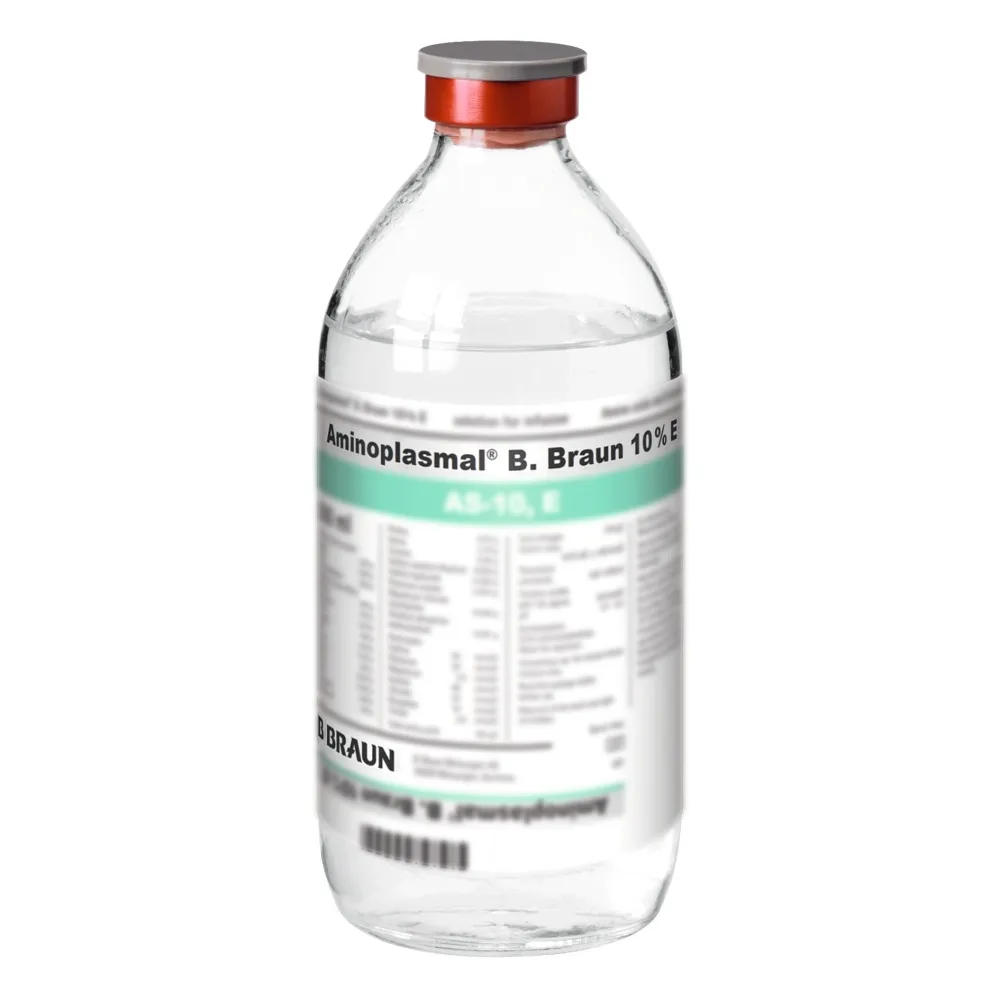
Table of Contents
- Package leaflet: Information for the user
- Introduction
- 1. What Aminoplasmal B. Braun 10% E is and what it is used for
- 2. What you need to know before starting to use Aminoplasmal B. Braun 10% E
- 3. How to use Aminoplasmal B. Braun 10% E
- 4. Possible adverse effects
- 5. Storage of Aminoplasmal B. Braun 10% E
- 6. Contents of the package and other information
- In cases where amino acid requirements are 1.0 g per kg of body weight per day or higher, special attention must be paid to limitations in fluid intake. In these situations, amino acid solutions with a higher amino acid content may need to be used to avoid fluid overload.
Package leaflet: Information for the user
Introduction
Package leaflet: information for the user
Aminoplasmal B. Braun 10% E solution for infusion
amino acids and electrolytes
Read the entire leaflet carefully before you start using this medicine, because it contains important information for you.
- Keep this leaflet. You may need to read it again.
- If you have any questions, ask your doctor or pharmacist.
- If you experience any adverse reactions, consult your doctor or pharmacist, even if they are adverse reactions not listed in this leaflet. See section 4.
Leaflet contents:
- What Aminoplasmal B. Braun 10% E is and what it is used for
- What you need to know before using Aminoplasmal B. Braun 10% E
- How to use Aminoplasmal B. Braun 10% E
- Possible side effects
- How to store Aminoplasmal B. Braun 10% E
- Contents of the pack and other information
1. What Aminoplasmal B. Braun 10% E is and what it is used for
Aminoplasmal B. Braun 10% E is a solution administered through a small tube with a cannula inserted into a vein (intravenous infusion).
The solution contains amino acids and mineral salts (electrolytes), which are essential for growth and recovery of the body.
You will receive this medicine if you are unable to take food normally and cannot be fed through a tube inserted into your stomach. This solution may be administered to adults, adolescents, and children over 2 years of age.
2. What you need to know before starting to use Aminoplasmal B. Braun 10% E
Do not use Aminoplasmal B. Braun 10% E:
-
if you are allergic to the active substances or to any of the other components of this medicine (listed in section 6),
-
if you have a congenital disorder of amino acid or protein metabolism,
-
if you have a severe (life-threatening) circulatory disorder (shock),
-
if you are receiving insufficient oxygen supply (hypoxia),
-
if you have an accumulation of acidic substances in your blood (metabolic acidosis),
-
if you have a severe liver disease (severe hepatic insufficiency or decompensated liver cirrhosis with hepatic encephalopathy [grades III and IV]),
-
if you have a severe kidney disorder (severe renal insufficiency) not adequately treated by dialysis or similar treatments,
-
if you have excessively high levels of any of the mineral salts (electrolytes) contained in the solution,
-
if you have inadequately controlled heart failure with significant circulatory impairment (decompensated cardiac insufficiency),
-
if you have fluid accumulation in your lungs (acute pulmonary edema),
-
if the balance of salts (electrolytes) or water in your body is disturbed.
This solution must not be administered to newborns, infants, or children under two years of age, as its composition does not adequately meet the special nutritional requirements of this age group.
Warnings and precautions
Consult your doctor or pharmacist before using Aminoplasmal B. Braun 10% E
- if you have any amino acid metabolism disorder due to a condition other than those listed above (see section "Do not use Aminoplasmal B. Braun 10% E"),
- if you have mild or moderate impairment of liver function, decompensated liver cirrhosis with hepatic encephalopathy (grades I and II), or impaired kidney function,
- if you have impaired heart function,
- if your blood serum is abnormally concentrated (increased serum osmolarity).
If your body's water or mineral salt balance is disturbed, this imbalance must be corrected before administering this medicine. Examples include simultaneous deficiency of water and mineral salts (hypotonic dehydration), or deficiency of sodium (hyponatremia) or potassium (hypopotasemia).
Before and during treatment with this medicine, your blood levels of electrolytes and glucose, fluid balance, acid-base balance, blood proteins, and kidney and liver function will be monitored. For this purpose, blood samples will be taken and your urine collected for analysis.
If you have renal insufficiency or are under 18 years of age, your magnesium (Mg++) levels should be carefully monitored.
Usually, you will receive Aminoplasmal B. Braun 10% E as part of an intravenous nutritional regimen, which will also include energy supplements (carbohydrate solutions, fat emulsions), essential fatty acids, electrolytes, as well as vitamins, fluids, and trace elements.
Use of Aminoplasmal B. Braun 10% E with other medicines
Inform your doctor or pharmacist if you are taking, have recently taken, or might need to take any other medicines.
Pregnancy and breastfeeding
If you are pregnant or breastfeeding, think you may be pregnant, or plan to become pregnant, consult your doctor or pharmacist before using this medicine.
Pregnancy
If you are pregnant, you will only receive this medicine if your doctor considers it necessary for your recovery. There are no available data on the use of this medicine in pregnant women.
Breastfeeding
At therapeutic doses of Aminoplasmal B. Braun 10% E, effects on the newborn/infant during breastfeeding are not expected. However, breastfeeding is not recommended if women simultaneously require intravenous nutrition.
Driving and use of machines
This medicine is generally administered to immobile patients in a controlled setting (emergency treatment, acute treatment in a hospital or day-care center). Therefore, driving and operating machinery are excluded.
3. How to use Aminoplasmal B. Braun 10% E
Follow exactly the administration instructions for this medicine as given by your doctor or pharmacist. If in doubt, consult your doctor or pharmacist again.
Dosage
Adults
Your doctor will determine the amount of solution you need each day.
The normal dose will be 10–20 ml per kg of body weight per day. The solution will flow at a rate not exceeding 1.0 ml per kg of body weight per hour.
Children aged 2 to 18 years
In children, the doctor will carefully adjust the dose according to age, stage of development, and existing illness.
The amounts to be administered will be:
From 2 to less than 3 years: 10–25 ml per kg of body weight per day
From 3 to 18 years: 10–20 ml per kg of body weight per day
For severely ill children, the amount administered may be higher (up to 30 ml per kg of body weight per day).
The solution will be administered at a rate not exceeding 1 ml per kg of body weight per hour.
Patients with renal or hepatic disease
Doses will be adjusted according to your individual needs if you have liver disease (mild or moderate liver insufficiency or decompensated liver cirrhosis with hepatic encephalopathy [grades I and II]) or kidney disease. When administered during dialysis, amino acid losses into the dialysate must be taken into account.
Duration of administration
This medicine may be used as long as intravenous feeding is required.
Method of administration
This medicine will be administered to you through a small tube inserted into one of your large veins (central venous infusion).
If you have received more Aminoplasmal B. Braun 10% E than you should have
It is unlikely that this will happen, as your doctor will determine your daily doses.
However, if you receive an overdose or the solution flows too rapidly, you may experience nausea, vomiting and/or headache.
In addition, your blood may contain too much ammonia (hyperammonaemia), or you may lose amino acids in the urine.
You may also develop excessive fluid in the body (hyperhydration), your body's electrolyte balance may be disturbed (electrolyte imbalance), or you may develop fluid in the lungs (pulmonary oedema).
If this occurs, the infusion should be stopped and restarted after a certain period at a lower infusion rate.
If you have any further questions about the use of this medicine, ask your doctor or pharmacist.
4. Possible adverse effects
Like all medicines, this medicine can cause adverse effects, although not everyone will experience them.
These adverse effects are not specifically related to Aminoplasmal B. Braun 10% E, but may occur with any type of intravenous nutrition, especially at the beginning.
The following adverse effects can be serious. If any of the following occur, inform your doctor immediately, and he or she will stop administering this medicine:
Frequency not known (cannot be estimated from available data)
- Allergic reactions
Other adverse effects:
Uncommon (may affect up to 1 in 100 people)
- Vomiting, nausea
Reporting of adverse effects
If you experience any type of adverse effect, consult your doctor or pharmacist, even if it is a possible adverse effect not listed in this leaflet. You may also report them directly via the Spanish Pharmacovigilance System for Human Medicines: www.notificaRAM.es.
By reporting adverse effects, you can help provide more information on the safety of this medicine.
5. Storage of Aminoplasmal B. Braun 10% E
Keep this medicine out of the sight and reach of children.
Do not use this medicine after the expiry date stated on the label of the vial and the carton. The expiry date refers to the last day of the month indicated.
Store the vial in the outer packaging to protect it from light.
Do not store above 25 °C.
Do not freeze.
Storing the solution cold, below 15 °C, may cause crystal formation, which however can be easily redissolved by gentle warming to 25 °C until complete dissolution. Gently shake the container to ensure homogeneity.
After infusion, any remaining solution must not be retained for later use.
Medicines should not be disposed of via wastewater or household waste. Return unused medicines and their containers to your pharmacy’s SIGRE Point (or any other medicine waste collection system). If in doubt, ask your pharmacist how to dispose of medicines and containers you no longer need. This will help protect the environment.
6. Contents of the package and other information
Composition of Aminoplasmal B. Braun 10% E
The active substances are amino acids and electrolytes.
This medicine contains:
Amino acids: | in 1 ml | in 250 ml | in 500 ml | in 1,000 ml |
Isoleucine | 5.00 mg | 1.25 g | 2.50 g | 5.00 g |
Leucine | 8.90 mg | 2.23 g | 4.45 g | 8.90 g |
Lysine hydrochloride | 8.56 mg | 2.14 g | 4.28 g | 8.56 g |
(equivalent to lysine) | (6.85 mg) | (1.71 g) | (3.43 g) | (6.85 g) |
Methionine | 4.40 mg | 1.10 g | 2.20 g | 4.40 g |
Phenylalanine | 4.70 mg | 1.18 g | 2.35 g | 4.70 g |
Threonine | 4.20 mg | 1.05 g | 2.10 g | 4.20 g |
Tryptophan | 1.60 mg | 0.40 g | 0.80 g | 1.60 g |
Valine | 6.20 mg | 1.55 g | 3.10 g | 6.20 g |
Arginine | 11.50 mg | 2.88 g | 5.75 g | 11.50 g |
Histidine | 3.00 mg | 0.75 g | 1.50 g | 3.00 g |
Alanine | 10.50 mg | 2.63 g | 5.25 g | 10.50 g |
Glycine | 12.00 mg | 3.00 g | 6.00 g | 12.00 g |
Aspartic acid | 5.60 mg | 1.40 g | 2.80 g | 5.60 g |
Glutamic acid | 7.20 mg | 1.80 g | 3.60 g | 7.20 g |
Proline | 5.50 mg | 1.38 g | 2.75 g | 5.50 g |
Serine | 2.30 mg | 0.58 g | 1.15 g | 2.30 g |
Tyrosine | 0.40 mg | 0.10 g | 0.20 g | 0.40 g |
Sodium acetate trihydrate | 2.858 mg | 0.715 g | 1.429 g | 2.858 g |
Potassium acetate Sodium hydroxide | 2.453 mg 0.360 mg | 0.613 g 0.090 g | 1.227 g 0.180 g | 2.453 g 0.360 g |
Magnesium chloride hexahydrate | 0.508 mg | 0.127 g | 0.254 g | 0.508 g |
Disodium phosphate dodecahydrate | 3.581 mg | 0.895 g | 1.791 g | 3.581 g |
The other components are acetylcysteine, citric acid monohydrate (for pH adjustment), and water for injections.
Electrolyte concentrations | ||
Sodium | 50 | mmol/l |
Potassium | 25 | mmol/l |
Magnesium | 2.5 | mmol/l |
Acetate | 46 | mmol/l |
Chloride | 52 | mmol/l |
Phosphate | 10 | mmol/l |
Citrate | 1.0 – 2.0 | mmol/l |
Total amino acids | 100 | g/l |
Total nitrogen | 15.8 | g/l |
Energy value [kJ/l (kcal/l)] | 1675 | (400) |
Theoretical osmolarity [mOsm/l] | 1030 | |
Acidity (titration to pH 7.4) [mmol NaOH/l] | approx. 26 | |
pH | 5.7 – 6.3 |
Appearance of the product and contents of the container
Aminoplasmal B. Braun 10% E is a clear, colourless to slightly straw-coloured solution and practically free from visible particles.
The product is supplied in colourless glass bottles of 250 ml, 500 ml and 1,000 ml, closed with a rubber stopper.
The 250 ml and 500 ml bottles are available in packs of 10. The 1,000 ml bottles are available in packs of 6.
Only certain pack sizes may be marketed.
Marketing Authorization Holder and Manufacturer
- Braun Melsungen AG
Carl-Braun-Straße 1
34212 Melsungen
Germany
Postal address:
34209 Melsungen, Germany
Telephone: +49/5661/71-0
Fax: +49/5661/71-4567
Further information on this medicinal product is available from the local representative of the Marketing Authorization Holder
- Braun Medical SA
Ctra. Terrassa, 121
08191 Rubí (Spain)
This medicinal product has been authorized in the Member States of the European Economic Area under the following names:
Bulgaria, Cyprus | Aminoplasmal B. Braun 10 % E Solution for infusion |
Denmark | Aminoplasmal Elektrolyt |
Germany, Portugal | Aminoplasmal B. Braun 10 % E |
Greece | Aminoplasmal/ B. Braun E, Διάλυμα για έγχυση 10 % |
Poland | Aminoplasmal B. Braun 10 % E, concentrate for infusion solution |
Romania | Aminoplasmal 100 g/l with electrolytes perfusion solution |
Spain | Aminoplasmal B. Braun 10 % E solution for infusion |
Date of the last revision of this leaflet: 08/2025
Detailed information on this medicinal product is available on the website of the Spanish Agency for Medicines and Health Products (AEMPS) http://www.aemps.gob.es/
This information is intended for healthcare professionals only:
Dosage
In cases where amino acid requirements are 1.0 g per kg of body weight per day or higher, special attention must be paid to limitations in fluid intake. In these situations, amino acid solutions with a higher amino acid content may need to be used to avoid fluid overload.
Patients with hepatic/renal insufficiency
Dosages should be individually adjusted in patients with mild to moderate hepatic insufficiency or decompensated liver cirrhosis with hepatic encephalopathy (grades I and II) or renal insufficiency. When administered during dialysis, amino acid losses into the dialysate should be taken into account.
Handling instructions
Use a sterile infusion set for the administration of Aminoplasmal B. Braun 10% E infusion solution.
If additional nutrients such as carbohydrates, lipids, vitamins, electrolytes, and trace elements need to be added to this medicinal product for complete parenteral nutrition, such additions must be made under strict aseptic conditions. Mix thoroughly after adding any additive. Aminoplasmal B. Braun 10% E may only be mixed with other nutrients whose compatibility has been documented. Upon request, the manufacturer will provide compatibility data for various additives and the corresponding shelf life of such mixtures. Pay special attention to compatibility.
- Glucose: Physicochemical stability has been demonstrated at room temperature for up to 24 hours with a total glucose concentration of up to 158 g/l in the mixture.
- Electrolytes: Physicochemical stability has been demonstrated at room temperature for up to 24 hours with total concentrations of up to 32 mmol/l sodium, 16 mmol/l potassium, and 2 mmol/l magnesium in the mixture.
- Lipids: Physicochemical stability has been demonstrated at room temperature for up to 24 hours with a total lipid emulsion concentration of up to 50 g/l in the mixture.
- Trace elements and vitamins: Stability has been demonstrated for 24 hours at room temperature with commercially available trace elements and multivitamins (e.g., Tracutil, Cernevit) up to the standard recommended dose specified by the respective micronutrient manufacturer.
Special storage precautions
The solution should only be used if the container closure is intact and the solution is clear and colorless to slightly straw-colored, with practically no visible particles.
Single-use containers. Discard the container and any remaining contents after use.
Shelf life after mixing with additives
Do not refrigerate.
Chemical and physical stability during use has been demonstrated for 24 hours at 25 °C. From a microbiological standpoint, unless the method of opening and mixing eliminates the risk of microbial contamination, the product should be used immediately. If not used immediately, the conditions and duration of storage during use are the responsibility of the user.
For complete information on this medicinal product, consult the package leaflet or product characteristics summary.