Amikacin Normon 500 mg/2 ml solution for injection and infusion EFG
Spain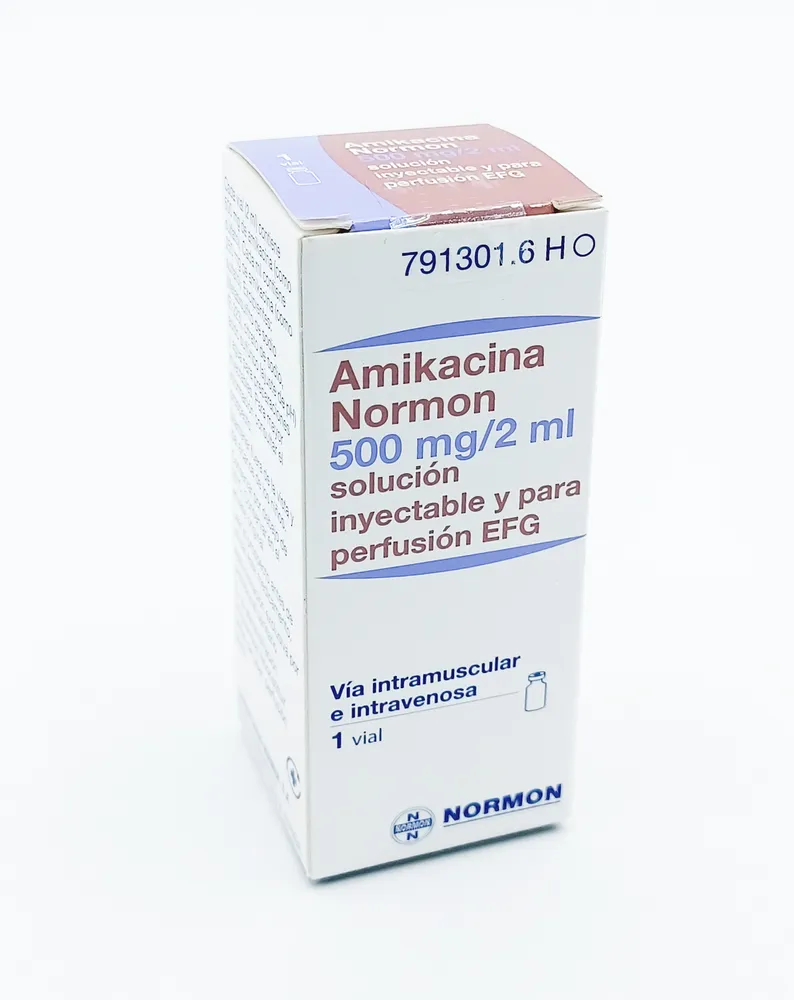
Table of Contents
Package leaflet: Information for the user
Introduction
PACKAGE LEAFLET: INFORMATION FOR THE USER
Amikacin Normon 500 mg / 2 ml solution for injection and infusion EFG
Amikacin
Read the entire leaflet carefully before you start using this medicine because it contains important information for you.
- Keep this leaflet as you may need to read it again.
- If you have any questions, ask your doctor or pharmacist.
- This medicine has been prescribed for you and must not be given to other people, even if they have the same symptoms, as it may harm them.
- If you experience any adverse reactions, consult your doctor, pharmacist, or nurse, even if they are adverse reactions not listed in this leaflet. See section 4.
Leaflet contents:
- What Amikacin Normon is and what it is used for
- What you need to know before using Amikacin Normon
- How to use Amikacin Normon
- Possible adverse effects
- How to store Amikacin Normon
- Contents of the pack and other information
1. What Amikacina Normon is and what it is used for
Amikacina Normon is an antibiotic belonging to the aminoglycoside group, which works by eliminating bacteria (germs) that cause infections.
Antibiotics are used to treat bacterial infections and are not effective against viral infections such as influenza or the common cold. It is important that you follow your doctor's instructions regarding dosage, administration, and duration of treatment. Do not store or reuse this medicine. If you have leftover antibiotics after completing the treatment, return them to the pharmacy for proper disposal. Medicines must not be disposed of via the sink or in household waste. |
It is indicated in the treatment of the following severe, short-duration infections:
- Severe systemic infection, known as sepsis (including neonatal sepsis).
- Severe respiratory tract infections.
- Central nervous system infections (including meningitis).
- Intra-abdominal infections (including peritonitis).
- Skin, bone, soft tissue, and joint infections.
- Infections in burn patients.
- Infections occurring after surgery (including post-vascular surgery).
- Complicated and recurrent urinary tract infections that cannot be treated with less toxic antibiotics.
2. What you need to know before using Amikacina Normon
Do not use Amikacina Normon
- If you are allergic (hypersensitive) to amikacin or to any of the other ingredients of this medicine (listed in section 6).
- If you have ever had a severe allergic reaction (hypersensitivity) to any other type of aminoglycoside antibiotic.
Warnings and precautions
Talk to your doctor or pharmacist before using Amikacina Normon.
-
If you or members of your family have a mitochondrial mutation disease (a genetic disorder) or hearing loss caused by antibiotics, you are advised to inform your doctor or pharmacist before taking an aminoglycoside; certain mitochondrial mutations may increase your risk of hearing loss with this medicine. Your doctor may recommend genetic testing before administering Amikacina Normon.
-
If you use this medicine, you will be subject to special monitoring due to possible toxicity affecting the ears and kidneys.
-
If you suffer from severe muscle disorders such as myasthenia gravis or Parkinson's disease, as this may increase muscle weakness.
-
If you have renal impairment or develop symptoms of kidney problems during treatment, blood and urine tests will be performed to adjust the dose or discontinue treatment.
-
If you have heart disease or other conditions for which you are taking medications that cause fluid retention (medications known as diuretics such as ethacrynic acid or furosemide).
-
If symptoms of ototoxicity occur, such as dizziness, vertigo, tinnitus (ringing in the ears), or hearing loss.
-
You should remain well hydrated to prevent or minimize kidney damage caused by this medicine.
If you require blood or urine tests, amikacin may alter test values for: blood urea nitrogen, transaminases, alkaline phosphatase, bilirubin, creatinine, lactate dehydrogenase, sodium, potassium, magnesium, and calcium.
Children and adolescents
Aminoglycosides should be used with caution in premature infants (born prematurely) and neonates (up to 4 weeks of age) because their kidneys are not fully developed. See section 3 "How to use Amikacina Normon" below for dosing recommendations.
Other medicines and Amikacina Normon
Inform your doctor or pharmacist if you are taking, have recently taken, or might need to take any other medicines, including those obtained without a prescription.
Administration of amikacin is not recommended with the following medicines:
- Anesthetics such as ether, chloroform, and medications used in general anesthesia.
- Amphotericin B, a medicine used for fungal infections.
- Muscle relaxants such as tubocurarine and pancuronium, used as relaxants in anesthesia.
- Antibiotics used to treat bacterial infections, such as colistin, polymyxin, piperacillin, clindamycin, and cephalothin.
- Cisplatin, a medicine used in cancer treatment.
- Clodronic acid, a medicine used to treat bone diseases.
- Loop diuretics such as ethacrynic acid and furosemide, medicines used to treat edema and high blood pressure.
- Indomethacin, a non-steroidal anti-inflammatory drug (NSAID), used for pain and inflammation.
You may need additional monitoring to assess kidney function while taking amikacin, as these medicines may increase the toxicity of amikacin.
Pregnancy and breastfeeding
If you are pregnant or breastfeeding, think you may be pregnant, or are planning to become pregnant, consult your doctor or pharmacist before using this medicine.
Treatment during pregnancy is not recommended, although your doctor will assess whether its use is necessary. If the medicine is used during pregnancy, or if a patient becomes pregnant while on treatment, she should be informed of the potential risks.
There are no data on excretion in breast milk. As a general rule, women receiving amikacin are advised to discontinue breastfeeding due to the potential for adverse reactions in the infant.
Driving and using machines
There are no data regarding the effect of Amikacina Normon on the ability to drive or use machines. However, if you experience adverse reactions such as dizziness, vertigo, etc., your ability to drive or operate machinery may be impaired. If this occurs, do not drive or operate any tools or machinery.
Amikacina Normon contains sodium metabisulfite and sodium
This medicine may cause severe allergic reactions and bronchospasm (sudden sensation of suffocation) because it contains metabisulfite (E-223).
This medicine contains less than 23 mg (1 mmol) of sodium per dose and is therefore considered essentially “sodium-free”.
3. How to use Amikacina Normon
Follow exactly the instructions for use provided in this leaflet or those given by your doctor or pharmacist. If in doubt, consult your doctor or pharmacist again. Remember to take your medicine. Your doctor will tell you how long your amikacin treatment should last. Do not stop treatment early. If you think the effect of this medicine is too strong or too weak, inform your doctor or pharmacist.
Your doctor will determine the most appropriate dose for you based on your age, body weight, general condition, severity of the infection, and kidney function.
Your doctor will assess your renal function and should monitor kidney function throughout treatment.
Administration must be performed exclusively by a healthcare professional. It may be administered by intramuscular or intravenous route (exclusively by slow intravenous infusion).
Maximum concentrations (30–90 minutes after injection) exceeding 35 µg/ml and minimum concentrations (just before the next dose) exceeding 10 µg/ml should be avoided.
If you use more Amikacina Normon than you should
In case of overdose or accidental ingestion, contact your doctor or pharmacist immediately or call the Toxicology Information Service at telephone number 91 562 04 20, indicating the medicine and the amount ingested.
If you forget to use Amikacina Normon
If you forget to take a dose, take it as soon as you remember. However, if it is almost time for your next dose, skip the missed dose. Do not take a double dose to make up for a missed one.
4. Possible adverse effects
Like all medicines, Amikacina Normon may cause adverse effects, although not everyone will experience them. Amikacina Normon potentially carries a risk of ototoxicity (ear toxicity), nephrotoxicity (kidney toxicity), and neuromuscular blockade. These reactions occur more frequently in patients previously treated with medications that cause ear or kidney toxicity, and in patients treated for prolonged periods and/or with doses exceeding the recommended levels.
These reactions are dose-dependent and related to the frequency and duration of treatment. Symptoms may appear during treatment or after treatment has ended.
If you experience any of the following effects, inform your doctor as soon as possible:
Very common (may affect more than 1 in 10 people):
- Neurological toxicity affecting the ears and muscular paralysis.
- Kidney toxicity.
- Hearing loss and loss of balance.
- Drug-induced fever.
Uncommon (may affect up to 1 in 100 people):
- Nausea, vomiting.
- Headache, tremors.
- Skin rash.
- Permanent retinal infarction with vision loss when amikacin is administered by intravitreal route (injection into the eye).
- Paresthesias, muscle and joint pain.
Rare (may affect up to 1 in 1000 people):
- Decreased blood pressure.
- Low levels of magnesium in the blood.
- Anemia (reduction in red blood cells) or eosinophilia (increase in white blood cells in the blood).
If any of these reactions occur, or any other reaction not described in this leaflet, consult your doctor or pharmacist.
Reporting of adverse effects:
If you experience any type of adverse effect, consult your doctor, pharmacist, or nurse, even if it is a possible adverse effect not listed in this leaflet. You may also report them directly via the Spanish Pharmacovigilance System for Human Medicinal Products: https://www.notificaram.es. By reporting adverse effects, you can help provide more information on the safety of this medicine.
5. Storage of Amikacin Normon
Store below 25°C. Keep in the original container.
Keep this medicine out of the sight and reach of children.
Do not use this medicine after the expiry date stated on the container after EXP. The expiry date refers to the last day of the month indicated.
Medicines must not be disposed of via wastewater or household waste. Dispose of unused medicines and their containers at the SIGRE collection point at your pharmacy. If you are unsure, ask your pharmacist how to dispose of medicines and containers you no longer need. This will help protect the environment.
6. Package contents and additional information
Composition of Amikacina Normon
- The active substance is amikacin (as sulfate). Each vial (2 ml) contains 500 mg of amikacin (as sulfate). Each ml contains 250 mg of amikacin (as sulfate).
- The other components (excipients) are: sodium metabisulfite (E-223), sodium citrate, sulfuric acid (pH adjuster) and water for injections.
Presentation of the product and contents of the container
Amikacina Normon is presented in type I glass vials closed with a butyl rubber stopper and sealed with an aluminum cap. Clear injectable solution in 2 ml vials.
Unit packs contain 1 vial and clinical packs contain 50 vials.
Marketing Authorization Holder and Manufacturer
LABORATORIOS NORMON, S.A.
Ronda de Valdecarrizo, 6
28760 Tres Cantos, Madrid
Spain
Date of latest revision of this leaflet: June 2023
Detailed and up-to-date information on this medicinal product is available on the website of the Spanish Agency of Medicines and Health Products (AEMPS) http://www.aemps.gob.es/
This information is intended exclusively for healthcare professionals
It is administered by intramuscular and intravenous routes (exclusively by slow intravenous infusion over 30–60 minutes).
The solution should be visually inspected for possible presence of particles and/or discoloration prior to administration, whenever the solution and container permit. It must be reconstituted before use.
For intravenous administration (exclusively by intravenous infusion), the vial must be reconstituted. The solution is prepared by adding the required dose to 100 ml or 200 ml of sterile diluent, such as saline solution or 5% glucose in water, or another compatible solution. The reconstituted solution is a clear, colorless solution. Occasionally, the solution may have a pale yellow color, which does not indicate any deterioration of the medicinal product.
Chemical and physical in-use stability of amikacin solutions at concentrations of 0.25 mg/ml and 5 mg/ml in 0.9% sodium chloride or at 0.25 mg/ml in Ringer's lactate solution has been demonstrated for 24 hours when stored below 25°C.
From a microbiological standpoint, the diluted product should be used immediately. If not used immediately, the storage conditions and duration prior to administration are the user's responsibility and should normally not exceed 24 hours below 25°C.
Amikacin must not be physically mixed with other medicinal products, but may be administered independently according to the recommended dose and route.
Administration in adults and children over 12 years of age:
The recommended intramuscular or intravenous (slow intravenous infusion) dose for adults is 15 mg/kg/day, divided into 2 or 3 equal doses administered at equal intervals, i.e., 7.5 mg/kg every 12 hours or 5 mg/kg every 8 hours. Treatment in patients with high body mass should not exceed 1.5 grams/day.
Single daily dose
In patients with normal renal function, as reflected by a creatinine clearance ≥ 50 ml/min, a single daily intravenous dose (slow intravenous infusion) of 15 mg/kg/day may be administered in adults for the treatment of bacteremia, sepsis, respiratory tract infections, complicated urinary tract infections, intra-abdominal infections, and febrile neutropenia. There is insufficient information on the use of a single daily dose in patients with impairment of other organs or systems.
Administration of normal doses at prolonged intervals between doses:
If creatinine clearance is not available and the patient's condition is stable, the dosing interval for a normal dose (the same as would be administered to patients with normal renal function, i.e., 7.5 mg/kg twice daily) can be calculated by multiplying the patient's serum creatinine value by 9. For example, if the patient has a serum creatinine concentration of 2 mg/100 ml, the recommended single dose (7.5 mg/kg) should be administered every 18 hours.
Patients with impaired renal function
Administration of reduced doses at fixed time intervals between doses:
When renal function is impaired and it is appropriate to administer this medicinal product at fixed time intervals, the dose should be reduced.
First, treatment is initiated by administering a standard loading dose of 7.5 mg/kg. This dose is the same as that given to patients with normal renal function. To determine the maintenance doses administered every 12 hours, the loading dose should be reduced in proportion to the reduction in the patient's creatinine clearance rate.
In patients with renal insufficiency demonstrated by a creatinine clearance < 50 ml/min, administration of the total daily dose as a single dose is not recommended, as patients would be exposed to high serum concentrations. In patients with renal insufficiency receiving doses two or three times daily, serum concentrations of amikacin should be monitored using appropriate analytical methods. Doses may be adjusted either by administering normal doses at prolonged intervals or by administering reduced doses at fixed intervals.
Administration in patients over 65 years of age:
The recommended dose, intramuscular or intravenous, is 15 mg/kg/day, divided into 2 or 3 equal doses administered at equal intervals, i.e., 7.5 mg/kg every 12 hours or 5 mg/kg every 8 hours (see section 4.4).
Paediatric population
Administration in children under 12 years of age:
The recommended intramuscular or intravenous (slow intravenous infusion) dose in children is 15 mg/kg/day, which may be administered as: 15 mg/kg once daily; 7.5 mg/kg twice daily; or 5 mg/kg three times daily.
Administration in infants and newborns:
The recommended dose in premature infants is 7.5 mg/kg every 12 hours. In newborns, a loading dose of 10 mg/kg should be administered, followed by 7.5 mg/kg every 12 hours. Children older than 2 weeks should receive 7.5 mg/kg every 12 hours or 5 mg/kg every 8 hours.
Care must be taken to calculate exact doses, and when necessary, the reconstituted solution of 50 mg/ml should be further diluted to allow administration in premature neonates.
Single daily dose: A single daily intravenous dose of 20 mg/kg/day may be administered in children aged 4 weeks or older for the treatment of bacteremia, sepsis, respiratory tract infections, complicated urinary tract infections, intra-abdominal infections, and febrile neutropenia.