Ambroxol Cinfa 3 mg/ml syrup EFG
Spain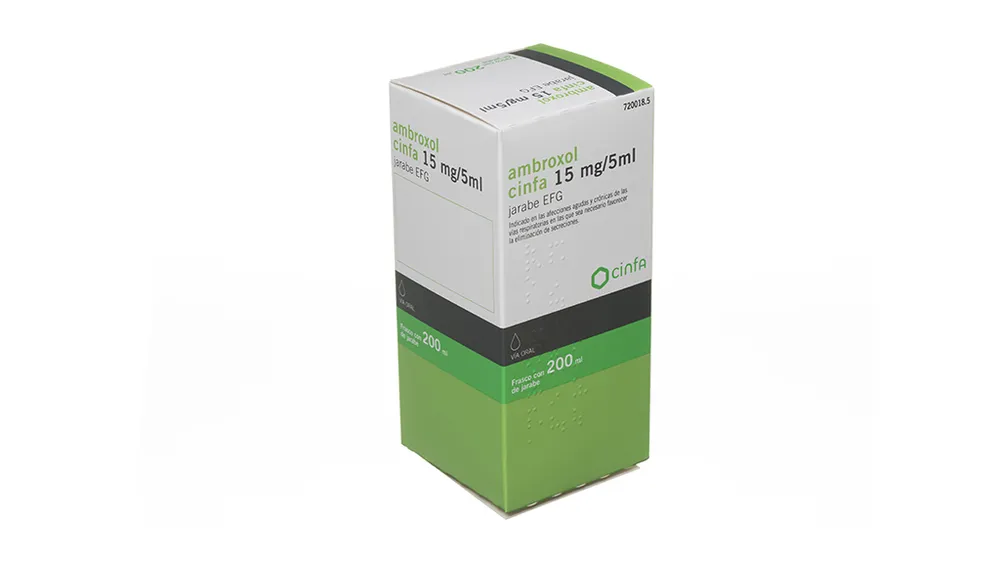
Table of Contents
Package leaflet: Information for the user
Introduction
Package leaflet: information for the user
ambroxol cinfa 3 mg/ml syrup EFG
Ambroxol Hydrochloride
Read the entire leaflet carefully before you start taking this medicine, because it contains important information for you.
Follow exactly the instructions for administration of this medicine provided in this leaflet or as directed by your doctor or pharmacist.
- Keep this leaflet as you may need to read it again.
- If you need advice or more information, consult your pharmacist.
- If you experience any adverse effects, consult your doctor or pharmacist, even if they are adverse effects not listed in this leaflet. See section 4.
- You should consult a doctor if your condition worsens or if you do not improve after 5 days.
Contents of the leaflet
- What ambroxol cinfa is and what it is used for
- What you need to know before taking ambroxol cinfa
- How to take ambroxol cinfa
- Possible adverse effects
- How to store ambroxol cinfa
- Contents of the pack and other information
1. What ambroxol cinfa is and what it is used for
Ambroxol, the active substance in this medicine, belongs to a group of medicines called mucolytics, which work by reducing the viscosity of mucus, liquefying it and facilitating its elimination.
This medicine is indicated to help eliminate excess mucus and phlegm in colds and flu, in children aged 2 to 12 years.
You should consult a doctor if symptoms worsen or do not improve after 5 days.
2. What you need to know before starting ambroxol cinfa
Do not take ambroxol cinfa
- If you are allergic to ambroxol hydrochloride or any of the other ingredients of this medicine listed in section 6.
- In children under 2 years of age.
Warnings and precautions
Consult your doctor or pharmacist before starting to take ambroxol.
- If you have kidney or liver function problems, consult your doctor before using this medicine.
- Serious skin reactions associated with ambroxol hydrochloride administration have been reported. If you develop a skin rash (including lesions of mucous membranes such as in the mouth, throat, nose, eyes, and genitals), stop using ambroxol and consult your doctor immediately.
Children
- Ambroxol is contraindicated in children under 2 years of age.
- For children aged 2 to 5 years, consult a doctor.
Other medicines and ambroxol cinfa
Inform your doctor or pharmacist if you are taking, have recently taken, or might need to take any other medicines.
Taking ambroxol cinfa with food and drink
Ambroxol can be taken with or without food.
Pregnancy, breastfeeding, and fertility
If you are pregnant or breastfeeding, think you may be pregnant, or are planning to become pregnant, consult your doctor or pharmacist before using this medicine.
No harmful effects have been observed during pregnancy. However, usual precautions regarding the use of medicines during pregnancy should be followed. The use of ambroxol is not recommended, especially during the first trimester of pregnancy.
The active substance in this medicine, ambroxol, may pass into breast milk. Although harmful effects in the nursing infant are not expected, use during breastfeeding should be avoided.
Animal studies do not indicate any direct or indirect adverse effects on fertility.
Driving and using machines
No effects on the ability to drive or operate machinery have been observed.
ambroxol cinfa contains sorbitol (E-420).
This medicine contains 450.1 mg of sorbitol per ml.
ambroxol cinfa contains benzoic acid (E-210).
This medicine contains 2 mg of benzoic acid per ml.
Benzoic acid may increase the risk of jaundice (yellowing of the skin and eyes) in newborns (up to 4 weeks of age).
ambroxol cinfa contains propylene glycol (E-1520).
This medicine contains 30.030 mg of propylene glycol per ml.
If the infant is less than 4 weeks old, consult your doctor or pharmacist, especially if the infant has been given other medicines containing propylene glycol or alcohol.
ambroxol cinfa contains sodium.
This medicine contains less than 1 mmol of sodium (23 mg) per ml; essentially "sodium-free".
ambroxol cinfa contains glucose.
If your doctor has diagnosed you with an intolerance to certain sugars, consult with him before taking this medicine. It may cause dental caries.
ambroxol cinfa contains benzyl alcohol (E-1519).
This medicine contains 0.023 mg of benzyl alcohol per ml.
Benzyl alcohol may cause allergic reactions. Consult your doctor or pharmacist if you are pregnant or breastfeeding.
This is because large amounts of benzyl alcohol may accumulate in your body and cause adverse effects (metabolic acidosis).
Consult your doctor or pharmacist if you have liver or kidney disease. This is because large amounts of benzyl alcohol may accumulate in the body and cause adverse effects (metabolic acidosis).
Benzyl alcohol has been associated with a risk of serious adverse effects, including breathing problems ("gasping syndrome"), in children.
Do not administer this medicine to your newborn (up to 4 weeks of age) unless advised by your doctor. This medicine should not be used for longer than one week in children under 3 years of age unless directed by your doctor or pharmacist.
3. How to take ambroxol cinfa
Follow exactly the dosing instructions for this medicine provided in this leaflet or as directed by your doctor or pharmacist. If in doubt, consult your doctor or pharmacist.
The recommended dose is:
Use in children
Children aged 6 to 12 years: 1 measuring spoonful of 5 ml, 2–3 times daily (every 8–12 hours, as needed), corresponding to a maximum daily dose of 45 mg of ambroxol hydrochloride. After 2–3 days, once the patient has improved, the dosing regimen may be reduced to twice daily every 12 hours.
Children aged 2 to 5 years: 1 measuring spoonful of 2.5 ml, 3 times daily (every 8 hours), corresponding to a maximum daily dose of 22.5 mg of ambroxol hydrochloride. After 2–3 days, once the patient has improved, the dosing regimen may be reduced to twice daily every 12 hours. Medical advice should be sought for this age group.
Children under 2 years: This medicine is contraindicated in children under 2 years of age.
How to take:
This medicine is for oral use. Measure the required amount of medicine using the dosing device provided in the package. It is recommended to drink a glass of water after each dose and to maintain adequate fluid intake throughout the day.
Consult a doctor if symptoms worsen or do not improve after 5 days of treatment (3 days in children under 6 years of age).
If you take more ambroxol cinfa than you should
If you have taken more ambroxol than recommended, you may experience nausea, altered taste sensation, numbness in the pharynx, numbness in the mouth, or any other adverse reaction described in section 4, Possible side effects.
In case of overdose or accidental ingestion, contact your doctor or pharmacist immediately, or call the Toxicology Information Service at telephone number 91 562 04 20, indicating the medicine and the amount ingested.
In the event of accidental massive ingestion, symptomatic treatment is recommended.
4. Possible adverse effects
Like all medicines, this medicine can cause adverse effects, although not everyone experiences them.
The following adverse effects may occur:
Frequent (may affect up to 1 in 10 people): nausea, altered taste sensation, numbness of the pharynx, and numbness of the mouth.
Uncommon (may affect up to 1 in 100 people): vomiting, diarrhoea, indigestion, abdominal pain, and dry mouth.
Rare (may affect up to 1 in 1,000 people): hypersensitivity reactions, rash, urticaria, and dry throat.
Frequency not known (cannot be estimated from available data): anaphylactic reactions such as anaphylactic shock, angioedema (rapidly progressive swelling of the skin, subcutaneous tissues, mucous membranes, or submucosal tissues), and pruritus. Serious skin reactions (such as erythema multiforme, Stevens-Johnson syndrome / toxic epidermal necrolysis, and acute generalized exanthematous pustulosis).
Reporting of adverse effects
If you experience any type of adverse effect, consult your doctor or pharmacist, even if it is a possible adverse effect not listed in this leaflet. You may also report them directly through the Spanish Pharmacovigilance System for Human Medicines: http;//www.notificaram.es. By reporting adverse effects, you can help provide more information on the safety of this medicine.
5. Storage of ambroxol cinfa
Keep this medicine out of sight and reach of children.
Do not store above 30 °C.
Do not use this medicine after the expiry date stated on the packaging after EXP. The expiry date refers to the last day of the month indicated.
Medicines should not be disposed of via wastewater drains or household waste. Dispose of unused containers and medicines at the Sigre Point located at your pharmacy. If you have any doubts, ask your pharmacist how to properly dispose of containers and unused medicines. This will help protect the environment.
6. Contents of the pack and other information
Composition of ambroxol cinfa
-
The active substance is ambroxol hydrochloride. Each ml of syrup contains 3 mg of ambroxol hydrochloride.
-
The other components are: raspberry flavour (containing glucose syrup, propylene glycol (E-1520) and benzyl alcohol (E-1519)), citric acid monohydrate, glycerol (E-422), hydroxyethylcellulose, benzoic acid (E-210), propylene glycol (E-1520), non-crystallizable liquid sorbitol (E-420), sodium saccharin and purified water.
Appearance of the product and contents of the pack
ambroxol cinfa is a syrup presented as a colourless or slightly yellowish transparent solution.
The medicine is available in:
-
Amber glass bottle type III, fitted with an aluminium cylindrical cap.
-
Amber polyethylene terephthalate (PET) bottle fitted with a polypropylene cap, accompanied by a dosing cup adapted to the bottle.
Each pack contains one bottle with 200 ml of syrup and is supplied with a dosing cup graduated from 2.5 ml to 15 ml.
Marketing Authorisation Holder and Manufacturer
Laboratorios Cinfa, S.A.
Carretera Olaz-Chipi, 10. Polígono Industrial Areta
31620 Huarte (Navarra) - Spain
Date of the most recent revision of this leaflet: April 2022
Detailed information on this medicine is available on the website of the Spanish Agency for Medicines and Health Products (Agencia Española de Medicamentos y Productos Sanitarios - AEMPS) http://www.aemps.gob.es/
You can access detailed and up-to-date information about this medicine by scanning with your mobile phone (smartphone) the QR code included in the package leaflet and outer packaging. You can also access this information at the following internet address: https://cima.aemps.es/cima/dochtml/p/63626/P_63626.html
QR code link: https://cima.aemps.es/cima/dochtml/p/63626/P_63626.html