Ambisome liposomal 50 mg powder for dispersion for infusion
Spain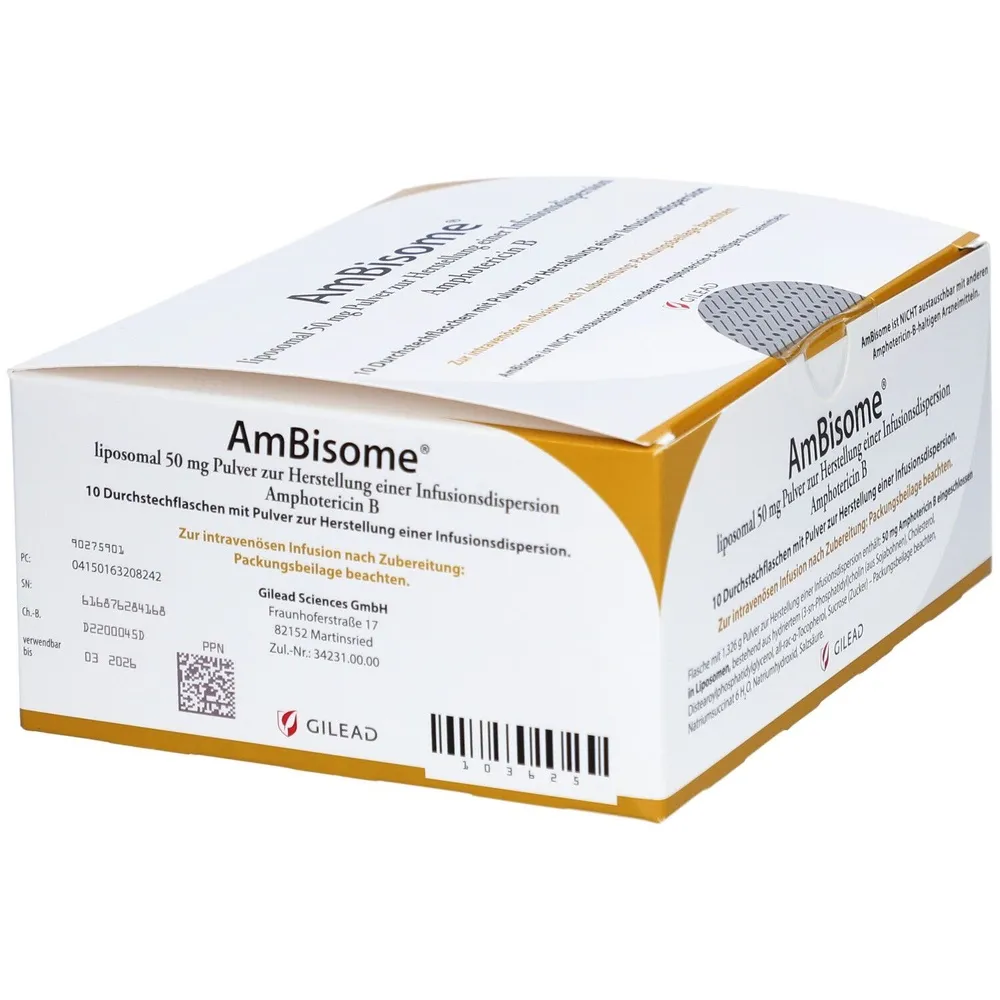
Table of Contents
- Package leaflet: Information for the user
- Introduction
- 1. What AmBisome liposomal is and what it is used for
- 2. What you need to know before using AmBisome liposomal
- 3. How to use AmBisome liposomal
- 4. Possible adverse effects
- 5. Storage of AmBisome liposomal
- 6. Package Contents and Additional Information
Package leaflet: Information for the user
Introduction
Package leaflet: Information for the user
AmBisome liposomal 50 mg powder for dispersion for infusion
Amphotericin B (in liposomes)
Read the entire leaflet carefully before you are given this medicine because it contains important information for you.
- Keep this leaflet as you may need to read it again.
- If you have any questions, ask your doctor.
- If you experience any side effects, consult your doctor, even if they are side effects not listed in this leaflet. See section 4.
Leaflet contents:
- What AmBisome liposomal is and what it is used for
- What you need to know before receiving AmBisome liposomal
- How to use AmBisome liposomal
- Possible side effects
- How to store AmBisome liposomal
Pack contents and other information
1. What AmBisome liposomal is and what it is used for
Amphotericin B is an antifungal agent used to treat serious fungal infections. This medicine is indicated for:
-
Treatment of serious systemic fungal infections.
-
Treatment of suspected fungal infections in patients with severe neutropenia (patients with a low number of a type of white blood cells called "neutrophils"), resulting from blood disorders or the use of cytotoxic or immunosuppressive drugs.
-
Treatment of visceral Leishmaniasis, a disease caused by a parasite.
2. What you need to know before using AmBisome liposomal
Do not use AmBisome liposomal
- If you are allergic (hypersensitive) to amphotericin B or to any of the other components of this medicine listed in section 6.
Warnings and precautions
Talk to your doctor before starting to use this medicine.
-
- If you have previously experienced a severe anaphylactoid/anaphylactic reaction to this medicine (an immediate, potentially life-threatening allergic reaction with symptoms such as flushing, itching, dizziness, swelling of the face, mouth, tongue, and airway, often severe enough to cause difficulty breathing).
If this occurs, your doctor will stop the treatment.
- If you experience other reactions thought to be related to the infusion. If this happens, your doctor may reduce the infusion rate so that you receive this medicine over a longer period of time (approximately 2 hours). Your doctor may also give you medications such as diphenhydramine (an antihistamine), paracetamol, meperidine (an analgesic), and/or hydrocortisone (an anti-inflammatory drug that works by reducing your immune system's response) to prevent or treat infusion-related reactions.
- If you are taking other medicines that may cause kidney damage, see section "Other medicines and AmBisome." AmBisome can damage the kidneys. Your doctor or nurse will take blood samples to measure your creatinine (a chemical in the blood that reflects kidney function) and levels of electrolytes (especially potassium and magnesium) before and during treatment with AmBisome, as both may be abnormal if there are changes in kidney function. This is especially important if you have had previous kidney injury or if you are taking other medicines that may affect your kidney function. Blood samples will also be tested for changes in liver function and your body's ability to produce new blood cells and platelets. If blood tests show changes in kidney function or other significant changes, your doctor may give you a lower dose of AmBisome or interrupt treatment.
- If blood tests show that your potassium levels are low. If this occurs, your doctor may prescribe a potassium supplement for you to take during treatment with AmBisome.
- If blood tests show that your potassium levels are high, you may experience irregular heartbeats, sometimes serious.
- If your blood test results show changes in kidney function or other significant changes. If this occurs, your doctor may give you a lower dose of the medicine or stop treatment.
- If you are receiving or have recently received a leukocyte (white blood cell) transfusion. Since sudden and serious lung problems may occur, your doctor will advise separating the infusions by as much time as possible to reduce the risk of pulmonary problems and will monitor your lung function.
- If you are undergoing hemodialysis or filtration for kidney failure. Your doctor may start treatment with this medicine once the procedure is completed.
- Interference with blood test results for phosphate levels when a specific system called the PHOSm assay is used, potentially leading to false readings showing increased blood phosphate levels.
If your test results show high phosphate levels, additional testing using a different system may be needed to confirm the results.
- If you have diabetes. This medicine contains approximately 900 milligrams of sucrose (sugar) per vial.
Other medicines and AmBisome liposomal. Use of other medicines
Tell your doctor if you are using or have recently used, or might need to use, any other medicines.
The following medicines interact with amphotericin B and may interact with this medicine.
-
Medicines that may be harmful to the kidneys, including:
-
Immunosuppressants (medicines that reduce the activity of the body's natural defenses) such as cyclosporine.
-
Antibiotics (medicines used to treat bacterial infections) in the group known as aminoglycosides, including gentamicin, neomycin, and streptomycin.
-
Pentamidine, a medicine used to treat pneumonia in patients with AIDS and leishmaniasis.
These medicines can damage the kidneys, and AmBisome liposomal may worsen the kidney damage caused by these medicines. If you are taking medicines that may damage the kidneys, your doctor or nurse will periodically take blood samples to monitor changes in kidney function.
-
Medicines that may reduce your potassium levels, including:
-
Corticosteroids (anti-inflammatory medicines that work by reducing your immune system's response) and corticotropin (ACTH), used to control the body's natural corticoid production rate in response to stress.
-
Diuretics (medicines that increase the volume of urine produced), for example, furosemide.
-
Digitalis glycosides, medicines derived from the digitalis plant, used to treat heart failure. This medicine may lower potassium levels in the blood, thereby worsening the side effects of digitalis (heart rhythm disturbances).
-
Muscle relaxants (e.g., tubocurarine). This medicine may enhance the muscle-relaxing effect.
-
Other medicines
-
Antifungals (medicines used to treat fungal infections), such as flucytosine. This medicine may worsen the side effects of flucytosine (changes in the body's ability to produce new blood cells, reflected in blood tests).
-
Antineoplastic drugs (anticancer drugs), such as methotrexate, doxorubicin, carmustine, and cyclophosphamide. Using these types of medicines during the infusion of this medicine may cause kidney damage, wheezing or breathing difficulties, and low blood pressure.
-
Leukocyte (white blood cell) transfusions. Sudden and serious lung problems have been reported in patients treated with amphotericin B. See also, Take special care with AmBisome liposomal
Pregnancy and breastfeeding
If you are pregnant or breastfeeding, think you may be pregnant, or plan to become pregnant, consult your doctor before using this medicine.
The safety of this medicine in pregnant women is unknown. If you are pregnant, your doctor will prescribe this medicine only if the benefits of treatment are considered to outweigh the potential risks to you and your child.
It is unknown whether this medicine passes into breast milk. While receiving this medicine, consider the potential risk to the infant as well as the benefits of breastfeeding for the infant and the benefits of treatment with AmBisome liposomal for the mother.
Driving and use of machines
Some of the adverse effects of this medicine may affect your ability to drive or operate machinery safely (see section 4 for possible side effects).
AmBisome liposomal contains sodium
This medicine contains less than 23 mg (1 mmol) of sodium per dose and is therefore considered essentially "sodium-free."
3. How to use AmBisome liposomal
This medicine will be administered to you personally by your doctor or nurse.
If you are a patient undergoing dialysis, your doctor should start administering this medicine at the end of each dialysis session (see section Take special care with AmBisome liposomal).
Your doctor will determine the dose of this medicine you should receive, based on your individual needs. It is given by intravenous infusion over a period of 30 to 60 minutes, once daily.
The recommended dose of AmBisome liposomal is:
- 1–3 mg/kg body weight per day for the treatment of confirmed or suspected fungal infections. This dose may be increased to 5 mg/kg body weight per day if the infection is very severe.
- For mucormycosis, the initial dose is generally 5 mg/kg body weight per day. Your doctor will assess the appropriate dose, and the duration of treatment will be determined individually by your doctor. Treatment should continue until signs and symptoms of infection have disappeared.
- 1 to 1.5 mg/kg body weight per day for 21 days, or 3 mg/kg body weight per day for 10 days, for the treatment of visceral leishmaniasis.
If you have visceral leishmaniasis, you will receive this medicine for either 10 or 21 days. If the infection recurs, you may require additional, shorter or longer-term treatment to control the infection (also known as maintenance therapy).
If you use more AmBisome liposomal than you should
Inform your doctor or nurse immediately if you think you have been given too much AmBisome liposomal.
Inform your doctor or nurse immediately if you experience any of the adverse effects listed in section 4 of this leaflet, as some of these may occur if you receive too much AmBisome liposomal. If you have received too much AmBisome liposomal, your doctor will closely monitor you and, if necessary, provide treatment for overdose symptoms.
In case of overdose or accidental ingestion, contact your doctor or pharmacist immediately or call the Toxicology Information Service at telephone number (91) 562 04 20, indicating the medicine and the amount ingested.
If you forget to use AmBisome liposomal
Your doctor will decide whether you need an additional dose of this medicine if a dose has been missed.
If you stop using AmBisome liposomal
Your doctor will determine the duration of your treatment with this medicine according to your individual needs. Do not stop treatment with this medicine, even if you feel better, until your doctor decides it is appropriate, as your illness may persist if you do not complete the full course of treatment.
4. Possible adverse effects
Like all medicines, AmBisome liposomal can cause adverse effects, although not everyone will experience them.
The most common infusion-related reactions expected are fever, chills, and shivering. Other less common infusion-related reactions may include chest tightness, chest pain, shortness of breath, difficulty breathing (possibly with wheezing), flushing, faster than normal heart rate, low blood pressure, and musculoskeletal pain (described as joint pain, back pain, or bone pain). All of these usually resolve quickly when the infusion is stopped. These reactions do not necessarily occur with subsequent infusions of AmBisome liposomal, or may be avoided by reducing the infusion rate (over 2 hours). Your doctor may give you other medicines to prevent infusion-related reactions or to treat symptoms if they occur. If you experience a serious infusion-related reaction, your doctor will stop the AmBisome liposomal infusion and you should not receive this treatment in the future.
The following adverse effects have been observed during treatment with AmBisome liposomal:
Very common: may affect more than 1 in 10 people:
- Feeling tired, confused, weak, or muscle cramps due to low blood potassium levels.
- Dizziness or nausea.
- Fever, chills or shivering, stiffness.
Common: may affect up to 1 in 10 people:
- Feeling tired, confused, weak, or muscle cramps due to low blood magnesium, calcium, or sodium levels.
- Increased blood sugar levels.
- Headache.
- Faster than normal heart rate.
- Blood vessel dilation, low blood pressure, and flushing (redness of the skin).
- Shortness of breath.
- Diarrhea, abdominal pain.
- Abnormal liver or kidney function test results observed in blood or urine tests.
- Skin rash.
- Chest or back pain.
- High blood potassium levels.
Uncommon: may affect up to 1 in 100 people:
- Bleeding into the skin, bruising without known cause, or prolonged bleeding after an injury.
- Anaphylactoid reaction (for information on anaphylactoid reactions, see section 2 of this leaflet).
- Seizures (fits or convulsions).
- Difficulty breathing, possibly with wheezing (whistling sounds).
In addition, the following adverse effects have been observed during treatment with AmBisome liposomal, but their frequency is unknown.
- Anaemia (reduction in the number of red blood cells in the blood, with symptoms of excessive tiredness, shortness of breath after mild activity, and paleness).
- Anaphylactic and hypersensitivity reactions (for information on anaphylactic reactions, see section 2 of this leaflet).
- Heart attacks (infarction) and disturbances in the normal heart rhythm.
- Kidney failure and decreased kidney function.
- Severe swelling of the skin around the lips, eyes, or tongue.
- Muscle breakdown.
- Bone pain and joint pain.
If you consider any of the adverse effects you experience to be severe, or if you notice any adverse effects not listed in this leaflet, inform your doctor.
Reporting of adverse effects
If you experience any type of adverse effect, talk to your doctor, pharmacist, or nurse, even if it is a possible adverse effect not listed in this leaflet. You can also
report them directly via the Spanish Pharmacovigilance System for Human Medicines:
www.notificaRAM.es
By reporting adverse effects, you can help provide more information on the safety of this medicine.
5. Storage of AmBisome liposomal
Keep this medicine out of the sight and reach of children.
Do not use this medicine after the expiry date stated on the container after EXP. The expiry date refers to the last day of the month.
Do not store above 25°C.
Any reconstituted or diluted solution of AmBisome liposomal not used immediately should be discarded.
Shelf life of AmBisome liposomal before opening the vial
3 years.
Shelf life of AmBisome liposomal after opening the vial
The following in-use chemical and physical stability data have been demonstrated:
- In-use chemical and physical stability after reconstitution with water for injections:
Glass vials for 24 hours at 25±2°C exposed to ambient light.
Glass vials and polypropylene syringes for up to 7 days at 2–8°C. Do not freeze.
- In-use chemical and physical stability after dilution with glucose:
Infusion bags: See Table for recommendations.
Diluent | Dilution (V/V) | Concentration of Amphotericin B mg/ml | Maximum storage duration at 2-8°C (do not freeze) | Maximum storage duration at 25±2°C |
5% Glucose | 1 in 2 | 2.0 | 7 days | 72 hours |
1 in 8 | 0.5 | 7 days | 72 hours | |
1 in 20 | 0.2 | 4 days | 24 hours | |
10% Glucose | 1 in 2 | 2.0 | 48 hours | 72 hours |
20% Glucose | 1 in 2 | 2.0 | 48 hours | 72 hours |
From a microbiological standpoint, since AmBisome liposomal does not contain any bacteriostatic agent, the reconstituted or diluted product should be used immediately.
If not used immediately, the storage times and conditions prior to administration are the responsibility of the user and should normally not exceed 24 hours at 2–8°C, unless reconstitution has taken place under controlled and validated aseptic conditions. Do not freeze.
6. Package Contents and Additional Information
Composition of AmBisome liposomal
- The active substance is amphotericin B (in liposomes). Each vial contains 50 mg of amphotericin B (in liposomes).
- Other components are: liposome components (hydrogenated soybean phosphatidylcholine, cholesterol, distearoyl phosphatidylglycerol, alpha-tocopherol), and other components: sucrose, disodium succinate hexahydrate, sodium hydroxide, and hydrochloric acid.
Appearance of the product and package contents
AmBisome liposomal is a sterile, lyophilized yellow powder for perfusion dispersion. It is supplied in single-dose glass vials. Each vial contains 50 mg of the active substance amphotericin B. The closure consists of rubber stoppers sealed with an aluminum seal, which in turn is provided with a disposable plastic cap. Each cardboard package contains 10 vials and 10 filters of 5 microns.
Marketing Authorization Holder and Manufacturer
Marketing Authorization Holder
Gilead Sciences S.L.
Via de los Poblados, 3 ef 7/8 plta 6ª - Pque
Empresarial Cristalia,
(Madrid) - 28033 - Spain
Manufacturer
GILEAD SCIENCES CORK LIMITED
IDA Business and Technology Park (Carrigtohill,
Co. Cork) - - - Ireland
This summary of product characteristics was approved in April 2024
Detailed and up-to-date information on this medicinal product is available on the website of the Spanish Agency of Medicines and Health Products (AEMPS) http://www.aemps.gob.es/
This information is intended exclusively for healthcare professionals: INSTRUCTIONS FOR USE/HANDLING
READ THIS SECTION CAREFULLY BEFORE INITIATING RECONSTITUTION
AmBisome liposomal must not be administered if particulate matter is detected in the perfusion solution.
AmBisome liposomal is NOT physically compatible with saline solutions.
DO NOT mix AmBisome liposomal with other drugs or electrolytes.
AmBisome liposomal is not interchangeable with other medications containing amphotericin.
AmBisome liposomal must be reconstituted using Sterile Water for Injections (without a bacteriostatic agent) and diluted in Glucose solution (5%, 10%, or 20%) for infusion only.
The use of any solution other than those recommended, or the presence of a bacteriostatic agent (e.g., benzyl alcohol) in the solution, may cause precipitation of AmBisome liposomal.
AmBisome liposomal is NOT compatible with saline solutions and must not be reconstituted or diluted with saline solutions, nor administered through an intravenous line previously used for saline solutions, unless the line is first flushed with Glucose solution (5%, 10%, or 20%) for infusion. If this is not feasible, AmBisome liposomal must be administered through a separate intravenous line.
Strict aseptic technique must be followed during all manipulations, as AmBisome liposomal does not contain any bacteriostatic agent or preservative, nor do the materials specified for reconstitution and dilution.
AmBisome liposomal vials containing 50 mg of amphotericin B are prepared as follows:
1.- Add 12 ml of Sterile Water for Injections to each AmBisome liposomal vial to obtain a preparation containing 4 mg/ml of amphotericin B.
2.- IMMEDIATELY after adding sterile water, SHAKE THE VIAL VIGOROUSLY for 30 seconds to completely disperse the AmBisome liposomal. After reconstitution, the concentrate is a translucent yellow dispersion. Do not use if precipitation of foreign matter is observed.
3.- Calculate the required volume of reconstituted AmBisome liposomal (4 mg/ml) for subsequent dilution (see table below).
The perfusion dispersion is obtained by diluting the reconstituted AmBisome liposomal with a volume of between one (1) and nineteen (19) parts of Glucose solution (5%, 10%, or 20%) for infusion, to achieve a final concentration in the recommended range of 0.2 mg/ml to 2 mg/ml of amphotericin B as AmBisome liposomal (see table below).
4.- Withdraw the calculated volume of reconstituted AmBisome liposomal into a sterile syringe. Using the provided 5-micron filter, transfer the AmBisome liposomal preparation into a sterile container containing the appropriate volume of Glucose solution (5%, 10%, or 20%) for infusion.
For intravenous infusion of AmBisome liposomal, an in-line membrane filter may be used. However, the mean pore diameter of the filter must not be less than 1 micron.
Example of preparation of AmBisome liposomal perfusion dispersion at a dose of 3 mg/kg/day in 5% glucose solution for infusion.
Weight (kg) | Number of vials | Amount of liposomal AmBisome (mg) to withdraw for subsequent dilution | Volume of reconstituted liposomal AmBisome (ml)* | To prepare a concentration of 0.2 mg/ml (1 in 20 dilution) | To prepare a concentration of 2 mg/ml (1 in 2 dilution) | ||
Required volume of 5% glucose (ml) | Total volume (ml; liposomal AmBisome plus 5% glucose) | Required volume of 5% glucose (ml) | Total volume (ml; liposomal AmBisome plus 5% glucose) | ||||
10 | 1 | 30 | 7.5 | 142.5 | 150 | 7.5 | 15 |
25 | 2 | 75 | 18.75 | 356.25 | 375 | 18.75 | 37.5 |
40 | 3 | 120 | 30 | 570 | 600 | 30 | 60 |
55 | 4 | 165 | 41.25 | 783.75 | 825 | 41.25 | 82.5 |
70 | 5 | 210 | 52.5 | 997.5 | 1050 | 52.5 | 105 |
85 | 6 | 255 | 63.75 | 1211.25 | 1275 | 63.75 | 127.5 |
*Each vial of liposomal AmBisome (50 mg) is reconstituted with 12 ml of Water for Injections to provide a concentration of 4 mg/ml of amphotericin B.
Any reconstituted or diluted liposomal AmBisome solution not used immediately should be discarded (it must never be stored for reuse).
Disposal of unused medicinal product and of all materials that have come into contact with it should be carried out in accordance with local regulations.