Almax Forte 1,5 g oral suspension
Spain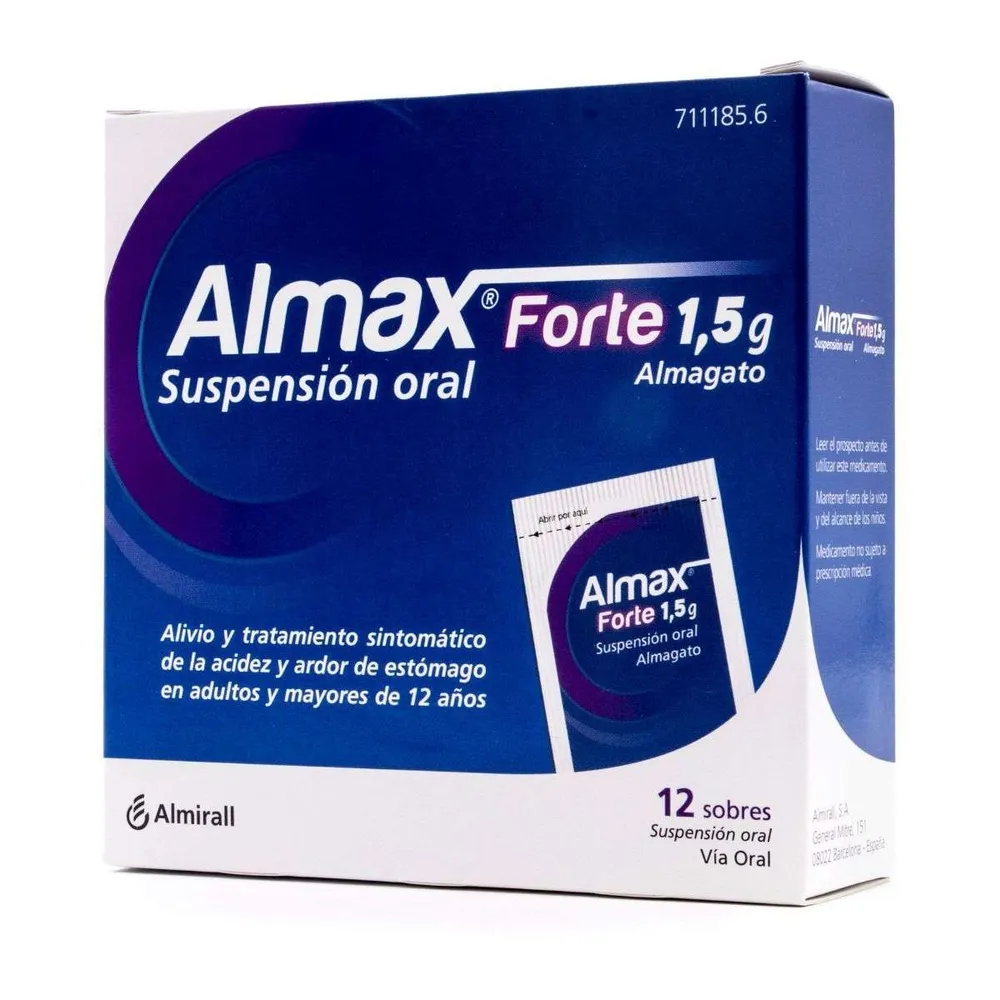
Instructions for Use
Package leaflet: Information for the user
Introduction
Package leaflet: information for the user
Almax Forte 1.5 g oral suspension
almagatum
Read all of this leaflet carefully before you start taking this medicine because it contains important information for you.
Follow exactly the instructions for administration contained in this leaflet or those indicated by your doctor, pharmacist, or nurse.
- Keep this leaflet, as you may need to read it again.
- If you need advice or more information, consult your pharmacist.
- If you experience any adverse effects, consult your doctor, pharmacist, or nurse, even if these effects are not listed in this leaflet. See section 4.
- You should consult a doctor if your condition worsens or if you do not improve after 14 days.
Contents of this leaflet:
- What Almax Forte is and what it is used for
- What you need to know before taking Almax Forte
- How to take Almax Forte
- Possible side effects
- How to store Almax Forte
- Contents of the pack and other information
1. What Almax Forte is and what it is used for
Almax belongs to a group of medicines called antacids, which are compounds that work by neutralizing excess stomach acid.
It is indicated for the relief and symptomatic treatment of acid reflux and heartburn in adults and children over 12 years of age.
You should consult a doctor if your condition worsens or does not improve after 14 days.
2. What you need to know before taking Almax Forte
Do not take Almax Forte
- If you are allergic to algeldrate or any of the other ingredients of this medicine (listed in section 6).
- If you have Alzheimer's disease.
- If you have undiagnosed gastrointestinal bleeding, haemorrhoids, fluid retention (oedema), liver complications during pregnancy (gestational toxemia), or diarrhoea.
Warnings and precautions
Consult your doctor, pharmacist, or nurse before starting Almax:
- If you have mild or moderate kidney disease, as aluminium and magnesium ions may accumulate in the body over time. In such cases, you may be advised to take the lowest dose. Almax is not recommended in severe renal impairment.
- If you are on a low-phosphorus diet, have diarrhoea, malabsorption, or are severely debilitated, since aluminium salts reduce phosphate absorption, which may lead, especially with prolonged treatment, to decreased blood phosphate levels (symptoms such as loss of appetite, muscle weakness, general malaise, etc.) and inadequate bone mineralization (osteomalacia).
- If you are elderly, since prolonged use of aluminium-containing antacids may worsen pre-existing bone disorders (osteoporosis and osteomalacia), due to reduced phosphate and calcium levels.
Inform your doctor if you experience any symptoms indicating gastrointestinal bleeding, such as vomiting blood or black-coloured stools.
Children and adolescents
Antacids should not be given to children under 12 years of age, as other underlying conditions (e.g. appendicitis) may be masked. In younger children, there is a risk of increased blood magnesium levels or aluminium toxicity, especially if they are dehydrated or have kidney disease.
Use of other medicines
Inform your doctor or pharmacist if you are taking, have recently taken, or might need to take any other medicines.
Antacids alter the absorption of many medicines; therefore, Almax Forte 1.5 g should generally be taken at least 3 hours apart from any other medication.
It is especially important to inform your doctor if you are taking any of the following medicines:
- Non-steroidal anti-inflammatory drugs (medicines used to treat pain and inflammation, e.g. flufenamic acid or mefenamic acid, indomethacin)
- Anti-ulcer medicines (medicines to treat stomach or duodenal ulcers and gastric acidity, e.g. cimetidine, famotidine, ranitidine)
- Digitalis glycosides (medicines to treat heart function disorders, e.g. digoxin, digitoxin)
- Antipsychotics (medicines to treat behavioural disorders and psychiatric symptoms, e.g. chlorpromazine)
- Lansoprazole (a medicine to treat stomach ulcers)
- Corticosteroids (prednisone)
- Gabapentin (a medicine to treat epilepsy)
- Ketoconazole (a medicine to treat fungal infections)
- Medicines for treating infections, such as penicillamine, quinolones (ciprofloxacin), tetracyclines (chlortetracycline, demeclocycline, doxycycline)
- Iron salts (ferrous sulphate)
as Almax may reduce the absorption of the above-listed medicines due to changes in gastric conditions or formation of poorly soluble complexes.
- Quinidine (a medicine to treat heart rhythm disorders), as Almax may enhance its toxicity by reducing its elimination due to increased urinary pH.
- Salicylates (medicines to relieve pain and reduce fever and inflammation, e.g. acetylsalicylic acid), as Almax may reduce their concentrations due to increased elimination caused by elevated urinary pH, particularly with high salicylate doses.
Consult your doctor if you are scheduled for an analysis of gastric composition, as Almax may interfere with test results.
Pregnancy, breastfeeding and fertility
If you are pregnant or breastfeeding, think you may be pregnant, or are planning to become pregnant, consult your doctor or pharmacist before using this medicine.
Pregnancy
Chronic or excessive use of Almax during pregnancy should be avoided due to the risk of fetal/neonatal disturbances.
If prolonged treatment is required, consult your doctor, who will advise you on the appropriate regimen.
If you are pregnant or think you might be pregnant, consult your doctor or pharmacist before taking any medication. Taking medications during pregnancy can be dangerous for the embryo or fetus and should be monitored by your doctor. |
Lactation
Chronic or excessive use of Almax should be avoided.
Although small amounts of aluminium and magnesium may be excreted in breast milk in mothers treated with Almax, their concentration is not high enough to cause adverse effects in the nursing infant.
Driving and operating machinery
Almax does not affect your ability to drive or operate machinery.
Almax Forte 1.5 g Oral Suspension contains sorbitol (E-420), benzoic acid (E-210), and sodium
This medicine contains 1.05 g of sorbitol (E-420) per sachet. Sorbitol is a source of fructose. If your doctor has informed you (or your child) that you have an intolerance to certain sugars, or if you (or your child) have been diagnosed with hereditary fructose intolerance (HFI), a rare genetic disorder in which patients cannot metabolize fructose, consult your doctor before taking this medicine. Sorbitol may cause gastrointestinal discomfort and has a mild laxative effect.
This medicine contains 0.0028 mg of benzoic acid (E-210) (contained in the simethicone emulsion) per sachet.
This medicine contains less than 1 mmol of sodium (23 mg) per sachet; thus, it is essentially “sodium-free”.
3. How to take Almax Forte
Follow exactly the administration instructions for this medicine provided in this leaflet or those indicated by your doctor, pharmacist, or nurse. If in doubt, consult your doctor, pharmacist, or nurse.
Use in adults and children over 12 years of age: The recommended dose is 1 sachet (1.5 grams of algeldrate), three times daily, preferably from half an hour to one hour after meals. If discomfort recurs, another dose may be taken before going to bed.
Do not exceed 8 grams per day (5 sachets).
Use in elderly patients: Dose adjustment is not necessary (see section “Warnings and precautions”).
Use in patients with kidney disease: If you have severe renal insufficiency, Almax is not recommended (see section “Warnings and precautions”).
If you have mild or moderate kidney disease, your doctor may recommend lower doses (see section “Warnings and precautions”).
Almax must be taken orally.
The sachet should be pressed several times before opening to ensure complete use of its contents. The oral suspension can be taken directly from the sachet or the contents of one sachet can be poured into half a glass of water, stirred, and taken immediately.
If you take more Almax Forte than you should
At the recommended doses, poisoning with this medicine is not expected. In patients on a low-phosphorus diet and/or undergoing prolonged treatment with high doses, a decrease in blood phosphate levels and inadequate bone mineralization may occur.
If you have taken more Almax than you should, contact your doctor or pharmacist immediately, or call the Toxicology Information Service at telephone number 915 620 420, indicating the medicine and the amount taken.
If you forget to take Almax Forte
Do not take a double dose to make up for missed doses. Take the missed dose as soon as possible if the elapsed time is short, or wait until the next scheduled dose, unless discomfort occurs, in which case the dose may be taken earlier. Take subsequent doses at the recommended intervals.
If you have any further questions about the use of this medicine, ask your doctor, pharmacist, or nurse.
4. Possible adverse effects
Like all medicines, Almax may produce adverse effects, although not everyone experiences them.
Due to its low intestinal absorption, adverse effects of almagate are uncommon. Occasionally (frequency cannot be estimated from available data), diarrhoea has been reported, which generally resolves after discontinuation of treatment.
Reporting of adverse effects
If you experience any type of adverse effect, consult your doctor, pharmacist, or nurse, even if it is an adverse effect not listed in this leaflet. You may also report them directly via the Spanish Pharmacovigilance System for Human Medicines at Website: www.notificaram.es. By reporting adverse effects, you can help provide more information on the safety of this medicine.
5. Storage of Almax Forte
Keep this medicine out of the sight and reach of children.
No special storage conditions are required.
Do not use this medicine after the expiry date stated on the packaging after EXP. The expiry date is the last day of the month indicated.
Medicines must not be disposed of via wastewater or household waste. Dispose of containers and unused medicines at the SIGRE collection point at your pharmacy. If in doubt, ask your pharmacist how to dispose of containers and medicines you no longer need. This will help protect the environment.
6. Contents of the pack and other information
Composition of Almax Forte 1.5 g oral suspension
- The active substance is almagate. Each sachet contains 1.5 grams of almagate.
- The other components are microcrystalline cellulose (E-460), carmellose sodium, calcium saccharin (E-954), chlorhexidine diacetate, peppermint essence, 70% non-crystallizable sorbitol solution (E-420), simeticone emulsion (purified water, simeticone, polyoxyethylene sorbitan triestearate (E-436), methylcellulose (E-461), polyethylene glycol stearate, glycerol monostearate (E-471), xanthan gum (E-415), benzoic acid (E-210), sulfuric acid (E-513), sorbic acid (E-200)) and purified water.
Appearance of the product and contents of the pack
Almax Forte is a white liquid with a peppermint odour and flavour. Each box contains 12, 24 or 506 sachets.
Marketing Authorization Holder and Manufacturer
Marketing Authorization Holder
Almirall, S.A.
General Mitre, nº 151
08022 – Barcelona (Spain).
Manufacturer
Industrias Farmacéuticas Almirall, S.A.
Ctra de Martorell, 41-61
08740 Sant Andreu de la Barca ‑ Barcelona (Spain).
Date of revision of this leaflet: April 2022
Detailed and up-to-date information on this medicine is available on the website of the Spanish Agency of Medicines and Health Products (AEMPS): http://www.aemps.gob.es/
Similar Medications
-
Almagato Stadapharm 1,5 g oral suspension
Form: suspension, oral
Active substance Dosage ALMAGATO 1500 mg Manufacturer: Laboratorio Stada S.L.
-
Almax 1 g/7.5 ml oral suspension
Form: suspension, oral
Active substance Dosage ALMAGATO 13,30 g Manufacturer: Almirall S.A.
This page has been machine-translated and may contain inaccuracies. The original data is available in the manufacturing country's language.
Last data check: May 18, 2026 · Data source: CIMA — AEMPS