Alkeran 2 mg film-coated tablets
Spain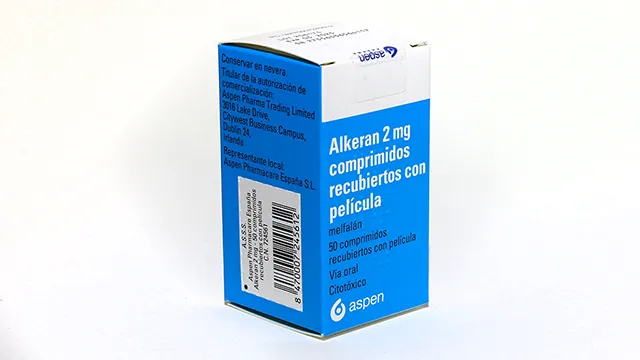
Table of Contents
Package leaflet: Information for the user
Introduction
Package leaflet: Information for the user
Alkeran 2mg film-coated tablets
melphalan
Read all of this leaflet carefully before you start taking this medicine, because it contains important information for you.
- Keep this leaflet, as you may need to read it again.
- If you have any questions, ask your doctor or nurse.
- This medicine has been prescribed for you only, and you should not give it to others, even if they have the same symptoms as you, because it may harm them.
- If you experience any adverse effects, consult your doctor or nurse, even if they are adverse effects not listed in this leaflet. See section 4.
Contents of the leaflet
- What Alkeran is and what it is used for
- What you need to know before taking Alkeran
- How to take Alkeran
- Possible side effects
- How to store Alkeran
- Contents of the pack and other information
1. What Alkeran is and what it is used for
Alkeran tablets contain a drug called melphalan, which belongs to a group of medicines known as cytotoxic agents (also known as chemotherapy), and is used to treat certain types of cancer. It works by reducing the number of abnormal cells that your body produces.
Alkeran tablets are used for:
- Multiple myeloma – a type of cancer that develops from bone marrow cells called plasma cells. Plasma cells help fight infections and diseases by producing antibodies.
- Advanced ovarian cancer
- Advanced breast cancer
- Polycythaemia vera – a type of blood cancer in which the number of red blood cells in the blood increases due to uncontrolled production in the body. This causes the blood to become thicker, leading to blood clots, which may cause headaches, dizziness, and difficulty breathing.
Ask your doctor if you would like more information about these conditions.
You should consult a doctor if you get worse or do not improve.
2. What you need to know before taking Alkeran
Do not take Alkeran:
- if you are allergic to melphalan or to any of the other ingredients of this medicine (listed in section 6).
- if you are breastfeeding.
If you are unsure, consult your doctor or pharmacist before taking Alkeran.
Warnings and precautions
Talk to your doctor or nurse before starting Alkeran:
- if you are currently receiving or have recently received radiotherapy or chemotherapy,
- if you have any kidney disease,
- if you have recently been vaccinated or are planning to get vaccinated. This is because vaccines (such as those against polio, measles, mumps, and rubella) could cause you an infection if administered while you are being treated with melphalan,
- if you are using combined oral contraceptives (the pill). This is due to an increased risk of venous thromboembolism (a blood clot forming in a vein and traveling to another location) in patients with multiple myeloma.
- if you are planning to have a child. This is due to the risk of genotoxicity (damage to genetic material) and infertility (see Pregnancy, breastfeeding, and fertility).
Melphalan may increase the risk of developing another type of cancer (e.g., secondary solid tumors) in a small number of patients, particularly when used in combination with lenalidomide, thalidomide, and prednisone. Your doctor will carefully evaluate the risks and benefits when prescribing Alkeran.
If you have any doubts about whether the above applies to you, consult your doctor or pharmacist before taking Alkeran.
Other medicines and Alkeran
Tell your doctor if you are taking, have recently taken, or might need to take any other medicines, including over-the-counter medicines. This includes herbal medicines.
Inform your doctor if you are taking any other medicines, especially:
- vaccines containing live microorganisms (see Warnings and precautions)
- nalidixic acid (an antibiotic used to treat urinary tract infections)
- cyclosporine (used to prevent rejection of transplanted organs or tissues, or to treat certain skin conditions such as psoriasis and eczema, or to treat rheumatoid arthritis)
- in children, busulfan (another chemotherapeutic drug used to treat certain types of cancer)
Pregnancy, breastfeeding, and fertility
Pregnancy and breastfeeding
If you are pregnant or breastfeeding, think you may be pregnant, or plan to become pregnant, consult your doctor before using this medicine.
Treatment with Alkeran is not recommended during pregnancy because it may cause permanent harm to the fetus. Do not take Alkeran if you are planning to have a child. This applies to both men and women. Reliable and effective contraceptive measures must be used to prevent pregnancy while either partner is taking this medicine.
Women should use reliable and effective contraceptive methods during treatment and for up to 6 months after treatment ends.
Men should use reliable and effective contraceptive methods during treatment and for up to 3 months after treatment ends.
If you are already pregnant, it is important that you consult your doctor before starting Alkeran.
Your doctor will consider the risks and benefits of taking Alkeran for you and your baby.
You must not take Alkeran while breastfeeding. Seek advice from your doctor.
Fertility
Melphalan may affect the ovaries and sperm, which can lead to infertility (inability to conceive a child). In women, menstruation may stop (amenorrhea), and in men, a complete absence of sperm (azoospermia) may occur. Because melphalan treatment may cause sterility in men, it is recommended that they seek advice on sperm preservation before starting treatment.
Driving and using machines
The effects of this medicine on the ability to drive and use machines have not been studied in patients taking this medicine.
3. How to take Alkeran
Only a specialist doctor experienced in cancer treatment can prescribe Alkeran for you.
Alkeran is an active cytotoxic agent that should only be used under the supervision of physicians experienced in the administration of such agents.
Follow exactly the administration instructions for this medicine as given by your doctor. It is important that you take the medication at the correct time. The label on the packaging will tell you how many tablets to take and how often. If the label does not specify this, or if you have any doubts, consult your doctor, nurse, or pharmacist.
- Swallow the tablets whole with a glass of water.
- Do not break, crush, or chew the tablets.
The dose of Alkeran will depend on the type of blood disorder or cancer (see section 1).
Your doctor may also adjust the dose during treatment, depending on your individual needs. The dose may sometimes vary if you are elderly or have kidney problems.
While you are taking Alkeran, your doctor will perform regular blood tests. These are to monitor your blood cell counts. Your doctor may adjust your dose based on the results of these tests.
Thromboembolic events
An increased risk of deep vein thrombosis (formation of a blood clot, called a thrombus, within a deep vein, predominantly in the legs) and pulmonary embolism (a blockage of the main pulmonary artery or its branches by a blood clot that has dislodged and traveled to the lungs) may occur when melphalan is used in combination with other medicines that can affect immune system function (such as lenalidomide/thalidomide) and other agents that may enhance the benefits of melphalan treatment (such as prednisone/dexamethasone).
Your doctor will determine which preventive measures should be taken after careful evaluation of your underlying risk factors (such as tobacco use, high blood pressure, elevated blood lipid levels, or history of thrombosis).
If you develop any signs or symptoms of thromboembolism (such as difficulty breathing, chest pain, or swelling in arms or legs), consult your doctor immediately. If you experience a thromboembolic event, your doctor may decide to interrupt your treatment and initiate standard anticoagulant therapy. Your doctor will decide whether to restart melphalan in combination with lenalidomide and prednisone or thalidomide and prednisone or dexamethasone once the thromboembolic events have been controlled.
Neutropenia and thrombocytopenia
An increased risk of hematologic toxicity, such as neutropenia (reduced number of white blood cells, which may increase the risk of infections) and thrombocytopenia (low platelet count, which may lead to bleeding and bruising), has been observed when melphalan is used in combination with other medicines that can affect immune system function (such as lenalidomide/thalidomide) and other agents that may enhance the benefits of melphalan treatment (such as prednisone/dexamethasone).
Multiple myeloma
- The recommended dose is 0.15 mg per kilogram of body weight daily for 4 days. The treatment is repeated every 6 weeks.
Advanced ovarian adenocarcinoma
- The recommended dose is 0.2 mg per kilogram of body weight daily for 5 days. The treatment is repeated every 4 to 8 weeks.
Advanced breast carcinoma
- The recommended dose is 0.15 mg per kilogram of body weight daily for 5 days. The treatment is repeated every 6 weeks.
Polycythemia vera
- The initial dose is between 6 and 10 mg daily for 5 to 7 days. The dose is then reduced to between 2 and 4 mg daily.
Use in children
Alkeran is rarely indicated in children. There are no available dosing guidelines for pediatric patients.
If you take more Alkeran than you should
If you take more Alkeran than prescribed, inform your doctor immediately or go directly to the hospital. Take the medicine packaging with you.
In case of overdose or accidental ingestion, contact your doctor or pharmacist immediately, or call the Toxicology Information Service at 91 562 04 20, indicating the medicine and the amount ingested.
If you forget to take Alkeran
Inform your doctor. Do not take a double dose to make up for a missed dose.
If you stop taking Alkeran
If you have any further questions about the use of this medicine, ask your doctor or nurse.
4. Possible adverse effects
Like all medicines, this medicine can cause adverse effects, although not everyone will experience them.
Consult your specialist doctor or go to hospital immediately if you notice any of the following effects:
-
allergic reaction, signs may include:
-
rash, lumps or hives on the skin
-
swollen face, eyelids or lips
-
sudden onset of "wheezing" and chest tightness
-
fainting (due to cardiac arrest)
-
any signs of high temperature or infection (sore throat, mouth pain or urinary problems).
Treatment with melphalan may cause a decrease in the number of white blood cells. White blood cells fight infections, and when there are too few, an infection may occur.
- any unexpected bruising or bleeding or feeling extremely tired, dizzy or short of breath, as this could mean that too few blood cells of a certain type are being produced
- if you suddenly feel unwell (even with a normal temperature).
- if you experience any signs/symptoms that may be related to a thromboembolic event (such as difficulty breathing, chest pain, swelling of arms or legs), especially if you are being treated with melphalan in combination with lenalidomide and prednisone or thalidomide and prednisone or dexamethasone.
Consult your doctor if you have any of the following adverse effects, which may also occur with this medicine:
Very common (may affect more than 1 in 10 people)
- a decrease in the number of blood cells and platelets
- nausea, vomiting and diarrhoea – with high doses of this medicine
- mouth ulcers – with high doses of this medicine
- hair loss – with high doses of this medicine
Common (may affect up to 1 in 10 people)
- hair loss – with usual doses of this medicine
- high levels in the blood of a chemical substance called urea – in people with kidney problems who are being treated for myeloma.
Rare (may affect up to 1 in 1,000 people)
- a condition in which there is a low number of red blood cells due to their premature destruction – this may make you feel very tired, short of breath and dizzy, and may cause headaches or yellowing of the skin or eyes
- lung problems that may cause coughing, wheezing and difficulty breathing
- liver problems that may show up in blood tests or cause jaundice (yellowing of the whites of the eyes and skin)
- mouth ulcers – with normal doses of this medicine
- skin rashes or itchy skin
Frequency not known (frequency cannot be estimated from the available data)
- leukaemia – blood cancer
- in women: absence of periods (amenorrhoea)
- in men: absence of sperm in semen (azoospermia)
- deep vein thrombosis and pulmonary embolism
- acute kidney injury or renal failure (significant deterioration in kidney function) occurring over a short period of time
If any of the adverse effects become severe, or if you notice any adverse effects not listed in this leaflet, please inform your doctor or pharmacist.
Use of melphalan may increase the risk of developing another type of cancer called secondary acute leukaemia (blood cancer) in the future. Secondary acute leukaemia causes the bone marrow (tissue inside bones that produces red and white blood cells) to produce a large number of blood cells that do not function properly. Symptoms of this disease include fatigue, fever, infection and bruising. This condition may also be detected by a blood test showing a large number of abnormal blood cells and very few properly functioning ones.
Inform your doctor as soon as possible if you experience any of these symptoms. You may need to stop taking Alkeran, but only your doctor can determine whether this is necessary.
Reporting of adverse effects
If you experience any adverse effect, talk to your doctor or nurse, even if it is a possible adverse effect not listed in this leaflet. You can also report them directly via the Spanish Pharmacovigilance System for Human Medicinal Products: https://www.notificaram.es. By reporting adverse effects, you can help provide more information on the safety of this medicine.
5. Storage of Alkeran
- Keep this medicine out of the sight and reach of children.
- Do not use this medicine after the expiry date stated on the vial and carton after 'EXP'. The expiry date is indicated as month and year and refers to the last day of that month.
- Store in a refrigerator (between 2°C and 8°C).
- If your doctor instructs you to stop taking the tablets, it is important that you return any remaining tablets to your pharmacist, who will dispose of them according to hazardous waste disposal guidelines. Only keep the tablets if your doctor specifically tells you to do so.
- Medicines must not be disposed of via wastewater drains or household waste. Dispose of empty containers and unused medicines at the Sigre collection point at your pharmacy. If you are unsure, ask your pharmacist how to properly dispose of containers and unused medicines. This helps protect the environment.
6. Contents of the pack and other information
Composition of Alkeran
- The active substance is melphalan. Each Alkeran tablet contains 2 mg of melphalan.
- The other components are microcrystalline cellulose, crospovidone, anhydrous colloidal silica, magnesium stearate, hypromellose, titanium dioxide (E-171), and macrogol.
Appearance of the product and contents of the pack
Alkeran tablets are film-coated, white to off-white, round, biconvex tablets, engraved with ‘GX EH3’ on one side and ‘A’ on the other. They are available in bottles containing 25 and 50 tablets.
Only certain pack sizes may be marketed.
Marketing Authorization Holder and Manufacturer
Marketing Authorization Holder:
Aspen Pharma Trading Limited
3016 Lake Drive,
Citywest Business Campus,
Dublin 24, Ireland
Tel: +34 952 010 137
Manufacturer:
EXCELLA GmbH & Co. KG,
Nürnberger Strasse 12, 90537 Feucht,
Germany
Local representative:
Aspen Pharmacare España S.L.
Avenida Diagonal, 512
Planta Interior 1, Oficina 4
08006 Barcelona
Spain
Date of the most recent review of this leaflet: January 2024
Detailed information on this medicinal product is available on the website of the Spanish Agency for Medicines and Health Products (AEMPS) http://www.aemps.gob.es/