Alka-Seltzer 2.1 g effervescent tablets
Spain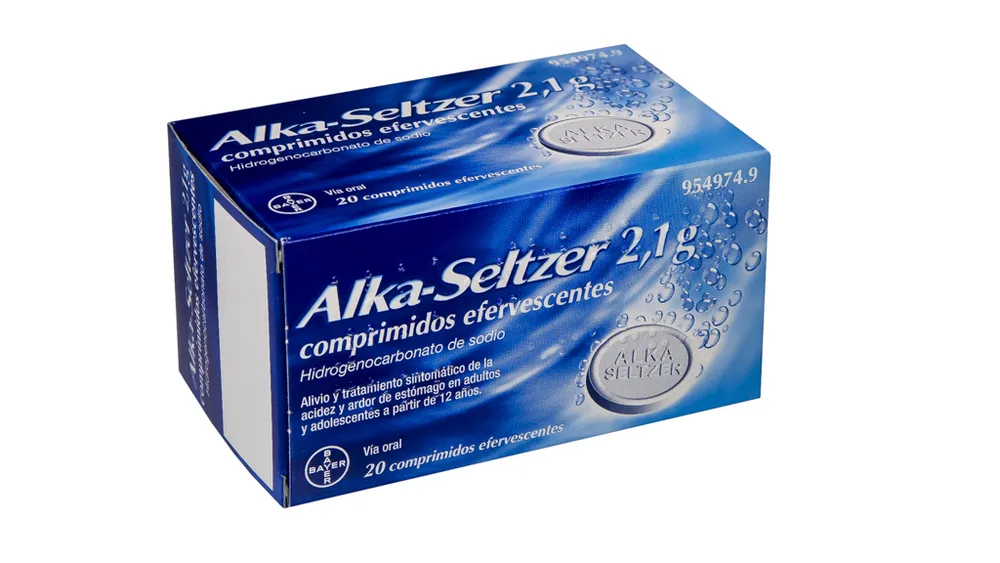
Table of Contents
Package leaflet: Information for the user
Introduction
Package leaflet: information for the user
ALKA-SELTZER 2.1 g effervescent tablets
Sodium hydrogen carbonate
Read the entire leaflet carefully before you start using this medicine, as it contains important information for you.
Always follow exactly the instructions for taking this medicine as described in this leaflet or as directed by your doctor or pharmacist.
- Keep this leaflet, as you may need to read it again.
- If you need advice or further information, consult your pharmacist.
- If you experience any adverse effects, consult your doctor or pharmacist, even if they are effects not listed in this leaflet. See section 4.
- You should consult a doctor if you worsen or do not improve after 14 days.
Contents of the leaflet:
- What Alka-Seltzer is and what it is used for
- What you need to know before using Alka-Seltzer
- How to use Alka-Seltzer
- Possible adverse effects
- Storage of Alka-Seltzer
- Contents of the pack and other information
1. What Alka-Seltzer is and what it is used for
It belongs to the group of medicines called antacids, which work by reducing excess stomach acidity.
This medicine is indicated for the symptomatic relief of acidity and heartburn in adults and adolescents aged 12 years and older.
2. What you need to know before taking Alka-Seltzer
Do not take ALKA-SELTZER:
- If you are allergic to sodium bicarbonate or to any of the other ingredients of this medicine (listed in section 6).
- If you have metabolic or respiratory alkalosis.
- If you have hypocalcemia.
- If you have hypochlorhydria.
- If you are prone to edema formation (fluid retention).
- If you have appendicitis or its symptoms (nausea, vomiting, cramps, abdominal pain).
- If you have intestinal obstruction (partial or complete blockage of the intestine causing interruption of intestinal content passage).
Warnings and precautions
Consult your doctor or pharmacist before taking Alka-Seltzer.
As with other antacids, this medicine may mask symptoms of a more serious stomach condition. If symptoms persist or worsen after 14 days of treatment, consult your doctor.
Use with caution in patients with hypertension (high blood pressure), liver, kidney or heart disease, edema, hypokalemia, hypocalcemia, and aldosteronism (a syndrome associated with increased secretion of the hormone aldosterone by the adrenal gland), and in patients taking diuretics, as alkalosis may occur.
Prolonged use or high doses of Alka-Seltzer may cause metabolic alkalosis.
Due to its citric acid content, use with caution in patients with uric acid stones, as it may promote calcium stone formation.
Children and adolescents
Do not administer this medicine to children under 12 years of age.
Taking Alka-Seltzer with other medicines
Inform your doctor or pharmacist if you are taking, have recently taken, or might need to take any other medicines.
This is especially important in the case of:
-
ketoconazole (used to treat fungal infections)
-
quinolones, tetracyclines (especially doxycycline), acidic forms of sulfonamides, erythromycin, methenamine (different classes of antibiotics)
-
iron salts (medicines used to prevent or treat anemia)
-
naproxen, salicylates (used to treat pain and fever)
-
valproic acid (used to treat epilepsy)
-
levodopa (used to treat Parkinson's disease)
-
amphetamine, dexamphetamine, ephedrine (central nervous system stimulants)
-
cardiac antiarrhythmics
-
methadone (used to relieve severe pain)
-
mecamylamine (a medicine for hypertension)
-
lithium salts (used in certain psychiatric conditions)
-
barbiturates
-
methotrexate (used to treat cancer and rheumatoid arthritis)
-
calcium-containing preparations, as this may lead to milk-alkali syndrome, whose symptoms include: high blood calcium levels, kidney and heart problems, metabolic alkalosis, dizziness, vomiting, muscle cramps, apathy, headache, confusion, and anorexia.
As with other antacids, this medicine, when taken with enteric-coated medicines, may cause the coating to dissolve too quickly, potentially causing gastric or duodenal irritation.
Antacids alter the absorption of many medicines; therefore, in general, administration should be spaced apart from other medicines. This medicine should generally be taken at least 2 hours before or after any other medicine.
Inform your doctor or pharmacist if you are taking, or have recently taken, any other medicines, including those obtained without a prescription.
Interference with diagnostic tests:
If you are scheduled for any diagnostic tests (including blood and urine tests, detection of gastric acid secretion, etc.), inform your doctor that you are taking this medicine, as it may alter test results.
Taking ALKA-SELTZER with food and drinks:
Do not take this medicine with milk or dairy products.
Due to its sodium bicarbonate content, this medicine should not be taken immediately after excessive food or drink consumption, as it may increase carbon dioxide production, leading to gastric distension and, in rare cases, perforation of the stomach wall.
Pregnancy, breastfeeding, and fertility
If you are pregnant or breastfeeding, think you may be pregnant, or are planning to become pregnant, consult your doctor or pharmacist before using this medicine.
Driving and using machines:
No effects of Alka-Seltzer on the ability to drive or operate machinery have been reported.
Alka-Seltzer contains Sodium and Aspartame (E-951).
This medicine contains 570 mg of sodium (a main component of table/cooking salt) per effervescent tablet. This corresponds to 28.5% of the maximum recommended daily sodium intake for an adult.
Consult your doctor or pharmacist if you need to take 6 or more effervescent tablets daily over a prolonged period, especially if you have been advised to follow a low-salt (low-sodium) diet.
This medicine contains 10 mg of aspartame per effervescent tablet. Aspartame is a source of phenylalanine, which may be harmful if you have phenylketonuria (PKU), a rare genetic disorder in which phenylalanine accumulates because the body cannot properly eliminate it.
3. How to take Alka-Seltzer
Follow exactly the instructions for use of this medicine as outlined in this leaflet or as directed by your doctor or pharmacist. If in doubt, consult your doctor or pharmacist.
This medicine is administered orally.
The recommended dose is:
Adults and adolescents aged 12 years and older: The usual dose is 1 effervescent tablet, which may be increased to 2 if necessary, after meals or when experiencing gastric discomfort.
Do not exceed 6 tablets per day.
Patients aged 65 years and older: Do not exceed 3 tablets per day.
Patients with renal impairment
Must consult their doctor before taking this medicine.
Use in children and adolescents
Do not use in children under 12 years of age.
Always use the lowest effective dose.
If you feel that the effect of ALKA-SELTZER is too strong or too weak, inform your doctor or pharmacist.
This medicine should not be taken when the stomach is overly full of food or drink. Wait between 20 minutes and 1 hour after meals before taking the medicine. Always wait until the effervescent tablet has completely dissolved in water and the fizzing has stopped before taking it. Consult your doctor if you experience severe stomach pain immediately after taking the medicine.
Administration of this preparation should only occur when gastric discomfort is present. Once symptoms resolve, treatment should be discontinued.
If symptoms persist for more than 14 days, worsen, or new symptoms appear, discontinue treatment and consult your doctor.
If you take more ALKA-SELTZER than you should
The main symptoms of overdose include metabolic alkalosis (headache, dizziness, tinnitus, blurred vision, drowsiness, sweating, nausea, vomiting, occasionally diarrhea, hyperirritability, and tetany (muscle weakness)) and fluid retention.
In case of overdose or accidental ingestion, contact your doctor or pharmacist immediately, go to a medical center immediately, or call the Toxicology Information Service at: 91 562 04 20, indicating the medicine and the amount ingested.
If you forget to take ALKA-SELTZER:
Do not take a double dose to make up for missed doses.
4. Possible adverse effects
Like all medicines, Alka-Seltzer may cause adverse effects, although not everyone experiences them.
Adverse reactions are listed in decreasing order of severity within each frequency category.
The convention used to define frequencies is as follows: very common (≥1/10); common (≥1/100 to <1/10); uncommon (≥1/1,000 to <1/100); rare (≥1/10,000 to <1/1,000); and very rare (<1/10,000). Frequency not known (cannot be estimated from available data).
Frequency not known (frequency cannot be estimated from available data): Flatulence (gas in the stomach or intestines), belching, vomiting, stomach cramps, stomach distension, and rebound effect (increase in acidity caused by the medicine itself).
Hypokalemia (decreased potassium levels in blood) and hypernatremia (increased sodium levels in blood).
If used continuously or at high doses, systemic alkalosis may occur, the symptoms of which include difficulty breathing, muscle weakness, increased muscle tone, spasms, tetany (involuntary muscle contractions), especially with hypercalcemia, anxiety, and other central nervous system effects.
Hypertension (increased blood pressure) and edema (fluid retention) may occur if used continuously or at high doses.
With unknown frequency, oral ingestion of Sodium hydrogen carbonate has caused spontaneous gastric perforation due to gas production.
Excessive oral administration of medicines containing citrate salts may have a laxative effect.
Reporting of adverse effects:
If you experience any type of adverse effect, consult your doctor or pharmacist, even if it is a possible adverse effect not listed in this leaflet. You may also report them directly via the Spanish Pharmacovigilance System for Human Medicines: http://www.notificaram.es. By reporting adverse effects, you can help provide more information on the safety of this medicine.
5. Storage of Alka-Seltzer
Keep this medicine out of the sight and reach of children.
Keep the container tightly closed.
Do not use Alka-Seltzer after the expiry date stated on the packaging, following the abbreviation CAD. The expiry date refers to the last day of the month indicated.
Medicines must not be disposed of via wastewater or household waste. Dispose of unused containers and medicines at the SIGRE collection point at your pharmacy. If in doubt, ask your pharmacist how to properly dispose of unused containers and medicines. This will help protect the environment.
6. Contents of the pack and other information
Composition of Alka-Seltzer
- The active substance is Sodium hydrogen carbonate. Each effervescent tablet contains 2.1 g (2081.8 mg) of sodium hydrogen carbonate (sodium bicarbonate).
- The other components (excipients) are citric acid, aspartame (E-951), mannitol (E-421), potassium acesulfame, lime-lemon flavour, vanilla flavour, and amiflex (a compound of amino acids, glutamic acid and sodium chloride).
Description of the product and contents of the pack:
This medicine consists of effervescent tablets, round and white in colour. It is available in packs of 10 or 20 effervescent tablets.
Some pack sizes may not be marketed.
Marketing Authorization Holder:
BAYER HISPANIA, S.L.
Av. Baix Llobregat, 3-5
08970 Sant Joan Despí (Barcelona)
Manufacturer:
BAYER BITTERFELD GmbH
OT Greppin
Salegaster Chaussee, 1
06803 Bitterfeld-Wolfen
Germany
Date of the most recent review of this leaflet: September 2019
Detailed and up-to-date information on this medicine is available on the website of the Spanish Agency of Medicines and Medical Devices (AEMPS) http://www.aemps.es/