Alitretinoin IFC 10 mg soft capsules EFG
Spain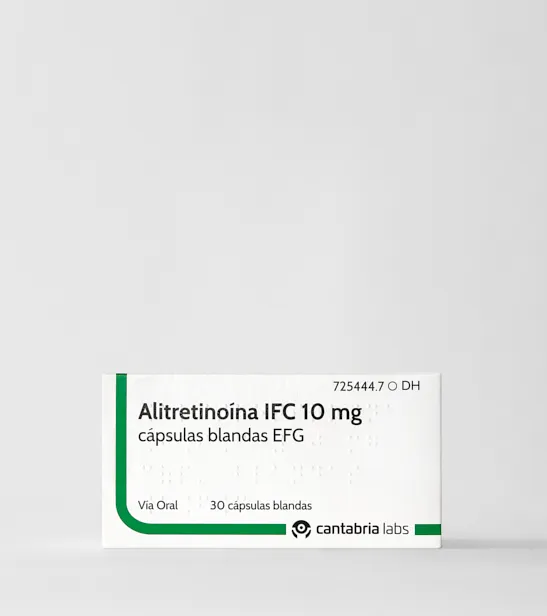
Instructions for Use
Table of Contents
- Introduction
- 1. What Alitretinoin IFC 10 mg soft capsules EFG is and what it is used for
- 2. What you need to know before taking Alitretinoin IFC 10 mg soft capsules EFG
- 3. How to take Alitretinoin IFC
- 4. Possible adverse effects
- 5. Storage of Alitretinoin IFC
- 6. Contents of the pack and other information
Package leaflet: Information for the user
Introduction
Package leaflet: information for the user
Alitretinoin IFC 10 mg soft capsules EFG
WARNING IF YOU ARE PREGNANT, IT MAY SERIOUSLY HARM THE BABY. Women must use effective contraception throughout treatment. Do not use if you are pregnant or think you may be pregnant. |
?This medicine is subject to additional monitoring, which will help speed up the detection of new safety information. You can help by reporting any adverse reactions you may experience. The end of section 4 includes information on how to report these adverse reactions.
Read the entire leaflet carefully before starting to take this medicine, as it contains important information for you.
- Keep this leaflet, as you may need to read it again. If you have any questions, consult your doctor or pharmacist.
- This medicine has been prescribed for you only and must not be given to other people, even if they have the same symptoms as you, as it may harm them.
- If you experience any adverse effects, consult your doctor or pharmacist, even if they are adverse effects not listed in this leaflet. See section 4.
Leaflet contents
- What Alitretinoin IFC 10 mg soft capsules EFG is and what it is used for
- What you need to know before taking Alitretinoin IFC 10 mg soft capsules EFG
- How to take Alitretinoin IFC 10 mg soft capsules EFG
- Possible side effects
- Storage of Alitretinoin IFC 10 mg soft capsules EFG
- Contents of the pack and other information
1. What Alitretinoin IFC 10 mg soft capsules EFG is and what it is used for
The active substance in Alitretinoin IFC is alitretinoin. It belongs to a group of medicines known as retinoids, which are derived from Vitamin A. Alitretinoin IFC is available in two strengths, containing either 10 mg or 30 mg of alitretinoin.
Alitretinoin IFC is used to treat severe chronic hand eczema in adult patients that has not improved with any other topical treatment, including corticosteroids. Treatment with Alitretinoin IFC should be supervised by a specialist skin doctor (dermatologist).
2. What you need to know before taking Alitretinoin IFC 10 mg soft capsules EFG
Do not take Alitretinoin IFC:
- If you are pregnant or breastfeeding.
- If there is any possibility that you could become pregnant, you must follow the precautions outlined in the “Pregnancy Prevention Programme”; see the section “Warnings and precautions”.
- If you have liver disease.
- If you have severe kidney disease.
- If you have high levels of fats in the blood (such as high cholesterol or elevated triglycerides).
- If you have untreated thyroid disease.
- If you have very high levels of vitamin A in your body (hypervitaminosis A).
- If you are allergic to alitretinoin, to other retinoids (such as isotretinoin), to peanuts, to soy, or to any of the other ingredients of this medicine (listed in section 6).
- If you are taking tetracyclines (a type of antibiotic).
If any of the above apply to you, consult your doctor. You must not take Alitretinoin IFC.
Warnings and precautions
Pregnancy Prevention Programme
Pregnant women must not take Alitretinoin IFC
This medicine can seriously harm the unborn baby (the medicine is considered "teratogenic") – it may cause severe abnormalities in the baby’s brain, face, ears, eyes, heart, and certain glands (thymus and parathyroid glands). It also increases the risk of miscarriage. This can occur even if Alitretinoin IFC is taken for only a short time during pregnancy.
- Do not take Alitretinoin IFC if you are pregnant or think you might be pregnant.
- Do not take Alitretinoin IFC if you are breastfeeding. The medicine is likely to pass into your milk and may harm your baby.
- Do not take Alitretinoin IFC if you could become pregnant during treatment.
- Do not become pregnant during the month following discontinuation of this treatment, as the medicine may still remain in your body.
Women who could become pregnant must be prescribed Alitretinoin IFC under strict rules due to the risk of serious harm to the unborn baby
These rules are:
-
Your doctor must explain the risk of harm to the unborn baby – you must understand why you must not become pregnant and what you need to do to avoid pregnancy.
-
You must have discussed contraception (birth control) with your doctor. Your doctor will provide information on how to avoid pregnancy. Your doctor may refer you to a specialist for contraceptive advice.
-
Before starting treatment, your doctor will require you to undergo a pregnancy test. The test must confirm that you are not pregnant when starting treatment with Alitretinoin IFC.
Women must use effective contraception before, during, and after taking Alitretinoin IFC
- You must agree to use at least one highly reliable contraceptive method (e.g., an intrauterine device or a contraceptive implant) or two effective methods that work in different ways (e.g., a hormonal contraceptive pill and a condom). Discuss with your doctor which methods are suitable for you.
- You must use contraception for one month before starting Alitretinoin IFC, during treatment, and for one month after stopping treatment.
- You must use contraception even if you do not have periods or are not sexually active (unless your doctor decides it is not necessary).
Women must agree to undergo pregnancy tests before, during, and after taking Alitretinoin IFC
You must agree to attend regular follow-up visits, ideally every month.
- You must agree to undergo regular pregnancy tests, ideally every month during treatment and, because the medicine may still remain in your body, one month after stopping Alitretinoin IFC (unless your doctor decides it is not necessary in your case).
- You must agree to undergo additional pregnancy tests if requested by your doctor.
- You must not become pregnant during treatment or within one month after stopping treatment, as the medicine may still be present in your body.
- Your doctor will discuss all these points with you using a checklist and will ask you (or a parent/guardian) to sign it. This checklist confirms that you have been informed of the risks and will follow the above rules.
If you become pregnant while taking Alitretinoin IFC, stop taking the medicine immediately and consult your doctor. Your doctor may refer you to a specialist for advice.
Additionally, if you become pregnant within one month after stopping Alitretinoin IFC, you must consult your doctor. Your doctor may refer you to a specialist for advice.
Advice for men
Levels of oral retinoids in semen of men taking Alitretinoin IFC are too low to harm a partner’s unborn baby. However, you must never share your medicine with anyone.
Additional precautions
Never give this medicine to another person. Please return any unused capsules to your pharmacist at the end of treatment.
Do not donate blood during treatment with this medicine or for 1 month after stopping Alitretinoin IFC, as a baby could be harmed if a pregnant woman receives your blood.
Consult your doctor before starting Alitretinoin IFC:
- If you have ever had any mental health problems. This includes depression, aggressive tendencies, or mood changes. Also included are thoughts of self-harm or ending your life. This is because your mood may be affected while taking Alitretinoin IFC.
- If you have kidney disease. Alitretinoin IFC is not recommended in patients with moderate kidney disease. If you have kidney disease, consult your doctor to determine whether Alitretinoin IFC is suitable for you.
- If you have high levels of fats in the blood; you may need more frequent blood tests. Alitretinoin IFC generally increases blood fat levels, such as cholesterol or triglycerides. If blood fat levels remain high, your doctor may reduce the dose or discontinue treatment with Alitretinoin IFC.
- If you have high blood sugar levels (diabetes); you may need to monitor your blood sugar levels more frequently, and your doctor may reduce the dose of Alitretinoin IFC.
- If you have had thyroid disease. Alitretinoin IFC may reduce thyroid hormone levels. If thyroid hormone levels are low, your doctor may prescribe supplements.
Take special care during treatment:
- If you experience any eye-related problems; inform your doctor immediately. You may need to stop taking Alitretinoin IFC and have your eyes monitored.
- If you experience persistent headache, nausea or vomiting (feeling sick or actually vomiting), and blurred vision, as these may be signs of a condition called benign intracranial hypertension. Stop taking the capsules immediately and contact your doctor as soon as possible.
- If you have bloody diarrhoea. Stop taking the capsules immediately and contact your doctor as soon as possible.
- Reduce exposure to sunlight and avoid sunlamps. Your skin may become more sensitive to sunlight. Before sun exposure, use a high-protection sunscreen (SPF 15 or higher). If you develop dry skin and lips during treatment, use moisturizing creams or ointments and lip balm.
- Reduce intense physical activity. Alitretinoin may cause muscle and joint pain.
- If you develop dry eyes; this can be relieved with lubricating eye ointment or artificial tears. If you wear contact lenses, you may need to wear glasses during treatment with alitretinoin. Dry eyes and vision problems usually resolve when treatment is stopped.
- Alitretinoin IFC may increase liver enzyme levels. Your doctor will perform blood tests during treatment to monitor these levels. If levels remain high, your doctor may reduce the dose or discontinue treatment with Alitretinoin IFC.
Mental health problems
-
You may not notice some changes in your mood and behaviour, so it is very important to inform your friends and family that you are taking this medicine. They may notice these changes and help you identify any problems quickly so you can discuss them with your doctor.
-
If you develop any mental health problems, including depression, aggressive tendencies, mood changes, thoughts of self-harm, or thoughts of ending your life, you must stop taking Alitretinoin IFC immediately and contact your doctor as soon as possible.
Children and adolescents
The use of Alitretinoin IFC is not recommended in individuals under 18 years of age. Efficacy in this age group is unknown.
Taking Alitretinoin IFC with other medicines
Do not take other medicines containing retinoids (e.g., isotretinoin), vitamin A supplements, or tetracyclines (a type of antibiotic) while taking Alitretinoin IFC, as this increases the risk of adverse effects.
Inform your doctor or pharmacist if:
- you are taking amiodarone (a medicine used to regulate heart rhythm). Taking amiodarone with Alitretinoin IFC is not recommended.
- you are taking ketoconazole, fluconazole, or miconazole (medicines used to treat infections). Your doctor may decide to reduce the dose of Alitretinoin IFC.
- you are taking simvastatin (a medicine used to lower cholesterol levels). Alitretinoin IFC may reduce the amount of this medicine in your body.
- you are taking gemfibrozil (another medicine used to lower cholesterol) or oxandrolone (an anabolic agent). Your doctor may decide to reduce the dose of Alitretinoin IFC.
- you are receiving paclitaxel (used to treat cancer), taking rosiglitazone, or repaglinide (used to treat diabetes). Alitretinoin IFC may increase the amount of these medicines in your body.
Tell your doctor or pharmacist if you are taking, have recently taken, or might need to take any other medicines, including those obtained without a prescription. This also includes herbal medicines.
Pregnancy, breastfeeding, and fertility
For further information on pregnancy and contraception, refer to the “Pregnancy Prevention Programme” section under “Warnings and precautions”.
Driving and using machines
Your vision may be impaired at night during treatment. If this occurs, you must not drive or operate machinery.
Alitretinoin IFC contains soya oil
Do not use this medicine if you are allergic to peanuts or soya.
Alitretinoin IFC contains sorbitol
This medicine contains 13.28 mg of sorbitol in each Alitretinoin IFC 10 mg capsule.
3. How to take Alitretinoin IFC
Follow exactly the instructions for use of this medicine given by your doctor or pharmacist. If in doubt, please consult your doctor or pharmacist again.
When to take the capsules
The capsule should be taken with a main meal, preferably at the same time each day. The capsules must be swallowed whole and not chewed.
How much to take
The dose is 10 or 30 mg once daily. If your body cannot tolerate the recommended dose of 30 mg, your doctor may prescribe the lower dose of 10 mg.
How long to take the capsules
A treatment cycle usually lasts between 12 and 24 weeks, depending on how the disease improves. If your first treatment has been successful, your doctor may prescribe another treatment cycle if symptoms reappear.
If you take more capsules than you should
If you take too many capsules or if someone accidentally takes your medicine, contact your doctor, pharmacist, or go to the nearest hospital immediately. In case of overdose or accidental ingestion, contact the Toxicology Information Service, telephone: 91 562 04 20. It is recommended to bring the container and the package leaflet of this medicine to the healthcare professional.
If you forget to take Alitretinoin IFC
If you forget to take a dose, take it as soon as you can. However, if it is almost time to take the next dose, do not take the missed dose and continue with your regular schedule. Do not take a double dose to make up for a missed dose.
If you have any further questions about the use of this product, ask your doctor or pharmacist.
4. Possible adverse effects
Like all medicines, this medicine can cause adverse effects, although not everyone will experience them.
Very common effects (may affect more than 1 in 10 people)
- Headache.
- Increase in blood fats: higher levels of fats (triglycerides) and cholesterol in the blood.
Common effects (may affect up to 1 in 10 people)
- Blood cell disorders: increase in the number of blood platelets (cells that help with clotting), decrease in the number of red and white blood cells observed in blood tests.
- Thyroid problems: decreased levels of thyroid hormones.
- Eye problems: eye inflammation (conjunctivitis) and inflammation of the eyelid area, causing dryness and irritation of the eyes.
? Ask a pharmacist for a suitable eye drop. If you wear contact lenses and experience dry eyes, you may need to wear glasses instead.
- Ear problems: persistent ringing or noise in the ears (tinnitus).
- Dizziness.
- Blood and circulation disorders: hot flushes, high blood pressure (hypertension).
- Intestinal and stomach problems: nausea, vomiting, dry mouth.
- Muscle and joint pain: muscle pain, joint pain, lack of energy (fatigue). High blood levels of muscle breakdown products if you exercise vigorously.
- Skin and hair problems: dry skin, especially of the face, dryness and inflammation of the lips, skin redness, itchy skin rash, inflamed skin, hair loss.
- Liver problems: elevated liver enzymes observed in blood tests.
Uncommon effects (may affect up to 1 in 100 people)
- Vision problems, including blurred vision, distorted vision, cloudy area in the eye (corneal opacity, cataracts).
??If your vision is affected**, stop taking Alitretinoin IFC immediately** and contact your doctor.
- Skin problems: itchy skin, skin peeling, rash, eczema with dry skin.
- Ear, nose and throat problems: nosebleeds.
- Intestinal and stomach problems: indigestion (dyspepsia).
- Bone disorders: abnormal bone growth, including the spinal condition called ankylosing spondylitis.
Rare effects (may affect up to 1 in 1,000 people)
- Persistent headache, accompanied by general discomfort (nausea), vomiting, and changes in vision, including blurred vision. These may be signs of benign intracranial hypertension.
??If you experience these symptoms, stop taking Alitretinoin IFC immediately and contact your doctor.
- Blood and circulation disorders: inflammation of blood vessels.
- Skin and hair problems: nail abnormalities, increased sensitivity of the skin to sunlight, changes in hair texture.
Mental health problems
Rare effects (may affect up to 1 in 1,000 people)
- Depression or related disorders. These signs include low or altered mood, anxiety, feelings of emotional distress.
- Worsening of existing depression.
- Becoming violent or aggressive.
Very rare effects (may affect up to 1 in 10,000 people)
- Some people have experienced feelings or thoughts about harming themselves or ending their lives (suicidal thoughts), have attempted to end their lives (suicide attempt), or have died by suicide. These individuals may not appear to be depressed.
- Unusual behaviour.
- Signs of psychosis: loss of contact with reality, such as hearing voices or seeing things that are not there.
Contact your doctor immediately if you experience any signs of these mental health problems. Your doctor may advise you to stop taking Alitretinoin IFC. This may not be enough to stop the effects: you may need further help, which your doctor can provide.
Other adverse effects
In a very small number of people, other adverse effects have occurred, the exact frequency of which is unknown:
Severe allergic reactions
Signs include:
- itchy raised rash (hives).
- swelling, sometimes of the face or mouth (angioedema), causing difficulty breathing.
- collapse.
??If you have these symptoms, contact your doctor immediately. Stop taking Alitretinoin IFC.
Intestinal and stomach disorders
Severe abdominal pain, with or without bloody diarrhoea, general discomfort (nausea), and vomiting.
??Stop taking Alitretinoin IFC immediately and contact your doctor. These may be signs of serious intestinal conditions.
Night vision problems
Vision problems usually return to normal after stopping treatment.
Blood and circulation disorders
Swelling of the hands, lower legs and feet (peripheral oedema).
Adverse effects of other medicines in the same class as Alitretinoin IFC
These effects have not been observed with Alitretinoin IFC so far, but cannot be ruled out.
They are very rare and may affect fewer than 1 in 10,000 people.
Diabetes
Excessive thirst, frequent need to urinate, blood tests showing increased blood sugar levels.
All of these may be signs of diabetes.
Bone disorders
Arthritis, bone disorders (growth delay, changes in bone density). Growing bones may stop growing.
Eye and vision disorders
Worsening of colour blindness and colour vision, intolerance to contact lenses.
In rare cases, soybean oil may cause severe allergic reactions.
Reporting of adverse effects
If you experience any adverse effect, talk to your doctor or pharmacist, even if it is a possible adverse effect not listed in this leaflet. You can also report them directly via the Spanish Pharmacovigilance System for Human Medicinal Products: www.notificaRAM.es. By reporting adverse effects, you can help provide more information on the safety of this medicine.
5. Storage of Alitretinoin IFC
Keep this medicine out of the sight and reach of children.
Do not use this medicine after the expiry date stated on the packaging after EXP. The expiry date refers to the last day of the month indicated.
This medicine does not require any special storage conditions.
Medicines must not be disposed of via wastewater or household waste. Dispose of empty containers and unused medicines at the SIGRE collection point in your pharmacy. If in doubt, ask your pharmacist how to properly dispose of containers and medicines you no longer need. This will help protect the environment.
6. Contents of the pack and other information
Composition of Alitretinoin IFC
- The active substance is alitretinoin.
Each soft capsule contains 10 mg of alitretinoin.
- Other components are:
Capsule contents: soybean oil (refined), partially hydrogenated soybean oil, hydrogenated vegetable oil, glyceryl monostearate, medium-chain triglycerides, all-rac-α-tocopherol.
Capsule shell: gelatin, glycerol, liquid sorbitol (non-crystalline) (E420), titanium dioxide (E171), purified water, iron oxide red (E172), iron oxide yellow (E172), and iron oxide black (E172).
Appearance of the medicinal product and contents of the container
Alitretinoin IFC 10 mg soft capsules are oval-shaped, light brown, measuring 10 mm x 6 mm, and contain an opaque, viscous, yellow-orange suspension.
The capsules are packed in PVC/PVDC/Aluminum blisters.
Pack size: 30 capsules.
Marketing Authorization Holder
Industrial Farmacéutica Cantabria, S.A.
Ctra. Cazoña-Adarzo, s/n
39011 Santander
Spain
Manufacturer
Industrial Farmacéutica Cantabria, S.A.
C/ Pirita, 9
28850 Torrejón de Ardoz (Madrid)
Spain
This medicinal product is authorized in the European Economic Area member states under the following names:
Netherlands: ALITRETINOÏNE IFC 10 mg capsules, soft
Spain: Alitretinoin IFC 10 mg soft capsules EFG
Italy: ALITRECARE
Portugal: ALITRETINOÍNA CANTABRIA 10 mg soft capsules
Date of the most recent review of this leaflet: April 2021
Detailed and up-to-date information on this product is available by scanning the QR code included in the leaflet using a smartphone. The same information is also available at the following link: http://www.aemps.gob.es

Similar Medications
-
Alitretinoin IFC 30 mg soft capsules EFG
Form: capsules, soft gelatin
Active substance Dosage ALITRETINOIN 30 mg Manufacturer: Industrial Farmaceutica Cantabria S.A.
-
Toctino 10 mg soft capsules
Form: capsules, soft gelatin
Active substance Dosage ALITRETINOIN 10 mg Manufacturer: Glaxosmithkline S.A.
-
Toctino 30 mg soft capsules
Form: capsules, soft gelatin
Active substance Dosage ALITRETINOIN 30 mg Manufacturer: Glaxosmithkline S.A.
This page has been machine-translated and may contain inaccuracies. The original data is available in the manufacturing country's language.
Last data check: May 18, 2026 · Data source: CIMA — AEMPS