Aleudrina 0.2 mg/ml solution for injection
Spain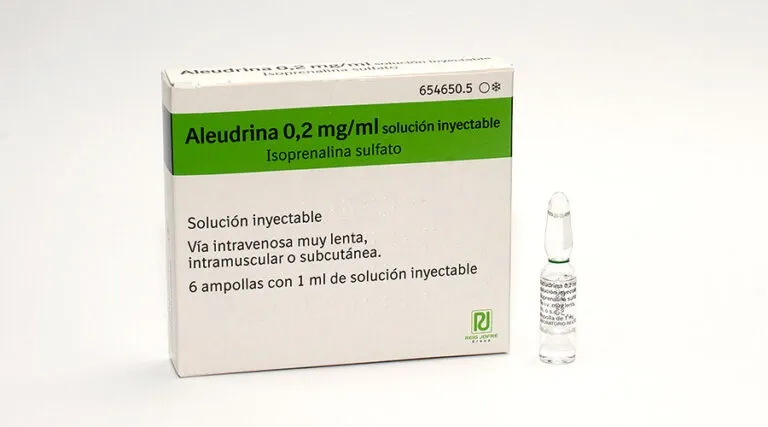
Table of Contents
- Package leaflet: Information for the user
- Introduction
- 1. What Aleudrina 0.2 mg/ml is and what it is used for
- 2. What you need to know before using Aleudrina 0.2 mg/ml
- 3. How to use Aleudrina 0.2 mg/ml
- 4. Possible adverse effects
- 5. Storage of Aleudrina 0.2 mg/ml
- 6. Contents of the pack and other information
Package leaflet: Information for the user
Introduction
Package leaflet: information for the user
Aleudrina 0.2 mg/ml injectable solution
Isoprenaline Sulfate
Read all of this leaflet carefully before you start using this medicine, because it contains important information for you.
- Keep this leaflet, as you may need to read it again.
- If you have any questions, ask your doctor or pharmacist.
- This medicine has been prescribed for you only and must not be given to other people, even if they have the same symptoms, as it may harm them.
- If you experience any adverse effects, consult your doctor, pharmacist, or nurse, even if such effects are not listed in this leaflet.
Contents of the leaflet:
- What Aleudrina 0.2 mg/ml injectable solution is and what it is used for
- What you need to know before taking Aleudrina 0.2 mg/ml injectable solution
- How to take Aleudrina 0.2 mg/ml injectable solution
- Possible adverse effects
- How to store Aleudrina 0.2 mg/ml injectable solution
- Contents of the pack and other information
1. What Aleudrina 0.2 mg/ml is and what it is used for
Aleudrina belongs to a group of medicines known as beta-adrenergic agonists, which stimulate the rate and force of heart contractions.
Aleudrina is used in the treatment of Morgagni-Stokes-Adams syndrome (transient episodes of dizziness, loss of consciousness, and seizures due to a sudden reduction in cerebral blood flow), bradycardia (decreased heart rate), and cardiac blocks. It is also indicated in conditions associated with insufficient cardiac output, such as cardiogenic shock (when the heart is unable to pump sufficient blood) or following cardiac surgery.
2. What you need to know before using Aleudrina 0.2 mg/ml
Do not use Aleudrina 0.2 mg/ml
- If you are allergic (hypersensitive) to isoprenaline or to any of the other components of this medicine (listed in section 6).
- If you have hyperthyroidism (a metabolic disorder in which there is excessive activity of the thyroid gland).
- If you have had or currently have angina pectoris.
- If you suffer from tachycardia arrhythmias with increased heart rate.
- If you have decompensated heart disease (heart disease with insufficient cardiac contraction).
- If you have aortic stenosis (the aortic valve is narrowed).
- If you have recently suffered a myocardial infarction.
- If you have tachycardia (increased heart rate) or heart block (the cardiac impulse does not propagate properly) as a consequence of taking digitalis agents (medicines used to treat heart failure and heart rhythm disorders derived from digitalis).
- If you are taking other beta-1 agonists such as adrenaline, due to the risk of arrhythmias (see section Interaction of Aleudrina 0.2 mg/ml with other medicines).
Warnings and precautions
Consult your doctor, pharmacist, or nurse before starting to take Aleudrina:
- If you are elderly.
- If you are diabetic.
- If you have hyperthyroidism.
- If you have hypersensitivity to sympathomimetic drugs (stimulants of the sympathetic system), e.g., adrenaline.
- If you have cardiovascular diseases such as: ischemic heart disease (insufficient blood and oxygen supply to the heart), arrhythmia (disorder in heart rhythm), or tachycardia, occlusive vascular disease (narrowing of arteries), including arteriosclerosis (hardening of arterial walls).
- If you are being treated with digitalis agents.
- If you have hypertension.
- If you have aneurysms (dilatation of arterial walls).
- If you have prostate problems.
- If you have narrow-angle glaucoma (a disorder with increased intraocular pressure).
- If you are pregnant and delivery is imminent, as it inhibits uterine contractions.
- If you are breastfeeding.
- If you have liver disease.
- If you have kidney disease.
- If you have asthma.
- If you have epileptic seizures.
Use with caution if administered simultaneously with monoamine oxidase inhibitor (MAOI) antidepressants (a type of antidepressant medication) (see section Use of other medicines).
In cases of increased cardiac excitability (heart rhythm disorders) and tendency to extrasystoles (rapid contractions of the heart ventricles), your doctor will prescribe a particularly cautious dosage.
Use in athletes:
Athletes are advised that this medicine contains isoprenaline, which may lead to a positive result in doping control tests.
Interaction of Aleudrina 0.2 mg/ml with other medicines
Inform your doctor or pharmacist if you are taking, have recently taken, or might need to take any other medicines.
Aleudrina must not be administered simultaneously with sympathomimetic agents such as adrenaline, other sympathomimetic amines, tricyclic antidepressants, or monoamine oxidase inhibitors (MAOIs), as their combined effect may induce arrhythmias.
Isoprenaline increases the elimination of theophylline (a bronchodilator) and may potentiate hypokalemia (low potassium levels), hyperglycemia (high blood sugar), tachycardia, and hypertension.
Beta-adrenergic blockers (medicines that help reduce heart rate), such as propranolol, may antagonize the effect of isoprenaline.
Aleudrina should be used with caution in patients receiving halogenated anesthetics or cyclopropane (types of anesthetic gases), as arrhythmias may occur.
Fertility, pregnancy, and breastfeeding
It is not known whether this medicine may affect reproductive capacity.
If you are pregnant or breastfeeding, think you may be pregnant, or plan to become pregnant, consult your doctor or pharmacist before using this medicine.
Due to its inhibitory effect on uterine contractions, Aleudrina should be used with caution during periods close to delivery.
It is unknown whether isoprenaline is excreted in breast milk; therefore, the benefits of treatment must be weighed against the potential risk before administering this medicine.
Driving and use of machines
Not applicable, as Aleudrina is intended solely for emergency use.
Important information about some of the components of Aleudrina 0.2 mg/ml
This medicine may cause severe allergic reactions and bronchospasm (sudden sensation of suffocation) because it contains sodium metabisulfite (E 223).
This medicine contains less than 23 mg (1 mmol) of sodium per ampoule and is therefore considered essentially "sodium-free".
3. How to use Aleudrina 0.2 mg/ml
Follow exactly the administration instructions for this medicine as indicated by your doctor or pharmacist. If in doubt, consult your doctor or pharmacist again.
The recommended dose is:
Adults:
For intravenous infusion, one ampoule (0.2 mg or 200 gammas of isoprenaline sulfate) is diluted in 100 ml of infusion fluid, and administered at a rate of 20 drops (= 1 ml) per minute, delivering 2 gammas of Aleudrina (equivalent to 0.002 mg of aleudrine).
This is the dose delivered when the infusion of one ampoule is calculated to last approximately 1 1/2 hours.
Children:
Children should receive from 1/4 to 1/2 of the adult dose.
In special situations (Stokes-Adams attacks, shock (the heart is unable to pump the necessary blood), or collapse (a sudden and severe drop in blood pressure causing respiratory insufficiency)) where intravenous infusion cannot be performed, 1/2 to 1 ampoule of Aleudrina may be administered subcutaneously or, more rarely, intramuscularly.
In case of inadequate response, consider the possibility of a metabolic acidosis (a condition caused by excess acid in tissues and blood).
In such cases, administration of infusions of sodium lactate or sodium bicarbonate, or other buffer solutions, is recommended until the alkaline reserve is balanced.
If you use more Aleudrina 0.2 mg/ml than you should
In exceptional cases of administration of truly excessive doses, some of the following symptoms characteristic of beta-adrenergic stimulant intoxication may occur: facial flushing, hand tremor, restlessness, palpitations, extrasystolic tachycardia (a heartbeat occurring earlier than the normal rhythm), ventricular fibrillation (a chaotic increase in heart rate), cardialgia (pain in the area of the heart), nausea.
Profound hypotension (a significant drop in blood pressure) may occur, and symptoms resembling shock may develop.
Treatment:
Most toxic effects subside upon discontinuation of treatment.
Beta-adrenergic receptor blocking agents should be used. Additionally, sedatives or tranquilizers may be administered.
In case of overdose or accidental injection, consult your doctor, pharmacist, or nurse, or call the Toxicology Information Service at telephone number 91 562 04 20, indicating the medicine and the amount injected.
4. Possible adverse effects
Like all medicines, Aleudrina can produce adverse effects, although not everyone will experience them.
The main adverse reactions include tachycardia, arrhythmias, palpitations, hypotension, tremors, headache, sweating, and hot flushes. Prolonged use has been associated with edema of the parotid glands.
Other possible adverse reactions are: anxiety, fear, restlessness, insomnia, confusion, irritability, headache, and psychotic states. Dyspnea, weakness, anorexia, nausea, and vomiting are also common.
Paradoxically, in some patients, isoprenaline has precipitated Stock-Adams attacks (transient cardiac arrest) during normal sinus rhythm or transient atrioventricular block.
If you experience any adverse effects, consult your doctor, pharmacist, or nurse, even if they are adverse effects not listed in this leaflet.
5. Storage of Aleudrina 0.2 mg/ml
Store in a refrigerator (between 2°C and 8°C).
Keep this medicine out of the sight and reach of children.
Do not use Aleudrina after the expiry date stated on the packaging. The expiry date refers to the last day of the month indicated.
Medicines must not be disposed of via wastewater or household waste. Dispose of unused medicines and their containers at the SIGRE Point in your pharmacy. If you have any doubts, ask your pharmacist how to dispose of medicines and containers you no longer need. This will help protect the environment.
6. Contents of the pack and other information
Composition of Aleudrina 0.2 mg/ml
-
The active substance is Isoprenaline sulfate.
-
The other components (excipients) are:
Sodium metabisulfite (E 223), disodium edetate, sodium chloride, hydrochloric acid and water for injections.
Appearance of the product and contents of the pack
Clear, colourless solution.
Each 1 ml ampoule contains 0.2 mg of isoprenaline sulfate.
Marketing Authorization Holder and Manufacturer
Laboratorio Reig Jofré
c/ Gran Capitán 10
08970 Sant Joan Despí
Barcelona
This patient information leaflet was approved in January 2012
Detailed and up-to-date information on this medicine is available on the website of the Spanish Agency for Medicines and Health Products (AEMPS) http://www.aemps.gob.es/