Alerlisin 1 mg/ml oral solution
Spain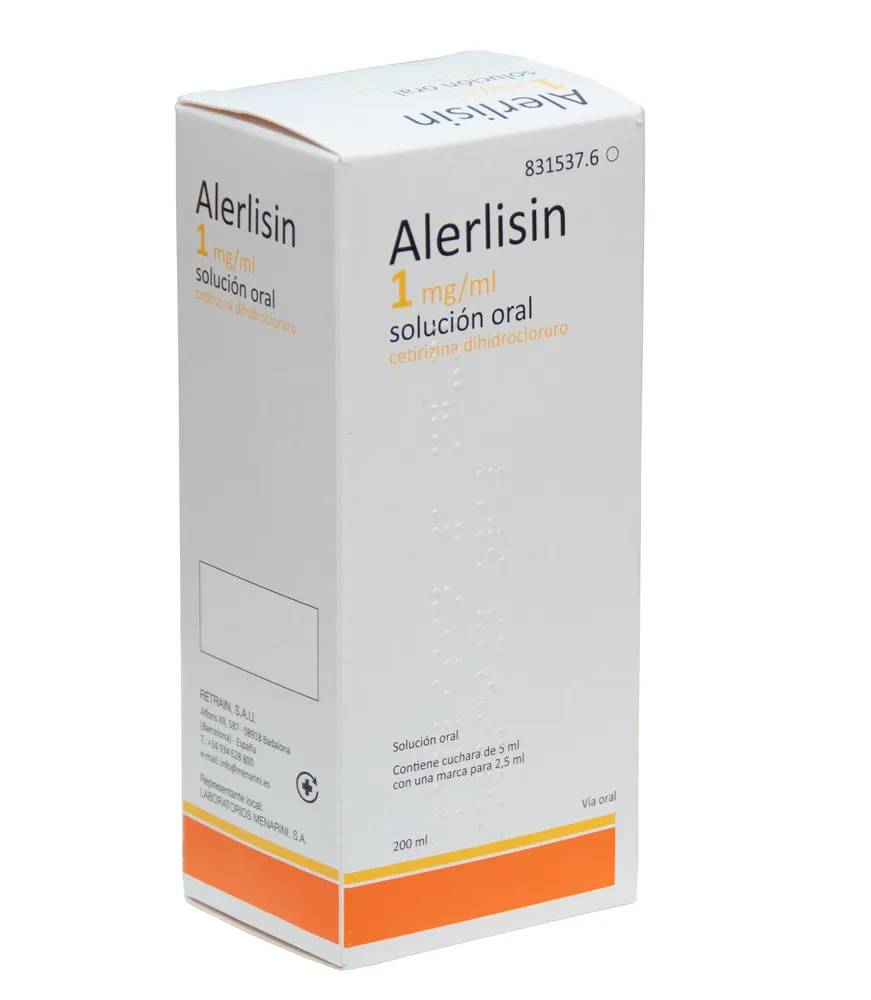
Table of Contents
Package leaflet: Information for the user
Introduction
Package leaflet: information for the user
Alerlisin 1mg/ml oral solution
cetirizine dihydrochloride
Read all of this leaflet carefully before you start taking this medicine, because it contains important information for you.
-
Keep this leaflet, as you may need to read it again.
-
If you have any questions, ask your doctor or pharmacist.
-
This medicine has been prescribed for you only, and you should not give it to other people, even if they have the same symptoms as you, because it may harm them.
-
If you experience any adverse effects, consult your doctor or pharmacist, even if these are adverse effects not listed in this leaflet. See section 4.
Contents of this leaflet
- What Alerlisin is and what it is used for
- What you need to know before taking Alerlisin
- How to take Alerlisin
- Possible side effects
- How to store Alerlisin
- Contents of the pack and other information
1. What Alerlisin is and what it is used for
The active substance of Alerlisin is cetirizine dihydrochloride.
Alerlisin is an antiallergic medicine.
Alerlisin is indicated in adults and children from 2 years of age for:
- relief of nasal and ocular symptoms associated with seasonal and perennial allergic rhinitis.
- relief of chronic urticaria (chronic idiopathic urticaria).
2. What you need to know before taking Alerlisin
Do not take Alerlisin
- if you have severe kidney disease (severe renal insufficiency with creatinine clearance below 10 ml/min);
- if you are allergic to the active substance, to any of the other ingredients of this medicine (listed in section 6), to hydroxyzine, or to any piperazine derivative (active substances closely related to other drugs).
You must not take Alerlisin 1 mg/ml oral solution if:
- you have rare hereditary fructose intolerance.
Warnings and precautions
Talk to your doctor or pharmacist before taking Alerlisin
-
if you have renal impairment, consult your doctor; if necessary, you will be prescribed a lower dose. Your doctor will determine the new dose.
-
if you are an epileptic patient or a patient at risk of seizures, consult your doctor.
No clinically significant interactions have been observed between alcohol (with a blood level of 0.5 per mille) and cetirizine at normal doses. However, as with all antihistamines, it is recommended to avoid concomitant alcohol consumption during treatment.
Taking Alerlisin with other medicines
Tell your doctor or pharmacist if you are taking, have recently taken, or might need to take any other medicines.
Due to the profile of cetirizine, no interactions with other drugs are expected.
Children
The use of this medicine is not recommended in children under 2 years of age.
Taking Alerlisin with food and drinks
Food does not significantly affect the extent of absorption of cetirizine.
Pregnancy and breastfeeding
If you are pregnant or breastfeeding, think you may be pregnant, or are planning to become pregnant, consult your doctor or pharmacist before using this medicine.
The use of Alerlisin should be avoided in pregnant women. Accidental use of the medicine in pregnant women does not produce any harmful effects on the fetus. However, treatment with the medicine should be discontinued.
Alerlisin should not be taken during breastfeeding, as cetirizine is excreted in breast milk.
Driving and using machines
Clinical studies have not shown evidence that Alerlisin causes disturbances in attention, reduced reaction capacity, or impaired driving ability at the recommended dose.
If you intend to drive, perform potentially hazardous activities, or operate machinery, you must not exceed the recommended dose. You should closely monitor your response to the medicine.
If you are a sensitive individual, you may find that the concomitant use of alcohol or other central nervous system depressants may further impair your attention and reaction capacity.
Alerlisin contains sorbitol (E-420), methyl parahydroxybenzoate (E-218), propyl parahydroxybenzoate (E-216), propylene glycol (E-1520), and sodium
This medicine contains 450 mg of sorbitol (E-420) in each ml.
Sorbitol is a source of fructose. If your doctor has informed you (or your child) that you have an intolerance to certain sugars, or if you (or your child) have been diagnosed with hereditary fructose intolerance (HFI), a rare genetic disorder in which the patient cannot break down fructose, consult your doctor before taking this medicine.
Sorbitol may cause gastrointestinal discomfort and a mild laxative effect.
It may cause allergic reactions (possibly delayed) because it contains methyl parahydroxybenzoate (E-218) and propyl parahydroxybenzoate (E-216).
This medicine contains 50 mg of propylene glycol (E-1520) in each ml.
This medicine contains less than 23 mg of sodium (1 mmol) per ml; hence, it is essentially “sodium-free”.
3. How to take Alerlisin
Follow exactly the instructions for use of this medicine as given by your doctor or pharmacist. If in doubt, consult your doctor or pharmacist again.
The solution can be taken as it is.
Adults and adolescents from 12 years of age
10 mg once daily as 10 ml of oral solution (2 full tablespoons).
Use in children between 6 and 12 years of age
5 mg twice daily as 5 ml (one full tablespoon) of oral solution twice daily.
Use in children between 2 and 6 years of age
2.5 mg twice daily as 2.5 ml of oral solution (half a tablespoon) twice daily.
Patients with moderate to severe renal impairment
It is recommended that patients with moderate renal impairment take 5 mg once daily.
If you notice that the effect of Alerlisin is too weak or too strong, consult your doctor.
Duration of treatment
The duration of treatment depends on the type, duration, and course of your symptoms and will be determined by your doctor.
If you take more Alerlisin than you should
After an overdose, the adverse effects described below may occur with greater intensity. Adverse effects reported include confusion, diarrhea, dizziness, fatigue, headache, weakness, pupillary dilation, tingling, irritation, sedation, somnolence, stupor, abnormally increased heart rate, tremor, and urinary retention.
Inform your doctor if you think you have taken an overdose of Alerlisin.
Your doctor will then decide what measures should be taken.
In case of overdose or accidental ingestion, go immediately to a medical center or call the Toxicology Information Service at telephone number 91 562 04 20, indicating the medicine and the amount ingested.
If you forget to take Alerlisin
Do not take a double dose to make up for missed doses.
If you stop treatment with Alerlisin
If you have any further questions about the use of this medicine, ask your doctor or pharmacist.
4. Possible adverse effects
Like all medicines, this medicine can cause adverse effects, although not everyone experiences them.
The following adverse effects have been reported in post-marketing experience:
Frequent: may affect up to 1 in 10 people
- Fatigue
- Diarrhea, dry mouth, nausea
- Dizziness, headache
- Somnolence
- Pharyngitis, rhinitis
Uncommon: may affect up to 1 in 100 people
- Abdominal pain
- Asthenia (extreme fatigue), malaise
- Paresthesia (abnormal sensation of the skin)
- Agitation
- Pruritus, rash
Rare: may affect up to 1 in 1,000 people
- Tachycardia (heart beating too fast)
- Edema (swelling)
- Allergic reactions, some severe (very rare)
- Abnormal liver function
- Weight gain
- Seizures, movement disorders
- Aggression, confusion, depression, hallucination, insomnia
- Urticaria
Very rare: may affect up to 1 in 10,000 people
- Thrombocytopenia (low platelet levels in blood)
- Accommodation disorders, blurred vision, ocular nystagmus (eyes exhibit uncontrolled circular movement)
- Syncope, tremor, dysgeusia (taste disturbance)
- Tic
- Abnormal urination
- Edema, drug-induced rash
At the first signs of hypersensitivity, stop taking Alerlisin.
Your doctor will assess the severity and decide on the necessary measures to take.
Reporting of adverse effects
If you experience any type of adverse effect, consult your doctor or pharmacist, even if it is a possible adverse effect not listed in this leaflet. You may also report them directly through the Spanish Pharmacovigilance System for Human Medicines: www.notificaRAM.es. By reporting adverse effects, you can help provide more information on the safety of this medicine.
5. Storage of Alerlisin
Keep this medicine out of the sight and reach of children.
Do not use this medicine after the expiry date stated on the outer packaging and bottle after EXP. The expiry date refers to the last day of the month indicated.
No special storage conditions are required.
Medicines must not be disposed of via wastewater or household waste. Dispose of unused medicines and their containers at the SIGRE Point in your pharmacy. If you are in doubt, ask your pharmacist how to dispose of medicines and containers you no longer need. This will help protect the environment.
6. Contents of the pack and other information
Composition of Alerlisin 1 mg/ml oral solution
- The active substance is cetirizine dihydrochloride. 10 ml (equivalent to 2 measuring spoons) contain 10 mg of cetirizine dihydrochloride.
- The other components are 70 % sorbitol solution (non-crystalline) (E-420), glycerol (E-422), propylene glycol (E-1520), sodium saccharin, methyl 4-hydroxybenzoate (E-218), propyl 4-hydroxybenzoate (E-216), flavouring agent, sodium acetate, acetic acid, purified water.
Nature of the product and pack contents
Colourless, transparent liquid with a slightly sweet taste and banana flavour.
Original packaging containing a bottle of 60, 75, 100, 125, 150 or 200 ml of solution.
Not all pack sizes may be marketed.
Marketing Authorization Holder
RETRAIN, S.A.U.
Alfons XII, 587 – 08918 Badalona (Barcelona) – Spain
Manufacturer
LABORATORIOS MENARINI, S.A.
Alfons XII, 587 – 08918 Badalona (Barcelona) – Spain
For further information about this medicinal product, contact the local representative of the Marketing Authorization Holder:
LABORATORIOS MENARINI, S.A.
Alfons XII, 587 – 08918 Badalona (Barcelona) – Spain
This medicinal product is authorized in the Member States of the European Economic Area under the following names:
Austria: Zyrtec 1 mg/ml – orale Lösung
Belgium: Zyrtec
Cyprus: Zyrtec
Denmark: Benaday, Zyrtec
Estonia: Zyrtec
Finland: Zyrtec
France: Virlix, Zyrtec
Germany: Zyrtec saft, cetirizin allergie saft
Hungary: Zyrtec oldat
Ireland: Zyrtek oral solution 1 mg/ml
Italy: Zirtec 1 mg/ml soluzione orale
Latvia: Zyrtec
Lithuania: Zyrtec
Luxembourg: Zyrtec
Malta: Zyrtec
Netherlands: Zyrtec
Norway: Zyrtec
Poland: Virlix, Zyrtec
Portugal: Zyrtec, Virlix
Slovenia: Zyrtec 1 mg/ml peroralna raztopina
Spain: Alerlisin, Virlix, Reactine 5 mg/ml oral solution, Zyrtec oral solution
Sweden: Zyrlex
United Kingdom: Benadryl allergy oral syrup, Benadryl for children allergy solution, Zirtek allergy relief for children, Zirtek allergy solution 1 mg/ml
Date of the most recent review of this leaflet: January 2020
Detailed and up-to-date information on this medicinal product is available on the website of the Spanish Agency of Medicines and Health Products (AEMPS) http://www.aemps.gob.es/