Aldomet 250 mg film-coated tablets
Spain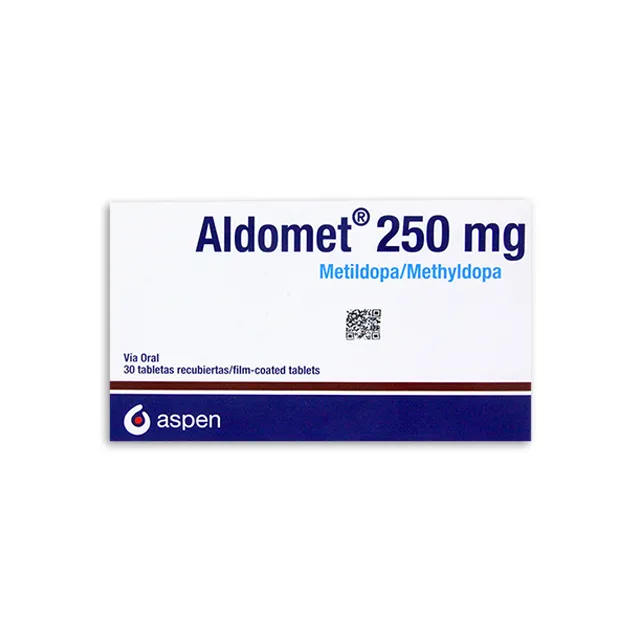
Table of Contents
Package leaflet: Information for the user
Introduction
Package leaflet: information for the user
Aldomet® 250 mg film-coated tablets
Metildopa
Read all of this leaflet carefully before you start taking this medicine because it contains important information for you.
- Keep this leaflet. You may need to read it again.
- If you have any questions, ask your doctor or pharmacist.
- This medicine has been prescribed for you only. Do not pass it on to other people, even if they have the same symptoms as you, because it may harm them.
- If you experience any adverse effects, consult your doctor or pharmacist, even if they are adverse effects not listed in this leaflet. See section 4.
Leaflet contents:
- What Aldomet is and what it is used for
- What you need to know before taking Aldomet
- How to take Aldomet
- Possible side effects
- How to store Aldomet
- Contents of the pack and other information
1. What Aldomet is and what it is used for
Aldomet contains methyldopa as the active substance. Aldomet belongs to a group of medicines called antihypertensives, which lower blood pressure.
Aldomet tablets are used for the treatment of high blood pressure (hypertension).
2. What you need to know before taking Aldomet
Do not take Aldomet
- if you are allergic to methyldopa or to any of the other ingredients of this medicine (listed in section 6).
- if you have any liver disease
- if you suffer from depression
- if you have high blood pressure due to a tumor near the kidney called a pheochromocytoma or paraganglioma.
- if you are taking any medication for depression belonging to the group of monoamine oxidase inhibitors (MAOIs)
- if you have porphyria (an inherited metabolic disorder)
Warnings and precautions
Talk to your doctor or pharmacist before starting to take this medicine. Inform your doctor if you have or have had any of the following conditions:
- any liver disease or jaundice (yellowing of the skin)
- kidney problems
- blood disorders such as hemolytic anemia
- fever
- involuntary movements
Inform your doctor:
- if you are undergoing surgery, including dental surgery, as Aldomet, in combination with certain anesthetics, may cause a drop in blood pressure.
- if you are undergoing dialysis,
- if you need a blood transfusion or blood tests, since Aldomet may alter the results of such tests.
Your doctor may want to monitor proper liver function and carry out blood tests during the first 6–12 weeks of treatment with Aldomet. These tests may also be performed if you develop fever of no apparent cause at any time during treatment with Aldomet.
Laboratory tests
If you need a urine or blood test, inform your doctor or laboratory staff that you are taking Aldomet.
Aldomet may affect the results of certain tests.
In rare cases, in patients taking Aldomet, urine may darken when exposed to air.
Taking Aldomet with other medicines
Tell your doctor or pharmacist if you are using, have recently used, or might need to use any other medicines.
Certain medicines may interact with Aldomet. In such cases, it may be necessary to adjust the dose or discontinue treatment with one of the other medicines.
This is especially important if you are taking:
- lithium, used to treat depression and mental illnesses
- other medicines used to treat high blood pressure
- iron or iron supplements, such as multivitamins with minerals
- sympathomimetic medicines, mainly used for cough and colds
- non-steroidal anti-inflammatory drugs (NSAIDs), used for pain relief
- anxiolytic medicines used to treat anxiety or insomnia
- medicines used to treat Parkinson's disease
- antipsychotic medicines used to treat mental illnesses
- monoamine oxidase inhibitors (MAOIs), used to treat depression
- muscle relaxants, such as tizanidine
Taking Aldomet with food and alcohol
Avoid drinking alcoholic beverages while taking Aldomet. Alcohol consumption may increase the occurrence of adverse effects.
Pregnancy and breastfeeding
If you are pregnant or breastfeeding, think you may be pregnant, or plan to become pregnant, consult your doctor or pharmacist before using this medicine.
Driving and using machines
Aldomet may cause drowsiness. If this occurs, do not drive or operate any tools or machinery that require alertness.
3. How to take Aldomet
Follow exactly the instructions for use of this medicine as given by your doctor. If in doubt, consult your doctor or pharmacist again.
Your doctor will determine the dose you should take and the duration of treatment.
Adults
The recommended starting dose is 250 mg two or three times a day for two days.
The daily dose may be increased or decreased every two days or more until the desired response is achieved.
The maximum recommended daily dose is 3 g.
Use in children and adolescents
The recommended starting dose is 10 mg per kg of body weight per day, divided into 2 to 4 doses.
The daily dose may be increased or decreased until an adequate response is achieved. The maximum dose is the lower of either 65 mg/kg or 3.0 g per day.
Elderly patients
The initial dose in elderly patients should be kept as low as possible, not exceeding 250 mg daily.
The daily dose may be increased or decreased every two days or more until the desired response is achieved.
The maximum recommended daily dose is 2 g.
If you take more Aldomet than you should
If you have taken more Aldomet tablets than you should, contact your doctor or pharmacist immediately, go to a medical center, or call the Toxicology Information Service at telephone number 91 562 04 20, indicating the medicine and the amount ingested.
Symptoms of overdose include drowsiness, weakness, slow heart rate, low blood pressure, dizziness, lightheadedness, feeling of bloating, gas, nausea, or vomiting.
If you forget to take Aldomet
If you forget a dose, take it as soon as you remember, and then take the next dose at your usual time. Do not take a double dose to make up for forgotten doses.
If you stop taking Aldomet
If you stop taking Aldomet, your blood pressure may rise again. Therefore, do not interrupt treatment without first consulting your doctor.
If you have any further questions about the use of this medicine, ask your doctor or pharmacist.
4. Possible adverse effects
Like all medicines, this medicine can cause adverse effects, although not everyone experiences them.
The following adverse effects have been reported, although their frequency cannot be estimated from the available data.
CONTACT YOUR DOCTOR IMMEDIATELY if you experience any of the following adverse effects, as they are serious and require immediate medical attention:
- Severe allergic reaction, such as difficulty breathing, wheezing ("whistling" when breathing), skin rash or itching, hives, swelling of the lips, face, or tongue.
- Chills, fever, or joint pain.
- Chest pain, slow heart rate. Worsening of angina pectoris, difficulty breathing, palpitations, fever.
- Serious skin reactions (such as painful redness, followed by blistering and peeling of the skin).
- Jaundice (yellowing of the skin and whites of the eyes), sometimes accompanied by fever, pale stools, and dark urine.
- Intestinal pain and diarrhea caused by inflammation of the intestine (colitis).
- Severe pain in the intestine and back caused by inflammation of the pancreas (pancreatitis).
The following adverse effects have also been reported:
Blood:
- Changes in the number and type of blood cells. Inform your doctor if you develop unexplained bruising, nosebleeds, sore throat, infections, or fever.
- Decrease in the number of red blood cells (anemia). This may cause your skin to appear pale and make you feel weak or short of breath.
- Bruising and prolonged bleeding after injury.
Nervous system:
- Drowsiness or fatigue. This may occur at the beginning of treatment or when the dose is increased. It usually resolves over time.
- Headache or feeling of weakness. This may occur at the beginning of treatment and usually resolves.
- Tingling or "pins and needles" sensation.
- Parkinsonism, such as tremors, shuffling gait, reduced body movements, and inability to move muscles.
- Partial facial paralysis.
- Involuntary movements.
- Impaired mental agility.
- Dizziness upon standing or frequent fainting, likely due to low blood pressure.
Nose and chest:
- Nasal congestion.
Digestive system:
- Nausea, vomiting, abdominal pain and bloating, constipation, diarrhea, flatulence (gas).
- Dry mouth, black discoloration of the tongue, and tongue pain.
Skin and hair:
- Eczema, skin rash, peeling, urticaria (rosy patches accompanied by intense itching).
Joints and muscles:
- Joint pain and inflammation.
- Muscle pain and cramps.
Infections:
- Inflammation of the salivary glands.
General condition:
- Fluid retention causing swelling and weight gain.
- Fever, weakness.
Reproductive system and breasts:
- Breast enlargement in both men and women.
- Absence of menstruation.
- Abnormal milk secretion not related to breastfeeding.
- Impotence, failure to ejaculate.
- Decreased sexual desire.
Psychiatric disorders:
- Mental disturbances including nightmares, confusion, drowsiness, depression.
- Delusions and paranoia. These usually disappear when the medicine is discontinued.
Laboratory tests:
Your doctor may need to perform blood tests during the first few months of treatment with Aldomet.
Results may show:
- a decrease in blood cell production
- an increase in certain white blood cells
- abnormal levels of prolactin (a hormone that stimulates milk secretion)
Aldomet may also interfere with the interpretation of certain blood and urine tests.
Reporting of adverse effects
If you experience any type of adverse effect, consult your doctor or pharmacist, even if it is a possible adverse effect not listed in this leaflet. You may also report them directly via the Spanish Pharmacovigilance System for Human Medicines: https://www.notificaram.es.
By reporting adverse effects, you can help provide more information on the safety of this medicine.
5. Storage of Aldomet
Keep this medicine out of the sight and reach of children. No special storage conditions are required.
Do not use this medicine after the expiry date stated on the packaging after EXP. The expiry date is the last day of the month indicated.
Medicines must not be disposed of via wastewater or household waste. Dispose of empty containers and unused medicines at the SIGRE collection point at your pharmacy. If you are unsure, ask your pharmacist how to properly dispose of unused containers and medicines. This will help protect the environment.
6. Contents of the pack and other information
Composition of Aldomet 250 mg film-coated tablets
- The active substance is methyldopa. Each film-coated tablet contains 250 mg of methyldopa.
- The other components are:
Tablet core: anhydrous citric acid, disodium calcium edetate, ethylcellulose, guar gum, powdered cellulose, colloidal silicon dioxide, magnesium stearate.
Coating: citric acid monohydrate, hypromellose, propylene glycol, red iron oxide (E-172), titanium dioxide (E-171), talc, quinoline yellow aluminium lake, carnauba wax.
Appearance of the product and contents of the pack
Aldomet 250 mg are film-coated, round, biconvex, yellow tablets, marked with “ALDOMET” on one side and “250” on the other. They are available in blister packs containing 30 or 60 film-coated tablets.
Marketing Authorization Holder and Manufacturer
Marketing Authorization Holder
H.A.C. Pharma
Péricentre II
43 Avenue de la Côte de Nacre
14000 Caen
France
Manufacturer
allphamed PHARBIL Arzneimittel GmbH
Hildebrandstrasse 10-12
37081 Göttingen - Germany
You can request further information about this medicinal product by contacting the local representative of the Marketing Authorization Holder:
Euromed Pharma Spain, S.L.
C/Eduard Maristany, 430-432
08918 Badalona - Spain
Tel: +34 932 684 208
Fax: +34 933 150 469
Date of the most recent review of this leaflet: June 2018
Detailed and up-to-date information on this medicinal product is available on the website of the Spanish Agency of Medicines and Health Products (AEMPS) http://www.aemps.gob.es/.