Aldactacine 25 mg/15 mg tablets
Spain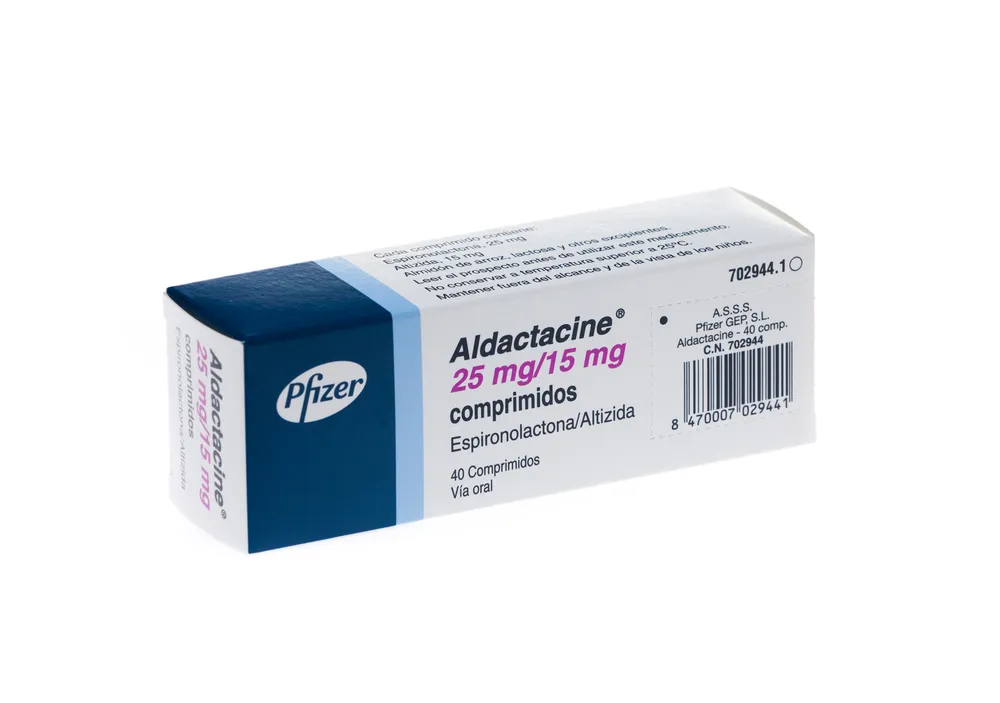
Table of Contents
Package leaflet: Information for the user
Introduction
Package leaflet: information for the user
Aldactacine 25 mg/15 mg tablets
spironolactone/altizide
Read the entire leaflet carefully before you start taking this medicine, because it contains important information for you.
- Keep this leaflet, as you may need to read it again.
- If you have any questions, ask your doctor, pharmacist, or nurse.
- This medicine has been prescribed for you only, and you should not give it to others, even if they have the same symptoms as you, because it may harm them.
- If you experience any adverse reactions, consult your doctor, pharmacist, or nurse, even if they are adverse reactions not listed in this leaflet. See section 4.
Leaflet contents
- What Aldactacine is and what it is used for
- What you need to know before taking Aldactacine
- How to take Aldactacine
- Possible side effects
- How to store Aldactacine
- Contents of the pack and other information
1. What Aldactacine is and what it is used for
Aldactacine contains two active substances, spironolactone and althiazide. Spironolactone and althiazide belong to a group of medicines called diuretics. These are medicines that increase the removal of fluid from the body.
Aldactacine is used to reduce high blood pressure (hypertension) and swelling due to fluid accumulation (edema) caused by certain kidney, liver, or heart conditions.
2. What you need to know before taking Aldactacine
Do not take Aldactacine:
- if you are allergic to the active substances (spironolactone and altizide) or to any of the other components of this medicine (listed in section 6).
- if you have a history of autoimmune diseases such as systemic lupus erythematosus
- if you have certain kidney function disorders (acute renal failure, severely impaired renal function, lack of urine reaching the bladder, or anuria)
- if you have high levels of potassium or calcium in the blood
- if you suffer from a disease called Addison’s disease, which causes damage to the adrenal cortex leading to hormonal deficiency
- if you are taking eplerenone (a medicine used to reduce high blood pressure).
Warnings and precautions
Talk to your doctor, pharmacist, or nurse before starting Aldactacine if:
- you have severe liver problems, including hepatic cirrhosis
- you are diabetic
- you have kidney or liver problems, or if you are elderly, as the use of spironolactone and altizide may alter your blood levels of certain electrolytes; your doctor will perform periodic monitoring
- you are scheduled for surgery, as altizide may alter the response to certain medications used during operations
- you suffer from gout
- you are taking other medicines that may reduce potassium levels in the blood
- the use of spironolactone with potassium-containing salt substitutes is not recommended, as it may lead to severe poisoning
Concomitant administration of Aldactacine with certain medicines, potassium supplements, or potassium-rich foods may cause severe hyperkalemia (increased blood potassium concentration). Symptoms of severe hyperkalemia may include muscle cramps, irregular heartbeat, diarrhea, nausea, dizziness, or headache.
Contact your doctor as soon as possible if during treatment you experience a decrease in vision or eye pain, as these could be symptoms of fluid accumulation in the vascular layer of the eye (choroidal effusion) or increased eye pressure, which may occur within hours to weeks after taking Aldactacine.
During treatment with Aldactacine, your doctor may perform periodic tests to monitor your blood levels of salts, cholesterol, and triglycerides to help predict the risk of adverse effects.
Other medicines and Aldactacine
Inform your doctor or pharmacist if you are taking, have recently taken, or might need to take any other medicine. Some medicines may interact with Aldactacine:
- Medicines that may alter potassium levels in the blood (e.g., potassium-sparing diuretics)
- Concomitant use of Aldactacine with medicines known to increase blood potassium levels may lead to a serious condition of elevated blood potassium.
- Medicines for pain and fever (e.g., aspirin, antipyrine)
- Certain anti-ulcer agents (e.g., carbenoxolone)
- Non-steroidal anti-inflammatory drugs (aspirin, indomethacin, mefenamic acid)
- Medicines that may alter the body's electrolyte balance (e.g., ammonium chloride, cholestyramine)
- Muscle relaxants (e.g., tubocurarine)
- Certain anti-inflammatory medicines (corticosteroids)
- Other medicines that lower blood pressure (antihypertensives)
- Alcohol, barbiturates, narcotics
- Medicines used in emergency situations to raise blood pressure (e.g., norepinephrine)
- Medicines to regulate heart rhythm (e.g., digoxin)
- Lithium
- Certain medicines to reduce cholesterol levels (cholestyramine and colestipol)
- Medicines for diabetes (oral hypoglycemics and insulin)
- Medicines for gout (e.g., allopurinol, uricosurics, xanthine oxidase inhibitors)
- Trimethoprim and trimethoprim-sulfamethoxazole.
Inform your doctor if you are taking abiraterone for the treatment of prostate cancer.
Inform your doctor if you are taking mitotane for the treatment of malignant adrenal gland tumors. This medicine must not be used together with mitotane.
Interference with diagnostic tests
Aldactacine may interfere with the results of certain diagnostic tests. If you are to undergo any diagnostic test to assess digoxin levels, inform your doctor that you are being treated with Aldactacine, as it may alter test results.
Aldactacine may also alter the results of parathyroid function tests; therefore, treatment should be discontinued before performing these tests.
Use in children
The use of Aldactacine is not recommended in children or adolescents under 18 years of age.
Taking Aldactacine with food, drinks, and alcohol
Alcohol
Avoid drinking large amounts of alcohol while taking this medicine, as it may enhance the hypotensive effect of Aldactacine.
Pregnancy, breastfeeding, and fertility
If you are pregnant or breastfeeding, think you may be pregnant, or are planning to become pregnant, consult your doctor or pharmacist before using this medicine.
Pregnancy
There is limited data on the use of Aldactacine in pregnant women. Your doctor will prescribe Aldactacine only if the potential benefit outweighs the potential risk.
Breastfeeding
Aldactacine must not be used if you are breastfeeding your child. Discuss the use of Aldactacine with your doctor, who will advise you to consider an alternative method of feeding your baby while taking this medicine.
Fertility
Women of childbearing age should use appropriate contraceptive measures.
Consult your doctor or pharmacist before taking any medicine.
Use in athletes
Athletes should be aware that this medicine contains a component that may result in a positive analytical finding in doping controls.
Driving and use of machines
Aldactacine may cause drowsiness and dizziness, especially at the beginning of treatment. If you experience these effects, consult your doctor before engaging in such activities.
Do not operate tools or machinery if your ability to do so is affected by this medicine.
Aldactacine contains lactose and sodium
If your doctor has diagnosed you with an intolerance to certain sugars, consult him before taking this medicine.
This medicine contains less than 1 mmol of sodium (23 mg) per tablet; therefore, it is essentially “sodium-free”.
3. How to TAKE Aldactacine
The recommended starting dose of Aldactacine is 1 to 2 tablets per day. Your doctor may increase or decrease this dose as needed to reach the dose suitable for you. Your doctor will adjust the dose at intervals of 2 weeks or more. The maximum dose of Aldactacine is 8 tablets per day.
Aldactacine tablets can be taken at any time of day, with or without food. However, try to take your tablet at the same time each day.
Always follow exactly the instructions provided by your doctor or pharmacist. If in doubt, consult your doctor or pharmacist again.
Your doctor will decide how long your treatment with Aldactacine should last.
Ask your doctor if you think that the effect of Aldactacine is too strong or too weak.
If you take more Aldactacine than you should
In case of overdose or accidental ingestion, contact your doctor or pharmacist immediately or call the Toxicology Information Service at 91 562 04 20.
If you forget to take Aldactacine
If you miss a dose, take the next scheduled dose at the correct time.
Do not take a double dose to make up for a missed dose.
If you stop taking Aldactacine
If you have any further questions about the use of this medicine, ask your doctor or pharmacist.
4. Possible adverse effects
Like all medicines, this medicine can cause adverse effects, although not everyone will experience them. If you consider any of the adverse effects you experience to be severe, or if you notice any adverse effects not listed in this leaflet, inform your doctor or pharmacist.
The following adverse effects are important and, if you experience any of them, immediate action will be required:
- Occasionally, patients have developed disturbances in blood electrolytes, and very rarely this has led to a serious, potentially life-threatening condition (called hyperkalemia). If you experience irregular heartbeat, tingling sensation, muscle weakness, flaccid paralysis, or muscle spasms, stop taking Aldactacine and contact your doctor immediately.
Very common adverse effects (may affect more than 1 in 10 people):
- Increased potassium in the blood (hyperkalemia)
Common adverse effects (may affect up to 1 in 10 people):
- Confusion
- Dizziness, headache, drowsiness
- Diarrhea, vomiting, nausea, abdominal pain
- Itching, skin rash
- Leg cramps
- Acute kidney injury
- Excessive breast development in men (gynecomastia), breast pain in men, breast enlargement, menstrual disturbances (irregularities, amenorrhea, postmenopausal bleeding), impotence
- Fever, fatigue, malaise
Uncommon adverse effects (may affect up to 1 in 100 people):
- Benign breast tumors in men
- Disturbances in blood electrolytes, decreased sodium
- Tingling sensation (paresthesia), cramps
- Inflammation of the pancreas
- Jaundice, liver function abnormalities
- Photosensitivity, eczema, urticaria, redness
- Increased blood creatinine concentration
- Breast pain in women
Rare adverse effects (may affect up to 1 in 1,000 people):
- Decreased number of neutrophils in the blood (agranulocytosis), decreased number of white blood cells (leukopenia), decreased number of platelets (thrombocytopenia)
- Acute kidney failure
Very rare adverse effects (may affect up to 1 in 10,000 people):
- Benign breast tumors
- Changes in libido
- Lack of coordination of movement (ataxia)
- Hair loss (alopecia), excessive hair growth (hypertrichosis)
- Chest pain
Adverse effects with unknown frequency (cannot be estimated from available data):
- Allergic reaction, activation of autoimmune processes (lupus erythematosus)
- Non-physical origin impotence
- Decreased vision or eye pain due to elevated pressure [possible signs of fluid accumulation in the vascular layer of the eye (choroidal effusion) or acute angle-closure glaucoma], blurred vision for distant objects (acute myopia)
- Gastrointestinal disorders
- Serious skin reactions (toxic epidermal necrolysis, Stevens-Johnson syndrome, drug reaction with eosinophilia and systemic symptoms), pemphigoid (a disease causing fluid-filled blisters on the skin)
- Lupus
Reporting of adverse effects
If you experience any type of adverse effect, consult your doctor or pharmacist, even if it is a possible adverse effect not listed in this leaflet. You may also report them directly via the Spanish Pharmacovigilance System for Human Medicines: https://www.notificaram.es. By reporting adverse effects, you can help provide more information on the safety of this medicine.
5. Storage of Aldactacine
Keep this medicine out of sight and reach of children. Do not store above 25°C.
Do not use this medicine after the expiry date stated on the packaging after EXP. The expiry date refers to the last day of the month indicated.
Do not use this medicine if you notice any visible signs of deterioration.
Medicines must not be disposed of via wastewater or household waste. Dispose of unused medicines and their containers at the SIGRE point located at your pharmacy. If you have any doubts, ask your pharmacist how to properly dispose of unused medicines and their packaging. This will help protect the environment.
6. Contents of the pack and other information
Composition of Aldactacine
-
The active substances are spironolactone and altizide. Each tablet contains 25 mg of spironolactone and 15 mg of altizide.
-
The other components (excipients) are: monohydrate lactose, rice starch, sodium lauryl sulfate, potassium polymethacrylate, and magnesium stearate E 470b.
Appearance of the product and contents of the pack
Aldactacine tablets are white, biconvex, and scored.
Aldactacine is available in cartons containing blisters with 40 tablets.
Marketing Authorization Holder and Manufacturer
Marketing Authorization Holder
Pfizer, S.L.
Avda. de Europa, 20-B
Parque Empresarial La Moraleja
28108 Alcobendas (Madrid)
Spain
Manufacturer
Piramal Pharma Solutions (Dutch) B.V.
Bargelaan 200
2333 CW
Leiden
The Netherlands
Date of the most recent revision of this leaflet: 02/2025
Detailed and up-to-date information on this medicinal product is available on the website of the Spanish Agency of Medicines and Health Products (AEMPS): http://www.aemps.gob.es