Albutein 200 g/L solution for infusion
Spain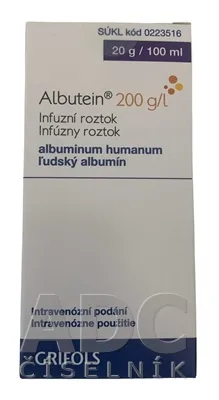
Table of Contents
- Package leaflet: Information for the user
- Introduction
- 1. What Albutein 200 g/l is and what it is used for
- 2. What you need to know before using Albutein 200 g/l
- **Other medicines and Albutein 200 g/l**
- **Pregnancy, lactation and fertility**
- 3. How to use Albutein 200 g/l
- 4. Possible adverse effects
- 5. Storage of Albutein 200 g/l
- 6. Contents of the pack and other information
Package leaflet: Information for the user
Introduction
Package leaflet: information for the user
Albutein 200 g/l solution for infusion
human albumin
Read the entire leaflet carefully before you start using this medicine, because it contains important information for you.
- Keep this leaflet as you may need to read it again.
- If you have any questions, ask your doctor, pharmacist or nurse.
- This medicine has been prescribed for you only, and you must not give it to other people, even if they have the same symptoms as you, because it may harm them.
- If you experience any adverse reactions, consult your doctor, pharmacist or nurse, even if they are adverse reactions not listed in this leaflet. See section 4.
Contents of the leaflet
- What Albutein 200 g/l is and what it is used for
- What you need to know before using Albutein 200 g/l
- How to use Albutein 200 g/l
- Possible side effects
- How to store Albutein 200 g/l
- Contents of the pack and other information
1. What Albutein 200 g/l is and what it is used for
Albutein 200 g/l is an intravenous infusion solution containing proteins derived from human plasma (plasma proteins), which is the liquid portion of blood. Each vial/bottle/bag contains a solution with 200 g of plasma proteins/l, of which at least 95% is human albumin.
This medicine belongs to the group of medicines known as plasma substitutes and plasma protein fractions.
Albutein 200 g/l is used to restore and maintain circulating blood volume when a volume deficit has been demonstrated and when the use of a plasma substitute is considered appropriate.
Albutein may be used in all age groups. For children, see section 4.
If you have any questions about the use of Albutein 200 g/l, consult your doctor.
2. What you need to know before using Albutein 200 g/l
Do not use Albutein 200 g/l
- If you are allergic (hypersensitive) to the active substance or to any of the other ingredients of this medicine (listed in section 6).
Warnings and precautions
Talk to your doctor, pharmacist, or nurse before using Albutein 200 g/l.
Take special care with Albutein 200 g/l
- If you are at special risk due to an increase in blood volume, for example, in cases of severe heart disease, arterial hypertension, esophageal varices, pulmonary edema, coagulation disorders, severe reduction in red blood cells, or absence of urine production.
- If signs of increased blood volume occur (headache, breathing difficulties, jugular vein distension) or increased blood pressure. The infusion must be stopped immediately.
- If signs of an allergic reaction occur. The infusion must be stopped immediately.
- When used in patients with severe traumatic brain injury.
When medicines derived from human plasma or blood are administered, certain measures are taken to prevent the transmission of infections to patients. These measures include:
- careful selection of donors to exclude those at risk of carrying infectious diseases,
- testing for specific markers of infection in individual donations and in pooled plasma,
- inclusion of steps in the manufacturing process to inactivate and/or remove viruses.
Despite these measures, when medicines derived from human blood or plasma are administered, the possibility of transmitting infectious agents cannot be completely ruled out. This also applies to emerging or unknown viruses and other types of infections.
No cases of viral infections have been reported with albumin manufactured according to the specifications and processes defined in the European Pharmacopoeia.
It is highly recommended that each time healthcare personnel administer a dose of Albutein 200 g/l, they record the name of the medicine and the batch number administered in order to maintain a record of the batches used.
Children
The safety and efficacy of Albutein 200 g/l have not been established in children in controlled clinical trials. However, clinical experience with albumin in children indicates that harmful effects are not expected, provided special attention is paid to dosing in order to avoid circulatory overload.
See also section 4.
Other medicines and Albutein 200 g/l
Inform your doctor or pharmacist if you are taking, have recently taken, or might need to take any other medicines.
No specific complications of human albumin with other medicines are known.
Pregnancy, lactation and fertility
Pregnancy
If you are pregnant or breastfeeding, think you may be pregnant or plan to become pregnant, consult your doctor or pharmacist before using this medicine.
The safety of Albutein 200 g/l use in women during pregnancy has not been established in controlled clinical trials. Clinical experience with albumin suggests that adverse effects on the course of pregnancy, the fetus or the newborn are not expected.
Lactation
It is unknown whether Albutein 200 g/l is excreted in human milk. Excretion of human albumin in breast milk has not been studied in animals. The decision whether to continue/interrupt breastfeeding or to continue/interrupt treatment with Albutein should be made by weighing the benefit of breastfeeding for the infant against the benefit of Albutein therapy for the mother.
Fertility
No animal reproduction studies have been conducted with Albutein 200 g/l.
However, human albumin is a normal constituent of human blood.
Driving and use of machines
No effects on the ability to drive or operate machinery have been observed.
Albutein 200 g/l contains sodium
This medicine contains 33.4 mg of sodium (main component of table/cooking salt) in each 10 ml vial, 166.8 mg of sodium in each 50 ml bottle/bag and 333.5 mg of sodium in each 100 ml bottle/bag. This corresponds to 1.7%, 8.3% and 16.7%, respectively, of the maximum recommended daily sodium intake for an adult.
This medicine contains less than 39 mg (1 mmol) of potassium per vial/bottle/bag and is therefore considered essentially “potassium-free”.
3. How to use Albutein 200 g/l
Albutein 200 g/l is a hospital-use medicine, so it will be administered to you in a hospital by appropriate healthcare personnel.
The dose and infusion rate of Albutein 200 g/l you will receive, as well as the frequency and duration of your treatment, will be adjusted according to your individual needs. Your doctor will determine this.
If you use more Albutein 200 g/l than you should
If you have been given more Albutein 200 g/l than you need, consult your doctor immediately.
If you forget to use Albutein 200 g/l
Do not administer a double dose to make up for a missed dose.
4. Possible adverse effects
Like all medicines, this medicine can produce adverse effects, although not everyone will experience them.
-
Mild reactions such as redness, skin rashes, fever, nausea may occur. These reactions are rare.
-
Very rarely, serious allergic reactions (anaphylactic shock) may occur.
-
For information on viral safety, see section 2.
Other adverse effects in children
There are no specific data available to assess the likelihood of different adverse reactions occurring in this population.
Reporting of adverse effects
If you experience any type of adverse effect, consult your doctor, pharmacist, or nurse, even if it is a possible adverse effect not listed in this leaflet. You may also report them directly through the Spanish Pharmacovigilance System for Human Medicines: www.notificaRAM.es. By reporting adverse effects, you can help provide more information on the safety of this medicine.
5. Storage of Albutein 200 g/l
Keep this medicine out of the sight and reach of children.
Do not use this medicine after the expiry date stated on the container following EXP.
Do not store above 30 °C. Do not freeze.
Keep the vial/bottle/bag in the outer packaging to protect it from light.
Do not use this medicine if you notice that the solution is cloudy or if any precipitate has formed.
Once the container has been opened for connection to the infusion equipment, the contents should be used immediately.
Medicines must not be disposed of via wastewater or household waste. Ask your pharmacist how to dispose of medicines and packaging you no longer need. This will help protect the environment.
6. Contents of the pack and other information
Composition of Albutein 200 g/l
-
The active substance is human albumin. One millilitre of Albutein 200 g/l contains 200 mg of plasma proteins, of which at least 95% is human albumin.
-
The other components are sodium chloride, sodium caprylate, sodium N-acetyltryptophanate and water for injections.
Produced from plasma obtained from human donors.
For more information about the components, see also “Albutein 200 g/l contains sodium” at the end of section 2.
Appearance of the product and contents of the container
Albutein 200 g/l is a solution for infusion. The solution is clear, slightly viscous, almost colourless, yellow, amber or green.
Albutein 200 g/l may be supplied in:
-
Vials/bottles with a chlorobutyl rubber stopper, aluminium cap, plastic cover and plastic security seal ensuring the integrity of the container. Vials contain 10 ml of product and bottles contain 50 ml or 100 ml of product.
-
Bags (FlexBag) made of polyethylene, with a protective polypropylene overwrap. Bags contain 50 ml or 100 ml of product.
Pack sizes:
- 1 vial containing 10 ml per carton
- 1 bottle containing 50 ml or 100 ml per carton
- 1 bag containing 50 ml or 100 ml per carton
Marketing Authorisation Holder and Manufacturer
Instituto Grifols, S.A.
Can Guasch, 2 - Parets del Vallès
08150 Barcelona - SPAIN
This medicinal product is authorised in the Member States of the European Economic Area under the following names:
Germany, Bulgaria, Croatia, Slovakia, Finland, France, Greece, Ireland, Iceland, Poland, Portugal, Czech Republic, Romania, Sweden: Albutein 200 g/l
Denmark, Norway: Albumin Grifols 200 g/l
Italy: Albumina Umana Grifols 200 g/l
Spain: Albutein 200 g/l solution for infusion
Date of the most recent review of this leaflet: 12/2023
Detailed information on this medicinal product is available on the website of the Spanish Agency of Medicines and Health Products (AEMPS) http://www.aemps.gob.es/
This information is intended for healthcare professionals only:
-
Albutein 200 g/l may be administered directly intravenously, or it may be diluted in an isotonic solution (e.g., 5% glucose solution or 0.9% sodium chloride). Mixing with electrolyte solutions must be performed under aseptic conditions.
-
Albumin solutions must not be diluted with water for injections, as this may cause haemolysis in the recipient.
-
Human albumin must not be mixed with other medicinal products, whole blood or red blood cell concentrates.
-
Do not use solutions that are cloudy or contain precipitates. This may indicate protein instability or contamination of the solution. Once the container has been opened, its contents must be used immediately.
-
Infusion is performed intravenously using a single-use, sterile, pyrogen-free infusion set. Before inserting the infusion set into the stopper, the stopper must be disinfected with an appropriate antiseptic. Once the infusion set is attached to the vial/bottle, the contents must be infused immediately.
-
The infusion rate must be adjusted according to individual circumstances and the indication. During plasmapheresis, the infusion rate must be adjusted to the exchange rate. If the dose and infusion rate have not been adjusted to the patient's circulatory status, hypervolaemia may occur. If clinical signs of circulatory overload appear (e.g., headache, dyspnoea, jugular distension), increased blood pressure, increased venous pressure or pulmonary oedema, the infusion must be stopped.
-
When large volumes are administered, the product must be warmed to room or body temperature before use.
-
The 200 g/l albumin solution exerts a corresponding hyperoncotic effect. When concentrated albumin is administered, adequate hydration of the patient must be ensured.
-
Patients must be adequately monitored to prevent circulatory overload and hyperhydration.
-
When administering albumin, the patient's electrolyte balance must be monitored and, if necessary, appropriate measures taken to restore or maintain it.
-
Adequate replacement of other blood components (coagulation factors, electrolytes, platelets and erythrocytes) must be ensured.
Any unused solutions must be disposed of in accordance with local regulations.
Bag:
-
Do not remove the overwrap until the time of use. Some moisture or condensation may be observed on the protective overwrap. This is normal and does not affect the quality or safety of the albumin solution.
-
Before administration, check for small leaks by firmly pressing the bag. If leaks are detected, discard the solution.
-
To connect the infusion set, break the valve by twisting.
-
Once the infusion set is attached to the bag, the contents must be infused immediately.
-
Do not connect bags in series. This use could result in gas embolism due to residual air being drawn from the primary bag before completion of fluid administration from the secondary bag.