Aklief 50 micrograms/g cream
Spain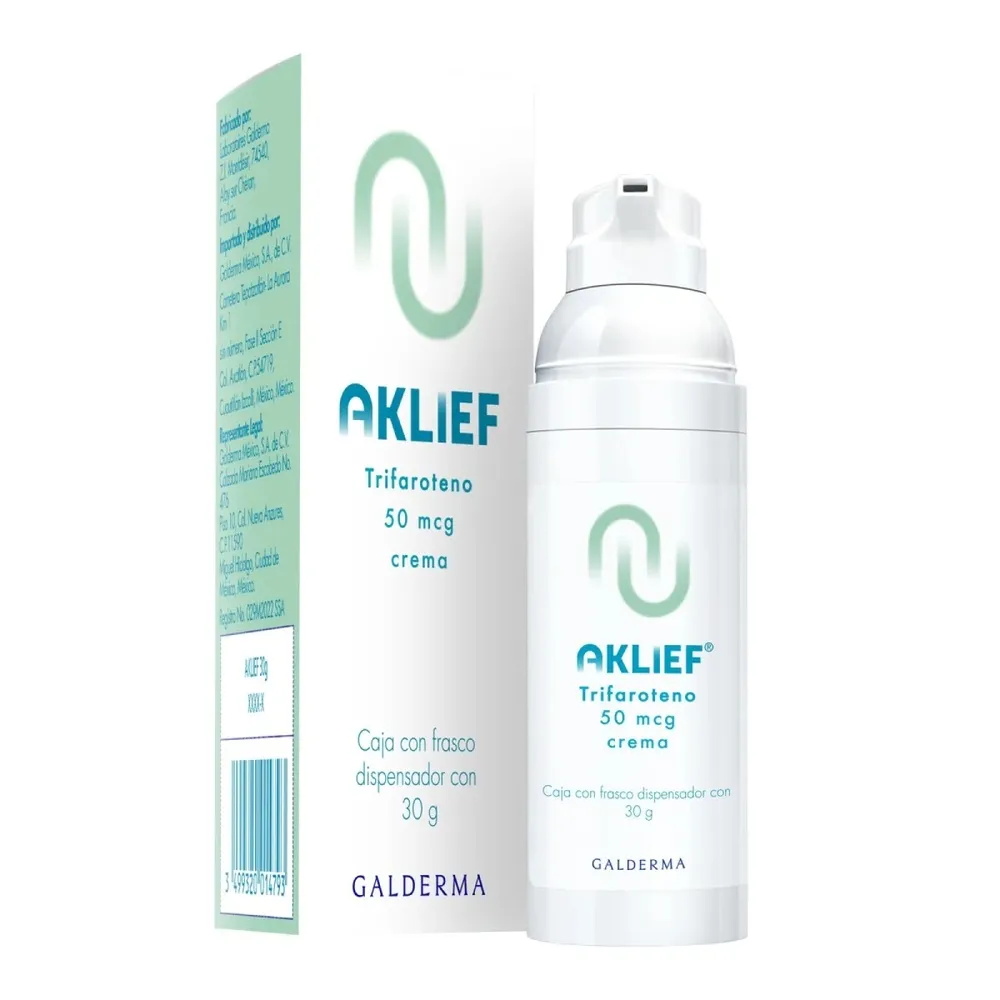
Table of Contents
Package leaflet: Information for the user
Introduction
PACKAGE LEAFLET
Package leaflet: information for the patient
Aklief 50 micrograms/g cream
trifarotene
This medicinal product is subject to additional monitoring, which will allow rapid identification of new information on its safety. You can help by reporting any adverse reactions you may experience. Section 4 at the end of this leaflet includes information on how to report adverse reactions.
Read this leaflet carefully before you start using this medicine, because it contains important information for you.
-
Keep this leaflet. You may need to read it again.
-
If you have any questions, ask your doctor or pharmacist.
-
This medicine has been prescribed for you only. Do not give it to others, even if they have the same symptoms as you, because it may harm them.
- If you experience any adverse reactions, consult your doctor or pharmacist, even if they are adverse reactions not listed in this leaflet. See section 4.
Contents of the leaflet
- What Aklief is and what it is used for
- What you need to know before using Aklief
- How to use Aklief
- Possible side effects
- How to store Aklief
- Contents of the pack and other information
1. What Aklief is and what it is used for
Aklief contains the active substance trifarotene, which belongs to a group of medicines known as retinoids.
This medicine is used for topical treatment of facial, chest, and/or back acne vulgaris in patients over 12 years of age when they have numerous comedones (blackheads and whiteheads) and multiple papules and pustules (inflamed pimples).
2. What you need to know before using Aklief
Do not use Aklief:
- If you are planning to become pregnant or if you are pregnant (see section Pregnancy and Breastfeeding)
- if you are allergic to trifarotene or to any of the other ingredients of this medicine (listed in section 6).
Warnings and precautions
-
You may experience redness, peeling, dryness, and stinging/burning with the use of Aklief cream (see section 4 "Possible side effects"). Consult a doctor if you experience these symptoms. They may recommend applying a moisturizer from the start of treatment, which could help prevent these reactions. If symptoms occur, your doctor may advise you to use a moisturizer (if you haven't already), to use the cream less frequently, or to stop treatment temporarily. If symptoms persist despite these measures, they may advise you to discontinue use completely.
-
Aklief must not be used on areas with cuts, scratches, abrasions, or eczema.
-
Aklief must not come into contact with the eyes, eyelids, lips, or mucous membranes. If the product accidentally gets into the eye, rinse immediately with plenty of lukewarm water. Take care when applying to sensitive skin areas such as the neck or armpits.
-
Exercise caution when applying Aklief cream at the same time as other products, including cosmetics (see section Other medicines and Aklief).
-
Do not use waxing as a hair removal method on skin treated with Aklief.
-
If a reaction suggesting sensitivity to any component of the formulation occurs, use of Aklief should be discontinued.
Aklief must not be used on sunburned skin. Avoid excessive exposure to sunlight, including sunlamps or phototherapy, during treatment. Use of a sunscreen with a sun protection factor (SPF) of 30 or higher is recommended, and protective clothing (such as a hat and T-shirt) should be worn over treated areas when sun exposure cannot be avoided. If, despite these precautions, your face, chest, shoulders, or back become sunburned, stop applying the medication to the affected area until the skin has healed.
Other medicines and Aklief
Inform your doctor if you are using, have recently used, or might need to use any other medicines.
Avoid using this medicine at the same time as cosmetics or acne treatments that are irritating, drying, or exfoliating, as they may produce additive irritant effects with this medicine. If you experience skin irritation, consult your doctor.
Pregnancy and breastfeeding
Pregnancy
DO NOT use Aklief if you are pregnant or intend to become pregnant. Your doctor can provide further information.
If you become pregnant during treatment, you must stop using this medicine and consult a doctor immediately.
Breastfeeding
When using Aklief, there is a risk that the active ingredient in the cream may pass into breast milk, and the risk to the infant cannot be excluded. You and your doctor should decide whether to discontinue breastfeeding or discontinue treatment with Aklief, taking into account the benefit of breastfeeding for the child and the benefit of treatment for the mother.
To avoid the risk of ingestion and/or contact exposure to an infant, breastfeeding women must not apply trifarotene cream to the chest or breast area.
Driving and using machines
The influence of this medicine on the ability to drive and use machines is none or negligible.
Aklief contains propylene glycol (E1520)
This medicine may cause skin irritation.
This product also contains 50 mg of alcohol (ethanol) in each gram, equivalent to 5% w/w. This may cause a burning sensation on damaged skin.
3. How to use Aklief
Follow exactly the administration instructions for this medicine as given by your doctor. If in doubt, consult your doctor or pharmacist again.
Important: Aklief is indicated for patients over 12 years of age for use on the skin of the face, chest and/or back. Do not use this medicine on other parts of the body. Do not ingest.
Keep this medicine out of the reach of children.
Method of administration
-
Before using the container for the first time, prepare it by pressing several times until a small amount of medicine is dispensed (up to a maximum of 10 times). The container is now ready for use. Apply a thin layer of Aklief cream to the affected areas of the face (forehead, nose, chin, and left and right cheeks) and to all affected areas of the trunk once daily, at night, on clean and dry skin:
-
One (1) pump should be sufficient to cover the entire face (e.g., forehead, cheeks, nose, and chin).
-
Two (2) pumps should be sufficient to cover the upper trunk (e.g., upper back, shoulders, and chest). An additional one (1) pump may be used for the mid and lower back if acne is present.
-
More than four (4) pumps per day are not recommended.
-
Avoid contact with eyes, eyelids, lips, and mucous membranes such as the inside of the nose or mouth. If cream accidentally enters any of these areas, wash immediately with plenty of lukewarm water.
-
Wash your hands immediately after applying the cream.
The use of a moisturizer is recommended as frequently as needed from the beginning of treatment with Aklief. The moisturizer may be used before or after application of Aklief, allowing sufficient time for the skin to dry between application of the moisturizer and Aklief.
Your doctor will tell you how long you need to use Aklief. After three months of treatment, your doctor may require a new evaluation to assess improvement in your acne with treatment.
Use in children
This medicine must not be used in children under 12 years of age.
If you use more Aklief than you should
If you apply more Aklief than you should to the skin, your acne will not clear more quickly, but your skin may become irritated, scaly, and red. Contact your doctor if you have used more Aklief than recommended.
Contact your doctor or healthcare center if:
- a child has accidentally taken this medicine.
- you or another person has accidentally ingested this medicine.
Your doctor will advise on the necessary measures.
In case of overdose or accidental ingestion, contact your doctor or pharmacist immediately or call the Toxicology Information Service at telephone: 91 562 04 20, indicating the medicine and the amount ingested.
If you forget to use Aklief
If you forget to apply Aklief at night, apply it the following night. Do not apply a double dose to make up for missed doses.
If you stop using Aklief
Pimples (papules, blackheads, and pustules) will only reduce after several applications of this medicine. It is important that you continue using Aklief for as long as your doctor has instructed.
If you have any further questions about using this medicine, consult your doctor or pharmacist.
4. Possible adverse effects
Like all medicines, this medicine can cause adverse effects, although not everyone will experience them.
You may often experience redness, peeling, dryness, and stinging/burning with the use of Aklief cream. See section 2 “ Warnings and precautions” for more information on what to do if you experience these symptoms.
Aklief may cause the following adverse effects:
Common adverse effects (may affect up to 1 in 10 people)
- Irritation at the application site, pruritus (itching), sunburn
Uncommon adverse effects (may affect up to 1 in 100 people)
- Skin pain
- Skin dryness
- Skin discoloration (change in skin color)
- Erosion (loss of skin)
- Rash
- Swelling
- Skin irritation
- Acne
- Allergic dermatitis (skin allergy)
- Erythema (redness)
Rare adverse effects (may affect up to 1 in 1000 people)
- Urticaria (hives)
- Vesicles
- Asteatotic eczema (dry skin with scaling and cracks)
- Seborrheic dermatitis (red, scaly, and itchy skin)
- Burning sensation in the skin
- Skin fissures
- Hyperpigmentation of the skin (darkening of skin pigmentation)
- Eyelid exfoliation (peeling of eyelid skin) or edema (swelling of eyelid skin)
- Cracked lips
- Flushing (red face)
Reporting of adverse effects
If you experience any type of adverse effect, consult your doctor or pharmacist, even if it is a possible adverse effect not listed in this leaflet. You can also report them directly via the Spanish Pharmacovigilance System for Human Medicines: https://www.notificaRAM.es. By reporting adverse effects, you can help provide more information on the safety of this medicine.
5. Storage of Aklief
Keep this medicine out of the sight and reach of children.
Do not use this medicine after the expiry date stated on the carton and tube/multidose container after CAD/EXP. The expiry date refers to the last day of the month indicated.
Expiry date after first opening: 6 months.
This medicine does not require any special storage conditions.
Medicines must not be disposed of via wastewater or household waste. Dispose of unused medicines and their containers at a SIGRE Point at your pharmacy. If you are in doubt, ask your pharmacist how to dispose of medicines and containers you no longer need. This will help protect the environment.
6. Contents of the pack and other information
Composition of Aklief
- The active substance is trifarotene. One gram of cream contains 50 micrograms of trifarotene.
- The other components are: allantoin, Simulgel 600 PHA (copolymer of acrylamide and sodium acryloyldimethyltaurate, isohexadecane, polysorbate 80, sorbitan oleate), cyclomethicone, ethanol, phenoxyethanol, propylene glycol (E1520), medium-chain triglycerides and purified water.
Nature of the product and pack contents
Aklief is a homogeneous white cream.
Aklief is available in tubes of 5 g or in multidose containers of 15, 30 or 75 g. The packs will contain either a tube or a multidose container.
Not all pack sizes may be marketed.
Marketing Authorization Holder and Manufacturer
Marketing Authorization Holder:
Laboratorios Galderma, S.A.
Serrano Galvache, 56
28033 Madrid
Spain
Manufacturer:
Laboratoires Galderma
Z.I. Montdésir
74540 Alby sur Chéran
France
This medicinal product is authorized in the European Economic Area member states under the following names:
Belgium, Bulgaria, Croatia, Czech Republic, Denmark, Estonia, Finland, France, Hungary, Iceland, Ireland, Latvia, Lithuania, Luxembourg, Malta, Netherlands, Norway, Poland, Portugal, Slovakia, Spain, Romania, United Kingdom and Sweden: Aklief
Cyprus, Germany, Greece and Italy: Selgamis
Date of the most recent review of this leaflet:
Detailed and up-to-date information on this medicinal product is available on the website of the Spanish Agency of Medicines and Health Products (AEMPS): http://www.aemps.gob.es