Akineton Retard 4 mg prolonged-release tablets
Spain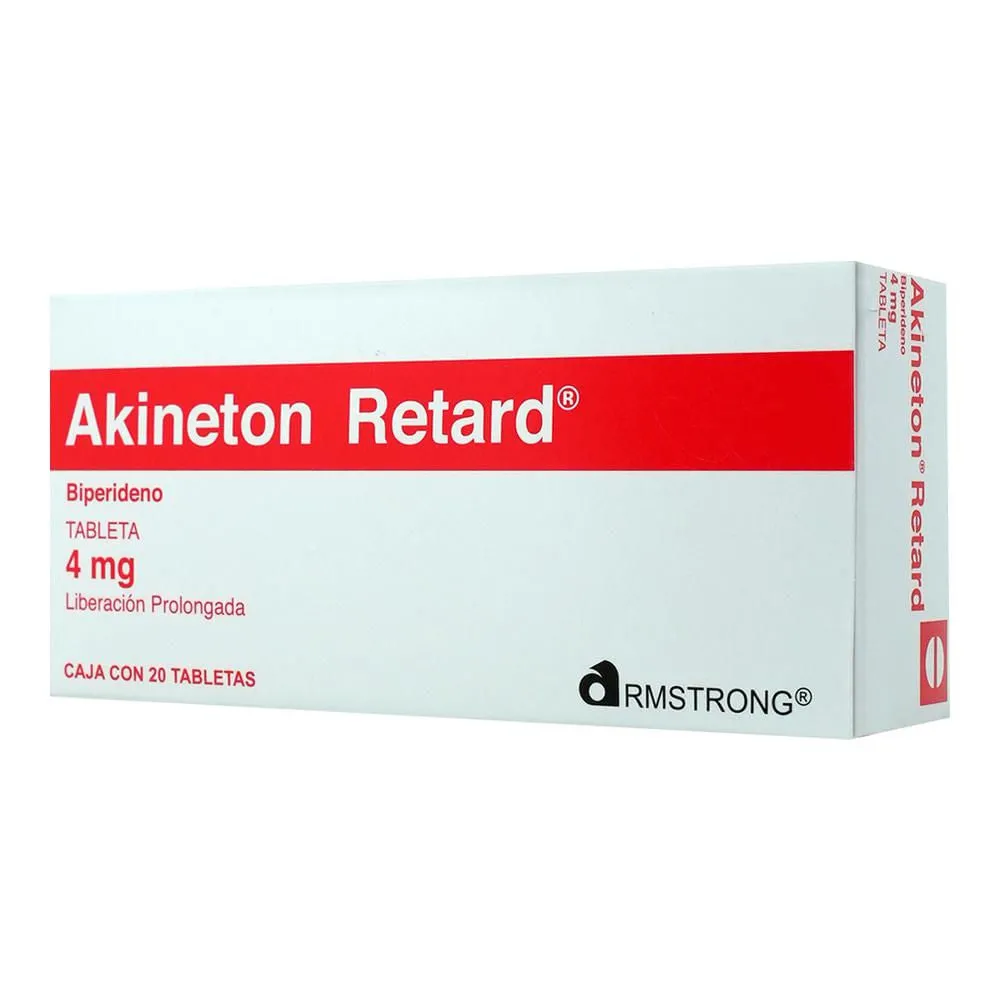
Table of Contents
Package leaflet: Information for the user
Introduction
Package leaflet: information for the user
AKINETÓN RETARD 4 mg prolonged-release tablets
Biperiden hydrochloride
Read all of this leaflet carefully before you start taking this medicine because it contains important information for you.
- Keep this leaflet as you may need to read it again.
If you have any questions, ask your doctor or pharmacist.
- This medicine has been prescribed for you only, and you should not give it to other people, even if they have the same symptoms as you, because it may harm them.
- If you experience any adverse effects, consult your doctor or pharmacist, even if they are adverse effects not listed in this leaflet. See section 4.
Contents of the leaflet
- What Akinetón Retard is and what it is used for
- What you need to know before taking Akinetón Retard
- How to take Akinetón Retard
- Possible side effects
- How to store Akinetón Retard
Contents of the pack and other information
1. What Akinetón Retard is and what it is used for
Akinetón Retard contains as its active substance biperiden, which is an anticholinergic agent.
Akinetón Retard is indicated for:
-
Treatment of Parkinson's disease, primarily in patients who have muscle rigidity and tremor,
-
Treatment of extrapyramidal symptoms (characterized by involuntary and slow movements, muscle weakness, tremor, excessive salivation and sweating) caused by certain medications.
2. What you need to know before starting Akinetón Retard
Do not take Akinetón Retard:
- If you are allergic to biperiden or any of the other ingredients of this medicine (listed in section 6).
- If you have intestinal problems such as mechanical stenosis (narrowing of the intestines), megacolon (enlargement of the colon), or ileus (interruption of intestinal transit).
- Closed-angle glaucoma (increased internal pressure in the eyes).
Warnings and precautions
Talk to your doctor before starting Akinetón Retard:
- Enlarged prostate (prostatic hypertrophy).
- Irregular heartbeats (cardiac arrhythmias).
- Epilepsy (seizures affecting part or all of the body).
You should not stop treatment abruptly, as this could lead to a worsening of your condition.
In elderly patients, the effect of this medicine may be increased, causing mental confusion, dizziness, agitation, balance problems, and euphoria.
Antiparkinsonian agents such as levodopa may increase involuntary movements (tardive dyskinesia) when administered together with Akinetón Retard. In addition, these types of movements, sometimes caused by neuroleptic medications, may also increase with concomitant administration of Akinetón Retard.
In all cases, your doctor will assess whether treatment with Akinetón Retard should be continued.
Elderly population
Elderly patients are particularly susceptible to medications affecting the central nervous system. In these patients, administration of anticholinergics may cause mental confusion, dizziness, agitation, behavioral disturbances, and euphoria.
Taking Akinetón Retard with other medicines
Inform your doctor or pharmacist if you are taking, have recently taken, or might need to take any other medicines.
Consult your doctor if you are taking any of the following medicines:
- Antihistamines (medicines for allergies), as they may enhance its activity.
- Spasmolytics (used to treat spasms), as they may enhance its activity.
- Antiparkinsonian agents such as levodopa (used to treat Parkinson's disease).
- Pethidine (an opioid medicine for acute pain), as it may increase the risk of delirium.
- Quinidine (a medicine for heart conditions), as it may cause cardiac disturbances.
- Metoclopramide (for nausea and vomiting), as it may reduce its effect.
- Potassium supplements, as they may enhance gastrointestinal injury.
Taking Akinetón Retard with food, drinks, and alcohol
To minimize possible gastrointestinal discomfort, it is recommended to take Akinetón Retard with some liquid, preferably during or after meals.
Consumption of alcoholic beverages should be avoided during treatment with Akinetón Retard, as it may enhance the effects of alcohol.
Pregnancy and breastfeeding
If you are pregnant or breastfeeding, think you may be pregnant, or plan to become pregnant, consult your doctor or pharmacist before using this medicine.
Pregnancy
It is unknown whether biperiden can cause fetal harm when administered to pregnant women or whether it can affect reproductive capacity. Biperiden should not be administered to pregnant women unless clearly necessary, as determined by your doctor.
Breastfeeding
It is unknown whether biperiden is excreted in breast milk. Therefore, caution should be exercised when administering biperiden during breastfeeding.
Driving and using machines
Akinetón Retard reduces the ability to drive vehicles and operate machinery, especially when combined with other medicines that affect the central nervous system.
Akinetón Retard contains lactose
This medicine contains lactose. If your doctor has informed you that you have an intolerance to certain sugars, consult with him before taking this medicine.
3. How to take Akinetón Retard
Follow exactly the instructions for use of this medicine as given by your doctor. If in doubt, consult your doctor or pharmacist again.
Your doctor will determine the dose and will adjust it individually for you.
Elderly patients may require a lower dose.
Treatment with Akinetón Retard should normally start with low doses, which may be increased depending on the patient's efficacy and tolerability, therapeutic response, and adverse reactions.
Akinetón Retard is administered orally.
The recommended dose is:
Parkinsonian syndromes:
The recommended dose is 1 to 2 tablets of Akinetón Retard per day (4–8 mg of biperiden hydrochloride/day). The total daily dose may be increased up to a maximum of 3 Akinetón Retard tablets (12 mg of biperiden hydrochloride per day), as determined by your doctor.
In exceptional cases where three prolonged-release tablets must be taken per day, a single dose must not exceed two tablets (equivalent to 8 mg of biperiden hydrochloride).
Drug-induced extrapyramidal symptoms:
The recommended dose is 4 mg of biperiden hydrochloride per day (1 tablet of Akinetón Retard). The required daily dose may vary between 2 mg and 6 mg of biperiden hydrochloride per day, depending on the individual patient's needs and the physician's judgment.
Switching from Akinetón immediate-release tablets
For a more convenient dosing regimen, patients currently treated with immediate-release Akinetón tablets may be switched to prolonged-release Akinetón Retard tablets. Your doctor will decide which option is most suitable for you. Your doctor will first adjust your biperiden dose using Akinetón 2 mg tablets for approximately 20 days before switching you to Akinetón Retard. Your doctor will then assess the appropriate dose to prescribe if this change is made.
Use in children and adolescents
Akinetón Retard is not recommended for use in children or adolescents under 18 years of age due to lack of efficacy and safety data in this population.
Use in elderly patients
Elderly patients, especially those with increased susceptibility to seizures, are more sensitive to anticholinergic medication; therefore, caution is required in dosing.
If you take more Akinetón Retard than you should
In case of overdose or accidental ingestion, contact your doctor or pharmacist immediately, go to the nearest hospital, or call the Toxicology Information Service at 91 562 0420, indicating the medicine and the amount ingested.
Symptoms may include drowsiness, confusion, lack of motor coordination, dizziness, dry mouth, nausea, vomiting, pupil dilation, blurred vision, flushing, increased heart rate, urinary and intestinal retention, and elevated body temperature. Sometimes anxiety states and hallucinations may occur. In severe intoxication, muscle cramps, respiratory depression, and risk of circulatory collapse may occur.
If you forget to take Akinetón Retard
Do not take a double dose to make up for missed doses. Continue with your next scheduled dose as usual.
If you stop taking Akinetón Retard
Abrupt discontinuation of treatment is not advisable due to the risk of symptom exacerbation, except when life-threatening complications occur.
If you have any further questions about the use of this product, ask your doctor or pharmacist.
4. Possible adverse effects
Like all medicines, this medicine may cause adverse effects, although not everyone experiences them.
Adverse effects occur mainly when starting treatment or when the dose is increased rapidly.
Rare adverse effects (may affect up to 1 in 1,000 people)
- excitement, agitation, fear, confusion, delusions, hallucinations, insomnia, and sleep disturbances
- fatigue, dizziness, and memory impairment
- rapid heart rate
- dry mouth, nausea, and gastric disturbances
- muscle spasms
- somnolence
Very rare adverse effects (may affect up to 1 in 10,000 people)
- hypersensitivity (allergic reaction)
- nervousness and euphoria
- headache, involuntary and uncontrolled movements, speech disorders, increased tendency to suffer cerebral crises and seizures
- difficulty focusing vision, dilated pupils, light sensitivity, glaucoma (increased internal eye pressure)
- slow heart rate
- constipation
- decreased sweating
- difficulty urinating or urinary retention
Adverse effects of unknown frequency (cannot be estimated from the available data)
- mumps
Reporting of adverse effects
If you experience any type of adverse effect, consult your doctor or pharmacist, even if it is a possible adverse effect not listed in this leaflet. You may also report them directly through the Spanish Pharmacovigilance System for Human Medicines: https://www.notificaram.es. By reporting adverse effects, you can help provide more information on the safety of this medicine.
5. Storage of Akinetón Retard
Keep this medicine out of the sight and reach of children.
Do not use this medicine after the expiry date stated on the packaging after EXP. The expiry date refers to the last day of the month indicated.
Do not store above 25 ºC.
Medicines should not be disposed of via wastewater or household waste. Dispose of empty containers and unused medicines at the SIGRE point in your pharmacy. Ask your pharmacist how to dispose of containers and medicines you no longer need. This will help protect the environment.
6. Contents of the pack and other information
Composition of Akinetón Retard
- The active substance is biperiden hydrochloride. Each Akinetón Retard tablet contains 4 mg of biperiden hydrochloride.
- The other components (excipients) are: monohydrate lactose, corn starch, microcrystalline cellulose, povidone K30, hypromellose, magnesium stearate, purified water, hydroxypropylcellulose, macrogol 400, macrogol 6000, sodium docusate, titanium dioxide (E-171), yellow iron oxide (E-172), talc, anhydrous colloidal silica, carnauba wax.
Appearance of the medicine and contents of the pack
Akinetón Retard prolonged-release tablets are oval-shaped, film-coated, white tablets with a score line. The score line is not intended for dividing the tablet.
Each pack contains 20 or 50 tablets in Al/PVC/PVDC blisters.
Marketing Authorization Holder and Manufacturer
Laboratorio Farmaceutico S.I.T., Srl
Via Cavour, 70
27035 Mede (PV)
Italy
For further information about this medicine, please contact the local representative of the Marketing Authorization Holder:
Desma Laboratorio Farmacéutico SL
Paseo de la Castellana 121, Left staircase, 3rd floor B
28046 Madrid – Spain
Date of the most recent review of this leaflet: May 2024
Other sources of information
Detailed and up-to-date information on this medicine is available on the website of the Spanish Agency for Medicines and Health Products (AEMPS): http://www.aemps.gob.es/