Agilus 120 mg powder for injection solution
Spain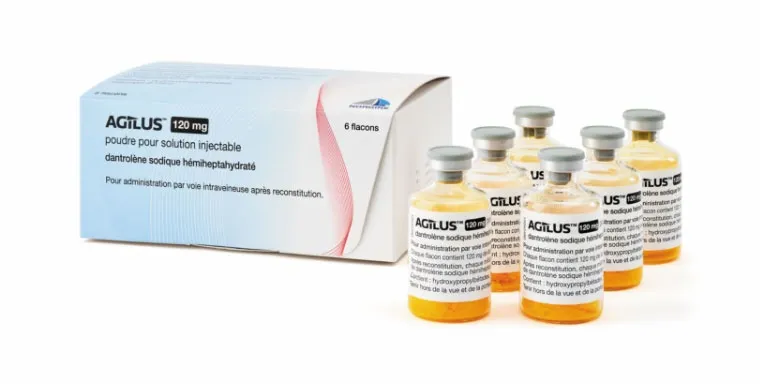
Table of Contents
Package leaflet: Information for the user
Introduction
Package leaflet: information for the user
Agilus 120 mg powder for injectable solution
sodium dantrolene hemiheptahydrate
Read the entire leaflet carefully, as it contains important information for you.
This medicine is used in emergency situations and your doctor will have decided that you need it.
- Keep this leaflet, as you may need to read it again.
- If you have any questions, consult your doctor.
- If you experience any adverse effects, consult your doctor, even if they are effects not listed in this leaflet. See section 4.
Leaflet contents
- What Agilus is and what it is used for
- What you need to know before being administered Agilus
- How Agilus is administered
- Possible adverse effects
- Storage of Agilus
- Contents of the pack and other information
1. What Agilus is and what it is used for
Agilus contains dantrolene sodium. It is a type of medicine called a direct-acting muscle relaxant. It binds to a target inside muscle cells and helps the body's muscles to relax when they are overstimulated.
This medicine is used for the treatment of malignant hyperthermia in adults and children of all ages, in combination with other supportive measures. Malignant hyperthermia is a potentially life-threatening condition requiring urgent attention, in which the body's skeletal muscles are overstimulated and cannot relax. This can cause a very rapid rise in body temperature and/or a buildup of waste products in the body (metabolic acidosis), which may prevent vital organs from functioning properly.
2. What you need to know before Agilus is administered to you
Do not use Agilus
- if you are allergic to sodium dantrolene or any of the other ingredients of this medicine (listed in section 6).
Warnings and precautions
You may have already been given this medicine before reading this leaflet.
Consult your doctor or nurse if:
- you are currently taking medications for high blood pressure or angina called “calcium antagonists”. Taking these medicines together with Agilus may increase the amount of potassium in the blood, which could cause irregular heartbeat or inability to move some of your muscles.
- you suspect that any of the medicine has spilled onto your skin, you should wash it off with water.
Liver damage has been observed in patients exposed to long-term oral use of sodium dantrolene. Inform your doctor if you think you have symptoms of liver damage (e.g., if your skin and eyes appear yellowish or if you have abdominal pain and swelling).
Other medicines and Agilus
Inform your doctor if you are taking, have recently taken, or might need to take any other medicines.
The following medicines may affect the way Agilus works, or Agilus may affect their action:
- blood pressure and angina medications called “calcium antagonists”, such as verapamil or diltiazem, may cause heart failure when administered together with Agilus (see warnings and precautions).
- muscle relaxants, such as vecuronium, may enhance the muscle-relaxing effect of Agilus if administered at the same time.
Pregnancy and breastfeeding
If you are pregnant or breastfeeding, think you might be pregnant, or plan to become pregnant, inform your doctor or nurse if possible before receiving this medicine.
Pregnancy
Agilus will not be used during pregnancy unless considered necessary. After administration of Agilus, the muscles of the uterus (womb) may weaken. If you receive Agilus during a caesarean section, your newborn baby may experience muscle weakness.
Breastfeeding
You must not breastfeed while receiving Agilus or for 60 hours after the last dose. Inform your doctor if you are breastfeeding.
Driving and using machines
After administration of Agilus, the muscles in your hands and legs may weaken, and you may feel dizzy or drowsy. These effects may last up to 48 hours after administration of Agilus. Do not drive or operate machinery during this time.
Agilus contains cyclodextrin and sodium
This medicine contains 3,530 mg of hydroxypropyl betadex (a cyclodextrin) per vial, equivalent to 156.2 mg/ml in the reconstituted solution.
Inform your doctor if you have previously experienced hearing problems, for example, if you are prone to ear infections. Cases of hearing loss (hypacusis) have been observed in patients who received hydroxypropyl betadex to treat other diseases at doses higher than those recommended for Agilus. This hypacusis is usually mild and short-lived. For patients requiring high doses of Agilus (above 10 mg/kg), treatment must be re-evaluated due to this risk.
The potential risk associated with hydroxypropyl betadex may increase if the kidneys are not functioning properly.
This medicine contains 6.9 mg of sodium (a main component of table salt) per vial.
This represents less than 0.5% of the maximum daily recommended sodium intake for an adult.
3. How Agilus is administered
This injection will be administered into a vein by a healthcare professional. The dose of Agilus you receive will depend on your body weight. The dose will be repeated every 10 minutes until symptoms improve. If symptoms do not improve after receiving the medicine, your doctor may re-evaluate the diagnosis and consider other treatments. If you experience a relapse, your healthcare professional will inject Agilus again.
If you receive more Agilus than you should
If you have received more Agilus than you should, adverse effects may occur. Severe muscle weakness may occur, which could affect breathing. Your doctor will monitor you closely.
If you have any further questions about the use of this medicine, ask your doctor or nurse.
4. Possible adverse effects
Like all medicines, this medicine can cause adverse effects, although not everyone experiences them. The following adverse effects have been observed with the active substance in Agilus:
The frequency of the following adverse effects is unknown (frequency cannot be estimated from the available data)
Serious adverse effects: your doctor will stop administering Agilus immediately
- sudden and severe allergic reaction with difficulty breathing, swelling, dizziness, rapid heartbeat, sweating, and loss of consciousness (anaphylactic reaction)
Other adverse effects
The following adverse effects have been observed with the active substance of Agilus:
-
allergic reactions (hypersensitivity)
-
high levels of potassium in the blood (hyperkalaemia), which may cause tiredness, muscle weakness, feeling unwell, and changes in heart rhythm
-
dizziness, drowsiness, seizures, difficulty speaking (dysarthria), headache
-
vision disturbances
-
heart failure, slow heart rate (bradycardia), rapid heartbeats (tachycardia)
-
inflammation in a vein causing a blood clot and blockage (thrombophlebitis)
-
difficulty breathing (respiratory failure), breathing that is too slow and shallow (respiratory depression)
-
stomach pain (abdominal pain), nausea (feeling unwell), vomiting, intestinal and stomach bleeding with signs of blood in stools or vomit (gastrointestinal haemorrhage), diarrhoea, difficulty swallowing (dysphagia)
-
yellowing of the eyes and skin (jaundice)*, inflammation of the liver (hepatitis)*, potentially life-threatening liver failure*, changes in liver function tests, liver disease due to an unknown cause or allergic reaction
-
itching (urticaria), redness of the skin (erythema), excessive sweating (hyperhidrosis)
-
muscle weakness, tired muscles
-
crystalline particles in the urine (crystalluria)
-
weak contractions during childbirth (uterine hypotonia)
-
feeling of tiredness (fatigue), general weakness (asthenia), reactions at the injection site
*These side effects were observed in situations where dantrolene treatment was administered orally over a prolonged period.
Reporting of adverse effects
If you experience any type of adverse effect, talk to your doctor or nurse, even if it is a possible adverse effect not listed in this leaflet. You may also report them directly through the national reporting system included in Appendix V. By reporting adverse effects, you can help provide more information on the safety of this medicine.
5. Storage of Agilus
Keep this medicine out of the sight and reach of children.
This medicine will be stored in the hospital and these instructions are intended exclusively for healthcare professionals.
Unopened vial: no special storage temperature required. Store the vial in the original packaging to protect it from light.
Reconstituted solution: Use within 24 hours. The reconstituted solution must be protected from light. Do not store above 25 °C and do not refrigerate.
Do not use this medicine after the expiry date stated on the label and on the outer carton of the vials after “EXP”. The expiry date refers to the last day of the month indicated.
For single use only. Any unused portion of the reconstituted solution must be discarded.
6. Contents of the pack and other information
Composition of Agilus
The active substance is dantrolene sodium hemiheptahydrate.
Each vial contains 120 mg of dantrolene sodium hemiheptahydrate. After reconstitution with 20 ml of water for injection, each millilitre of solution contains 5.3 mg of dantrolene sodium hemiheptahydrate.
The other components are hydroxypropyl betadex (a cyclodextrin) and macrogol (E1521). See section 2, “Agilus contains cyclodextrin and sodium”.
Appearance of the product and contents of the pack
Glass vials with rubber stopper and seal containing 120 mg of yellow-orange powder for injectable solution.
Pack of 6 or 10 vials.
Only certain pack sizes may be marketed.
Marketing Authorisation Holder and Manufacturer
Norgine B.V.
Antonio Vivaldistraat 150
1083 HP Amsterdam
The Netherlands
Date of the most recent revision of this leaflet
Other sources of information
Detailed information on this medicine is available on the European Medicines Agency website: http://www.ema.europa.eu.
This leaflet can be found on the European Medicines Agency website in all languages of the European Union/European Economic Area.
This information is intended for healthcare professionals only:
Dosage and method of administration
Treatment with Agilus should be initiated as soon as a malignant hyperthermia crisis is suspected, i.e., with the characteristic presentation of muscle rigidity, metabolic acidosis and/or rapid rise in body temperature.
Dosage
Agilus should be administered rapidly by intravenous injection at an initial dose of 2.5 mg/kg body weight in both adult and paediatric patients.
While the main clinical symptoms of tachycardia, hypoventilation, sustained hyperacidaemia [requiring monitoring of pH and partial pressure of carbon dioxide (pCO2)] and hyperthermia persist, repeated bolus injections of 2.5 mg/kg should be administered every 10 minutes until physiological and metabolic abnormalities improve. If a cumulative dose of 10 mg/kg or higher is being considered, the diagnosis of malignant hyperthermia should be re-evaluated.
The following table shows how to calculate the number of vials required for the rapid injection of the initial dose of 2.5 mg/kg:
Table 1: Dosage examples
Examples of dosing based on body weight to achieve a loading dose of 2.5 mg/kg in both adults and children | ||||
Number of vials to prepare | Body weight range | Example recommended dose | ||
Body weight | Dose to be administered | Volume to be administereda | ||
1 | Up to 48 kg | 3 kg | 7.5 mg | 1.4 ml |
6 kg | 15 mg | 2.8 ml | ||
12 kg | 30 mg | 5.6 ml | ||
24 kg | 60 mg | 11.3 ml | ||
48 kg | 120 mg | 22.6 ml | ||
2 | From 49 kg to 96 kg | 72 kg | 180 mg | 33.9 ml |
96 kg | 240 mg | 45.2 ml | ||
3 | From 97 kg onwards | 120 kg | 300 mg | 56.5 ml |
144 kgb | 300 mgb | 56.5 ml |
aThe total volume of a reconstituted vial is 22.6 ml.
bFor all body weights, the initial dose and any repeat dose must not exceed 300 mg, equivalent to 2.5 vials.
Treatment of recurrence (relapse)
It should be noted that the hypermetabolic response associated with malignant hyperthermia may reappear within the first 24 hours. If recurrence occurs, a dose of Agilus of 2.5 mg/kg should be re-administered every 10 minutes until signs of malignant hyperthermia subside again. Considerations applicable to monitoring metabolic abnormalities and dose adjustments during an initial episode also apply to the treatment of recurrence.
Paediatric population
Dose adjustment is not required.
Method of administration
Intravenous route.
Special precautions for storage, preparation and handling
Preparation
Each vial must be reconstituted by adding 20 ml of water for injections and shaking for approximately 1 minute, before inspecting for the presence of particles. Further shaking may be necessary. The reconstituted solution should be orange-yellow in colour and free from particles.
The volume of solution in a reconstituted vial is 22.6 ml.
Chemical and physical stability in use has been demonstrated for 24 hours at 25 °C after reconstitution. From a microbiological standpoint, unless the method of opening/reconstitution excludes the risk of microbial contamination, the reconstituted product should be used immediately. If not used immediately, the storage times and conditions during use are the responsibility of the user and must not exceed 24 hours at 25 °C.
Storage
The unopened vial does not require any special storage temperature. Keep the vial in the outer packaging to protect it from light.
The reconstituted solution must be protected from light. Do not store above 25 °C and do not refrigerate.
Handling
In the absence of compatibility studies, this medicinal product must not be mixed with other medicinal products.
The reconstituted solution of Agilus must not be mixed with other solutions nor administered through the same intravenous access.
Spilling of the solution onto the skin should be avoided. If contact with the skin occurs, wash thoroughly with abundant water.
This medicinal product is for single use only and any unused reconstituted solution must be discarded.
Disposal of unused medicinal product and all materials that have come into contact with it should be carried out in accordance with local regulations.